Engineering Mathematics Exam  >  Engineering Mathematics Test  >  Engineering Mathematics  >  Test: Euler's Equation - Engineering Mathematics MCQ

Euler's Equation - Free MCQ Practice Test with solutions, GATE MA Engineering


MCQ Practice Test & Solutions: Test: Euler's Equation (10 Questions)

You can prepare effectively for Engineering Mathematics Engineering Mathematics with this dedicated MCQ Practice Test (available with solutions) on the important topic of "Test: Euler's Equation". These 10 questions have been designed by the experts with the latest curriculum of Engineering Mathematics 2026, to help you master the concept.

Test Highlights:

  • - Format: Multiple Choice Questions (MCQ)
  • - Duration: 30 minutes
  • - Number of Questions: 10

Sign up on EduRev for free to attempt this test and track your preparation progress.

Test: Euler's Equation - Question 1

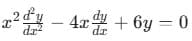
The general solution of the differential equation is:     

Detailed Solution: Question 1

Substitute x = et, so x2 y''2 → D(D-1)y and x y' → Dy. The auxiliary equation is:
m(m-1) - 4m + 6 = 0
m2 - m - 4m + 6 = 0
m2 - 5m + 6 = 0
(m-2)(m-3) = 0.
Roots are real and distinct: m1 = 2, m2 = 3.
Solution: y = C1 x2 + C2 x3.

Test: Euler's Equation - Question 2

The general solution of the differential equation x2 y'' + 3x y' + 5y = 0 is:

Detailed Solution: Question 2
Substitute x = et. The auxiliary equation becomes:
m(m-1) + 3m + 5 = 0
⇒ m2 + 2m + 5 = 0.
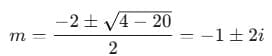
Roots: .
The solution in terms of t:
y(t) = e-t [C1 cos(2t) + C2 sin(2t)].
Substitute e-t = x-1 and t = x: y(x) = x-1 [C1 cos(2 ln x) + C2 sin(2 lnx)].

Test: Euler's Equation - Question 3

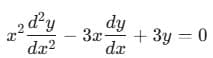
The Particular Integral (P.I.) of the differential equation is:   

Detailed Solution: Question 3

Transform to constant coefficients with x = et:
[D(D-1) - 2D + 2]y = e3t
⇒ [m2 - 3m + 2]y = e3t.
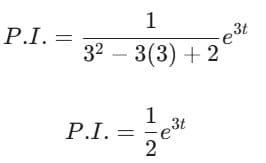
For P.I., substitute D = 3 (coefficient of t in exponent) into the operator

.
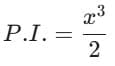
Substitute back e3t = (et)3=x3:

Test: Euler's Equation - Question 4

The Particular Integral of the differential equation x2 y'' + x y' - y = 4 ln x is:

Detailed Solution: Question 4

Substitute x = et, so ln x = t.
[D(D-1) + D - 1]y = 4t
⇒ [D2 - 1]y = 4t.
.
Using binomial expansion: (1-z)-1 = 1 + z + z2 .......
P.I. = - [1 + D2 + D4 + ...] (4t).
Since D2(4t) = 0:
P.I. = - [1](4t) = -4t.
Substitute t = ln x:
P.I. = -4 ln x.

Test: Euler's Equation - Question 5

The general solution of is:   

Detailed Solution: Question 5

Auxiliary equation:
m(m-1) + 5m + 4 = 0
⇒ m2 + 4m + 4 = 0
⇒ (m+2)2 = 0.
Roots are real and repeated: m = -2, -2.
Solution for repeated roots:(m,m):
y = xm (C1 + C2 ln x)
y = x-2 (C1 + C2 ln x)

Test: Euler's Equation - Question 6

The general solution of the differential equation x2 y'' + x y' = 0 is:

Detailed Solution: Question 6

Auxiliary equation:
m(m-1) + m = 0
m2 - m + m = 0
m2 = 0.
Roots are repeated: m = 0, 0.
Using the repeated root formula y = xm(C1 + C2 ln x) with m=0:
y = x0 (C1 + C2 ln x)
y = 1.(C1 + C2 ln x)
y= C1 + C2 ln x.

Test: Euler's Equation - Question 7

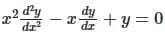
Consider the differential equation:

The general solution y(x) for x > 0 is:

Detailed Solution: Question 7

This is a homogeneous Cauchy-Euler equation. We assume a solution of the form y = xm.

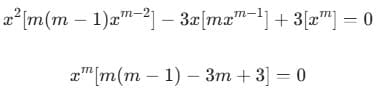
Substitute into the equation:

The auxiliary equation is:
m2 - m - 3m + 3 = 0
m2 - 4m + 3 = 0
(m-1)(m-3) = 0
The roots are real and distinct: m1 = 1, m2 = 3.
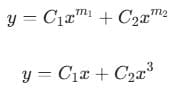
The general solution is:

Test: Euler's Equation - Question 8

The general solution of the differential equation x2 y'' + x y' + y = 0 is:

Detailed Solution: Question 8

Substitute x = et or t = ln x. Let . The equation transforms to constant coefficients using the operator identities x y' = Dy and x2 y'' = D(D-1)y.
[D(D-1) + D + 1]y = 0
[D2 - D + D + 1]y = 0
[D2 + 1]y = 0
The auxiliary equation is m2 + 1 = 0, so roots are m =±i (complex conjugates  α ± iβ
where α=0, β=1.
The solution in terms of  is:
y(t) = e0t [C1 cos(1t) + C2 sin(1t)]
y(t) = C1 cos t + C2 sin t
Substitute back t = ln x:
y(x) = C1 cos(\ln x) + C2 sin(ln x)

Test: Euler's Equation - Question 9

Solve the differential equation  subject to the initial conditions y(1) = 1 and y'(1) = 2.

Detailed Solution: Question 9

Substitute x = et, so t = ln x.
The equation becomes:
[D(D-1) - D + 1]y = 0
[D2 - 2D + 1]y = 0
(D-1)2 y = 0

The roots are real and repeated: m = 1, 1.
The solution in terms of t is:
y(t) = (C1 + C2 t)et
Substitute back t = ln x and et = x:
y(x) = (C1 + C2 ln x)x
y(x) = C1 x + C2 x ln x
Now apply boundary conditions:
1. y(1) = 1:
1 = C1(1) + C2(1)(0) ⇒ C1 = 1
2. Differentiate y(x):

Apply y'(1) = 2:
2 = C1 + C2(0 + 1)
2 = 1 + C2 ⇒ C2 = 1
Substitute constants back:
y = 1x + 1x ln x = x(1 + ln x)

Test: Euler's Equation - Question 10

To solve the Cauchy-Euler equation , the independent variable x is transformed to t using the substitution:   

Detailed Solution: Question 10

The standard method to linearize a Cauchy-Euler equation (which has variable coefficients xn) into a differential equation with constant coefficients is the substitution:   
x = et  or t = ln x   
This substitution converts terms like , allowing the use of standard auxiliary equation methods.

71 videos|135 docs|94 tests
Information about Test: Euler's Equation Page
In this test you can find the Exam questions for Test: Euler's Equation solved & explained in the simplest way possible. Besides giving Questions and answers for Test: Euler's Equation, EduRev gives you an ample number of Online tests for practice
71 videos|135 docs|94 tests
Download as PDF