
Triangles - 1 - Free MCQ Practice Test with solutions, SSC CGL Quant Aptitude
MCQ Practice Test & Solutions: MCQ: Triangles - 1 (15 Questions)
You can prepare effectively for SSC CGL Quantitative Aptitude for SSC CGL with this dedicated MCQ Practice Test (available with solutions) on the important topic of "MCQ: Triangles - 1". These 15 questions have been designed by the experts with the latest curriculum of SSC CGL 2026, to help you master the concept.
Test Highlights:
- - Format: Multiple Choice Questions (MCQ)
- - Duration: 15 minutes
- - Number of Questions: 15
Sign up on EduRev for free to attempt this test and track your preparation progress.

Directions: Study the following question carefully and choose the right answer:
Consider the following statements
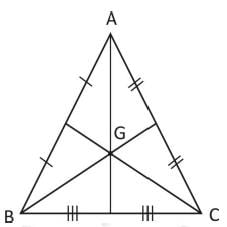
I. If G is the centroid of ΔABC, then GA = GB = GC.
II. If H is the orthocentre of ΔABC, then HA = HB = HC.
Which of the statements given above is/are correct?
I. If G is the centroid of ΔABC, then GA = GB = GC.
II. If H is the orthocentre of ΔABC, then HA = HB = HC.
Which of the statements given above is/are correct?
Detailed Solution: Question 1
Directions: Study the following question carefully and choose the right answer:
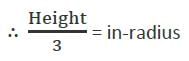
The in-radius of an equilateral triangle is of length 3 cm. Then the length of each of its medians is
Detailed Solution: Question 2

Directions: Study the following question carefully and choose the right answer:
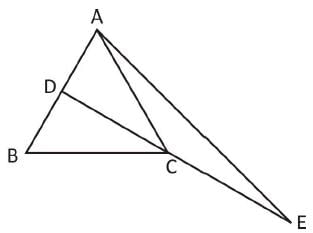
ABC is an equilateral triangle and CD is the internal bisector of ∠C. If DC is produced to E such that AC = CE, then ∠CAE is equal to
Detailed Solution: Question 3
Directions: Study the following question carefully and choose the right answer:
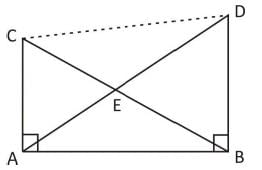
AB is a straight line, C and D are points the same side of AB such that AC is perpendicular to AB and DB is perpendicular to AB. Let AD and BC meet at E.
what is  equal to?
what is
equal to?Detailed Solution: Question 4
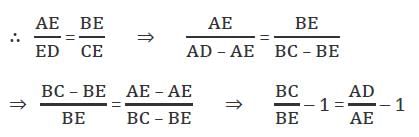
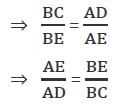
 Can't be determined.
Directions: Study the following question carefully and choose the right answer:
If the orthocentre and the centroid of a triangle are the same, then the triangle is :
Detailed Solution: Question 5
Directions: Study the following question carefully and choose the right answer:
G is the centroid of the equilateral ΔABC. If AB = 10 cm then length of AG is
Detailed Solution: Question 6
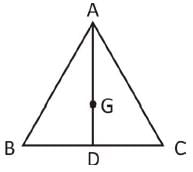
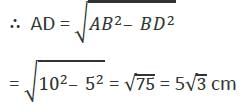
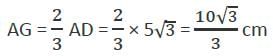
Directions: Study the following question carefully and choose the right answer:
The three sides of a triangle are 15, 25 and x units. Which one of the following is correct?
Detailed Solution: Question 7
Directions: Study the following question carefully and choose the right answer:
If in a triangle, the circumcentre, incentre, centroid and orthocentre coincide, then the triangle is
Detailed Solution: Question 8
Directions: Study the following question carefully and choose the right answer:
The radius of the incircle of the equilateral triangle having each side 6 cm is
Detailed Solution: Question 9
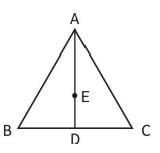


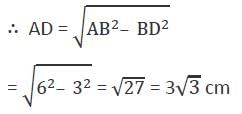
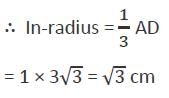
Directions: Study the following question carefully and choose the right answer:
Which one of the following is a Pythagorean triple in which one side differs from the hypotenuse by two units? Where, n is a positive real number.
Detailed Solution: Question 10
Directions: Study the following question carefully and choose the right answer:
In a triangle, if three altitudes are equal, then the triangle is
Detailed Solution: Question 11
Directions: Study the following question carefully and choose the right answer:
If the three medians of a triangle are same then the triangle is
Detailed Solution: Question 12
Directions: Study the following question carefully and choose the right answer:
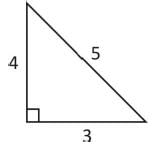
The sides of a right angled triangle are equal to three consecutive numbersexpressed in centimeters. What can be the area of such a triangle?
Detailed Solution: Question 13

Directions: Study the following question carefully and choose the right answer:
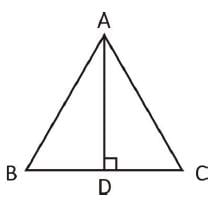
If ABC is an equilateral triangle and D is a point on BC such that AD ⊥ BC, then
Detailed Solution: Question 14
Directions: Study the following question carefully and choose the right answer:
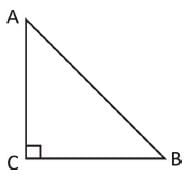
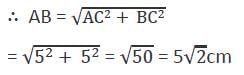
If ΔABC is an isosceles triangle with ∠C = 90° and AC = 5 cm then AB is :
Detailed Solution: Question 15
319 videos|366 docs|157 tests |
