
Ratio and Proportion - 2 - Free MCQ Practice Test with solutions, SSC CGL
MCQ Practice Test & Solutions: MCQ: Ratio and Proportion - 2 (15 Questions)
You can prepare effectively for SSC CGL Quantitative Aptitude for SSC CGL with this dedicated MCQ Practice Test (available with solutions) on the important topic of "MCQ: Ratio and Proportion - 2". These 15 questions have been designed by the experts with the latest curriculum of SSC CGL 2026, to help you master the concept.
Test Highlights:
- - Format: Multiple Choice Questions (MCQ)
- - Duration: 15 minutes
- - Number of Questions: 15
Sign up on EduRev for free to attempt this test and track your preparation progress.

60% population of a town is literate. The ratio of literate males to literate females is 5 : 3. The ratio of illiterate males to illiterate females is 5 : 3. In the village, the number of literate females is what percent of the illiterate males?
Detailed Solution: Question 1



The ratio of the incomes of A and B is 5 : 8 respectively and the sum of their expenditures is Rs. 18,000. If the savings of A is equal to the expenditure of B, what is the sum of their incomes?
Detailed Solution: Question 2

Vessels A and B contain mixtures of milk and water in the ratio 1 : 5 and 5 : 1 respectively. In what ratio should quantities of the mixtures from A and B be taken to form a mixture in which the ratio of milk to water be in the ratio 1 : 1 respectively?
Detailed Solution: Question 3
The total number of students in three classes of a school is 297. The ratio of the number of students in 6th class to that in 7th class is 5 : 4 and the ratio of the number of students in 6th class to 8th class is 2 : 3. What is the number of the students in the class which has the highest number of students?
Detailed Solution: Question 4
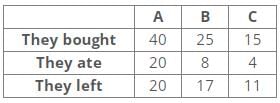
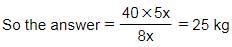
A, B and C bought mangoes in the ratio of 8 : 5 : 3 and ate some over the week in the ratio of 5 : 2 : 1 respectively. If A was left with 50% of his mangoes, who was left with least number of mangoes?
Detailed Solution: Question 5
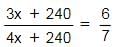
The students in three batches of a tuition teacher are in the ratio 3 : 4 : 6. If 240 students are increased in each batch, the ratio changes to 6 : 7 : 9. What was the initial number of students in all three batches?
Detailed Solution: Question 6
A container has 125 liters of milk. 25 liters milk is replaced by water. This process is done one more time. What is the quantity of water in the resultant mixture?
Detailed Solution: Question 7

A sum of Rs. 5085 is divided among A, B and C such that if Rs. 45, Rs. 145 and Rs. 245 be diminished from their shares respectively, the remainders shall be in the ratio of 52 : 19 : 22 respectively. What is the share of A?
Detailed Solution: Question 8
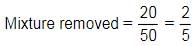
A vessel contains 60 liters mixture of milk and water in a ratio 5 : 1 respectively. What quantity of the mixture must be replaced with water so the ratio of the milk to water in the resultant mixture becomes 1 : 1?
Detailed Solution: Question 9



In 2025, the number of persons in villages A, B and C were in the ratio 2 : 4 : 7 respectively. In 2026 there is an increment of 100%, 50% and 14.29% in the population of villages A, B and C respectively. What is the ratio of the population of villages A, B and C respectively in 2026?
Detailed Solution: Question 10
A mixture contains wine and water in the ratio of 5 : 2 respectively and another mixture contains them in the ratio of 4 : 5 respectively. How many liters of the latter must be mixed with 35 liters of the former so that the resultant mixture must contain equal quantities of wine and water?
Detailed Solution: Question 11

The ratio of salary of A and B is 5 : 7 and that of B and C is 3 : 7. The salary of A is Rs. 45000 and C spends 5% of his salary on rent. What is the rent of C?
Detailed Solution: Question 12


The weights of two friends A and B are in the ratio of 5 : 7 respectively. After some time, A’s weight increased by 20% and the combined weight of both of them increased by 16.67%. If B’s new weight is 40 kg, what was the old weight (in kg) of A?
Detailed Solution: Question 13

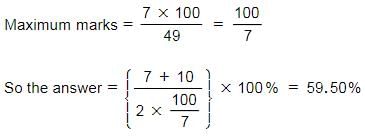
The ratio of the marks of a student in Hindi to that in English is 7 : 10. If the maximum marks of both the subjects are the same and he got 49% marks in Hindi, what is his percentage in both the subjects?
Detailed Solution: Question 14
A person distributed some chocolates among his four children and kept some with him. The eldest three children got chocolates in the ratio 5 : 3 : 4. The total number of chocolates with the father and the youngest child is the same as the total chocolates with the three eldest children. The ratio of chocolates with father and that with all the children is 1 : 2. If the youngest child has 12 chocolates with him, what is the total number of chocolates?
Detailed Solution: Question 15


319 videos|366 docs|157 tests |
