
Spectrum Test: The Lal Bahadur Shastri Years (June 1964–January 1966) -
MCQ Practice Test & Solutions: Spectrum Test: The Lal Bahadur Shastri Years (June 1964–January 1966) (20 Questions)
You can prepare effectively for UPSC History for UPSC CSE with this dedicated MCQ Practice Test (available with solutions) on the important topic of "Spectrum Test: The Lal Bahadur Shastri Years (June 1964–January 1966)". These 20 questions have been designed by the experts with the latest curriculum of UPSC 2026, to help you master the concept.
Test Highlights:
- - Format: Multiple Choice Questions (MCQ)
- - Duration: 12 minutes
- - Number of Questions: 20
Sign up on EduRev for free to attempt this test and track your preparation progress.

Statement 1: Lal Bahadur Shastri was sworn in as the second Prime Minister of India on June 9, 1964.Statement 2: Shastri maintained the portfolios of External Affairs and Atomic Energy initially in his tenure.
Detailed Solution: Question 1
Match the following initiatives with their respective leaders during Shastri's tenure:

Detailed Solution: Question 2

Arrange the following events in chronological order:
A) Lal Bahadur Shastri's death
B) Indo-Pak War 1965
C) Tashkent Declaration
D) Shastri sworn in as Prime Minister
B) Indo-Pak War 1965
C) Tashkent Declaration
D) Shastri sworn in as Prime Minister
Detailed Solution: Question 3
Assertion (A): Lal Bahadur Shastri played a key role in initiating the Green Revolution in India.
Reason (R): He aimed to solve the food shortage crisis in India.
Reason (R): He aimed to solve the food shortage crisis in India.
Detailed Solution: Question 4
Statement 1: Lal Bahadur Shastri resigned as Railways Minister in 1956, taking moral responsibility for a rail accident.
Statement 2: He returned to the cabinet as Finance Minister in 1961.
Statement 2: He returned to the cabinet as Finance Minister in 1961.
Detailed Solution: Question 5
Which of the following statements about the Tashkent Declaration is/are true?
A) It included a no-war pact between India and Pakistan.
B) It was signed under the mediation of Soviet President Alexei Kosygin.
C) It led to immediate friendly relations between India and Pakistan.
D) Lal Bahadur Shastri died before the declaration was signed.
B) It was signed under the mediation of Soviet President Alexei Kosygin.
C) It led to immediate friendly relations between India and Pakistan.
D) Lal Bahadur Shastri died before the declaration was signed.
Detailed Solution: Question 6
Who among the following was not a part of Lal Bahadur Shastri's cabinet?
Detailed Solution: Question 7
Statement 1: Lal Bahadur Shastri established the National Planning Council.
Statement 2: The aim was to diminish the dominance of the Planning Commission.
Statement 2: The aim was to diminish the dominance of the Planning Commission.
Detailed Solution: Question 8
Which of the following countries did Lal Bahadur Shastri visit to reestablish cordial relations after a military coup?
Detailed Solution: Question 9
Assertion (A): Lal Bahadur Shastri was known for his strong stance against the caste system.
Reason (R): He adopted the title 'Shastri' from Kashi Vidyapeeth to signify his caste.
Reason (R): He adopted the title 'Shastri' from Kashi Vidyapeeth to signify his caste.
Detailed Solution: Question 10
Statement 1: During Lal Bahadur Shastri's tenure, India faced major protests against the imposition of Hindi in non-Hindi speaking states.
Statement 2: Shastri responded by declaring Hindi as the sole official language of India.
Statement 2: Shastri responded by declaring Hindi as the sole official language of India.
Detailed Solution: Question 11
Who was appointed as the first secretary of the Prime Minister's Secretariat by Lal Bahadur Shastri?
Detailed Solution: Question 12
Match the following events with their respective years during Shastri's tenure:
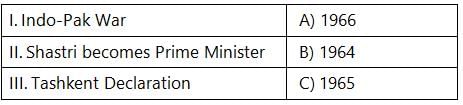
Detailed Solution: Question 13
Assertion (A): Lal Bahadur Shastri laid the foundation stone for the Alamatti Dam.
Reason (R): This was part of the Upper Krishna Project.
Reason (R): This was part of the Upper Krishna Project.
Detailed Solution: Question 14
Which of the following was not a focus area of Lal Bahadur Shastri's economic policy?
Detailed Solution: Question 15
Statement 1: Lal Bahadur Shastri was involved in the Quit India Movement.
Statement 2: He was never arrested during the Indian freedom struggle.
Statement 2: He was never arrested during the Indian freedom struggle.
Detailed Solution: Question 16
What was the primary reason for Lal Bahadur Shastri's 'Skip a Meal' initiative?
Detailed Solution: Question 17
Arrange in chronological order the positions held by Lal Bahadur Shastri post-independence:
A) Minister in Uttar Pradesh
B) General Secretary of the All India Congress Committee
C) Railways Minister
D) Home Minister
B) General Secretary of the All India Congress Committee
C) Railways Minister
D) Home Minister
Detailed Solution: Question 18
Who succeeded Lal Bahadur Shastri as Prime Minister of India?
Detailed Solution: Question 19
Assertion (A): Lal Bahadur Shastri was a firm secularist.
Reason (R): He emphasized India's diversity by advocating for a uniform civil code.
Reason (R): He emphasized India's diversity by advocating for a uniform civil code.
Detailed Solution: Question 20
124 videos|731 docs|171 tests |
