NEET Exam  >  NEET Test  >  Biology Class 11  >  Test: CNS ( Forebrain, Midbrain, Hindbrain) - NEET MCQ

CNS ( Forebrain, Midbrain, Hindbrain) - Free MCQ Practice Test with solutions,


MCQ Practice Test & Solutions: Test: CNS ( Forebrain, Midbrain, Hindbrain) (25 Questions)

You can prepare effectively for NEET Biology Class 11 with this dedicated MCQ Practice Test (available with solutions) on the important topic of "Test: CNS ( Forebrain, Midbrain, Hindbrain)". These 25 questions have been designed by the experts with the latest curriculum of NEET 2026, to help you master the concept.

Test Highlights:

  • - Format: Multiple Choice Questions (MCQ)
  • - Duration: 25 minutes
  • - Number of Questions: 25

Sign up on EduRev for free to attempt this test and track your preparation progress.

Test: CNS ( Forebrain, Midbrain, Hindbrain) - Question 1

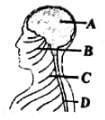
In the accompanying diagram of a part of the human body, the structures belonging to the central neural system are labelled as
Detailed Solution: Question 1

In the given figure, structures A and D are brain and spinal cord respectively, and these structures belong to central neural system. Structures 'B' and 'C' are the nerves arising from brain and spinal cord respectively and thus they belong to peripheral neural system.

Topic in NCERT: CENTRAL NEURAL SYSTEM

Line in NCERT: "The CNS consists of the brain and spinal cord."

Test: CNS ( Forebrain, Midbrain, Hindbrain) - Question 2

All sensory information to be registered consciously by the forebrain must pass via the

Detailed Solution: Question 2

The cerebrum wraps around a structure called thalamus, which is a major coordinating centre for sensory and motor signaling

Test: CNS ( Forebrain, Midbrain, Hindbrain) - Question 3

Which of the following is a part of our brain?

Detailed Solution: Question 3

The dorsal portion of the midbrain consists of four rounded lobes called quadrigemina.

Topic in NCERT: Midbrain

Line in NCERT: "The dorsal portion of the midbrain consists mainly of four round swellings (lobes) called corpora quadrigemina."

Test: CNS ( Forebrain, Midbrain, Hindbrain) - Question 4

The correct sequence of meninges from inner to outer side is

Detailed Solution: Question 4

Meninges are the three connective tissue membranes that enclose the brain and spinal cord. Piamater is the innermost membrane which is thin, delicate and vascular. The next membrane is arachnoid which is thin and webby. Duramater is the outermost membrane which is tough dense and fibrous in nature.

Test: CNS ( Forebrain, Midbrain, Hindbrain) - Question 5

Which of these is not a part of the hindbrain?

Detailed Solution: Question 5

  • The hindbrain comprises of the pons, the medulla oblongata and the cerebellum.
  • The hippocampus is present in the forebrain and is a part of the limbic system, which controls emotional reactions.

Topic in NCERT: Hindbrain

Line in NCERT: "The hindbrain comprises pons, cerebellum and medulla (also called the medulla oblongata)."

Test: CNS ( Forebrain, Midbrain, Hindbrain) - Question 6

Direction: 

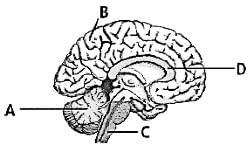
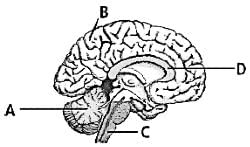
Which labelled part controls the process of breathing?

Detailed Solution: Question 6

Part 'C' is medulla oblongata that controls breathing.
Topic in NCERT: Hindbrain
Line in NCERT: "The medulla contains centres which control respiration, cardiovascular reflexes and gastric secretions."

Test: CNS ( Forebrain, Midbrain, Hindbrain) - Question 7

Direction: 

Which of the following functions is performed by the labelled 'C' in the given figure?

Detailed Solution: Question 7

Regulation of gastric secretion is also done by medulla oblongata.

Test: CNS ( Forebrain, Midbrain, Hindbrain) - Question 8

Which part of the brain receives and integrates visual, tactile, and auditory inputs?

Detailed Solution: Question 8

The midbrain is responsible for receiving and integrating sensory inputs such as visual, tactile, and auditory signals.

Test: CNS ( Forebrain, Midbrain, Hindbrain) - Question 9

Voluntary activities of body are controlled by :-

Detailed Solution: Question 9

The cerebrum is the largest part of the forebrain. It is responsible for the integration of complex sensory and neural functions and the initiation and coordination of voluntary activity in the body. It has specific functional lobe which is controls speech, generates several responses to different stimulus. 
So, the correct answer is option B.

Topic in NCERT: CENTRAL NEURAL SYSTEM

Line in NCERT: "The brain is the central information processing organ of our body, and acts as the 'command and control system'. It controls the voluntary movements, balance of the body, functioning of vital involuntary organs (e.g., lungs, heart, kidneys, etc.), thermoregulation, hunger and thirst, circadian (24-hour) rhythms of our body, activities of several endocrine glands and human behaviour."

Test: CNS ( Forebrain, Midbrain, Hindbrain) - Question 10

Which of the following contains cardiovascular reflexes, gastric secretions and the centres that control respiration?

Detailed Solution: Question 10

  • Medulla oblongata, also called medulla, is the lowest part of the brain and the lowest portion of the brainstem.
  • The medulla oblongata plays a critical role in transmitting signals between the spinal cord and the higher parts of the brain.
  • Medulla contains cardiovascular reflexes, gastric secretions and the centres that control respiration.

Topic in NCERT: Hindbrain

Line in NCERT: "The medulla contains centres which control respiration, cardiovascular reflexes and gastric secretions."

Test: CNS ( Forebrain, Midbrain, Hindbrain) - Question 11

Which part of the brain regulates the body temperature, hunger and water balance :-

Detailed Solution: Question 11

The part of the brain that regulates body temperature, hunger, and water balance is the Hypothalamus. Here's why:
- Hypothalamus:
- Regulates body temperature by triggering mechanisms like sweating or shivering.
- Controls hunger by responding to hunger hormones and signals.
- Manages water balance by regulating thirst and controlling the release of antidiuretic hormone (ADH).
In summary, the hypothalamus plays a crucial role in maintaining internal balance (homeostasis) within the body, ensuring optimal functioning.
Topic in NCERT: Forebrain
Line in NCERT: "A very important part of the forebrain called hypothalamus controls the body temperature, eating and drinking."

Test: CNS ( Forebrain, Midbrain, Hindbrain) - Question 12

Most of the involuntary action are controlled by :-

Detailed Solution: Question 12

Involuntary actions are those action that controlled by medulla oblongata which is a part of the autonomous nervous system where as voluntary actions are controlled by the cerebellum. The medulla oblongata directly controls heartbeat, blood pressure, breathing and digestion. It is located in the hindbrain, anterior to the cerebellum. It is a cone-shaped and contains the cardiac, respiratory, vomiting and vasomotor centers. Hence, the correct answer is option C.

Topic in NCERT: Hindbrain

Line in NCERT: "The medulla contains centres which control respiration, cardiovascular reflexes and gastric secretions."

Test: CNS ( Forebrain, Midbrain, Hindbrain) - Question 13

Corpus callosum connects :-

Detailed Solution: Question 13

The part of the brain that connects the two hemispheres of the brain is called the corpus callosum. It contains a bundle of neuronal fibers found in humans and other higher order mammals that allow the two hemispheres to talk to one another.

Test: CNS ( Forebrain, Midbrain, Hindbrain) - Question 14

The membrane which cover the brain and the spinal cord is :-

Detailed Solution: Question 14

Meninges are the membranes that cover and protect the brain and spinal cord. There are three layers of menings: dura mater (closest to the bone), arachnoid (loosely around the brain), pia mater (closely attached to the brain and spinal cord surface).

Test: CNS ( Forebrain, Midbrain, Hindbrain) - Question 15

Cerebellum is concerned with :-

Detailed Solution: Question 15

The cerebellum controls the timing and pattern of the muscle activation during movement. The main function of the cerebellum receives information from the sensory system, the spinal cord, and other parts of the brain and then regulates motor movements. The cerebellum coordinates voluntary movements such as posture, balance, coordination, and speech, resulting in smooth and balanced muscular activity.

So, the correct option is 'coordination of muscular movement'.

Test: CNS ( Forebrain, Midbrain, Hindbrain) - Question 16

The box like bony structure which encloses the brain is called :-

Detailed Solution: Question 16

The box enclosing and protecting the brain is called as the cranium. The cranium is the part of the skull, that encloses the brain. It is sometimes called as the braincase.

Test: CNS ( Forebrain, Midbrain, Hindbrain) - Question 17

Which of these is not a part of the forebrain?

Detailed Solution: Question 17

  • The brain is divided into three parts- the forebrain, the midbrain and the hindbrain.
  • The forebrain, which is the largest of all three, consists of the cerebrum, the thalamus and the hypothalamus.

Test: CNS ( Forebrain, Midbrain, Hindbrain) - Question 18

Which part of the neuron is present in a high concentration in the grey matter?

Detailed Solution: Question 18

  • The cell bodies or neurons or nerve cells are present in a high concentration in the grey matter of the brain and spinal cord.
  • The axons of neurons are present in a high concentration in the white matter.

Test: CNS ( Forebrain, Midbrain, Hindbrain) - Question 19

Which of the following is a richly vascular layer with lots of blood capillaries :-

Detailed Solution: Question 19

The pia mater of the brain is the innermost of the three membranes, that cover it. It is the vascular membrane of the brain. It carries the minute branches of the two internal carotids and the two vertebral arteries. It also returns the blood to the heart. The dura mater is the most external membrane of the brain. It forms the internal periosteum of the skull. The dura mater is a dense, tough, inelastic fibrous membrane. The epidermis contains no blood vessels, and cells in the deepest layers are nourished by diffusion from blood capillaries extending to the upper layers of the dermis. So, the correct answer is option B.

Test: CNS ( Forebrain, Midbrain, Hindbrain) - Question 20

Which of these is not true about the hypothalamus?

Detailed Solution: Question 20

  • The hypothalamus is a part of the forebrain. It lies at the base of the thalamus.
  • The hypothalamus controls body temperature and hunger.
  • It has neurosecretory cells which secrete hormones.

Test: CNS ( Forebrain, Midbrain, Hindbrain) - Question 21

 If the corpus callosum is removed in mammalian brain then what will be affected :-

Detailed Solution: Question 21

The corpus callosum is a bundle of nerve fibres found in the mammalian brain. It connects the left and right hemispheres of the brain and is responsible for most of the communication between the two. It is composed of white matter, that is, myelinated nerve cells, or axons, whose primary function is to connect grey areas together with neural impulses. The corpus callosum is the largest white matter structure in the brain, found in its interior. Grey matter occupies the periphery. Hence, if the corpus callosum is removed in the mammalian brain, then the communication between cerebral hemispheres will be lost.

Test: CNS ( Forebrain, Midbrain, Hindbrain) - Question 22

Where is the midbrain located?

Detailed Solution: Question 22

The midbrain is located between the hypothalamus of the forebrain and the pons of the hindbrain. The midbrain is also known as the mesencephalon and controls several motor movements.

Test: CNS ( Forebrain, Midbrain, Hindbrain) - Question 23

Which of these structures are found in the midbrain?

Detailed Solution: Question 23

  • The midbrain is present between the hypothalamus of the forebrain and the pons of the hindbrain.
  • The corpora quadrigemina is a four lobed structure which is present in the dorsal part of the midbrain.

Test: CNS ( Forebrain, Midbrain, Hindbrain) - Question 24

Which of the following statements about the hindbrain is incorrect?

Detailed Solution: Question 24

The brainstem is made up of the midbrain, pons, and medulla oblongata, but it does not include the cerebellum. The cerebellum, although part of the hindbrain, is a separate structure that is involved in coordination and motor control. The brainstem forms the connection between the brain and the spinal cord, and it plays a crucial role in basic life-sustaining functions such as respiration, heart rate, and reflexes.

Test: CNS ( Forebrain, Midbrain, Hindbrain) - Question 25

Which of the following statements correctly describes the functions and components of the brain?

Detailed Solution: Question 25

The limbic system is a part of the forebrain and is responsible for functions such as autonomic responses, emotional reactions, olfaction, regulation of sexual behavior, and motivation. The other options incorrectly describe the components or functions of the brain.

142 videos|410 docs|135 tests
Information about Test: CNS ( Forebrain, Midbrain, Hindbrain) Page
In this test you can find the Exam questions for Test: CNS ( Forebrain, Midbrain, Hindbrain) solved & explained in the simplest way possible. Besides giving Questions and answers for Test: CNS ( Forebrain, Midbrain, Hindbrain), EduRev gives you an ample number of Online tests for practice
142 videos|410 docs|135 tests
Download as PDF