JEE Exam  >  JEE Test  >  MET Mock Test Series  >  MET Mock Test - 3 - JEE MCQ

MET Mock Test - 3 Free Online Test 2026


Full Mock Test & Solutions: MET Mock Test - 3 (60 Questions)

You can boost your JEE 2026 exam preparation with this MET Mock Test - 3 (available with detailed solutions).. This mock test has been designed with the analysis of important topics, recent trends of the exam, and previous year questions of the last 3-years. All the questions have been designed to mirror the official pattern of JEE 2026 exam, helping you build speed, accuracy as per the actual exam.

Mock Test Highlights:

  • - Format: Multiple Choice Questions (MCQ)
  • - Duration: 120 minutes
  • - Total Questions: 60
  • - Analysis: Detailed Solutions & Performance Insights
  • - Sections covered: Physics, Chemistry, Mathematics, English

Sign up on EduRev for free and get access to these mock tests, get your All India Rank, and identify your weak areas to improve your marks & rank in the actual exam.

MET Mock Test - 3 - Question 1

If a long hollow copper pipe carries a current, the produced magnetic field will be

Detailed Solution: Question 1

When a current flows through a long hollow copper pipe, it generates a magnetic field. This magnetic field exists outside the pipe but not inside it. The hollow nature of the pipe means that the magnetic field does not penetrate its interior. Therefore, the magnetic field is only present outside the pipe.

MET Mock Test - 3 - Question 2

A body is projected at such an angle that the horizontal range is three times the greatest height. The angle of projection is

Detailed Solution: Question 2

To find the angle of projection when the horizontal range is three times the greatest height, we can use the following relationships:

  • Range (R) = 3 × Height (H)
  • The formulas are:
    • R = (u² sin 2θ) / g
    • H = (u² sin² θ) / (2g)
  • From the relation, we can express:
    • 3 × H = R
    • 3 × (u² sin² θ) / (2g) = (u² sin 2θ) / g
  • Simplifying, we get:
    • 3 sin² θ = 2 sin 2θ
    • Since sin 2θ = 2 sin θ cos θ, we can rewrite it as:
    • 3 sin² θ = 4 sin θ cos θ
  • Dividing both sides by sin θ (assuming θ ≠ 0):
    • 3 sin θ = 4 cos θ
    • tan θ = 4/3
  • Calculating θ gives:
    • θ ≈ 53° 1'

The angle of projection is 53° 1'.

MET Mock Test - 3 - Question 3

In the following question, a Statement of Assertion (A) is given followed by a corresponding Reason (R) just below it. Read the Statements carefully and mark the correct answer-
Assertion(A):Two bodies 1 and 2 exerting forces on each other.Force exerted on the body 1 by body 2 is F 12 and that exerted on the body 2 (by body 1) is F 21 . Then F 12 = − F 21 .
Reason(R):Force F 12 is of action and force F 21 is of reaction.

Detailed Solution: Question 3

Assertion is true as acc to Newton second law Fab=-Fba i.e every action has an equal and opposite reaction. Since force is a Vector quantity opposite direction is to be indicated by negative sign. So in question assertion is true but in reason the force of reaction is not in opposite direction because negative sign is not there. So reason is false.

MET Mock Test - 3 - Question 4

The M.I. of a body about the given axis is 1.2 kg x m2 initially the body is at rest. In order to produce a rotational kinetic energy of 1500 joule an angular acceleration of 25 rad/sec must be applied about that axis for a duration of

Detailed Solution: Question 4

To determine the time required to achieve a rotational kinetic energy of 1500 joules, we can use the following relationships:

  • Rotational Kinetic Energy (KE) is given by the formula: KE = 0.5 × I × ω², where I is the moment of inertia and ω is the angular velocity.
  • We know the moment of inertia (I = 1.2 kg × m²) and the desired kinetic energy (KE = 1500 joules).
  • Rearranging the formula, we find: ω = √(2 × KE / I).

Now, substituting the values:

  • ω = √(2 × 1500 / 1.2) = √(2500) = 50 rad/s.

Next, we need to find the time (t) required to reach this angular velocity using the angular acceleration (α = 25 rad/s²) with the formula:

  • ω = α × t implies t = ω / α.

Substituting the values:

  • t = 50 rad/s / 25 rad/s² = 2 seconds.

Therefore, the required duration is 2 seconds.

MET Mock Test - 3 - Question 5

The internal energy of an ideal gas increases during an isothermal process when the gas is

Detailed Solution: Question 5

  • In an isothermal process, the temperature of the ideal gas remains constant.
  • The internal energy of an ideal gas depends only on temperature, so it does not change during expansion or compression at constant temperature.
  • However, if more molecules are added (as in option 1), the internal energy can increase since the gas's total energy depends on the number of molecules.
  • Thus, the correct answer is that the internal energy increases when the gas is expanded by adding more molecules to it.

MET Mock Test - 3 - Question 6

Dimensional formula for torque is

Detailed Solution: Question 6

The dimensional formula for torque can be derived from its definition. Torque is the product of force and distance. The dimensional formula for force is given by \( ML T^{-2} \), where \( M \) represents mass, \( L \) represents length, and \( T \) represents time. To find the dimensional formula for torque, we multiply the force by the distance (length): \[ \text{Torque} = \text{Force} \times \text{Distance} = (M L T^{-2}) \times L = M L^2 T^{-2} \] Therefore, the correct dimensional formula for torque is \( M L^2 T^{-2} \).

MET Mock Test - 3 - Question 7

For the wave y = 20 sin π (x/4 + t/2), the correct statement is (where x is in metre and time is in second)

Detailed Solution: Question 7

The wave equation given is y = 20 sin(π (x/4 + t/2)). To analyse this wave: 1. Amplitude: The coefficient of the sine function indicates the amplitude. Here, it is 20 metres. 2. Angular Frequency (ω): The term in front of time (t) is π/2, so ω = π/2. 3. Wave Number (k): The coefficient of x in the argument of the sine function is π/4, thus k = π/4. 4. Frequency (f): The relationship between angular frequency and frequency is given by f = ω/(2π). Therefore, f = (π/2) / (2π) = 1/4 Hz. 5. Wavelength (λ): The wavelength can be calculated using the formula λ = 2π/k. Here, λ = 2π / (π/4) = 8 metres. In summary: - Amplitude: 20 m - Frequency: 0.25 Hz - Wavelength: 8 m - ω = π/2 and k = π/4 The correct statements based on this analysis would clarify the properties of the wave.

MET Mock Test - 3 - Question 8

The radionuclide 56Mn is being produced in a cyclotron at a constant rate P by bombarding a manganese target with deutrons. 56Mn has a half life of 2.5 hours and the target contains large number of only the stable manganese isotope 55Mn. The reaction that produces 56Mn is:

55Mn+d→56Mn+P

After being bombarded for a long time, the activity of 56Mn becomes constant equal to 13.86×10s−1. (Use ln2 = 0.693; Avogadro number = 6×10²³ atomic weight of 56Mn = 56gm/mole)

Q. After a long time bombardment, number of 56Mn nuclei present in the target depends upon 
(a) The number of 56Mn nuclei present at the start of the process 
(b) Half life of the 56Mn
(c) The constant rate of production P

Detailed Solution: Question 8

The number of \(^56\)Mn nuclei present in the target after prolonged bombardment is influenced by three factors: 1. The initial quantity of \(^56\)Mn nuclei at the start of the process. 2. The half-life of \(^56\)Mn, which indicates how quickly the nuclei decay. 3. The constant rate of production \(P\) of \(^56\)Mn from the bombardment. As the production of \(^56\)Mn reaches a steady state, these three factors together determine the final number of nuclei present. Thus, all three factors are significant in assessing the quantity of \(^56\)Mn in the target after a long period of bombardment.

*Answer can only contain numeric values
MET Mock Test - 3 - Question 9

A biconvex thin lens is prepared from glass of refractive index µ2 = 3/2. The two converging surface have equal radii of  20cm each. One of the surface is silvered from outside to make it reflecting. It is placed in a medium of refractive index µ1 = 5/3. This system will behave as concave mirror of focal length f, find value of |f| in cm.


Detailed Solution: Question 9
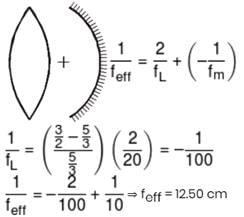
*Answer can only contain numeric values
MET Mock Test - 3 - Question 10

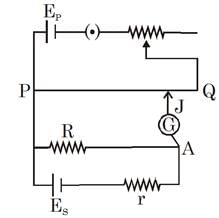
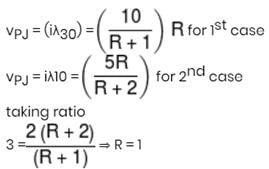
One of the circuits for the measurement of resistance by potentiometer is shown. The galvanometer is connected at point A and zero deflection is observed at length PJ = 30 cm. In second case the secondary cell is changed. Take ES = 10 V and r = 1Ω  in 1st reading and ES = 5V and r = 2Ω in 2nd reading. In second case, the zero deflection is observed at length PJ = 10 cm. What is the resistance R (in ohm)?

Detailed Solution: Question 10
*Answer can only contain numeric values
MET Mock Test - 3 - Question 11

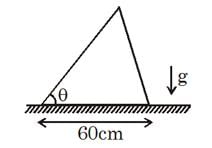
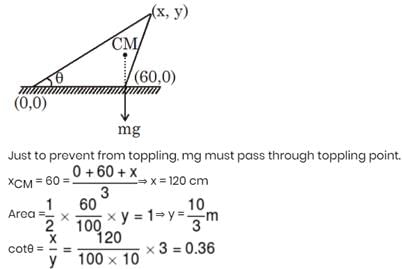
A uniform triangular plate of triangular area 1m2, base length 60 cm and thickness 10 mm (prism like shape) is lying vertically on a smooth ground as shown in figure. Find maximum value of cotθ for which it does not topple.

Detailed Solution: Question 11
MET Mock Test - 3 - Question 12

Vinegar made from cane sugar, now-a-days synthetically contains

Detailed Solution: Question 12

Vinegar made from cane sugar typically contains acetic acid, which is responsible for its sour taste and strong aroma.

MET Mock Test - 3 - Question 13

The rate, at which a substance reacts at constant temperature, depends upon its

Detailed Solution: Question 13

The rate of a substance's reaction at a constant temperature is influenced by its active mass. Active mass refers to the concentration of the reactants in a solution or the partial pressure of gases involved in the reaction. This concept is crucial in understanding how quickly reactions occur.

MET Mock Test - 3 - Question 14

The free energy change ∆G=0, when

Detailed Solution: Question 14

The change in free energy (∆G) equals zero when the system is at equilibrium. At this point, the forward and reverse reactions occur at the same rate, meaning there is no net change in the concentrations of reactants and products.

MET Mock Test - 3 - Question 15

Which of the following ingredients is not used in sun burn creams?

Detailed Solution: Question 15

Sunburn creams typically contain emollients to moisturise the skin, preservatives to maintain product integrity, and sometimes perfumes for fragrance. However, bleaching agents are not commonly included in these formulations.

*Answer can only contain numeric values
MET Mock Test - 3 - Question 16

What is the molecular weight of the final product in the following reaction sequence


*Answer can only contain numeric values
MET Mock Test - 3 - Question 17

6.84 gm Al2(SO4)3 is needed to coagulate 2.5 L of As2S3 sol completely in 2.0 hrs. The coagulation value of Al2(SO4)3 in terms of millimoles per litre is : 
[Atomic mass : Al = 27, S = 32].


Detailed Solution: Question 17

To determine the coagulation value of aluminium sulphate, we first need to find the number of moles of Al₂(SO₄)₃ in 6.84 grams. 1. Calculate the molar mass of Al₂(SO₄)₃: - Aluminium (Al): 27 g/mol × 2 = 54 g/mol - Sulphur (S): 32 g/mol × 3 = 96 g/mol - Oxygen (O): 16 g/mol × 12 = 192 g/mol Total molar mass = 54 + 96 + 192 = 342 g/mol. 2. Calculate the number of moles in 6.84 grams: Number of moles = mass / molar mass = 6.84 g / 342 g/mol ≈ 0.0200 moles. 3. Since this amount is used to coagulate 2.5 L of As₂S₃ sol, we can find the concentration in millimoles per litre (mmol/L): Concentration = (0.0200 moles / 2.5 L) × 1000 = 8.00 mmol/L. Thus, the coagulation value of Al₂(SO₄)₃ is 8.00 millimoles per litre.

*Answer can only contain numeric values
MET Mock Test - 3 - Question 18

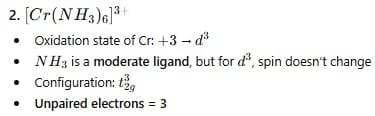
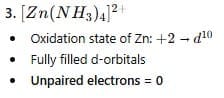
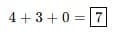
The sum of Number of unpaired electrons in
[COCl6]–3, [Cr(NH3)6]+3 , [Zn(NH3)4]+2 →


Detailed Solution: Question 18
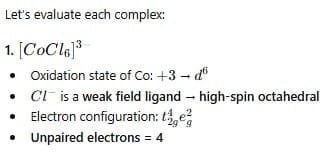


Total unpaired electrons: 

MET Mock Test - 3 - Question 19

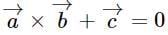
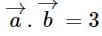
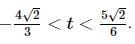
Let  Then the vector  satisfying  and  is

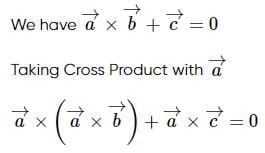
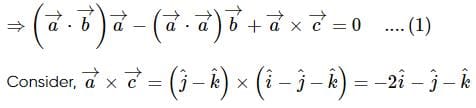
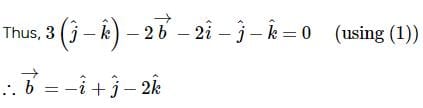
Detailed Solution: Question 19

Using formula for Vector Triple Product

MET Mock Test - 3 - Question 20

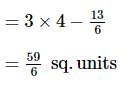
The area (in sq. units) of the region bounded by y ≤ x+ 3x, 0 ≤ y ≤ 4 and 0 ≤ x ≤ 3 is

Detailed Solution: Question 20
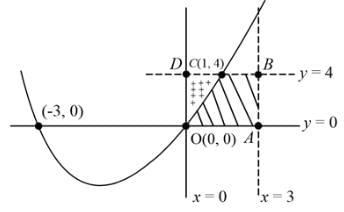
The area of the region ODC is

So, the area of the given region OABC is equal to
Area of OABD – Area of OCD

MET Mock Test - 3 - Question 21

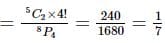
There are 8 seats in row, where 4 persons are to be seated. Then the probability of making them sit so that each person has exactly one neighbour, is

Detailed Solution: Question 21

Two pairs of two persons have to be formed so that they have exactly one neighbour.

Let x1,x2,x3 be the number of chairs left on all the empty sides of the 4 persons.

Then

The required number of arrangements will be the number of integral solutions of this equation = 5C2

So, required probability 

MET Mock Test - 3 - Question 22

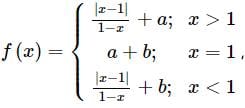
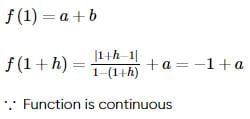
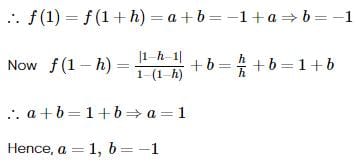
If is continuous at x=1 then a and b are respectively-

Detailed Solution: Question 22

MET Mock Test - 3 - Question 23

Let A={1, 2, 3, 4, 5, 6} and B={1, 2, 3, 4} be two sets, then the number of functions that can be defined from A to B
such that the element 2 in B has exactly 3 pre-images in A, is equal to

Detailed Solution: Question 23
3 pre-images from A can be selected in 6C3 ways.

The rest of the 3 elements can be mapped in 3 x 3 x 3 ways.

The required number of functions = 6C3 x 3=  540

MET Mock Test - 3 - Question 24

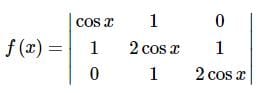
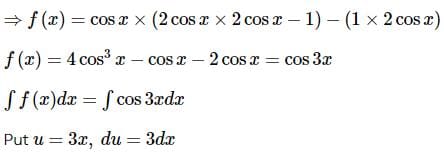
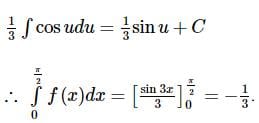
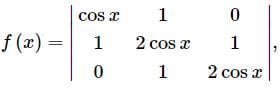
If  then  is equal to

Detailed Solution: Question 24

MET Mock Test - 3 - Question 25

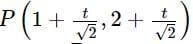
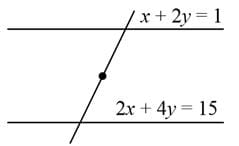
If  be any point on a line, then the range of the values of t for which the point P lies between the parallel lines x+2y=1 and 2x+4y=15 is

Detailed Solution: Question 25

Given
L1: x + 2y − 1 = 0 & L2: 2x+ 4y − 15 = 0  

Here, point O(0,0) & P lies on opposite side of L1 and on the same side of L2. 

Putting O(0,0) on L1 gives x + 2y − 1 = 0 + 0 − 1 = −1 < 0
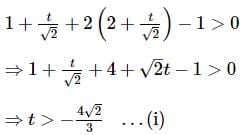
So, putting the point P on L1 should have opposite sign, i.e., 

Also, putting O(0,0) on L2 gives 2x + 4y − 15 = 0 + 0 − 15 = −15 < 0
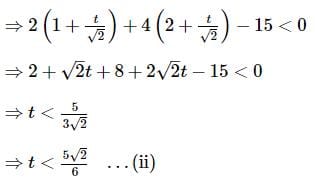
So, putting the point P on L2 should have same sign.

From equations (i) & (ii), we get

MET Mock Test - 3 - Question 26

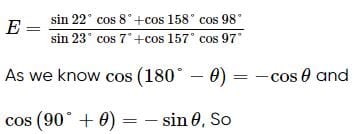
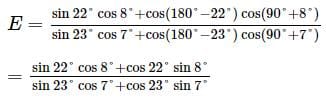
The value of 

Detailed Solution: Question 26
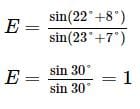
Let the given expression is

Now, using 

sin(A+B) = sinA cosB + cosA sinB , above expression becomes

*Answer can only contain numeric values
MET Mock Test - 3 - Question 27

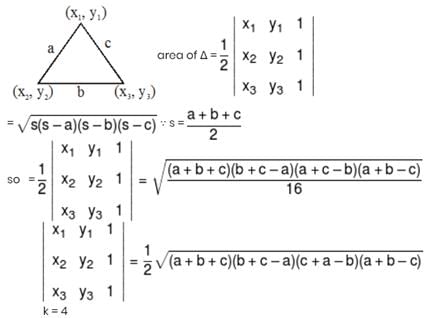
If (x1 – x2)2 + (y1 – y2)2 = a2 ;
(x2 – x3)2 + (y2 – y3)2 = b2 ;
(x3 – x1)2 + (y3 – y1)2 = c2  and
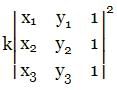
= (a + b + c)(b + c – a)(c + a – b)(a + b – c)
Then the value of k is :-


Detailed Solution: Question 27
MET Mock Test - 3 - Question 28

In the following questions, four groups of words are given. In each group, one word is misspelt. Find the misspelt word.

Detailed Solution: Question 28

The word given in option A is incorrectly spelled. The correct word will be 'pronounce'. It is a verb that means to make a sound of a word or a letter in a particular way.
Example sentence: John pronounces his words indistinctly.

MET Mock Test - 3 - Question 29

Rahul walks 8 km towards West, then turn to his left and walks 6 km. Rahul is how far (shortest distance) and in which direction from starting point?

Detailed Solution: Question 29
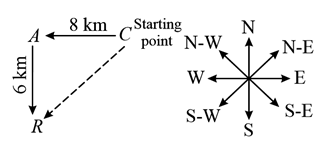
Make a digram according to question,

Using Pythagoras theorem,

Thus required answer is 10 km, South-West

MET Mock Test - 3 - Question 30

Consider the given statement to be true and decide which of the following conclusion logically follow from the statement? 

Statement:  Weight is also a Force. 

Conclusions: 

1. The unit of weight is Newton. 

2. The unit of weight is kilograms. 

Detailed Solution: Question 30

The conclusion 1 follows the statement because it is mentioned that weight is also a Force. So, the unit of Force is the Newton which will be unit of the weight in this case.

The conclusion 2 does not follow the statement because the unit of the weight is kilograms in normal cases but in this case, it is mention that weight is also a force.

Hence, only conclusion 1 follows.

View more questions
10 tests
Information about MET Mock Test - 3 Page
In this test you can find the Exam questions for MET Mock Test - 3 solved & explained in the simplest way possible. Besides giving Questions and answers for MET Mock Test - 3, EduRev gives you an ample number of Online tests for practice
Download as PDF