NEET Exam  >  NEET Test  >  Physics Class 11  >  Test: Work, Energy & Power - 1 - NEET MCQ

Work, Energy & Power - 1 - Free MCQ Practice Test with solutions, NEET


MCQ Practice Test & Solutions: Test: Work, Energy & Power - 1 (22 Questions)

You can prepare effectively for NEET Physics Class 11 with this dedicated MCQ Practice Test (available with solutions) on the important topic of "Test: Work, Energy & Power - 1". These 22 questions have been designed by the experts with the latest curriculum of NEET 2026, to help you master the concept.

Test Highlights:

  • - Format: Multiple Choice Questions (MCQ)
  • - Duration: 22 minutes
  • - Number of Questions: 22

Sign up on EduRev for free to attempt this test and track your preparation progress.

Test: Work, Energy & Power - 1 - Question 1

A particle experiences a variable force in a horizontal x-y plane. Assume distance in meters and force in newton. If the particle moves from point (1, 2) to point (2, 3) in the x-y plane; then kinetic energy changes by
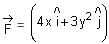
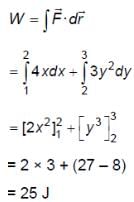
Detailed Solution: Question 1

The change in kinetic energy of a particle moving in a horizontal plane can be determined using the work-energy theorem. The theorem states that the work done by a force on a particle equals the change in its kinetic energy. We Know that, 

Test: Work, Energy & Power - 1 - Question 2

A stone of mass m tied to a string is being whirled in a vertical circle with a uniform speed. The tension in the string is

Detailed Solution: Question 2
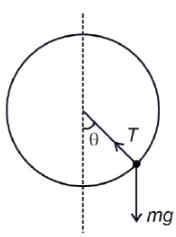

At any θ,
T - mgcosθ =

⇒ T = mg cosθ + 
Since v is constant,
⇒ T will be minimum when cos θ is minimum.
⇒ θ = 180° corresponds to Tmin.

Test: Work, Energy & Power - 1 - Question 3

A block of mass 'm' (as shown in figure) moving with kinetic energy E compresses a spring through a distance 25 cm when its speed is halved. The value of spring constant of used spring will be nE Nm-1 for n = _____________. (in integers)
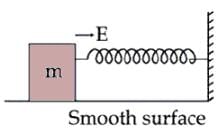
Detailed Solution: Question 3
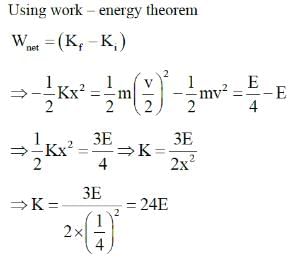
W = Force x displacement in the direction of forceWork done will be zero because porter is stationary (i.e. displacement is zero)

n = 24

Test: Work, Energy & Power - 1 - Question 4

Two cylindrical vessels of equal cross-sectional area 16 cm2 contain water up to heights 100 cm and 150 cm, respectively. The vessels are interconnected so that the water levels in them become equal. The work done by the force of gravity during the process is: [Take density of water = 103 kg/m3 and g = 10 ms-2]

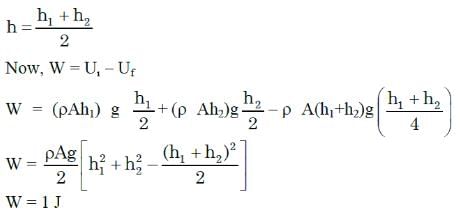
Detailed Solution: Question 4
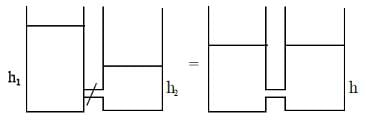

Test: Work, Energy & Power - 1 - Question 5

A body of mass 1 kg is thrown upwards with a velocity 20m/s. It momentarily comes to rest after attaining a height of 18 m. How much energy is lost due to air friction?
( g=10m/s):

Detailed Solution: Question 5

Step 1: Total Initial Energy (Kinetic Energy)

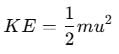
The kinetic energy at the start is given by

:

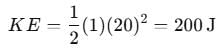
Substituting the values:

Step 2: Energy at Maximum Height (Potential Energy)

At the maximum height, the body momentarily comes to rest, so the energy is purely potential energy (PE):

PE=mgh

Substituting the values:

PE=(1)(10)(18)=180 J

Step 3: Energy Lost to Air Friction

The energy lost due to air friction is the difference between the initial energy and the energy at the maximum height:

Energy lost = K E − P E

Energy lost = 200 −180 = 20 J

Test: Work, Energy & Power - 1 - Question 6

As per the given figure, two blocks each of mass 250 g are connected to a spring of spring constant 2 Nm-1. If both are given velocity v in opposite directions, then maximum elongation of the spring is:
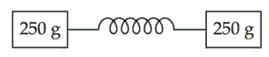
Detailed Solution: Question 6
Given Data:

Mass of each block: m = 250 g = 0.25 kg,

Spring constant: k = 2 N / m,

Initial velocities of blocks: v (in opposite directions).

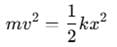
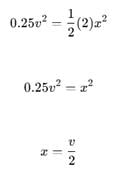
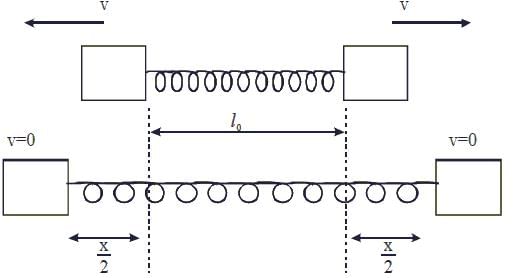
When the two blocks move with velocity v in opposite directions, the system's kinetic energy is converted into potential energy stored in the spring at the point of maximum elongation.

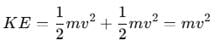
The total kinetic energy of the two blocks is:

The potential energy stored in the spring at maximum elongation (x) is:

At maximum elongation, all the kinetic energy of the system is converted into potential energy:

Test: Work, Energy & Power - 1 - Question 7

A body of mass 0.5 kg travels on a straight line path with velocity v = (3x2 + 4) m/s. The net work done by the force during its displacement from x = 0 to x = 2 m is:

Detailed Solution: Question 7

Solution:

  • Mass: 0.5 kg
  • Initial velocity at x = 0:
    • Formula: v = 3x2 + 4
    • Substitute: v = 3(0)2 + 4 = 4 m/s
  • Final velocity at x = 2:
    • Substitute: v = 3(2)2 + 4 = 16 m/s
  • Calculate the change in kinetic energy:
    • Initial kinetic energy: (1/2) × 0.5 × 42 = 4 J
    • Final kinetic energy: (1/2) × 0.5 × 162 = 64 J
  • Net work done by the force:
    • Work done = Change in kinetic energy = 64 J - 4 J = 60 J

Therefore, the net work done by the force is 60 J.

Test: Work, Energy & Power - 1 - Question 8

A particle of mass 500 gm is moving in a straight line with velocity v = b x5/2. The work done by the net force during its displacement from x = 0 to x = 4 m is: (Take b = 0.25 m-3/2 s-1)

Detailed Solution: Question 8
Solution:

The work-energy theorem states that the work done by a net force is equal to the change in kinetic energy.

Given the velocity equation: v = b x5/2, where b = 0.25 m-3/2 s-1.

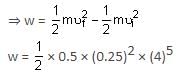
From the work energy theorem,
Work done by net force = ΔK.E.

w = 16 J

Test: Work, Energy & Power - 1 - Question 9

A body at rest is moved along a horizontal straight line by a machine delivering a constant power. The distance moved by the body in time 't' is proportional to

Detailed Solution: Question 9

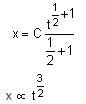
The problem involves a body moved by a machine with constant power.

P = constant

By integration,

Test: Work, Energy & Power - 1 - Question 10

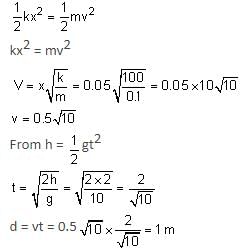
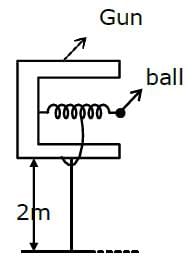
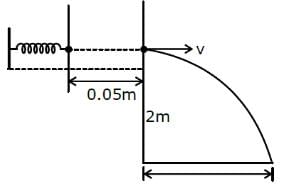
In a spring gun having spring constant 100 N/m, a small ball 'B' of mass 100 g is put in its barrel (as shown in figure) by compressing the spring through 0.05 m. There should be a box placed at a distance 'd' on the ground so that the ball falls in it. If the ball leaves the gun horizontally at a height of 2 m above the ground, the value of d is _______________ m.
(g = 10 m/s2) (in integers)
Detailed Solution: Question 10

Test: Work, Energy & Power - 1 - Question 11

A 60 HP electric motor lifts an elevator having a maximum total load capacity of 2000 kg. If the frictional force on the elevator is 4000 N, the speed of the elevator at full load is close to: (1 HP = 746 W, g = 10 ms-2)

Detailed Solution: Question 11

Ftotal = Mg + friction
= 2000 × 10 + 4000
= 20,000 + 4000 = 24,000 N
P = F × v
60 × 746 = 24,000 × v
⇒ v = 1.86 m/s ≈ 1.9 m/s

Test: Work, Energy & Power - 1 - Question 12

In an Inelastic Collision,

Detailed Solution: Question 12

Kinetic Energy is transferred to other forms of energy—such as thermal energy, potential energy, and sound—during the collision process. After collision if recovery of kinetic energy is less than % then it is called inelastic collision i.e.. some part of kinetic energy is not recover. So that in an inelastic collision the total kinetic energy after the collision is less than before the collision

Test: Work, Energy & Power - 1 - Question 13

Physically, the notion of potential energy is applicable only to

Detailed Solution: Question 13

Potential energy is the stored energy of an object. It is the energy by virtue of an object's position relative to other objects. Potential energy is often associated with restoring forces such as a spring or the force of gravity. It is applicable only for conservative forces.

Test: Work, Energy & Power - 1 - Question 14

A bolt of mass 0.3 kg falls from the ceiling of an elevator moving down with an uniform speed of 7 m/s. It hits the floor of the elevator (length of the elevator = 3 m) and does not rebound. What is the heat produced by the impact?

Detailed Solution: Question 14

Explanation:

Whole of the potential energy of bolt converted in to heat energy 

heat produced by the impact = mgh =0.3×9.8×3=8.82J

Test: Work, Energy & Power - 1 - Question 15

A body is projected at an angle of 30° to the horizontal with kinetic energy 40 J. What will be the kinetic energy at the top most point?

Detailed Solution: Question 15

Given:

  • Angle of projection, θ = 30°
  • Initial kinetic energy = 40 J

Concept: At the topmost point of a projectile’s motion, the vertical component of velocity becomes zero. So the kinetic energy is only due to the horizontal component.

Let initial speed be u, mass be m.
Total kinetic energy:
KE = (1/2)mu² = 40 J ⇒ mu² = 80

At the top: only horizontal velocity remains:
ux = u cosθ ⇒ KEtop = (1/2)mu²cos²θ

cos 30° = √3/2 ⇒ cos²30° = 3/4
KEtop = (1/2 × 80 × 3/4) = 30 J

Answer: (d) 30 J

    Test: Work, Energy & Power - 1 - Question 16

    A body is slowly lowered on to a massive platform moving horizontally at a speed of 4 m/s. through what distance will the body slide relative to the platform? (The coefficient of friction is 0.2; g = 10 m/s2)

    Detailed Solution: Question 16

    Option C is correct.

    The frictional force equals μmg, so the relative deceleration of the body due to friction is a = μg.

    With μ = 0.2 and g = 10 m/s2, a = 0.2 × 10 = 2 m/s2.

    The initial relative speed is u = 4 m/s and the final relative speed is v = 0.

    Use the kinematic relation v2 = u2 - 2as.

    Substituting values: 0 = (4)2 - 2 × 2 × s.

    So s = 16 / 4 = 4 m.

    Therefore the body slides a distance of 4 m relative to the platform; option C is correct.

    Test: Work, Energy & Power - 1 - Question 17

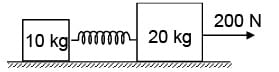
    Two masses 10 kg and 20 kg are connected by a massless spring. A force of 200 N acts on 20 kg mass. At the instant when the 10 kg mass has an acceleration 12 m/s2 the energy stored in the spring (k = 2400 N/m) will be
    Detailed Solution: Question 17

    F = 10× 12 = 120 N
    F = kx = 2400 x
    ∴ x = 1/20
    Energy stored in the spring E = 1/2 Kx2
    = 1/2 × 2400 × 1/400 = 3J

    Test: Work, Energy & Power - 1 - Question 18

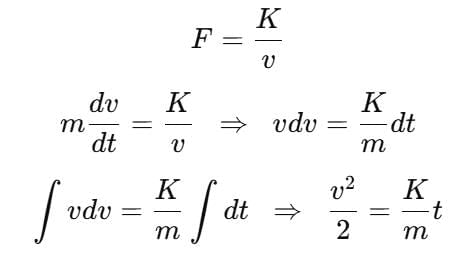
    Force acting on a particle moving in a straight line varies with the velocity of the particle as  Here K is constant.
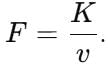
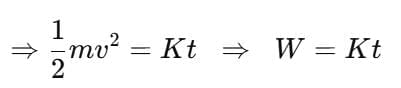
    The work done by this force in time t is

    Detailed Solution: Question 18

    Test: Work, Energy & Power - 1 - Question 19

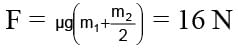
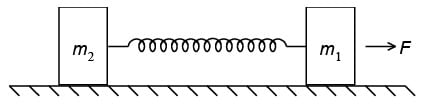
    Two bars of masses m1 = 4 kg and m2 = 8kg connected by a non-deformed light spring rest on a horizontal plane. The coefficient of friction between bars and surface is μ = 0.2. What minimum constant force has to be applied in the horizontal direction to the bar of mass m1 in order to shift the other bar?
    Detailed Solution: Question 19
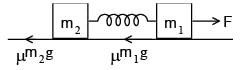
    Let F be the force applied as shown in the Figure.
    If F moves through x, the work done will be F× x.
    This is used to work against friction mm1g and store energy in the spring.

    Work done against friction = μm1gx;
    Energy stored = 1/2 kx2, where k is the spring constant.

    When the mass m2moves, the tension in the spring balances the force of friction at m2.
    ∴ kx = μm2g
    ∴ combining equations (i) and (ii),

    Test: Work, Energy & Power - 1 - Question 20

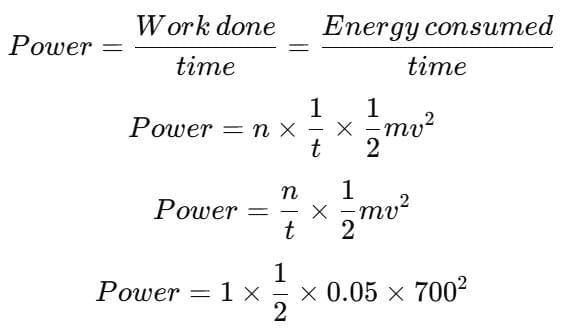
    A machine gun fires 60 bullets per minute with a velocity of 700 m/s. If each bullet has a mass of 50 g, the power developed by the gun is:

    Detailed Solution: Question 20

    Given: 

    The power developed by the gun is given by formula –

    Power = 12250 watt

    Test: Work, Energy & Power - 1 - Question 21

    A 100000 kg engine is moving up a slope of gradient 5o at a speed of 100 m/hr. The coefficient of friction between the engine and the rails is 0.1. If the engine has an efficiency of 4% for converting heat into work, find the amount of coal, the engine has to burn up in one hour. (Burning of 1 kg of coal yields 50000 J.)

    Detailed Solution: Question 21
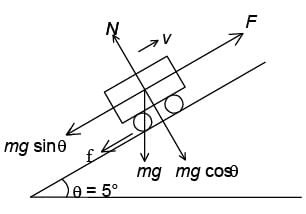
    The forces are shown in Figure.

    Net force to move the engine up the slope. 
    F = μN + mg sin θ
    = mg (μ cos θ + sin θ)
    If the engine has to apply an upward force equal to F, power of engine, P = Fv
    where v is the velocity equal to 100 m/hr.
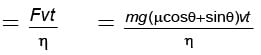
    Work done by engine, W = Pt  = Fvt
    Efficiency of engine,
    Energy used by engine 
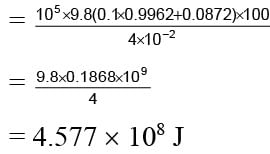
    m = 100000 kg, μ = 0.1, θ = 5°, v = 100 m/hr, t = 1 hr 
    η = 4/100 = 0.04
    Energy used by engine 

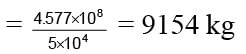
    As 1 kg coal yields 50000 J, we have the amount of coal burnt up

    Test: Work, Energy & Power - 1 - Question 22

    What will be the energy possessed by a stationary object of mass 10 kg placed at a height of 20 m above the ground? (take g = 10 m/s2)

    Detailed Solution: Question 22

    The energy possessed by an object due to its height is called gravitational potential energy. It can be calculated using the formula:

    • Potential Energy (PE) = mass (m) × gravitational acceleration (g) × height (h)

    In this case:

    • mass (m) = 10 kg
    • gravitational acceleration (g) = 10 m/s2
    • height (h) = 20 m

    Now, substituting the values into the formula:

    • PE = 10 kg × 10 m/s2 × 20 m
    • PE = 2000 kg·m2/s2

    Since 1 kg·m2/s2 is equal to 1 Joule, we can convert:

    • PE = 2000 J

    Therefore, the energy possessed by the object at that height is 2000 J, which is equivalent to 2 kJ.

    97 videos|376 docs|98 tests
    Information about Test: Work, Energy & Power - 1 Page
    In this test you can find the Exam questions for Test: Work, Energy & Power - 1 solved & explained in the simplest way possible. Besides giving Questions and answers for Test: Work, Energy & Power - 1, EduRev gives you an ample number of Online tests for practice
    97 videos|376 docs|98 tests
    Download as PDF