NEET Exam  >  NEET Test  >  Physics Class 11  >  Multiple Choice Questions (MCQs): Friction - NEET MCQ

Friction - NEET Physics Class 11 Free MCQ Test with solutions


MCQ Practice Test & Solutions: Multiple Choice Questions (MCQs): Friction (10 Questions)

You can prepare effectively for NEET Physics Class 11 with this dedicated MCQ Practice Test (available with solutions) on the important topic of "Multiple Choice Questions (MCQs): Friction". These 10 questions have been designed by the experts with the latest curriculum of NEET 2026, to help you master the concept.

Test Highlights:

  • - Format: Multiple Choice Questions (MCQ)
  • - Duration: 10 minutes
  • - Number of Questions: 10

Sign up on EduRev for free to attempt this test and track your preparation progress.

Multiple Choice Questions (MCQs): Friction - Question 1

After the body starts moving, the friction involved with motion is

Detailed Solution: Question 1

When the body is in rest it is under static friction but when it starts moving (neither rolling nor sliding), the static friction slowly chngs to kinetic friction as the coefficient of static friction start decreasing and that of kinetic friction starts increasing. In case it starts rolling motion then the friction is rolling friction & if it slides then sliding fiction.

Multiple Choice Questions (MCQs): Friction - Question 2

Impending motion of a body is opposed by

Detailed Solution: Question 2

The impending motion refers to the state of a body when it is on the verge of slipping. In such cases, the static friction has reached its upper limit and is given by the equation, F=μsN

Multiple Choice Questions (MCQs): Friction - Question 3

A block of mass 1 kg lies on a horizontal surface in a truck. The coefficient of static friction between the block and the surface is 0.6. If the acceleration of the truck is 5 m s-2, the frictional force acting on the block is

Detailed Solution: Question 3

Correct answer: 5 N (option B).

Maximum static friction is given by f_max = μ m g.

Substituting μ = 0.6, m = 1 kg and g = 9.8 m s-2 gives f_max = 0.6 × 1 × 9.8 = 5.88 N.

The frictional force required to accelerate the block with the truck is F = m a.

With m = 1 kg and a = 5 m s-2, we get F = 1 × 5 = 5 N.

Since F = 5 N is less than f_max = 5.88 N, static friction is sufficient and will supply exactly the required force. Therefore the frictional force acting on the block is 5 N.

Multiple Choice Questions (MCQs): Friction - Question 4

A body rests on an inclined plane and the angle of inclination is gradually increased until the body just begins to slide down. The coefficient of static friction between the body and the plane is 1/√3. What is the angle of inclination when the body is on the verge of sliding?

Detailed Solution: Question 4

Correct option: D - 30o

Draw the free-body forces: the weight mg acts vertically, the normal reaction is N, and the maximum static friction is f_{max} = μ_s N.

The normal force equals the perpendicular component of weight: N = mg cos θ.

At the point of impending motion, the downslope component of weight equals the maximum static friction: mg sin θ = μ_s N.

Substituting N = mg cos θ gives mg sin θ = μ_s (mg cos θ).

Cancel mg cos θ from both sides to obtain tan θ = μ_s.

Given μ_s = 1/√3, so tan θ = 1/√3, which yields θ = 30o.

Multiple Choice Questions (MCQs): Friction - Question 5

A block of mass 2kg rests on a plane inclined at an angle of 30with the horizontal. The coefficient of friction between the block and the surface is 0.7. The frictional force acting on the block is

Detailed Solution: Question 5

Mass of the block = 2 kg

Weight of the block = mg = 2 × 9.8 = 19.6 N

The component of the weight along normal = 19.6 Cos 30° = 16.97 N

Hence, the normal force (N) = 16. 97 N

Now, the component of the weight along the inclined plane = 19.6 Sin 30°

Along the inclined plane = 9.8 N

Now, the friction = μ N = 0.7 × 16.97 = 11.87 N

Since, 9.8 N is less than the maximum value of the friction (11.87 N)

Hence, the frictional force = 9.8 N

Multiple Choice Questions (MCQs): Friction - Question 6

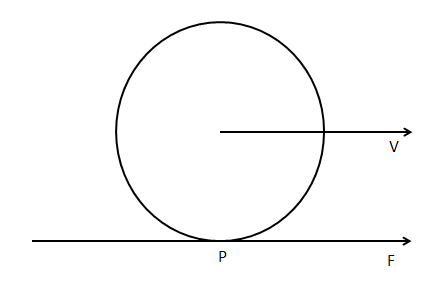
When a wheel rolls on a level road, the direction of frictional force at the point of contact of wheel and ground is:

Detailed Solution: Question 6
Frictional force is the opposing force which plays between two surfaces and it destroys the relative motion between them. Frictional force is a non-conservative force. The force produced by two surfaces that contact and slide against each other, that force is called the frictional force. These forces are affected by the nature of the surface and amount of force acting on them.

In case of a bicycle, the front wheel of the bicycle is connected to a rod passing through its centre. The force acting on the wheel about its central axis by the force coming from the rest of the bicycle is zero. Front wheel obtains linear velocity by pedalling but it cannot rotate it.

Wheel or ball can also be rolled by pushing on it. The frictional force prevents the wheel from sliding forward at the point of contact. Here, the frictional force prevents the wheel from sliding forward and it is in the opposite direction.

seo images
So, in the case of the wheel, the point P which is in contact with the ground tries to go backward due to rotation. Frictional force will oppose this motion. Hence it will move forward.
Hence the direction of frictional force at the point P of the wheel is in forward direction.
Note: Frictional force opposes the motion. Here static friction holds a wheel or a ball on the surface. Frictional force is equal and opposite in direction to the applied force parallel to the contacting surfaces. The resistance due to the rolling body on a surface is called rolling friction. Torque is a force that acts on a body that is undergoing rotation.

Multiple Choice Questions (MCQs): Friction - Question 7

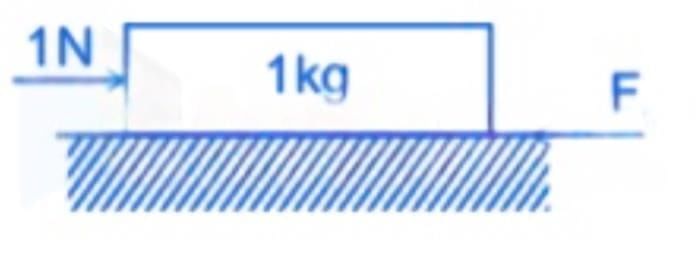
An external force of 1 N is applied on the block of 1 kg as shown in the figure. The magnitude of the friction force Fs is (where, μ = 0.3, g = 10 m/s2):
Detailed Solution: Question 7
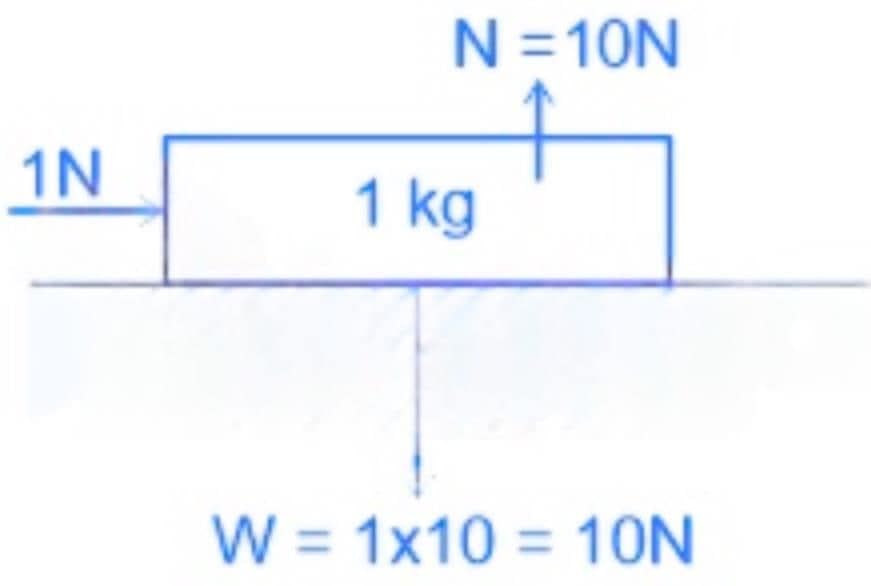
To determine the magnitude of the friction force (Fs) when an external force of 1 N is applied to a 1 kg block, we need to use the formula for frictional force:

Given:

  • μ is the coefficient of friction
  • N is the normal force

Values:

  • μ = 0.3
  • Mass of the block m =1 kg
  • Gravitational acceleration g = 10 m/s2
  • Applied force F = 1 N

First, we calculate the normal force N:

N = m ⋅ g = 1 kg × 10 m/s2= 10 N

Next, we calculate the frictional force Fs​:

F= μ ⋅ N = 0.3 × 10 N = 3 N

Since the frictional force is 3 N, and the applied force is 1 N, the block does not move because the applied force is less than the maximum static friction force.

Hence, the actual friction force will be equal to the applied force (since the block is not moving):

F= 1 N

Multiple Choice Questions (MCQs): Friction - Question 8

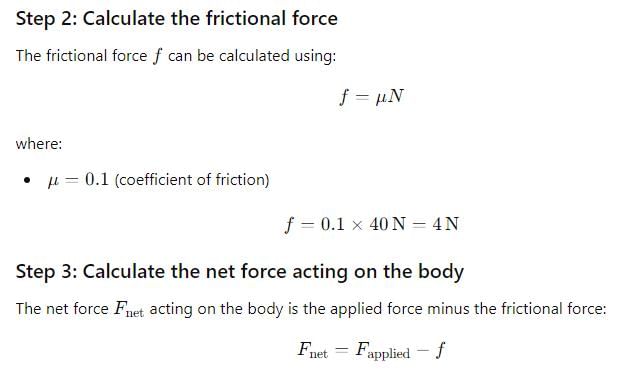
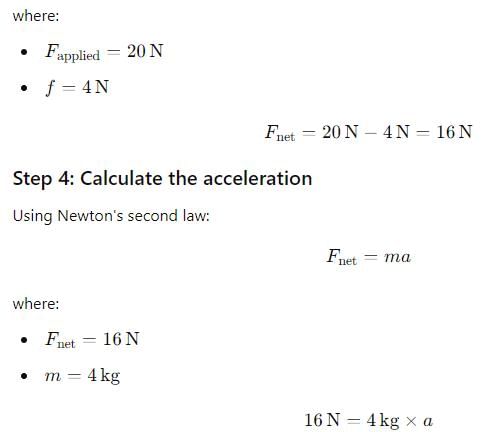
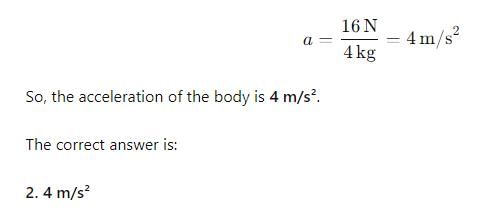
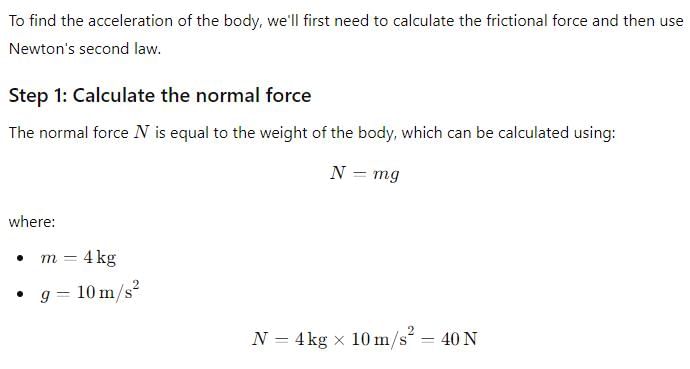
A force of 20 N is applied on a body of mass 4 kg kept on a rough surface having coefficient of friction 0.1. Find acceleration of body. Take g = 10 m/s2

Detailed Solution: Question 8
Multiple Choice Questions (MCQs): Friction - Question 9

Which of the following statement is correct?

Detailed Solution: Question 9

A) Friction and Area of Contact

  • The force of friction does not depend on the area of contact between two surfaces.
  • As long as the normal force (the perpendicular force between the surfaces) is constant, friction remains the same regardless of how large or small the contact area is.
  • This is because friction arises from the microscopic interlocking of surface irregularities, not the visible contact area.

Hence, Statement (A) is correct.

B) Friction and Normal Reaction

  • The maximum possible friction (limiting friction) is directly proportional to the normal reaction force (N).
  • The proportionality constant is the coefficient of friction (μ).

Mathematically: F = μ N

  • Thus, the magnitude of limiting friction bears a constant ratio to the normal reaction.

Hence, Statement (B) is correct.

Incorrect Statement

Statement (C) says friction depends on the area of contact, which is false.

Final Answer:

Since both Statement (A) and Statement (B) are correct, the right option is:
Option D: Both (A) and (B).
 

Multiple Choice Questions (MCQs): Friction - Question 10

A block of weight 50 N is resting on a horizontal surface. The coefficient of friction between the block and the surface is 0.4. What is the maximum frictional force before the block starts moving?

Detailed Solution: Question 10

To find the maximum frictional force before the block starts to move, we use the formula:

  • Frictional Force = Coefficient of Friction × Normal Force

In this case:

  • The weight of the block is 50 N, which acts as the normal force.
  • The coefficient of friction is 0.4.

Now we can calculate:

  • Frictional Force = 0.4 × 50 N
  • Frictional Force = 20 N

This means the maximum frictional force before the block begins to move is 20 N.

97 videos|376 docs|98 tests
Information about Multiple Choice Questions (MCQs): Friction Page
In this test you can find the Exam questions for Multiple Choice Questions (MCQs): Friction solved & explained in the simplest way possible. Besides giving Questions and answers for Multiple Choice Questions (MCQs): Friction, EduRev gives you an ample number of Online tests for practice
97 videos|376 docs|98 tests
Download as PDF