Civil Engineering (CE) Exam  >  Civil Engineering (CE) Test  >  APSC AE CE Mock Test Series 2026  >  APSC AE CE Paper 2 Mock Test - 8 - Civil Engineering (CE) MCQ

APSC AE CE Paper 2 Mock Test - 8 Free Online Test 2026


Full Mock Test & Solutions: APSC AE CE Paper 2 Mock Test - 8 (100 Questions)

You can boost your Civil Engineering (CE) 2026 exam preparation with this APSC AE CE Paper 2 Mock Test - 8 (available with detailed solutions).. This mock test has been designed with the analysis of important topics, recent trends of the exam, and previous year questions of the last 3-years. All the questions have been designed to mirror the official pattern of Civil Engineering (CE) 2026 exam, helping you build speed, accuracy as per the actual exam.

Mock Test Highlights:

  • - Format: Multiple Choice Questions (MCQ)
  • - Duration: 120 minutes
  • - Total Questions: 100
  • - Analysis: Detailed Solutions & Performance Insights

Sign up on EduRev for free and get access to these mock tests, get your All India Rank, and identify your weak areas to improve your marks & rank in the actual exam.

APSC AE CE Paper 2 Mock Test - 8 - Question 1

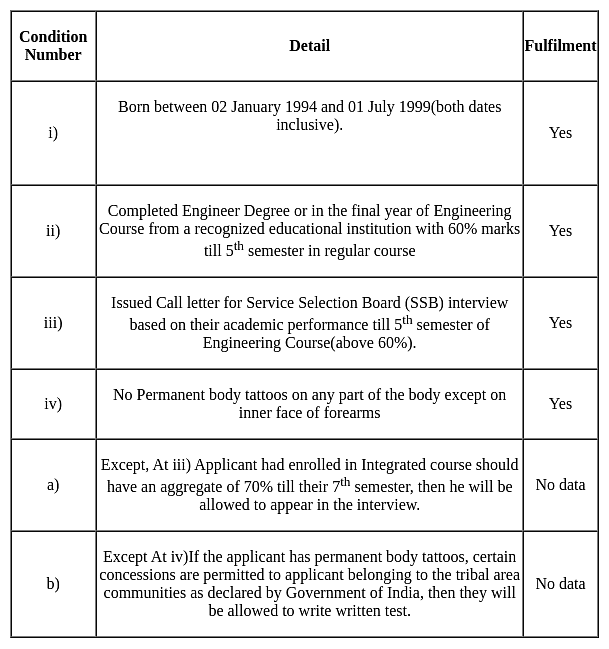
Jatin, born on 05 January 1998, is in final year of Engineering of an Integrated course, with an aggregate of 75% till his 7th semester, he does not have any permanent body tattoos.
Detailed Solution: Question 1

Hence. the person will be allowed to appear in the interview.

APSC AE CE Paper 2 Mock Test - 8 - Question 2

Direction: Choose the option closest in meaning to the OPPOSITE of the word given in capitals.

ENDOW

Detailed Solution: Question 2

Endow is to provide with something desirable.

APSC AE CE Paper 2 Mock Test - 8 - Question 3

Shivaji sacked Surat again in 1670. After  this he also raided the Mughal provinces of Berar, Baglana and Khandesh. What factor helped Shivaji?

Detailed Solution: Question 3

Factors that helped Shivaji in his raids:
1. The gradual decline of the Portuguese power on the western coast:
- The Portuguese had been a dominant force on the western coast, but their power was gradually declining during Shivaji's time.
- This decline weakened their ability to resist Shivaji's raids and allowed him to exploit their weak defenses.
2. The able assistance of Bijapur and Golcunda:
- Shivaji received support from the Sultanates of Bijapur and Golcunda in his raids.
- These Sultanates were rivals of the Mughals and saw Shivaji as a valuable ally against the Mughal Empire.
- Their assistance provided Shivaji with additional resources and manpower, increasing his chances of success in his raids.
3. Mughal preoccupation with the Afghan uprising in the northwest:
- The Mughal Empire was facing a significant challenge in the form of an Afghan uprising in the northwest region.
- This preoccupation with internal conflicts diverted their attention and resources away from dealing with Shivaji's raids.
- Shivaji took advantage of this situation and launched his attacks on the Mughal provinces of Berar, Baglana, and Khandesh.
4. None of these:
- This option is incorrect as there were clear factors that helped Shivaji in his raids, as mentioned above.
In conclusion, the factors that helped Shivaji in his raids include the decline of Portuguese power, assistance from Bijapur and Golcunda, and the Mughal Empire's preoccupation with the Afghan uprising. These factors created favorable conditions for Shivaji to successfully carry out his raids.

APSC AE CE Paper 2 Mock Test - 8 - Question 4

Mataberi Pera & Pachra, recently got a GI tag, belongs to which state?

Detailed Solution: Question 4

Traditional products from Tripura, Matabari Pera Prasad and Rignai Pachara textiles, have recently earned Geographical Indication (GI) tags, bringing the state’s total to 4 GI protected products. Matabari Pera Prasad, a sweet from Tripureswari temple, is made from milk and sugar. Rignai Pachara textiles, traditional hand-woven attire, symbolize Tripura’s cultural heritage. These products’ GI recognition highlights their significance and authenticity, attracting global attention and marketing opportunities.

APSC AE CE Paper 2 Mock Test - 8 - Question 5

TORTURE

Detailed Solution: Question 5

Torment : severe physical or mental suffering.
Chastisement : to criticize someone severely.
Harassment : aggressive pressure or intimidation.
Terror : extreme fear.
Torture : the action or practice of inflicting severe pain on someone as a punishment or in order to force them to do or say something.
Synonym of Torture is Torment
 

APSC AE CE Paper 2 Mock Test - 8 - Question 6

Direction: Choose the option closest in meaning to the OPPOSITE of the word given in capitals.

OSSIFIED

Detailed Solution: Question 6

To ossify is to harden or become inflexible, hence adaptable is an antonym.

APSC AE CE Paper 2 Mock Test - 8 - Question 7

Where does the Indian government plan to establish 'Bharat Park,' a dedicated trade zone for showcasing and storing Indian goods for a global audience?

Detailed Solution: Question 7

The Indian government aims to set up 'Bharat Park,' a trade zone in the UAE, with showrooms and warehouses to display and store Indian-made goods, facilitating international transactions and showcasing products globally.

APSC AE CE Paper 2 Mock Test - 8 - Question 8

If in a certain code language, 'four' is called 'five', 'five' is called 'six', 'six' is called 'seven', 'seven' is called 'eight', 'eight' is called 'nine' and 'nine' is called 'ten'. Then what is cube of the number 2?

Detailed Solution: Question 8

According to the given information:


So, the cube of the number 2 is 8.

But in the statement, 'eight' is called 'nine'.

Hence, the correct answer is "Nine".

APSC AE CE Paper 2 Mock Test - 8 - Question 9

No word must ever leak out about this plan! It has to be a clandestine operation in order to succeed. Which word is a synonym of "clandestine"?

Detailed Solution: Question 9

Clandestine means kept secret or done secretively, especially because illicit

The clandestine meeting took place in his house in the dead of night
The retailers also engaged in clandestine hoarding of pulses to artificially increase its price

APSC AE CE Paper 2 Mock Test - 8 - Question 10

Constituencies called ‘wards’ are made for the election to

Detailed Solution: Question 10

Constituencies called 'wards' are made for the election to:
- Panchayats and municipal bodies: Wards are constituencies that are created for the purpose of electing representatives to the Panchayats and municipal bodies. These local governing bodies play a crucial role in the administration and development of rural and urban areas, respectively.
- Parliament: Constituencies for the election to the Parliament are not called 'wards'. Instead, they are known as parliamentary constituencies.
- State Legislative Assembly: Similarly, constituencies for the election to the State Legislative Assembly are not referred to as 'wards'. They are known as assembly constituencies.
- State Legislative Council: Constituencies for the State Legislative Council, which is the upper house of the State Legislature, are also not called 'wards'. They are known as council constituencies.
Therefore, the correct answer is option D: Panchayats and municipal bodies. Wards are constituencies specifically created for the election of representatives to local governing bodies.

APSC AE CE Paper 2 Mock Test - 8 - Question 11

When is World Poetry Day celebrated?

Detailed Solution: Question 11

World Poetry Day is celebrated on March 21 every year. This day is significant as it honours the role of poetry in cultural and linguistic expression. It was adopted by UNESCO in 1999 to promote linguistic diversity, revive poetry traditions, and increase awareness and understanding of endangered languages. The theme for World Poetry Day 2024 is "Standing on the Shoulders of Giants," highlighting the influence and inspiration that past poets have on contemporary poetry.

APSC AE CE Paper 2 Mock Test - 8 - Question 12

Indifference curve represents?

Detailed Solution: Question 12

An indifference curve is a graph showing combination of two goods that give the consumer equal satisfaction and utility. Each point on an indifference curve indicates that a consumer is indifferent between the two and all points give him the same utility.

APSC AE CE Paper 2 Mock Test - 8 - Question 13

If A is the father of B and B is the father of C, then how is C related to A?

Detailed Solution: Question 13

By using the symbols in the table given below, we can draw the following family tree:

Clearly, C is the grandchild of A.

Hence, ‘Grandchild’ is the correct answer.

APSC AE CE Paper 2 Mock Test - 8 - Question 14

The information that Ashoka had large number of brothers, and he was guilty of murdering them, is primarily found in

Detailed Solution: Question 14

Buddhist accounts

  • According to Buddhist accounts, Ashoka had a large number of brothers.

  • It is believed that Ashoka was responsible for murdering his brothers to secure his claim to the throne.

  • These accounts provide insights into the violent and ruthless nature of Ashoka before his conversion to Buddhism.


The inscription

  • Some inscriptions found from the time of Ashoka also mention his brothers and the violence that occurred within the royal family.

  • These inscriptions corroborate the accounts found in Buddhist texts.

  • They provide historical evidence of the events surrounding Ashoka and his rise to power.


The Ceylonese chronicles

  • The Ceylonese chronicles, such as the Mahavamsa, also mention the violent acts committed by Ashoka, including the murder of his brothers.

  • These chronicles provide another source of information regarding Ashoka's early life and the struggles for power within the Mauryan dynasty.

  • They offer a different perspective on the events compared to Buddhist accounts and inscriptions.


Foreign accounts

  • There are also foreign accounts, such as Greek and Roman writings, that mention Ashoka and his reign.

  • While these accounts may not specifically focus on the murder of his brothers, they provide additional historical context to the time period.

  • Foreign accounts offer a broader view of Ashoka's rule and how it was perceived by other civilizations.


By examining these different sources, it becomes clear that the information about Ashoka having a large number of brothers and being guilty of murdering them is primarily found in Buddhist accounts, inscriptions, Ceylonese chronicles, and to some extent in foreign accounts. Each of these sources contributes to our understanding of Ashoka's early life and the violent events that shaped his reign.

APSC AE CE Paper 2 Mock Test - 8 - Question 15

The first captain of the National Hockey Team who was also the member of the Constituent Assembly was? 

Detailed Solution: Question 15

Jaipal Singh Munda, born in a tribal Munda family present day jharkhand. He captained the hockey team to clinch gold in the 1928 summer olympics in Amsterdam. As a member of the Constituent Assembly of India, he campaigned for the rights of the whole tribal community.

APSC AE CE Paper 2 Mock Test - 8 - Question 16

Consider the following statements regarding the Harappan Civilization:

  1. The civilization had a sophisticated system of weights and measures based on the multiples of 16.
  2. The script of the Harappan Civilization has been fully deciphered and understood.
  3. More than 1500 Harappan sites have been discovered across the Indian subcontinent.

How many of the statements given above are correct?

Detailed Solution: Question 16

  • Statement 1: Correct. The Harappan Civilization used a sophisticated system of weights and measures, often based on multiples of 16, which indicates their advanced understanding of standardization and trade.
  • Statement 2: Incorrect. The script of the Harappan Civilization remains undeciphered. Despite numerous efforts, the meaning of the symbols is still unknown.
  • Statement 3: Correct. Archaeologists have discovered over 1500 sites associated with the Harappan Civilization across the Indian subcontinent.

Thus, only two statements are correct.

APSC AE CE Paper 2 Mock Test - 8 - Question 17

If (a + b) : (b + c) : (c + a) = 6 : 7 : 8 and a + b + c = 14, then value of b is

Detailed Solution: Question 17

Given:

(a + b) : (b + c) : (c + a) = 6 : 7 : 8

a + b + c = 14

Calculaiton:

(a + b) = 6k

(b + c) = 7k

(c + a) = 8k

⇒ 2(a + b + c) = 21k

⇒ 21k = 2 × 14

⇒ 21k = 28

⇒ k = 4/3

⇒ c + a = 8 × 4/3

⇒ c + a = 32/3

As given,

⇒ b + 32/3 = 14

⇒ 3b + 32 = 42

⇒ 3b = 10

∴ b = 10/3

APSC AE CE Paper 2 Mock Test - 8 - Question 18

Directions: In each of the following questions, a sentence has been given in Active (or Passive) Voice. Out of the four alternatives suggested, select the one that best expresses the same sentence in Passive/ Active Voice.

Do not disturb the patient.

Detailed Solution: Question 18

The original sentence is in the active voice: "Do not disturb the patient."

The best expression of this sentence in the passive voice is: "The patient is not to be disturbed."

Therefore, the correct answer is indeed option B: "The patient is not to be disturbed."

APSC AE CE Paper 2 Mock Test - 8 - Question 19

Direction: Read the following passages carefully and answer the question that follows.
"Cloning is an advanced technological invention for producing a genetic twin of a living thing, an organism that starts life with the same genes as its parents. In mammals, DNA is taken from an adult animal and then it is inserted into an egg cell from another animal. This egg then divides into an embryo. The embryo is then transplanted into a surrogate mother and grown to term. This process has worked in animals like cows, sheep, goats, mice, pigs, rats, cat, monkeys, and horses." The opponents of human cloning say that an embryo at any stage of development is a human life. worthy of protection and any kind of research that entails destroying an embryo is immoral, unethical, no matter how worthy the intent may be. It involves using human beings as means; it turns human life into a commodity and fosters a culture of dehumanization.

Q. Find out the false statement out of the given options.

Detailed Solution: Question 19

In cloning, embryo is transplanted.

APSC AE CE Paper 2 Mock Test - 8 - Question 20

Direction: Read the following passages carefully and answer the question that follows.
"Cloning is an advanced technological invention for producing a genetic twin of a living thing, an organism that starts life with the same genes as its parents. In mammals, DNA is taken from an adult animal and then it is inserted into an egg cell from another animal. This egg then divides into an embryo. The embryo is then transplanted into a surrogate mother and grown to term. This process has worked in animals like cows, sheep, goats, mice, pigs, rats, cat, monkeys, and horses." The opponents of human cloning say that an embryo at any stage of development is a human life. worthy of protection and any kind of research that entails destroying an embryo is immoral, unethical, no matter how worthy the intent may be. It involves using human beings as means; it turns human life into a commodity and fosters a culture of dehumanization.

Q. What does a 'surrogate mother' mean?

Detailed Solution: Question 20

Here the expression surrogate has been used as an adjective meaning replacing someone else (human beings or animals) or used instead of somethings else. In this way option 'd' clears the meaning.

APSC AE CE Paper 2 Mock Test - 8 - Question 21

Which of these is permitted under the Rule of Law?

Detailed Solution: Question 21

Rule of law makes no distinction between any citizen, it gives equal basis to a worker and Prime minister.

APSC AE CE Paper 2 Mock Test - 8 - Question 22

Select the correct statement.

Detailed Solution: Question 22

Effect (impact) of noise pollution:

(1) Effects (side effects) of noise pollution in humans -

  • Hearing loss risk.
  • High blood pressure.
  • Can affect the circadian rhythm (sleep cycle).
  • Irritation.
  • High stress. etc.

(2) Effects (side effects) of noise pollution in animals -

  • Noise pollution increases mortality risk by altering prey–predator behavior (avoidance or detection).
  • Can interfere with navigation.
  • Risk of hearing loss.
  • Unusual behavior. etc.

APSC AE CE Paper 2 Mock Test - 8 - Question 23

Why did India and other small nations need to organise the NAM?

Detailed Solution: Question 23

India and other small nations needed to organise the NAM to prevent their independence from being threatened by the two power blocs of the USA and USSR.

APSC AE CE Paper 2 Mock Test - 8 - Question 24

Directions: Each of the following consists of a question and two statements numbered I and II given below it. You have to decide whether the data provided in the statements are sufficient to answer the question.

Which statement is required to derive the conclusion – ‘Some cycles are not cars’?
Statement I:
All cars are buses. No bus is a train.
Statement II: Some trains are cycles. All cycles are plans.

Detailed Solution: Question 24

Checking Statement I:
Using statement I, we do not get any relation between car and cycle.
Therefore, the conclusion cannot be derived using statement I alone.
Checking Statement II:
Using statement II, we do not get any relation between car and cycle.
Therefore, the conclusion cannot be derived using statement II alone.
Checking both statements I and II:
Using both statements I and II, we get the following diagram:

Since some cycles are trains and no train is buses and all cars are buses, therefore, some cycles are not cars is definitely true.
Since the required conclusion can be derived by using statements I and II together.
Hence, Option D is correct.

APSC AE CE Paper 2 Mock Test - 8 - Question 25

P, Q, R, S and T are sitting in a straight line facing the North. P sits next to S but not to T. Q is sitting next to R, who sits on the extreme left corner. Who sits to the immediate left of S if T does not sit next to Q?

Detailed Solution: Question 25


P sits to the immediate left of S.

Hence, option A is correct.

APSC AE CE Paper 2 Mock Test - 8 - Question 26

Who called the right to constitutional remedies as the heart and soul of the constitution?

Detailed Solution: Question 26

Explanation:
The correct answer is B: B.R. Ambedkar.
- B.R. Ambedkar, also known as Babasaheb Ambedkar, was a prominent Indian jurist, economist, and politician who played a key role in drafting the Indian Constitution.
- He called the right to constitutional remedies as the heart and soul of the constitution.
- The right to constitutional remedies is enshrined in Article 32 of the Indian Constitution. It allows citizens to approach the Supreme Court of India for the enforcement of their fundamental rights.
- Ambedkar believed that without the right to constitutional remedies, the fundamental rights guaranteed by the constitution would be meaningless.
- He emphasized the importance of this right to ensure that individuals could seek justice and protection against any violation of their fundamental rights.
- Ambedkar's vision for the constitution was to provide a strong framework for protecting the rights and interests of all citizens, particularly the marginalized and oppressed sections of society.
In conclusion, B.R. Ambedkar called the right to constitutional remedies as the heart and soul of the constitution due to its vital role in safeguarding fundamental rights and ensuring justice for all citizens.

APSC AE CE Paper 2 Mock Test - 8 - Question 27

Which of the following is the tributary of river Tangri ?

Detailed Solution: Question 27

  • Tangri river is also known as Dangri river has two tributaries namely Balaiali river and Amri river which originates from the foothills of Shivalik mountains near Haryana and Himachal Pradesh border.
  • Tangri river has an entire length of about 70 km after which it discharges into Ghaggar river.

APSC AE CE Paper 2 Mock Test - 8 - Question 28

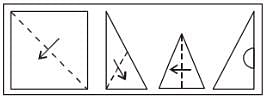
Direction: If a Paper (Transparent Sheet) is folded in a manner and a design or pattern is drawn. When unfolded this paper appears as given below in the answer figure. Choose the correct answer figure given below.

A piece of paper is folded and cut as shown below in the question figures. From the given answer figures, indicate how it will appear when opened.

Question Figure
Answer figure

Detailed Solution: Question 28

APSC AE CE Paper 2 Mock Test - 8 - Question 29

Directions: Given below is a sentence with a blank. From the options below, choose the correct idiom(s) that can fit in the blank to make the sentence grammatically and meaningfully correct.

The concept of global temperature change can be a little hard to _______________.

I. cry over spilt milk
II. give a wide birth
III. get one’s head around

Detailed Solution: Question 29

Get one’s head around: to understand, comprehend, apprehend, grasp, discern, recognize, interpret, get to know, fathom, get to the bottom of, come to terms with. This idiom can fit in the blank as the sentence implies that the concept is a little hard to understand.
Cry over spilt milk: regret of something that you will never be able to change. This idiom does not fit in the blank as there cannot be regret due to a concept.
Give a wide birth: stay away from (someone or something).
Hence, the correct answer is option C. 

APSC AE CE Paper 2 Mock Test - 8 - Question 30

Who was the Portuguse Governor in India to conclude a friendship treaty with Krishnadeva Raya around 1511 A.D.?

Detailed Solution: Question 30

In 1500, a new Portuguese company, Estado Da India was found by few merchants to trade iin India and other Asian countries. This was a private company.
They had set up the trading stations in India for carrying on business. A governor was appointed in the various stations.
Albuquerque (1509-1515) conquered Goa from Bijapur and in 1511 he concluded a friendly treaty with Krishnadeva Raya.

View more questions
20 tests
Information about APSC AE CE Paper 2 Mock Test - 8 Page
In this test you can find the Exam questions for APSC AE CE Paper 2 Mock Test - 8 solved & explained in the simplest way possible. Besides giving Questions and answers for APSC AE CE Paper 2 Mock Test - 8, EduRev gives you an ample number of Online tests for practice
Download as PDF