Electronics and Communication Engineering (ECE) Exam  >  Electronics and Communication Engineering (ECE) Test  >  MPPGCL JE Electronics Mock Test Series 2026  >  MPPGCL JE Electronics Mock Test - 1 - Electronics and Communication Engineering (ECE) MCQ

MPPGCL JE Electronics Mock Test - 1 Free Online Test 2026


Full Mock Test & Solutions: MPPGCL JE Electronics Mock Test - 1 (100 Questions)

You can boost your Electronics and Communication Engineering (ECE) 2026 exam preparation with this MPPGCL JE Electronics Mock Test - 1 (available with detailed solutions).. This mock test has been designed with the analysis of important topics, recent trends of the exam, and previous year questions of the last 3-years. All the questions have been designed to mirror the official pattern of Electronics and Communication Engineering (ECE) 2026 exam, helping you build speed, accuracy as per the actual exam.

Mock Test Highlights:

  • - Format: Multiple Choice Questions (MCQ)
  • - Duration: 120 minutes
  • - Total Questions: 100
  • - Analysis: Detailed Solutions & Performance Insights
  • - Sections covered: Electronics, General Awareness and Aptitude

Sign up on EduRev for free and get access to these mock tests, get your All India Rank, and identify your weak areas to improve your marks & rank in the actual exam.

MPPGCL JE Electronics Mock Test - 1 - Question 1

The attenuation constant of a medium is 400/m. Find the skin depth in the medium.

Detailed Solution: Question 1

CONCEPT:

  • The skin effect is the tendency of an alternating electric current to become distributed within a conductor such that the current density is largest near the surface of the conductor and decreases with greater depths in the conductor.
  • The electric current flows mainly at the skin of the conductor, between the outer surface and a level called the skin depth.
  • Skin depth is defined as the reciprocal of attenuation constant i.e.,

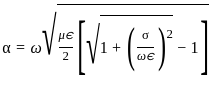
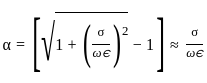
  • The attenuation constant is given by:

  • For an ideal conductor with σ ≈ ∞,

CALCULATION:

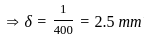
Given α = 400 /m

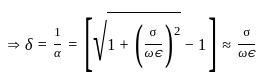
Skin depth is defined as the reciprocal of attenuation constant i.e.,

Important Point

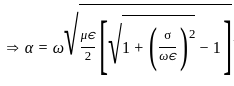
α is the attenuation constant given by:

ω = Operating frequency

μ = Permeability of the material

σ = Conductivity of the material

For a good conductor σ >> 1. The above expression for the attenuation constant can be approximated as:

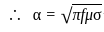
∴ The attenuation constant becomes:

Thus, the skin depth becomes:

Note: The skin depth is inversely proportional to the square root of frequency.

MPPGCL JE Electronics Mock Test - 1 - Question 2

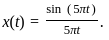
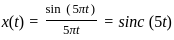
Consider the signal The energy of the signal is

Detailed Solution: Question 2

Concept:

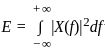
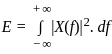
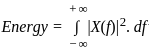
The Energy of a signal is given by:

E = ∫x2(t) dt

In the ‘frequency domain’, the Energy is given by:

Calculation:

Given signal:

.

Now, Since the Energy of sinc function is easier to calculate in the frequency domain.

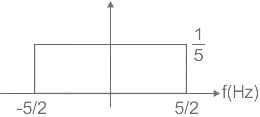
The Fourier Transform of sinc (5t) is represented as:

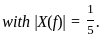
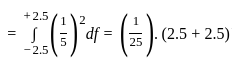
i.e

Energy = 1/5

MPPGCL JE Electronics Mock Test - 1 - Question 3

In a 8085 microprocessor system with memory mapped I/O

Detailed Solution: Question 3
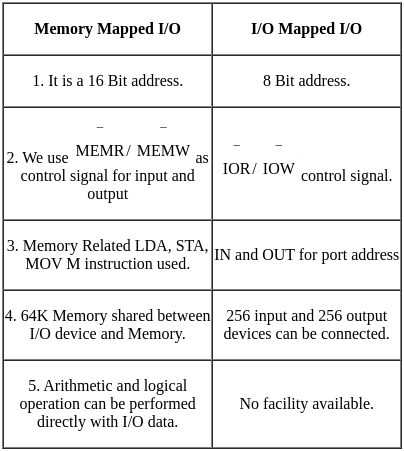
I/O Mapped I/O Interfacing:

A kind of interfacing in which we assign an 8-bit address value to the input/output devices which can be accessed using IN and OUT instruction is called I/O Mapped I/O Interfacing.

Memory-mapped I/O-

It uses the same address space to address both memory and I/O devices.

The memory and registers of the I/O devices are mapped to (associated with) address values.

So when an address is accessed by the CPU, it may refer to a portion of physical RAM, or it can instead refer to memory of the I/O device.

Important Points

Differences between Memory Mapped I/O and I/O Mapped I/O-

MPPGCL JE Electronics Mock Test - 1 - Question 4

Shifting the register content to left by two bits can be used to implement

Detailed Solution: Question 4

1) Shift registers are sequential circuits that are used for storage or for the transfer of binary data.

2) The shift register takes the data present on the input and "shifts" it to the output once every clock cycle.

3) Every shift in the register content to the right by one-bit position is equivalent to dividing the original number by two 

4) Every shift in the register content to the left by one-bit position is equivalent to multiplying the original number by two.

This is explained with the help of the following Example:

Example:

Let the original content of a 4-bit right shift register is 0100 which is 4 in decimal, i.e.

(0100)2 = (4)10

1). Shifting the content of the register to the left by two-bit position, the new content now becomes (10000)2, which is 16 in decimal, i.e.

(10000)2 = (16)10

Clearly, the original number is multiplied by 4.

2). Shifting the content of the register to the right by one-bit position, the new content now becomes (0010)2, which is 2 in decimal, i.e.

(0010)2 = (2)10

Clearly, the original number is divided by 2.

MPPGCL JE Electronics Mock Test - 1 - Question 5

If α = 0.98, Ico = 6 μA, & IB = 100 μA for a transistor, then the value of IC will be

Detailed Solution: Question 5
Concept:

For a BJT expression for collector current (Ic) is defined as-

IC = β IB + (1 + β) Ico

Where β = large signal current gain in CE mode of operation

IC = collector current

Ico = collector current when emitter is open

IB = Base current

α = large signal current gain in CB mode of operation

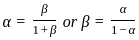
Relation between α and β:

Calculation:

Given data: α = 0.98

Ico = 6 μA

IB = 100 μA

Ic = β IB + (1 + β) Ico

Ic = 49 × 100 + (49 + 1) 6 μA

Ic = 5200 μA

[ ∵ 1 μA = 10-6 A

1 mA = 10-3 A

1 mA = 103 μA ]

Ic = 5.2 mA

MPPGCL JE Electronics Mock Test - 1 - Question 6

Fourier series of an odd periodic function contains only 

Detailed Solution: Question 6
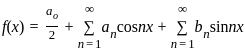
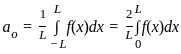
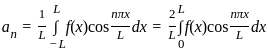
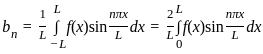
Fourier series:

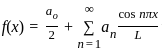
The Fourier series for the function f(x) in the interval α < x < α + 2π is given by

where

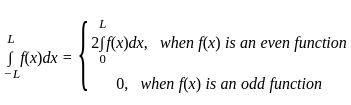
An even function is any function f such that f(-x) = f(x)

Example: cos x, sec x, x2, x4, x6 …….., x-2, x-4 ……..

An odd function is any function f such that f(-x) = -f(x)

Example: sin x, tan x, cosec x, cot x, n, x……., x-1, x-3 ……..

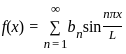
When f is an even periodic function of period 2L, then its Fourier series contains only cosine (include possibly, the constant term) terms.

When f is an odd periodic function of period 2L, then its Fourier series contains only sine terms.

  • Based on the symmetry of the periodic signal given we can conclude the Fourier series coefficients and the type of harmonics that are present in the signal given.
  • With the Fourier series, the non-sinusoidal periodic waveform can be converted into the sinusoidal wave.

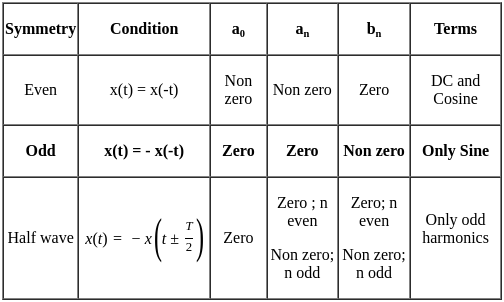
The below table shows the type of Fourier coefficient terms corresponding to the symmetry.

MPPGCL JE Electronics Mock Test - 1 - Question 7

What is the maximum data rate that can be transmitted using a QPSK modulation with a roll-off factor of 0.2 for a 36 MHz transponder?

Detailed Solution: Question 7
Concept:

QPSK is a modulation scheme that allows one symbol to transfer two bits of data. There are four possible two-bit numbers (00, 01, 10, 11).

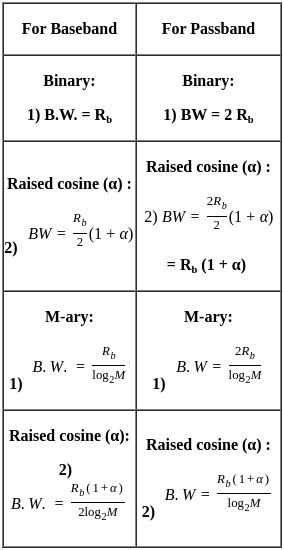
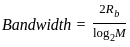
For bandpass transmission,

Bandwidth for M-ary PSK  

Given:

BW = 36 × 106 Hz

Roll-off factor = 0.2

Calculation:

Bandwidth for QPSK  

2 × 36 × 106 = 1.2 Rb

Rb = 72/1.2 Mbps 

= 60 Mbps

Important Point

MPPGCL JE Electronics Mock Test - 1 - Question 8

In a frequency modulated (FM) system, when the audio frequency is 500 Hz and the audio frequency voltage is 2.4 V, the frequency deviation δ is 4.8 kHz. If the audio frequency voltage is now increased to 7.2 V then what is the new value of deviation?

Detailed Solution: Question 8

Concept:

For an FM system, the frequency modulation is given as:

δ = Am kf

Am = Maximum amplitude of the modulating signal

kf = Frequency sensitivity of the FM modulator.

Note: We observe that the frequency deviation in independent of the frequency of the modulating signal.

Calculation:

For Am = 2.4 V, δ = 4.8 kHz, i.e.

4.8k = kf × 2.4

∴ For Am = 7.2 V, the dideviation will be:

δ = kf × 7.2

δ = 14.4 kHz

Important Point

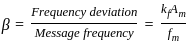
Modulation Index (β) in FM is given by:

kf = frequency sensitivity

Am = modulating voltage

MPPGCL JE Electronics Mock Test - 1 - Question 9

Which of the following is NOT a cursor control devices used in CAD systems

Detailed Solution: Question 9

Explanation:

CAD/CAM

  • CAD stands for Computer-Aided Design whereas CAM is the abbreviation for Computer-Aided Manufacturing.
  • CAD/CAM applications are used to both design a product and programme manufacturing processes, specifically, CNC machining.
  • CAD and CAM can be set up to create a direct link between the design and manufacture of a product. The drawing geometry is then used in the CAM program to generate instructions for the CNC machine tools employing stamping, cutting, burning, bending and other types of operations.

Hardware devices which are used in CAD/CAM application:

Cursor control devices:

  • Absolute touchpad
  • Thumbwheels
  • Mouse
  • Trackball
  • Light pen
  • Relative touchpad
  • Displacement joystick
  • Force joystick

MPPGCL JE Electronics Mock Test - 1 - Question 10

In the given circuit, if R1 = R2 = R = 1 Ω and I1 = I2 = 1 A. Then current through Resistor R is:
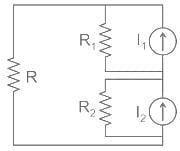
Detailed Solution: Question 10
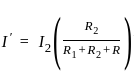
Applying the superposition theorem

Replace I1 by open circuit

(R1 + R) is in parallel with R2

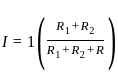
From current division

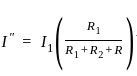
Replace I2 by open circuit

(R2 + R) is in parallel with R1

From current division

I1 = I2 = 1 A

Total current

Substituting the values

MPPGCL JE Electronics Mock Test - 1 - Question 11

Tuning of VCO frequency with the input frequency by the loop in Phase locked loop is known as:

Detailed Solution: Question 11

  • The VCO center frequency ω0 differs from the frequency ωi of the input signal
  • Therefore, first the VCO frequency has to be tuned to the input frequency by the loop
  • This process is called frequency pull-in
  • Then the VCO phase has to be adjusted according to the input phase
  • This process is known as phase lock-in

MPPGCL JE Electronics Mock Test - 1 - Question 12

In an n-MOS transistor, when Vgs = 0, and to cause the existing channel to cease to exist, a negative voltage Vtd (threshold Voltage) must be applied between gate and source. The transistor operates in:

Detailed Solution: Question 12
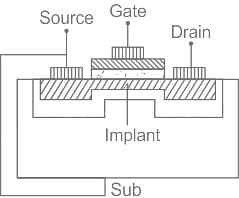
Depletion Mode n-MOS transistors have an n channel and are built on a p-type silicon substrate, whereas p-MOS Depletion mode transistors are built on an n-type substrate.

A thin gate oxide is present between the source and the drain regions.

  • In Depletion Mode, the channel is already established due to the implant, even when Vgs = 0 V.
  • A negative voltage (Vtd) must be applied between the gate and the source for n-MOS to remove the channel.
  • Similarly, a positive voltage (Vtd) between the Source and Drain is required to remove the channel for P-MOS Depletion mode.

Important Points

Entrancement Mode Transistor Action:

In enhancement mode MOSFET, to establish a channel, a minimum voltage level called the threshold voltage (Vt) must be applied between the Gate and the source.

  • When Vgs > Vt and Vds = 0, it operates in the cut-off region. Channel is formed but not no current flows between the drain and source.
  • For Vgs > Vt , Vds < Vgs < Vgs - Vt,  it operates in the linear region.
  • When Vds is increased, the drain side becomes more reverse-biased and the channel starts to pinch.
  • For Vgs > Vt, Vds > Vgs - Vt, it operates in the saturation region and if Vds is increased more and more, the increased voltage gets dropped in the depletion region, loading to const current.

MPPGCL JE Electronics Mock Test - 1 - Question 13

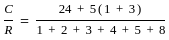
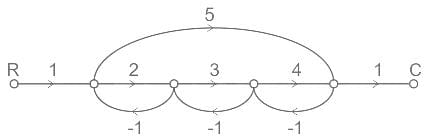
In the signal flow graph of figure given below, the gain C/R will be
Detailed Solution: Question 13
Concept:

Mason’s Gain Formula

  • It is a technique used for finding the transfer function of a control system. A formula that determines the transfer function of a linear system by making use of the signal flow graph is known as Mason’s Gain Formula.
  • It shows its significance in determining the relationship between input and output.

Suppose there are ‘N’ forward paths in a signal flow graph. The gain between the input and the output nodes of a signal flow graph is nothing but the transfer function of the system. It can be calculated by using Mason’s gain formula.

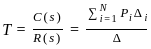
Mason’s gain formula is

Where,

C(s) is the output node

R(s) is the input node

T is the transfer function or gain between R(s) and C(s)

Pi is the ith forward path gain

Δ = 1−(sum of all individual loop gains) + (sum of gain products of all possible two non-touching loops) − (sum of gain products of all possible three non-touching loops) + ........

Δi is obtained from Δ by removing the loops which are touching the ith forward path.

Calculations:

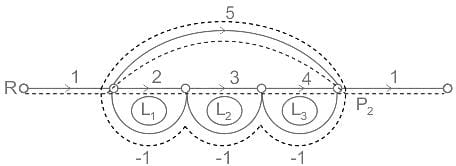
The forward paths are as follows:

P1 = 5

P2 = 2 × 3 × 4 = 24

The loops are as follows:

L1 = -2, L2 = -3, L3 = -4, L4 = -5

The two non-touching loops are:

L1L3 = 8

There is no three non-touching loops

By Mason’s gain formula:-


MPPGCL JE Electronics Mock Test - 1 - Question 14

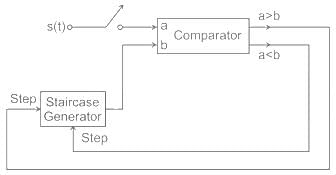
Which of the following PCM schemes is depicted in the below figure?
Detailed Solution: Question 14

Concept:

Adaptive Delta Modulation (ADM):

  • This Modulation is the refined form of delta modulation.
  • This method was introduced to solve the granular noise and slope overload error caused during Delta modulation.
  • In DM the step size is constant and depends on a maximum slope but in ADM the step size is varied according to the slope of the message signal.

Key Points

  • In Adaptive Delta Modulation, the step size of the staircase signal is not fixed and changes depending upon the input signal.
  • Here first the difference between the present sample value and previous approximation is calculated.
  • This error is quantized i.e. if the present sample is smaller than the previous approximation, quantized value is high or else it is low. (This is performed by the comparator)
  • The output of the one-bit quantizer is given to the Logic step size control circuit where the step size is decided.

MPPGCL JE Electronics Mock Test - 1 - Question 15

What will be the decimal equivalent for binary number 11010011?

Detailed Solution: Question 15

Key Points

  • A number with base 2 is known as a Binary Number, and numbers with base 10 are known as Decimal Numbers in the Number System.
  • The decimal numbers are 0, 1, 2, 3, 4, 5, 6, 7, 8, 9, and so on.
  • Binary numbers, on the other hand, are used in digital systems and are represented by just two digits – 0 and 1.

Binary to Decimal Conversion:

Given:

Given binary number = (11010011)2

Calculation:

(11010011)2 = (1 × 27 + 1 × 26 + 0 × 25 + 1 × 24 + 0 × 23 + 0 × 2+ 1 × 2+ 1 × 20)10

⇒ (128 + 64 + 16 + 2 + 1)10

⇒ (211)10

So, the decimal equivalent of the binary number (11010011)2 is (211)10.

∴ The number at the place of the question mark will be 211.

MPPGCL JE Electronics Mock Test - 1 - Question 16

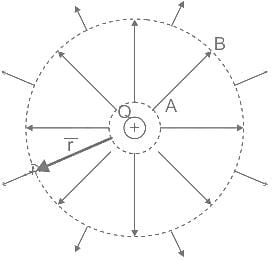
The electric field due to a point charge at distance ‘r’ is 

Detailed Solution: Question 16

The electric field at a distance 'r' due to a point charge is given by:

r = distance from the point charge

r = unit direction vector

This is explained with the help of the following diagram:

As the distance from the point charge decreases the magnitude also decreases.

Important Points:

  • The direction is radial: outward for +|Q| and inward for -|Q|
  • Magnitude: Constant on any spherical shell
  • Flux through any shell enclosing Q is the same: EAAA = EBAB

MPPGCL JE Electronics Mock Test - 1 - Question 17

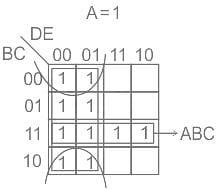
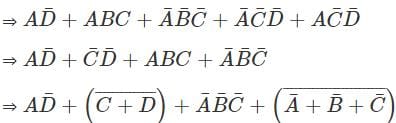
Simplify the below function represented in sum of minterms

F(A, B, C, D, E) = ∑ (0, 1, 2, 3, 8, 9, 16, 17, 20, 21, 24, 25, 28, 29, 30, 31)

Detailed Solution: Question 17
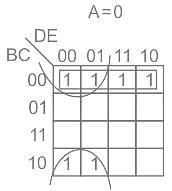
Concept:

The Karnaugh map uses the following rules for the simplification of expressions by grouping together adjacent cells containing ones.

  • Groups must not include any cell containing a zero.
  • Groups may be horizontal or vertical, but not diagonal.
  • Groups must contain 1, 2, 4, 8, or in general 2n cells. That is if n = 1, a group will contain two 1's since 21 = 2, if n = 2, a group will contain four 1's since 22 = 4 and so on.
  • Groups may overlap.
  • Groups may wrap around the table. The leftmost cell in a row may be grouped with the rightmost cell and the top cell in a column may be grouped with the bottom cell.

Calculation:

MPPGCL JE Electronics Mock Test - 1 - Question 18

The GSM system architecture consists of the following major interconnected subsystem(s).

Detailed Solution: Question 18
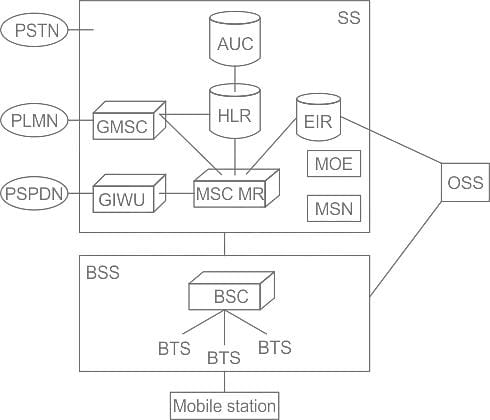
Global System for Mobile communication (GSM), is a globally accepted standard for digital cellular

Communication.

GSM specification defines the functions and interface requirements.

The GSM system is divided into 3-major systems:

  • The switching system (ss)
  • The Base station system (BSS)
  • The operation & support system (OSS)

MPPGCL JE Electronics Mock Test - 1 - Question 19

The total number of complex multiplications required for a 32- point FFT (Fast Fourier Transform) is:

Detailed Solution: Question 19

Concept:

The total number of complex multiplies for an N-point FFT is given by:

Calculation:

Given N = 32

So, for a 32-point FFT, the total number of complex multiplies required will be:

 = 16 × 5 = 80

MPPGCL JE Electronics Mock Test - 1 - Question 20

An IP packet has arrived with the first 8 bits as 0100 0010. Which of the following is correct?

Detailed Solution: Question 20

The correct answer is option 2.

Concept:

Minimum header size of IPv4 = 20-byte

The maximum header size of IPv4 = 60 bytes

The header length field in the IPv4 header is 4 bits.

Maximum possible value (1111) = 15.

Explanation:

The given data,  the first 8 bits is 0100 0010,
The First 4 bits represent version IPV4 (0100).
And another 4 bits represent header length ( bits decimal value x 4) which should range between 20 to 60 bytes. This means that these 4 bits must represent the decimal number between 5 and 15.

Which is 2 × 4 = 8 bytes which is not possible since the minimum header length for IPv4 is 20 bytes.

Here (0010=2)

Here are the last bits of decimal value=2.
Hence Receiver will reject the packet.

Hence the correct answer is The receiver rejects the packet.

MPPGCL JE Electronics Mock Test - 1 - Question 21

Determine the current 'i1' in the circuit of figure shown below -
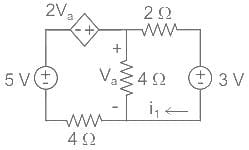
Detailed Solution: Question 21

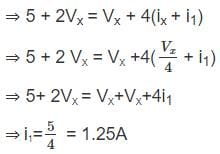
Solution

Given,

Vis the voltage across the 4Ω resistance.

so the current through resistance 4Ω is, ix

using KVL in inner loop 1, we have

Therefore i1 = 1.25A

Hence the correct option is option 4

MPPGCL JE Electronics Mock Test - 1 - Question 22

If the square of sum of three positive consecutive natural numbers exceeds the sum of their corresponding squares by 484 then what is the largest of the three numbers? 

Detailed Solution: Question 22
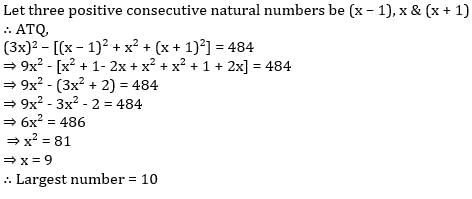
MPPGCL JE Electronics Mock Test - 1 - Question 23

In this questions, a number series is given with one term missing. Choose the correct alternative that will continue the same pattern and fill in the black spaces.

Q. 3, 9, 27, 81, (____)

Detailed Solution: Question 23

1st term = 3 * 1 = 3
2nd term = 3 * 3 = 9
3rd term = 3 * 9 = 27
4th term = 3 * 27 = 81

Thus, Missing number is 5th term = 3 * 81 = 243

MPPGCL JE Electronics Mock Test - 1 - Question 24

Sahibi river originates in which of the following districts?

Detailed Solution: Question 24
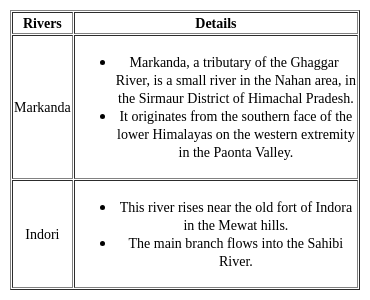
The correct answer is Sikar.

Key Points

  • ​Sahibi river:
    • Place of Origin- Jitgarh and Manoharpur of Sikar district in Rajasthan.
    • Entry in Haryana- Kot Kasin Rewari.
    • Passes through districts- Rewari, Gurugram.
    • Tributaries – Sota, Barkania Nala, Indori Nala
    • Merging or ending - gets absorbed in the Najafgarh lake.

Additional Information

Some of the rivers are:

MPPGCL JE Electronics Mock Test - 1 - Question 25

A man starts running from point P at 11:00 a.m. with a speed of 10 km/hr. He runs for 2 hours and then takes a 1 hour rest. He continues the pattern till he is caught by another man who starts at 2:00 p.m. from point P and runs non-stop at a speed of 15 km/hr towards the first man. At what time (in p.m.) will the first man be caught? 

Detailed Solution: Question 25
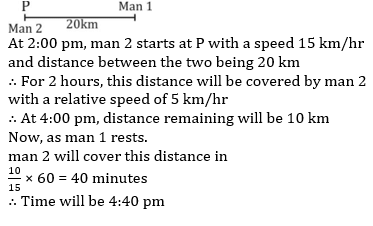
MPPGCL JE Electronics Mock Test - 1 - Question 26

Choose the alternative which is an odd word/number/letter pair out of the given alternatives.

Detailed Solution: Question 26
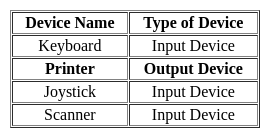

Hence, "Printer" is the correct answer.

Important PointsInput Device: A piece of equipment/hardware that helps us enter data into a computer is called an input device. For example keyboard, mouse, etc. 

1. Keyboard:

  • A simple device comprising keys and each key denotes either an alphabet, number, or number commands which can be given to a computer for various actions to be performed
  • It has a modified version of typewriter keys
  • The keyboard is an essential input device and computers and laptops both use keyboards to give commands to the computer

2. Joy Stick:

  • It is a device that comprises a stick that is attached at an angle to the base so that it can be moved and controlled
  • Mostly used to control the movement in video games
  • Apart from a computer system, a joystick is also used in the cockpit of an aeroplane, wheelchairs, cranes, trucks, etc. to operate them well

3. Scanner:

  • This device can scan images or text and convert it into a digital signal
  • When we place any piece of a document on a scanner, it converts it into a digital signal and displays it on the computer screen

Output Device: A piece of equipment/hardware that gives out the result of the entered input, once it is processed (i.e. converts data from machine language to a human-understandable language), is called an output device. For example printers, monitors, etc. 

Printer:

  • A device that makes a copy of the pictorial or textual content, usually over a paper is called a printer
  • For example, an author types the entire book on his/her computer and later gets a printout of it, which is in the form of paper and is later published
  • Multiple types of printers are also available in the market, which can serve different purposes

MPPGCL JE Electronics Mock Test - 1 - Question 27

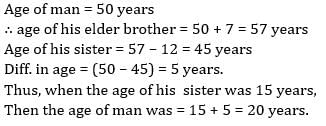
A man is 50 years old. His brother is 7 years older than him and his sister is 12 years younger than his brother. When his sister was 15 years old, then the men’s age was : 

Detailed Solution: Question 27
MPPGCL JE Electronics Mock Test - 1 - Question 28

The combined amount spent on 30 books and 120 notebooks is Rs. 15,000. If the price of each book is Rs. 400, what is the price of each notebook?

Detailed Solution: Question 28


Hence, Option D is correct.

MPPGCL JE Electronics Mock Test - 1 - Question 29

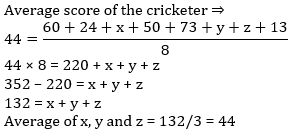
The average score of a cricketer in 8 innings is 44. He had scored 60, 24, x, 50, 73, y, z, 13 respectively in those innings. Find the average of x, y and z? 

Detailed Solution: Question 29
MPPGCL JE Electronics Mock Test - 1 - Question 30

0.002 x 0.5 = ?

Detailed Solution: Question 30

⇒ (2/1000) × (5/10)

⇒ (10/10000)

⇒ (1/1000) = 0.001

∴ 0.002 x 0.5 = 0.001

View more questions
10 tests
Information about MPPGCL JE Electronics Mock Test - 1 Page
In this test you can find the Exam questions for MPPGCL JE Electronics Mock Test - 1 solved & explained in the simplest way possible. Besides giving Questions and answers for MPPGCL JE Electronics Mock Test - 1, EduRev gives you an ample number of Online tests for practice
Download as PDF