Electronics and Communication Engineering (ECE) Exam  >  Electronics and Communication Engineering (ECE) Test  >  MPPGCL JE Electronics Mock Test Series 2026  >  MPPGCL JE Electronics Mock Test - 5 - Electronics and Communication Engineering (ECE) MCQ

MPPGCL JE Electronics Mock Test - 5 Free Online Test 2026


Full Mock Test & Solutions: MPPGCL JE Electronics Mock Test - 5 (100 Questions)

You can boost your Electronics and Communication Engineering (ECE) 2026 exam preparation with this MPPGCL JE Electronics Mock Test - 5 (available with detailed solutions).. This mock test has been designed with the analysis of important topics, recent trends of the exam, and previous year questions of the last 3-years. All the questions have been designed to mirror the official pattern of Electronics and Communication Engineering (ECE) 2026 exam, helping you build speed, accuracy as per the actual exam.

Mock Test Highlights:

  • - Format: Multiple Choice Questions (MCQ)
  • - Duration: 120 minutes
  • - Total Questions: 100
  • - Analysis: Detailed Solutions & Performance Insights
  • - Sections covered: Electronics, General Awareness and Aptitude

Sign up on EduRev for free and get access to these mock tests, get your All India Rank, and identify your weak areas to improve your marks & rank in the actual exam.

MPPGCL JE Electronics Mock Test - 5 - Question 1

For n-channel depletion JFET, the highest trans-conductance gain for a small signal is at

Detailed Solution: Question 1

The current equation for a depletion type JFET is given by:

   ---(1)

IDSS = Saturation Current of the JFET

VGS = Gate to source voltage applied

VP = Pinch off voltage at which ID = IDSS, which is also the voltage at which the channel ceases to exist. It is also denoted by VGS(off).

The transconductance (gm) is defined as the change in ID with respect to a change in the gate to source voltage (VGS), i.e.

Taking the differentiation of Equation (1), we get:

The maximum value of gm occurs when Vgs = 0

With 

gm0 is the maximum transconductance at VGS = 0

The characteristic graph for a change in VGS is as shown:

MPPGCL JE Electronics Mock Test - 5 - Question 2

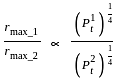
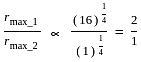
Two radars are transmitting powers P1 and P. If the transmitted power P1 is 16 times the transmitted power P2 and all other parameters are same then ratio of maximum range of radar 1 to radar 2 is:

Detailed Solution: Question 2

The maximum radar range is given by:

Where

Pt is the transmitted power

A0 is capture area

S = effective area

Pmin = minimum power at the receiver which can be recognized

λ = wavelength of EM radiation

MPPGCL JE Electronics Mock Test - 5 - Question 3

If the generator matrix is  then the parity check matrix is:

Detailed Solution: Question 3

Concept:

The generator matrix is of the form G = [I3 PT] and parity check matrix is of the form H = [P I3]

Calculation:

Given:

MPPGCL JE Electronics Mock Test - 5 - Question 4

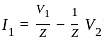
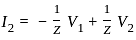
The y-parameters for the network shown in the figure can be represented by

Detailed Solution: Question 4

Concept:

Y parameter:

I1 = V1 Y11 + V2 Y12

I2 = V1 Y21 + V2 Y22

     ...1)

     ...2)

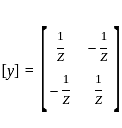
Calculation:

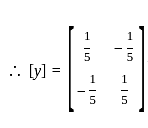
For the given question Z = 5 Ω

MPPGCL JE Electronics Mock Test - 5 - Question 5

In VCO IC 566, the value of charging & discharging is dependent on the voltage applied at ________.

Detailed Solution: Question 5

Voltage Controlled Oscillator (VCO):

  • For a Voltage controlled oscillator generating a sawtooth waveform, the main component is the capacitor that is charging and discharging and is deciding the formation of the output waveform.
  • The voltage is compared with a reference voltage using a comparator.
  • When the capacitor voltage exceeds the reference voltage, the comparator generates a high logic output that triggers the transistor, and the capacitor is connected to the ground and starts discharging. Thus the output waveform generated is the representation of the charging and discharging of the capacitor and the frequency is controlled by the Modulating Input.

  • A practical example of a voltage-controlled oscillator (VCO) is the LM566.
  • The LM566 is a general-purpose VCO that may be used to generate square wave and triangular waveforms as a function input voltage.

Applications:

  • Function generator
  • Tone generator
  • FM modulation
  • Frequency shift keying

MPPGCL JE Electronics Mock Test - 5 - Question 6

Find the final value of the system corresponding to 

Detailed Solution: Question 6

Final value theorem: A final value theorem allows the time domain behavior to be directly calculated by taking a limit of a frequency domain expression

The final value theorem states that the final value of a system can be calculated by:

F(s) is the Laplace transform of the function

For the final value theorem to be applicable system should be stable in steady-state and for that real part of the poles should lie on the left side of s plane.

Calculation:

= 0.6

Important Point

Initial value theorem:

It is applicable only when the number of poles of C(s) is more than the number of zeros of C(s).

MPPGCL JE Electronics Mock Test - 5 - Question 7

Which of the following is not a type of computer organization?

Detailed Solution: Question 7

The correct answer is Queue Organization.

Key Points

  • Computer organization deals with the components of the connections, and behavior of a computer as seen by the user.
  • It deals with low-level design issues. The important components of a computer organization are ALU. CPU, memory organization.
  • There are three types of computer organization based on the address fields: Single Accumulator organization, General register organization, and Stack organization. Hence option 2 is correct.
  • In a Single accumulator organization, the register is used implicitly to process the instructions of a program and store the results in the accumulator.
  • The instruction format used in this organization is one address field and hence the Central Processing Unit (CPU) is called one address machine.
  • In this, the first ALU operand is stored in the accumulator and the other is either in registers or memory.

Additional Information

  • A register is a high-speed temporary storage found in the CPU which speeds up the implementation of programs.
  • In General register organization, multiple general-purpose registers are used instead of a single accumulator.
    • Here the computer uses two or three address fields in their instruction format.
  • The Stack organization is also called Last In First Out (LIFO) which means the last stored element will be retrieved first.
  • The ALU operations are performed on stack data. Both operands are always required on the stack, after the operation, the result is placed in the stack.

MPPGCL JE Electronics Mock Test - 5 - Question 8

What will be the average value of the sawtooth waveform shown below?

Detailed Solution: Question 8

Concept:

Average Value:

The average value can be calculated by dividing the area by time period for one cycle

Rms value:

Vrms = Vm / √3 = 0.577 Vm

Note: The result of RMS value for standard triangular waveform and sawtooth waveform should be remembered as Vm/√3

Application:

Given, 

Peak voltage Vm = 200 V

Time period T = 2 sec

MPPGCL JE Electronics Mock Test - 5 - Question 9

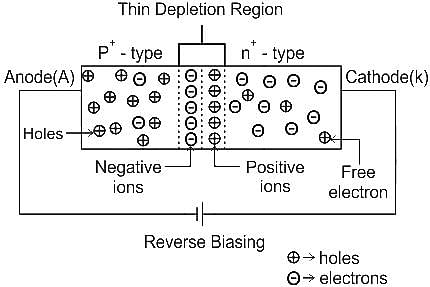
By narrowing the space charge region, the amount of reverse voltage needed to cause zener breakdown:
Detailed Solution: Question 9

Concept 

Zener Diode

  • Zener diodes are specially designed to give accurate and stable reverse breakdown voltage.
  • When it is forward-biased, it behaves like a standard diode.
  • When reverse-biased, a small leakage current flows through it.
  • If the reverse voltage across Zener diode is increased, a value of voltage will be attained at which reverse breakdown occurs.
  • As the breakdown occurs, a sudden increase in current takes place called as Zener Current.
  • Application: Voltage Regulator.

Zener Breakdown:

  • Zener diode is a highly doped PN junction diode, due to which the depletion region between P and N becomes very narrow and the electric field is quite high.
  • The breakdown easily occurs in reverse biased conditions because of the narrow junction in Zener Diode.
  • Even though the electric field is very high, the electrons can tunnel through due narrow depletion region.
  • In case, we narrow the space charge region, It is obvious that with the decreased reverse voltage applied reverse breakdown will occur. 
  • This causes a high reverse current to flow even in the reverse bias. This can be used as a normal PN junction diode in forward bias because the junction is not destroyed.

Fig: Circuit Diagram or Layer Structure of Zener Diode

Additional Information
Difference between Zener and Avalanche Breakdown:

MPPGCL JE Electronics Mock Test - 5 - Question 10

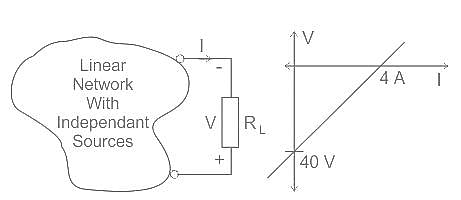
RL given in the below figure is variable resistance, find the maximum power transferred to that resistance. V vs I characteristic is also sown below. 
Detailed Solution: Question 10

The correct answer is 40 W

Concept:

Let's take the given below direction of voltage and current as a reference.

If any direction other than the reference was given, then don't forget to take the negative sign in the final answer.

Solution:

The graph shows that the current is zero, which means an open circuit condition. In this case, V is nothing but the Thevenin voltage across that point.

 Vth = - 40 V

But the given direction is opposite to the reference direction. 

 Vth = - (-40 V) = 40 V

From the graph, as we take output voltage zero means short circuit then short circuit current would be ISC = 4 A

= 10 

According to the maximum power transfer theorem 


= 40 W

MPPGCL JE Electronics Mock Test - 5 - Question 11

Consider the following statements regarding FIR (finite impulse response) digital filters:

1. They have finite memory and therefore, any transient start-up is of limited duration.

2. They are always BIBO stable.

3. The transfer function of an FIR digital filter is a rational function in z-1.

Which of the above statements is/are correct?

Detailed Solution: Question 11

Analyzing each statement in the question:

Statement-1:

  • The term transient response and steady-state response arise naturally in the context of sinewave analysis.
  • When the sinewave is switched on, the filter takes a while to “settle down” to a perfect sinewave at the same frequency.
  • The filter response during this settling period is called the transient response of the filter. The amplitude and phase of the output are determined by the filter’s frequency response.

Now, length N FIR filters only remember N – 1 sample into the past.

Thus, for N filters, the duration of the transient response is N – 1 sample.

Example: Consider a length N = 1 (zero or less) FIR filter (a simple gain) will have no memory state at all. ∴ It is will be in steady-state immediately when the input sinewave is switched on.

A length N = 2 FIR filter reaches steady-state, one sample after the input sinewave is switched on as it has one sample of delay.

∴ We can observe that the transients are depending upon the number of memory elements, i.e. When the number of memory elements is finite, the transient is also of limited duration.

Hence statement 1 is correct.

Statement 2:

The general input-output relation for an FIR filter is given by:

y(n) = bo x(n) + b1 x(n - 1) + …. + bN x(n - N)

x(n) = Input signal

y(n) = Output signal

bi are the filter coefficients

Since bi is finite, so if x(n) is bounded, y(n) is also bounded.

The FIR filter is Bounded Input Bounded Output.

Hence statement 2 is correct.

Statement 3:

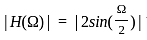
The transfer function of an FIR filter is not a rational function in z-1. It is actually a polynomial function in z-1, i.e. H(z) of FIR filter is:

Hence, Statement 3 is not correct.

MPPGCL JE Electronics Mock Test - 5 - Question 12

What is the Fourier Inverse of ?

Detailed Solution: Question 12

Concept:

If x(t) has Fourier transform X(ω)

Then,

Also, the Fourier transform of a discrete-time signal is 1, i.e.

δ(t) ↔ 1

Calculation:

Since ω = 2πf, the above can be written as:

Taking the inverse Fourier transform of the above, we get:

h(t) = 3δ(t) – 6e-2t 4(t)

MPPGCL JE Electronics Mock Test - 5 - Question 13

The output y(n) of a system T(.) to the input x(n) is given as y(n) = T(x(n)) = x(a0n). Where a0 is a positive integer not equal to 1. This system is

Detailed Solution: Question 13

Concept:

A system is called linear if it satisfies two mathematical properties:

  • Additive 
  • Homogeneity

This is as explained as shown:

To check for time invariance, we first shift the input in time and observe the output.

Next, we shift the original output in time by the same amount. We then compare both the outputs. If they are equal, then the system is time-invariant

Calculation:

Given, a system can be defined as:

Checking for linearity first:


When both the input is simultaneously applied:

Therefore, the system is Linear.

Checking for time invariance now:

Shifting the input by no,

Shifting the original output by the same amount,

i.e. y(n - no) ⇒ x(ao(n - no)) = x(aon - aono)

Clearly, x(aon - aono) ≠ x(aon - no)

The system is time-variant.

MPPGCL JE Electronics Mock Test - 5 - Question 14

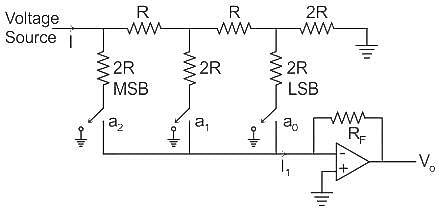
A 4-bit R-2R digital to analog converter (DAC) has a reference of 5 Volts. What is the analog output for input code 1010?

Detailed Solution: Question 14

Concept:

R – 2R ladder DAC:

3 bit R – 2R DAC  by using Inverting op-amp is shown below:

Output voltage is defined as:

V0 = - I1(RF) ⋯ (i)

Current is calculated as:

     ⋯ (ii)

Current drawn from the source is

I = V / R ⋯ (iii)

Current is calculated as:

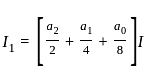
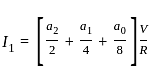
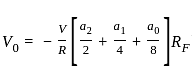
The final output voltage is

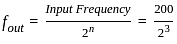
For n bit DAC output voltage is

Calculation:

Given digital input is 1010 and the reference voltage is 5 V

a= 1, a= 0, a= 1, a= 0

considering the value of the feedback resistor for Op amp is R Ω

Output voltage is

V= -3.125 V

MPPGCL JE Electronics Mock Test - 5 - Question 15

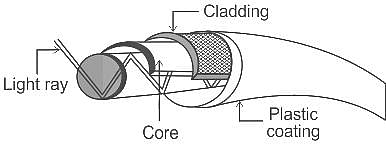
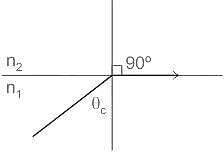
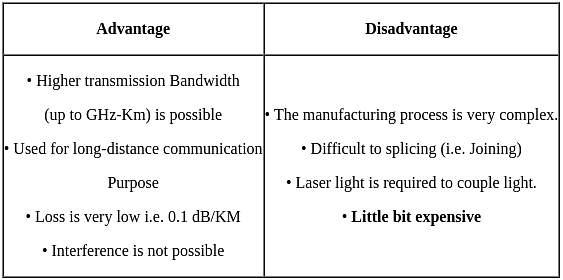
Which of the following is NOT the feature of optical cable?

Detailed Solution: Question 15

Advantages and disadvantages of step-index mono-mode optical fiber.

MPPGCL JE Electronics Mock Test - 5 - Question 16

Which type of waveguide are shown in the figure. 

Detailed Solution: Question 16

A waveguide with conducting ridges protruding into the center of the waveguide from the top wall or bottom wall or both walls, is called as a Ridged Waveguide. 

Single Ridged Waveguides:

A rectangular waveguide with a single protruding ridge from the top or bottom wall is called a Single Ridged Waveguides.

Different types of waveguides are shown in the figure below:

MPPGCL JE Electronics Mock Test - 5 - Question 17

A satellite link uses different frequencies for receiving and transmitting in order to

Detailed Solution: Question 17

In satellite communication, uplink and downlink frequencies are kept different, i.e.

Uplink frequency > Downlink frequency

Explanation:

  • The transmission of a signal from the first earth station to satellite through a channel is called uplink​.
  • The transmission of a signal from the satellite to the second earth station through a channel is called the downlink.
  • Since the satellite cannot afford to deliver high powers because of battery power constraints, the downlink is sent at lower frequencies, while the station at earth can afford to transmit at high frequencies, so it transmits at higher frequencies.
  • This helps in avoiding interference between its powerful transmitted signal and the weak incoming signal.
  • The satellite transponder converts this signal into another frequency and sends it down to the second earth station.
  • This frequency is called Downlink frequency. In a similar way, the second earth station can also communicate with the first one.

The block diagram of the transponder system is as shown:

MPPGCL JE Electronics Mock Test - 5 - Question 18

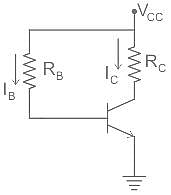
For the base bias circuit, RB = 470 kΩ, RC = 2.2kΩ, and VCC = 18V and the transistor has an hFE of 100. Find VCE.
Detailed Solution: Question 18

Concept:

Fixed bias circuit or Base bias circuit is represented as:

With IC = β IB

VCE = -IC RC + VCC

Calculation:

Given,

RB = 470 kΩ, RC = 2.2 kΩ, and VCC = 18 V

β = hfe = 100

The value of the collector current is:

IC = β Iβ

IC = 3.68 mA

∴ The required value of VCE is:

VCE = VCC - IC RC

VCE = 18 – 3.68 × 2.2

VCE = 9.902 V 

MPPGCL JE Electronics Mock Test - 5 - Question 19

Which of the following is not a standard Baud Rate?

Detailed Solution: Question 19

Baud Rate:

  • The baud rate is the rate at which information is transferred to a communication channel.
  • The baud rate indicates the number of electrical oscillations per second that occurs within a data transmission.
  • Baud rate is commonly used when discussing electronics that use serial communication.
  • The higher the band rate, the more bits per second that are transferred.
  • In the serial part content, ‘9600 band’ means that the serial port is capable of transferring a maximum of 9600 bits per second.
  • At baud rates above 76,800, the cable length will need to be reduced.
  • Higher the baud rate, the mere sensitive the able becomes to the quality of installation, due to how much of the wire is untwisted around each device.
  • Standard baud rates include 100, 300, 600, 1200, 2400, 4800, 9600, 14400, 19200, 38400, 57600, 115200, 128000 and 256000 bits per second.

Note:

  • Bit rate is the transmission of the number of bits per second whereas baud rate is the number of signal units transmitted per second.

MPPGCL JE Electronics Mock Test - 5 - Question 20

Read the following statement:

In a linear network having a number of voltage or current sources and resistances, the current through any branch of the network is the algebraic sum of the currents due to each of the sources when acting independently.

Which theorem does this statement belong to?

Detailed Solution: Question 20

  • The superposition theorem states that "in a linear circuit with several sources, the current and voltage for any element in the circuit is the sum of the currents and voltages produced by each source acting independently."
  • The superposition theorem applies only when all the components of the circuit are linear, which is the case for resistors, capacitors, and inductors it is not applicable to networks containing nonlinear elements.

Important Point

Ohm’s law:

Ohm’s law states that at a constant temperature, the current through a conductor between two points is directly proportional to the voltage across the two points.

Voltage = Current × Resistance

V = I × R

Thevenin Theorem:

Any linear circuit can be replaced by its Thevenin equivalent representation. This is explained with the help of the following circuits:

Vth = Open Circuit Voltage (Thevenin Voltage)

Rth = Thevenin Equivalent Resistance

Various Theorem and the circuits where they are applicable is shown below in the table:

MPPGCL JE Electronics Mock Test - 5 - Question 21

A signal m (t) = 5 cos 2π100t frequency modulates a carrier. The resulting FM signal is 10cos {(2π105t) + 15sin(2π100t)}. The appropriate BW of FM signal would be:

Detailed Solution: Question 21

Concept:

The standard equation of Frequency Modulation(FM) is given as:

where β = modulation index

The Bandwidth of the FM signal is given by

B.W = 2(1 + β) fm

Calculation:

β = 15, fm = 100 Hz,

BW = 2(1 + β)fm

= 2(1 + 15)100 = 3.2 kHz

Important Points

  • In FM transmission, the waveform has infinite sidebands occurring at frequencies fc ± nfm, where n is an integer.
  • Hence theoretical bandwidth requirement is infinite.
  • But, the amplitude (thereby energy content) of the sidebands is influenced by modulation index and frequency deviation. Generally in FM communication, the modulation index is chosen as small values for which the first two sidebands are significant and the rest are ignored.

MPPGCL JE Electronics Mock Test - 5 - Question 22

A student multiplied a number by 4/5 instead of 5/4. What is the percentage error in the calculation?

Detailed Solution: Question 22


Hence, Option B is correct.

MPPGCL JE Electronics Mock Test - 5 - Question 23

Select the odd letter from the given alternatives

Detailed Solution: Question 23

The logic is :

1) BEH

2) KNR

3) GJM

4) TWZ

Hence, 'KNR' is the odd letter.

MPPGCL JE Electronics Mock Test - 5 - Question 24

What is the average of all the composite numbers between 11 and 30?

Detailed Solution: Question 24

Prime numbers between 1 and 30 →13, 17, 19, 23 and 29 (5)
Rest are prime numbers.
Total numbers 12 to 29 = 18
Total composite numbers = 13

Hence, Option A is correct.

MPPGCL JE Electronics Mock Test - 5 - Question 25

Who organised the Non-Aligned Movement?

Detailed Solution: Question 25

Indian Prime Minister Jawaharlal Nehru, together with Egypt and Yugoslavia, organised the Non-Aligned Movement.

MPPGCL JE Electronics Mock Test - 5 - Question 26

What is the government formed by an alliance of two or more political parties called?

Detailed Solution: Question 26

Explanation:- During an election, When no party succeeds in securing a clear cut majority, then two or more parties join their hands (form an alliance) to form the government. This type of government is known as Coalition Government.

MPPGCL JE Electronics Mock Test - 5 - Question 27

The landforms on earth are formed by

Detailed Solution: Question 27

Tectonic plate movement under the Earth can create landforms by pushing up mountains and hills.Erosion by water and wind can wear down land and create landforms like valleys and canyons. Both processes happen over a long period of time, sometimes millions of years.

MPPGCL JE Electronics Mock Test - 5 - Question 28

On which number of term does 78 falls in the A.P. 3, 8, 13, 18, … is 78?

Detailed Solution: Question 28

Given, 3, 8, 13, 18, … is the AP.
a = 3
d = a(2) – a(1) = 8 − 3 = 5
Let a(n) term be 78.
a(n) = a + (n − 1) x d
78 = 3 + (n − 1) x 5
75 = (n − 1) x 5
(n − 1) = 15
n = 16

MPPGCL JE Electronics Mock Test - 5 - Question 29

A tap can fill a tank of 400 liters in 1 hour. In how many hours can the pipe fill a tank of 1800 liters?

Detailed Solution: Question 29


Hence, Option B is correct.

MPPGCL JE Electronics Mock Test - 5 - Question 30

In class 3/7 of the students are girls and rest are boys. If 2/9 of the girls and 1/11 of the boys are absent. What part of the total number of students are present? 

Detailed Solution: Question 30

View more questions
10 tests
Information about MPPGCL JE Electronics Mock Test - 5 Page
In this test you can find the Exam questions for MPPGCL JE Electronics Mock Test - 5 solved & explained in the simplest way possible. Besides giving Questions and answers for MPPGCL JE Electronics Mock Test - 5, EduRev gives you an ample number of Online tests for practice
Download as PDF