JEE Exam  >  JEE Test  >  Chapter-wise Tests Main & Advanced  >  Test: Maxima Minima (Derivative)- 2 - JEE MCQ

Maxima Minima (Derivative)- 2 - Free MCQ Practice Test with solutions,


MCQ Practice Test & Solutions: Test: Maxima Minima (Derivative)- 2 (10 Questions)

You can prepare effectively for JEE Chapter-wise Tests for JEE Main & Advanced with this dedicated MCQ Practice Test (available with solutions) on the important topic of "Test: Maxima Minima (Derivative)- 2". These 10 questions have been designed by the experts with the latest curriculum of JEE 2026, to help you master the concept.

Test Highlights:

  • - Format: Multiple Choice Questions (MCQ)
  • - Duration: 10 minutes
  • - Number of Questions: 10

Sign up on EduRev for free to attempt this test and track your preparation progress.

Test: Maxima Minima (Derivative)- 2 - Question 1

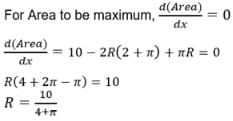
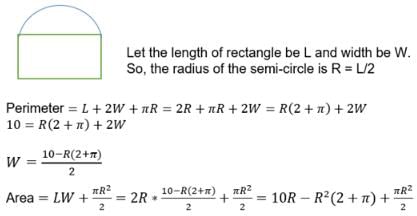
A window is in the form of a rectangle surmounted by a semicircular opening. The total perimeter of the window is 10 m. Find the radius of the semicircular opening of the window to admit maximum light.

Detailed Solution: Question 1
Test: Maxima Minima (Derivative)- 2 - Question 2

The point of local maxima for the function ​f(x) = sinx. cos x is

Detailed Solution: Question 2

f(x) = sinx.cosx
f’(x) = -sin2x + cos2x
-sin2x + cos2x = 0
sin2x = cos2x
tan2x = 1
tanx = +-1
for tan x = 1, x = π/4
for tan x = -1, x = 3π/4
At x = π/4, f(π/4) = ½
At x = 3π/4, f(3π/4) = -½
At π/4 is the local maxima.

Test: Maxima Minima (Derivative)- 2 - Question 3

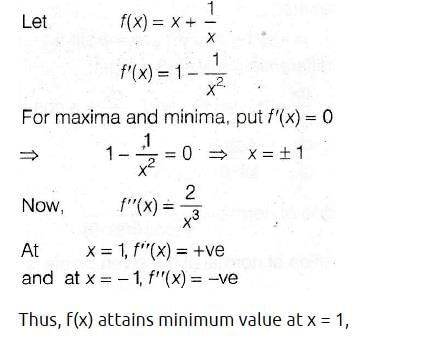
A real number x when added to its reciprocal give minimum value to the sum when x is

Detailed Solution: Question 3
Test: Maxima Minima (Derivative)- 2 - Question 4

The sum of two positive numbers is 20. Find the numbers if their product is maximum

Test: Maxima Minima (Derivative)- 2 - Question 5

The function f(x) = log x

Detailed Solution: Question 5

f(x) = log x
f’(x) = 1/x
Putting f’(x) = 0
1/x = 0
x = ∞ (this is not defined for x)
So, f(x) does not have minima or maxima

Test: Maxima Minima (Derivative)- 2 - Question 6

f(x) = x5 – 5x4 + 5x3 – 1. The local maxima of the function f(x) is at x =

Detailed Solution: Question 6

f(x) = x5 - 5x4 + 5x3 - 1
On differentiating w.r.t.x, we get 
f'(x) = 5x4 - 20x3 + 15x2
For maxima or minima,f'(x) = 0
⇒ 5x4 - 20x3 + 15x2 = 0
⇒ 5x2(x2-4x+3) = 0
⇒ 5x2(x-1)(x-3) = 0
⇒ x = 0,1,3
So, y has maxima at x = 1 and minima at x = 3
At   x = 0, y has neither maxima nor minima, which is the point of inflection .
f(1) = 1-5+5-1=0,which is local maximum value at x = 1. 

Test: Maxima Minima (Derivative)- 2 - Question 7

How many units should be sold so that a company can make maximum profit if the profit function for x units is given by ​p(x) = 25 + 64x - x2

Test: Maxima Minima (Derivative)- 2 - Question 8

Find two numbers whose sum is 24 and product is a large as possible.

Test: Maxima Minima (Derivative)- 2 - Question 9

A point c in the domain of a function f is called a critical point of f if​

Detailed Solution: Question 9

A point C in the domain of a function f at which either f(c) = 0 or f is not differentiable.  
The point f  is called the critical point.
c is called the point of local maxima
If f ′(x) changes sign from positive to negative as x increases through c, that is, if f ′(x) > 0 at every point sufficiently close to and to the left of c, and f ′(x) < 0 at every point sufficiently close to and to the right of c.
c is called the point of local minima
If f ′(x) changes sign from negative to positive as x increases through c, that is, if f ′(x) < 0 at every point sufficiently close to and to the left of c, and f ′(x) > 0 at every point sufficiently close to and to the right of c.
c is called the point of inflexion
If f ′(x) does not change sign as x increases through c, then c is neither a point of local maxima nor a point of local minima.

Test: Maxima Minima (Derivative)- 2 - Question 10

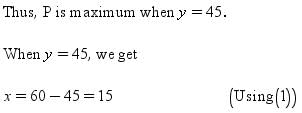
Find two positive numbers x and y such that x + y = 60 and xy3 is maximum

Detailed Solution: Question 10

two positive numbers x and y are such that x + y = 60.
 x + y = 60
⇒ x = 60 – y  ...(1)
Let P = xy3
∴ P =(60 – y)y3 = 60y3 – y4
Differentiating both sides with respect to y, we get

For maximum or minimum dP/dy = 0
⇒ 180y2 - 4y3 = 0
⇒ 4y2 (45 - y) = 0
⇒ y = 0 or 45 - y = 0
⇒ y = 0 or y = 45
⇒ y = 45 (∵ y = 0 is not possible)


Thus, the two positive numbers are 15 and 45.

446 docs|929 tests
Information about Test: Maxima Minima (Derivative)- 2 Page
In this test you can find the Exam questions for Test: Maxima Minima (Derivative)- 2 solved & explained in the simplest way possible. Besides giving Questions and answers for Test: Maxima Minima (Derivative)- 2, EduRev gives you an ample number of Online tests for practice
Download as PDF