Mechanical Engineering Exam  >  Mechanical Engineering Test  >  HPCL Mechanical Engineer Mock Test Series 2026  >  HPCL Mechanical Engineer Mock Test - 10 - Mechanical Engineering MCQ

HPCL Mechanical Engineer Mock Test - 10 Free Online Test 2026


Full Mock Test & Solutions: HPCL Mechanical Engineer Mock Test - 10 (170 Questions)

You can boost your Mechanical Engineering 2026 exam preparation with this HPCL Mechanical Engineer Mock Test - 10 (available with detailed solutions).. This mock test has been designed with the analysis of important topics, recent trends of the exam, and previous year questions of the last 3-years. All the questions have been designed to mirror the official pattern of Mechanical Engineering 2026 exam, helping you build speed, accuracy as per the actual exam.

Mock Test Highlights:

  • - Format: Multiple Choice Questions (MCQ)
  • - Duration: 150 minutes
  • - Total Questions: 170
  • - Analysis: Detailed Solutions & Performance Insights
  • - Sections covered: General Aptitude, Technical Knowledge

Sign up on EduRev for free and get access to these mock tests, get your All India Rank, and identify your weak areas to improve your marks & rank in the actual exam.

HPCL Mechanical Engineer Mock Test - 10 - Question 1

Directions: In the following question, a sentence is given with a blank. You have to fill the blank with one of the words given as options in order to make the sentence contextually and grammatically correct.

Human monkey pox was first identified in 1970 and named after the disease caused by the virus was _______________ in captive monkeys more than a decade before.

Detailed Solution: Question 1

The segment is in passive voice, thus only a verb in third form is eligible for the blank. Among all the given options, only ‘discovered’ fits the blank as the virus already existed in the monkeys but was found in 1970.

Hence, option D is correct.

HPCL Mechanical Engineer Mock Test - 10 - Question 2

Directions: In the following question, a sentence is given with a blank. You have to fill the blank with one of the words given as options in order to make the sentence contextually and grammatically correct.

The recent protests in China happened for a variety of reasons _______________ from unfavourable working conditions to bank failures.

Detailed Solution: Question 2

Let us first learn the meanings of the given words:

Span (verb): extend across.

Extend (verb): cause to cover a wider area or make larger.

Vary (verb): differ in size, amount, degree, or nature from something else of the same general class.

Range (verb): extend between specified limits.

The idea here is to express that there was a huge range of reasons why the protests in China had started. Grammatically only a verb in ‘-ing’ form will fit the blank, this eliminates ‘span’, ‘extended’ and ‘vary’. Now, between ‘scoping’ and ‘ranging’, ‘ranging’ is a better option to be placed before ‘from’.

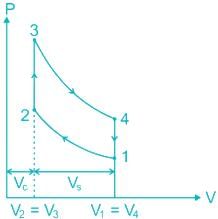
Hence, option d is correct.

HPCL Mechanical Engineer Mock Test - 10 - Question 3

Direction: In the following questions, out of the four alternatives, choose the word opposite in meaning to the given word.

Meticulous

Detailed Solution: Question 3

The word Meticulous (Adjective) means : paying careful attention to every detail; fastidious; thorough.
Careless in option (c) is the correct autonomy. 

HPCL Mechanical Engineer Mock Test - 10 - Question 4

Direction: In this question, you need to replace the underlined part of the sentence with the most suitable idiom / expression given as option.

The press saw the event as a sign of future happening that augured the resumption of diplomatic relations between the two countries.

Detailed Solution: Question 4

Straw in the wind: something believed to be a sign or warning of a future event.
Shot in the arm: something that has a sudden and positive effect on something, providing encouragement and new activity.
Stroke of luck: a fortunate occurrence that could not have been predicted or expected.
Plain sailing: smooth and easy progress in a process or activity.
Hence, the correct answer is option A. 

HPCL Mechanical Engineer Mock Test - 10 - Question 5

The average of 31 numbers is 57. The average of the first 10 numbers is 50 and that of the last 20 numbers is 61. What is the 11th number?

Detailed Solution: Question 5

Last 20 number = 12th to 31st
So remaining is 11th number.
So the answer = 31 × 57 – 10 × 50 – 20 × 61 = 47
Hence, Option D is correct.

HPCL Mechanical Engineer Mock Test - 10 - Question 6

The number  is :-

Detailed Solution: Question 6


HPCL Mechanical Engineer Mock Test - 10 - Question 7

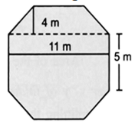
Top surface of a raised platform is in the shape of regular octagon as shown in the figure. Find the area of the octagonal surface.
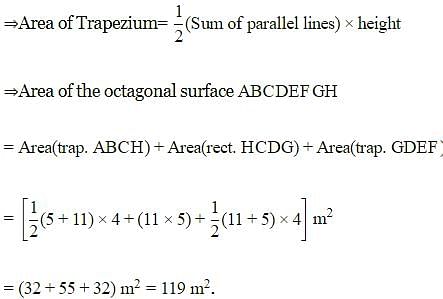
Detailed Solution: Question 7

Visually, the area of the octagonal surface will be the sum of the area of two trapezia and the area of rectangular region.

Area of octagon ABCDEFGH = Area of Trapezium ABCH + Area of rectangle HCDG + Area of trapezium EFGD

Side of the regular octagon = 5 cm

Area of trapezium ABCH = Area of trapezium EFGD

Area of trapezium ABCH = 1/2 × (AB + CH) × AI

= 1/2 × (5 m + 11 m) × 4 m

= 1/2 × 16 m × 4 m

= 32 m2

Area of trapezium ABCH = Area of trapezium EFGD = 32 m2

Area of rectangle HCDG = HC × CD = 11 m × 5 m = 55 m2

Area of ABCDEFGH = Area of trapezium ABCH + Area of rectangle HCDG + Area of trapezium EFGD

= 32 m2+ 55 m2+ 32 m2

= 119 m2

Thus the area of the octagonal surface is 119 m2

HPCL Mechanical Engineer Mock Test - 10 - Question 8

The average number of visitors in a museum on each Sunday is 420 and the average number of visitors in the museum on any other day is 210. What is the average number of per day visitors in the whole month of April, which starts on Saturday?

Detailed Solution: Question 8

Sundays → 2nd, 9th, 16th, 23rd and 30th (5 Sundays)

Hence, Option C is correct.

HPCL Mechanical Engineer Mock Test - 10 - Question 9

The d for the series of numbers -12, –6, 0, 6… is

Detailed Solution: Question 9

–12, –6, 0, 6,…
Let a(1) = -12, a(2) = -6, a(3) = 0, a(4) = 6
First relational d,
a(2) – a(1) = -6 – (-12) = 6
Second relational d,
a(3) – a(2) = 0 – (-6) = 6
Third relational d,
a(4) – a(3) = 6 – (0) = 6
all the d are equals to each other, hence
d = 6.

HPCL Mechanical Engineer Mock Test - 10 - Question 10

If the base of rhombus of 7 cm and its altitude is 4 cm, its area will be    

Detailed Solution: Question 10

Base =  7 cm
Height  = 4 cm
Area of  Rhombus = Base × Height
= 7 × 4
= 28 cm2

HPCL Mechanical Engineer Mock Test - 10 - Question 11

What is the area of the largest circle that can be made inside a rectangle with 50 meters length and 42 meters breadth?
Detailed Solution: Question 11

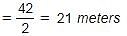
Diameter of the circle = breadth of the rectangle = 42 meters
Radius of the circle

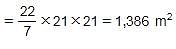
So the answer 

Hence, Option D is correct.

HPCL Mechanical Engineer Mock Test - 10 - Question 12

'Jade' is related to 'Green' in the same way as 'Garnet' is related to:

Detailed Solution: Question 12

'Jade' is a 'green' precious stone in the same way 'Garnet' is a 'red' precious stone.

HPCL Mechanical Engineer Mock Test - 10 - Question 13

A word with letters jumbled has been given. Choose the correct order of letters which are required to form the correct word.

Jumbled word: TESIDNRE

Detailed Solution: Question 13

1) 8, 4, 6, 1, 5, 3, 7, 2 

2) 7, 8, 3, 4, 5, 2, 6, 1

3) 3, 6, 1, 5, 4, 8, 2, 7

4) 7, 3, 6, 1, 5, 8, 4, 2

'RESIDENT' is a meaningful English word.

Hence, '7, 8, 3, 4, 5, 2, 6, 1' is the correct answer.

HPCL Mechanical Engineer Mock Test - 10 - Question 14

Find the number of triangles in the figure.

Detailed Solution: Question 14

The figure shown the no. of triangle is in the diagram so that total no. of triangle is 8 + 8 + 8 + 4 = 28

HPCL Mechanical Engineer Mock Test - 10 - Question 15

​In this questions, a number series is given with one term missing. Choose the correct alternative that will continue the same pattern and fill in the black spaces.

Q. 0.5, 0.55, 0.65, 0.8, (___)

Detailed Solution: Question 15

1st term = 0.5
2nd term = 0.5 + 0.05 = 0.55
3rd term = 0.55 + 0.1 = 0.65
4th term = 0.65 + 0.15 = 0.8

Thus, missing number is 5th term = 0.8 + 0.2 = 1

HPCL Mechanical Engineer Mock Test - 10 - Question 16

Direction: Study the following information carefully and answer the given questions besides.

Some boys are sitting in a row facing the south. Only three boys sit between O and H. Only two boys sit to the left of J. O sits third to the left of M. More than seven boys sit between P and J. V sits fourth to the right of O. Eight boys sit between R and J. More than 12 boys sit between P and H. Only three boys sit between R and M. T sits third to the right of M. P sits fourth to the right of R.
Q. How many boys are sitting between T and J?

Detailed Solution: Question 16

From the common explanation, we can say that there are at least 16 boys sitting in the row.
Hence, Option B is correct.
Final Arrangement:

Common Explanation:
References:

Only two boys sit to the left of J.
Eight boys sit between R and J.
Only three boys sit between R and M.
Inferences:
From the above references, we get two different cases:

References:
P sits fourth to the right of R.
O sits third to the left of M.
Inferences:
So, from this case 2 will be eliminated as P sits fourth to the right of R.

References:
Only three boys sit between O and H.
T sits third to the right of M.
V sits fourth to the right of O.
More than 12 boys sit between P and H.
More than seven boys sit between P and J.
Inferences:
From the above reference, we get the final arrangement:

HPCL Mechanical Engineer Mock Test - 10 - Question 17

'Walk' is related to 'Run' in the same way as 'Breeze' is related to:

Detailed Solution: Question 17

As fast mode of 'Walk' is 'Run' in the same way fast mode of 'Breeze' is 'Wind'.

HPCL Mechanical Engineer Mock Test - 10 - Question 18

In this questions, a number series is given with one term missing. Choose the correct alternative that will continue the same pattern and fill in the black spaces.

Q. 2, 3, 5, 7, 11, (____), 17

Detailed Solution: Question 18

Clearly, the given series consists of prime numbers starting from 2. The prime number after 11 is 13.

Thus, the missing number is 13.

HPCL Mechanical Engineer Mock Test - 10 - Question 19

Which one of the following statements is correct?

Detailed Solution: Question 19

First Law of Thermodynamics:

  • Energy can neither be destroyed nor created when it disappears in one form; it must re-appear at the same time in other forms.

  • When a closed system executes a complete cycle, the sum of heat interactions is equal to the sum of work interactions.

Second Law of Thermodynamics:

It has two statements:

  • Kelvin-Planck Statement: It is impossible to devise a cyclically operating device, the sole effect of which is to absorb energy in the form of heat from a single thermal reservoir and to deliver an equivalent amount of work

  • Clausius Statement: It is impossible to devise a cyclically operating device, the sole effect of which is to transfer energy in the form of heat from a low-temperature body to a high-temperature body

Violation of the Kelvin statement implies a violation of the Clausius statement, i.e., the Clausius statement implies the Kelvin statement.

Similarly, the Kelvin statement implies the Clausius statement, and hence the two are equivalent.

HPCL Mechanical Engineer Mock Test - 10 - Question 20

An involute profile is used in

Detailed Solution: Question 20

The tooth profiles of a pair of mating gears must be made of curves that satisfy the conditions of conjugate action and the law of gearing. Gears are generally made with two curves, either involute or cycloidal tooth profiles.

A cycloid is a curve traced by a point on the circumference of a circle that rolls without slipping on a fixed straight line.

An involute of a circle is a plane curve generated by a point on a tangent, which rolls on the circle without slipping, or by an end on a taut string that is unwrapped from a reel.

HPCL Mechanical Engineer Mock Test - 10 - Question 21

Strain energy stored in a body of volume V subjected to uniform stress σ is:

Detailed Solution: Question 21

When a body is loaded within the elastic limit, it changes its dimensions, and on the removal of the load, it regains its original dimensions. So long as it remains loaded, it has stored energy in itself. On removing the load, the energy stored is given off as in the case of a spring. This energy, which is absorbed in a body when strained within the elastic limit, is known as strain energy.

The strain energy stored in a body due to external loading within the elastic limit is known as resilience. The maximum energy that can be stored in a body up to the elastic limit is called proof resilience.

The proof of resilience per unit volume of a material is known as the modulus of resilience.

Strain energy stored in a body due to tensile or compressive load or resilience:

U = σ2V/2E

Modulus of resilience:

U = σ2/2E

HPCL Mechanical Engineer Mock Test - 10 - Question 22

Work done obtained in a free expansion process is_______.

Detailed Solution: Question 22

For free expansion, work done is zero.

So δW = 0

Also, No heat interaction takes place during free expansion. Hence δQ = 0

From the first law of Thermodynamics

δQ = dU + δW

dU = 0

HPCL Mechanical Engineer Mock Test - 10 - Question 23

The wheels of a moving car possess

Detailed Solution: Question 23

When an object, such as a solid sphere, travels along an axis, that object is usually experiencing both rotational kinetic energy and translation kinetic energy. Therefore the total kinetic energy of the object can be found by summing up the two types of kinetic energy.

HPCL Mechanical Engineer Mock Test - 10 - Question 24

Which clutch can be engaged progressively when one or both the elements are rotating?

Detailed Solution: Question 24

Cone clutch: The cone clutch can be engaged progressively while one or both of the elements are rotating. It can transmit low power.

HPCL Mechanical Engineer Mock Test - 10 - Question 25

The unit of Young’s modulus is the same as

Detailed Solution: Question 25

According to Hooke’s law

Stress-Strain

σ ∝ ϵ

σ = Eϵ

where E is known as Young’s modulus of elasticity.

Since strain (ϵ) is non – dimensional, the unit of E must be the same as those of stress (σ). Thus, E can be expressed in N/mm2, Pa, MPa, GPa, etc.

  • Unit of stress: N/mm2 (MPa)

  • Unit of strain: Dimensionless

  • Unit of Force: N

  • Unit of length: mm

HPCL Mechanical Engineer Mock Test - 10 - Question 26

Hardness of steel depends upon the amount of

Detailed Solution: Question 26

The maximum hardness of a steel is a function of its Carbon content. It increases as the percentage of carbon increases.

Cementite: Cementite or Iron Carbide has the chemical formula Fe3C and contains 6.67% carbon by weight. It is the hardest structure that appears in the iron-carbon equilibrium diagram. Cementite has an orthorhombic crystal structure and is extremely hard and brittle as compared to austenite and ferrite.

Martensite: It is a metastable phase of steel formed by the transformation of austenite below 320°C. Martensite is an interstitial supersaturated solid carbon solution in α – Iron and has a body-centred tetragonal lattice. It has a carbon content of up to 2% and is extremely hard and brittle. It is a product of rapid cooling (quenching) and possesses an acicular or needle-like structure.

The hardness of steel depends upon the amount of cementite. Martensite was obtained after hardening treatment of steel.

Steels with low carbon content do not respond appreciably to hardening treatment because the main constituent is soft ferrite. If hypo-eutectoid steel is cooled rapidly, martensite is formed.

HPCL Mechanical Engineer Mock Test - 10 - Question 27

The volume of air delivered by the compressor is called:

Detailed Solution: Question 27

Concept:

Compressor capacity: It is the quantity of air delivered by a compressor in m3/minute or m3/sec

Compression ratio: It is defined as the ratio of the volume of air before compression to the volume of air after compression. It is the ratio of total volume (V1) to the clearance volume (VC)

In other words, the compression ratio is the volume of air before compression to the volume of air after compression.

Free air delivery (FAD): The delivery volume reduced in the compressor to a pressure of 1 bar and temperature of 15C. The relative volume at that condition is known as Free Air Delivery.

Swept volume (Vs): The volume displaced or swept by the piston when it moves between the top dead center and bottom dead center.

Clearance volume: The difference between the total volume and the swept volume is the gap that remains between the piston head and the cylinder head when at the top dead center.

HPCL Mechanical Engineer Mock Test - 10 - Question 28

Hot coffee stored in a well insulated thermos flask is an example of

Detailed Solution: Question 28

As the hot coffee remains hot for a long time so neither heat nor mass is exchanged with the surroundings and hence it is an example of isolated system.

HPCL Mechanical Engineer Mock Test - 10 - Question 29

The secondary unbalanced force is maximum __________ in one revolution of the crank.

Detailed Solution: Question 29

The secondary unbalanced force is maximum, when θ = 0°, 90°,180° and 360°. Thus, the secondary force is a maximum of four times in one revolution of the crank.

HPCL Mechanical Engineer Mock Test - 10 - Question 30

Hartnell governor could be classified as ________ type governor.

Detailed Solution: Question 30

Governors are classified as:
  • Centrifugal Governor
  • Inertia Governor

Centrifugal Governors are classified as:

Dead Weight Governors:

  • Porter governor
  • Proell governor

Spring controlled governors:

  • Hartnell governor
  • Hartung governor
  • Pickering governor

View more questions
10 tests
Information about HPCL Mechanical Engineer Mock Test - 10 Page
In this test you can find the Exam questions for HPCL Mechanical Engineer Mock Test - 10 solved & explained in the simplest way possible. Besides giving Questions and answers for HPCL Mechanical Engineer Mock Test - 10, EduRev gives you an ample number of Online tests for practice
Download as PDF