
Introduction to Transition Metals - Free MCQ Practice Test with solutions,
MCQ Practice Test & Solutions: Test: Introduction to Transition Metals (15 Questions)
You can prepare effectively for JEE Chemistry for JEE Main & Advanced with this dedicated MCQ Practice Test (available with solutions) on the important topic of "Test: Introduction to Transition Metals". These 15 questions have been designed by the experts with the latest curriculum of JEE 2026, to help you master the concept.
Test Highlights:
- - Format: Multiple Choice Questions (MCQ)
- - Duration: 20 minutes
- - Number of Questions: 15
Sign up on EduRev for free to attempt this test and track your preparation progress.

Outof [TiF6]2−, [CoF6]3−, Cu2Cl2 and [NiCl4]2− (Z of Ti = 22, Co = 27, Cu = 29, Ni = 28), the colourless species are:
Detailed Solution: Question 1
 -orbitals which permits the
  excitation of electrons.
 is in
is in  O.S.
O.S.  -colourless
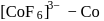 is in
is in  coloured
 is in
is in  O.S.
O.S.  colourless
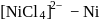 is in
is in  coloured
The basic character of the transition metal monoxides follows the order (Atomic Nos., Ti = 22, V = 23, Cr = 24, Fe = 26)
Detailed Solution: Question 2

Which of the following statement is incorrect?
Detailed Solution: Question 3
On the basis of data given below, 

Which of the following statements is incorrect?
Detailed Solution: Question 4
 is more stable than
  , thus
A metal M and its compound can give the following observable changes in a consequence of reactions
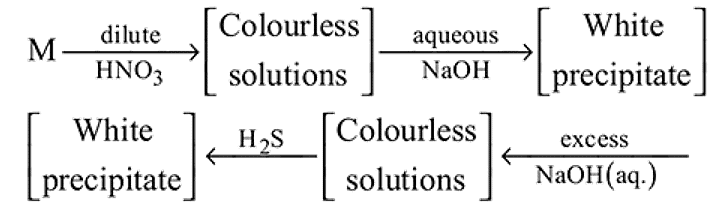
Detailed Solution: Question 5
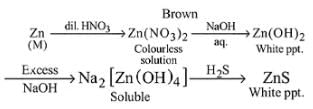
Detailed Solution: Question 6
 is hygroscopic.
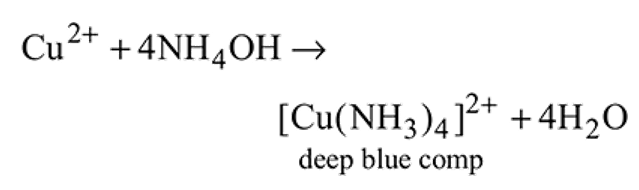
The blue complex formed on addition of conc.  solution to a
  salt solution has the structure?
solution to a salt solution has the structure?Detailed Solution: Question 7
When  is added to oxalic acid, the decolourisation is slow in the beginning but becomes instantaneous after sometime because
Detailed Solution: Question 8
 acts as autocatalyst.
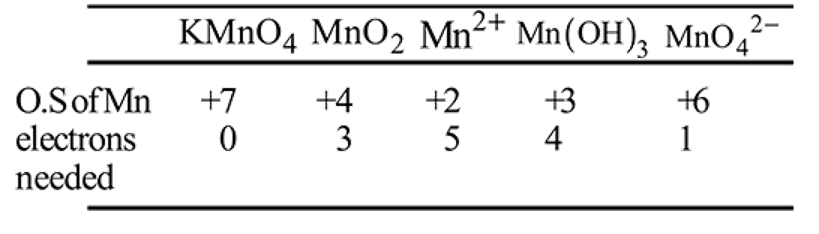
Number of electrons transfered in each case when  acts as an oxidising agent to give
  ,
,  and
and  are respectively
acts as an oxidising agent to give , and are respectivelyDetailed Solution: Question 9
Chloro compound of Vanadium has only spin magnetic moment of  . This Vanadium chloride has the formula:
. This Vanadium chloride has the formula:Detailed Solution: Question 10
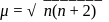

 we find
  No. of unpaired electrons
  hence its configuration will be
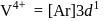
 Its chloride has the formula
Which of the following compounds has colour but no unpaired electrons?
Detailed Solution: Question 11
 is
is  . Being transition metal it has 7 valence electrons and all are involved in bond formation in
  . Hence it has no unpaired electron.
Which element of the  -series has highest third ionisation enthalpy?
Detailed Solution: Question 12

 means removal of electron from the stable configuration of
  .
. . Hence, the correct option is (b).
In which of the tollowing ions, d-d transition is not possible ?
Detailed Solution: Question 13
Whch of the following pairs involves isoelectronic ions
Detailed Solution: Question 14
 and
and  involve isoelectronic ions.
In a reaction the ferrous (Fe+2) ion is oxidised to ferric (Fe+3) ion. The equivalent weight of the ion in the above reaction is equal to
Detailed Solution: Question 15
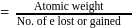

 Equivalent weight
  Atomic weight
332 videos|699 docs|300 tests |
