
F-Block elements - Free MCQ Practice Test with solutions, JEE Chemistry
MCQ Practice Test & Solutions: Test: F-Block elements (15 Questions)
You can prepare effectively for JEE Chemistry for JEE Main & Advanced with this dedicated MCQ Practice Test (available with solutions) on the important topic of "Test: F-Block elements". These 15 questions have been designed by the experts with the latest curriculum of JEE 2026, to help you master the concept.
Test Highlights:
- - Format: Multiple Choice Questions (MCQ)
- - Duration: 20 minutes
- - Number of Questions: 15
Sign up on EduRev for free to attempt this test and track your preparation progress.

Detailed Solution: Question 1

 is less stable than
  and thus it will readily accept
  convert into
  and so it will less basic than
  .
. is most basic among all given options.
Statement I : Many trivalent lanthanide ions are coloured both in solid state and in aqueous solution.
Statement II : Colour of these ions is due to the presence of f-electrons.
Detailed Solution: Question 2

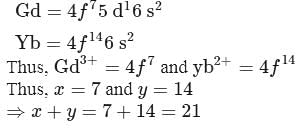
The number f-electrons in +3 oxidation state of gadolinium  is
is  and in +2 oxidation state of Ytterbium
  is
is  . The sum of
  and
and  is
is
is and in +2 oxidation state of Ytterbium is . The sum of and isDetailed Solution: Question 3
 is
isDetailed Solution: Question 4

 No. of unpaired electrons
Which one of the following elements shows maximum number of different oxidation states in its compounds?
Detailed Solution: Question 5
 , oxidation state, while Eu shows oxidation state of
  and
and  . Am shows
  ,
,  and
and  oxidation states. Therefore Americium (Am) has maximum number of oxidation states.
Detailed Solution: Question 6
Which of the following pairs is expected to form colourless compound?
Detailed Solution: Question 7
 is (4f)" while that of
  is
is  . They are expected to be colomicis.
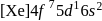
Gadolinium (atomic number = 64) is a member of 4f series. It's electronic configuration in +3 oxidation state is [Xe] 4f7. What is the ground state electronic configuration of gadolinium?
Detailed Solution: Question 8


Which of the following trivalent ion has the largest atomic radii in the lanthanide series
Detailed Solution: Question 9
 block elements because
Detailed Solution: Question 10
 ". and deu to electronic configuration.
Which element among the lanthandes has the smallest atomic radius?
Detailed Solution: Question 11
Detailed Solution: Question 12
 has tendency to go over to
  and hence acts as oxidiring agent.
Which of the following species has maximum tendency to form complexes?
Detailed Solution: Question 13
 being smallest (due to lanthanide contraction) has maximum tendency to form complexes.
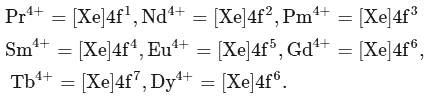
From the list given below, the number of lanthanides which exhibit +4 state in their oxides is Pr, Nd, Pm, Sm, Eu, Gd, Tb, Dy
Detailed Solution: Question 14
 (trivalent lanthanides ions) have E.C.
Detailed Solution: Question 15

 to
to 
333 videos|699 docs|300 tests |
