JEE Exam  >  JEE Test  >  Chemistry Main & Advanced  >  Test: Packing Efficiency (Old NCERT) - JEE MCQ

Packing Efficiency (Old NCERT) - Free MCQ Practice Test with solutions,


MCQ Practice Test & Solutions: Test: Packing Efficiency (Old NCERT) (10 Questions)

You can prepare effectively for JEE Chemistry for JEE Main & Advanced with this dedicated MCQ Practice Test (available with solutions) on the important topic of "Test: Packing Efficiency (Old NCERT)". These 10 questions have been designed by the experts with the latest curriculum of JEE 2026, to help you master the concept.

Test Highlights:

  • - Format: Multiple Choice Questions (MCQ)
  • - Duration: 15 minutes
  • - Number of Questions: 10

Sign up on EduRev for free to attempt this test and track your preparation progress.

Test: Packing Efficiency (Old NCERT) - Question 1

Packing efficiency of body centred cubic unit cell is:

Detailed Solution: Question 1

The packing efficiency of a body-centred cubic unit cell is 68%.

Explanation: 

The packing efficiency is the fraction of the crystal (or unit cell) actually occupied by the atoms. It is usually represented by a percentage or volume fraction.

Mathematically Packing Efficiency is:

Number of atoms × volume occupied by 1 share × 100/Total volume of unit cell × 100

Test: Packing Efficiency (Old NCERT) - Question 2

Packing efficiency in a unit cell is never 100% because constituent particles are assumed to be:

Detailed Solution: Question 2

 Packing efficiency can never be 100% because in packing calculations all constituent particles filling up the cubical unit cell are assumed to be spheres.

Test: Packing Efficiency (Old NCERT) - Question 3

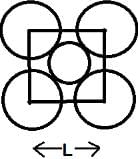
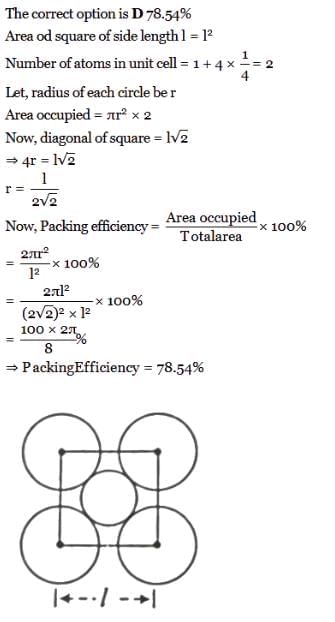
The packing efficiency of the two-dimensional square unit cell shown in the given figure is:
Detailed Solution: Question 3
Test: Packing Efficiency (Old NCERT) - Question 4

Packing efficiency in a unit cell is never 100% because constituent particles are assumed to be:

Detailed Solution: Question 4

The constituent particles i.e. atoms, molecules and ions are assumed to be spheres.

Test: Packing Efficiency (Old NCERT) - Question 5

What is the dimensional formula of packing fraction?

Detailed Solution: Question 5

Packing fraction is a dimensionless quantity which is the ratio of space occupied to total crystal space available. Since both the quantities have the same units the ratio renders dimensionless.

Test: Packing Efficiency (Old NCERT) - Question 6

Arrange the types of arrangement in terms of decreasing packing efficiency.

Detailed Solution: Question 6

HCP and CCP have the highest packing efficiency of 74% followed by BCC which is 68%. The simple cubic structure has a packing efficiency of 54%.

Test: Packing Efficiency (Old NCERT) - Question 7

Which of the following shows maximum packing efficiency?

Detailed Solution: Question 7

Packing efficiency is defined as the percentage of space occupied by constituent particles packed inside the lattice.

Packing efficiency = Number of atoms × volume occupied by one share × 100/total volume of the unit cell

  • Packing efficiency in fcc and hcp structures is 74%

  • The packing efficiency of the body-centred unit cell is 68%.

  • The packing efficiency of the simple unit cell is 52.4%

Since HCP shows the maximum packing efficiency, the correct answer is A. 

Test: Packing Efficiency (Old NCERT) - Question 8

What are the percentages of free space in a CCP and simple cubic lattice?

Detailed Solution: Question 8

The packing efficiency in CCP and simple cubic lattice are 74% and 52%, respectively. Hence the corresponding free spaces will be 100% – 74% = 26% and 100% – 52% = 48%.

Test: Packing Efficiency (Old NCERT) - Question 9

If metallic atoms of mass 197 and radius 166 pm are arranged in ABCABC fashion then what is the surface area of each unit cell?

Detailed Solution: Question 9

ABCABC arrangement is found in CCP.
In closed cubic packing, relation between edge length of unit cell, a, and radius of particle, r, is given as a=2√2r.
Surface area (S.A.) = 6a2
From the relationship,
a2 = 8r2
S.A. = 6a2 = 48r2
When r = 166 pm, S.A. = 48(166pm) = 1.32 x 10⁶ pm2

Test: Packing Efficiency (Old NCERT) - Question 10

If copper, density = 9.0 g/cm3 and atomic mass 63.5, bears face-centered unit cells then what is the ratio of surface area to volume of each copper atom?

Detailed Solution: Question 10

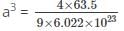
Density, d of unit cell is given by d
Given,
Density, d = 9.0 g/cm3
Atomic mass, M = 63.5 g/mole
Edge length = a
NA = Avogadro’s number = 6.022 x 10²³
z = 4 atoms/cell
On rearranging the equation for density we get a3 
Substituting the given values:

Therefore, a = 360.5 pm
The relation of edge length ‘a’ and radius of particle ‘r’ for FCC packing i.e. a = 2√2r.
On substituting the value of ‘a’ in the given relation,127.46 pm
Now, for spherical particles volume, V = 4πr3/3 and surface area, S = 4πr2
Required ratio = S/V=4πr2/(4πr3/3) = 3/r (after simplifying)
Thus, S/V = 3/127.46 = 0.0235.

335 videos|699 docs|300 tests
Information about Test: Packing Efficiency (Old NCERT) Page
In this test you can find the Exam questions for Test: Packing Efficiency (Old NCERT) solved & explained in the simplest way possible. Besides giving Questions and answers for Test: Packing Efficiency (Old NCERT), EduRev gives you an ample number of Online tests for practice
Download as PDF