JEE Exam  >  JEE Test  >  Chapter-wise Tests Main & Advanced  >  Test: Dimensions of Unit Cells (Old NCERT) - JEE MCQ

Dimensions of Unit Cells (Old NCERT) - Free MCQ Practice Test with solutions,


MCQ Practice Test & Solutions: Test: Dimensions of Unit Cells (Old NCERT) (10 Questions)

You can prepare effectively for JEE Chapter-wise Tests for JEE Main & Advanced with this dedicated MCQ Practice Test (available with solutions) on the important topic of "Test: Dimensions of Unit Cells (Old NCERT)". These 10 questions have been designed by the experts with the latest curriculum of JEE 2026, to help you master the concept.

Test Highlights:

  • - Format: Multiple Choice Questions (MCQ)
  • - Duration: 15 minutes
  • - Number of Questions: 10

Sign up on EduRev for free to attempt this test and track your preparation progress.

Test: Dimensions of Unit Cells (Old NCERT) - Question 1

 If an element crystallizes as a simple cube, what is the volume of an element provided its density is 1.5 g/cm3 and atomic mass of the element is 63?

Detailed Solution: Question 1
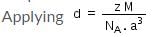
Simple cube has 1 atom

Therefore volume of cube i.e. a3 = 6.97 x 10⁻²³ cm3

Test: Dimensions of Unit Cells (Old NCERT) - Question 2

Mass of an atom in an unit cell is calculated by which of the following formula if M is the molar mass:

Detailed Solution: Question 2

(Molar mass = M) (1 molar of atom = M 6.023×10²³)( atom = M/Na)

Test: Dimensions of Unit Cells (Old NCERT) - Question 3

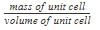
 In the formula to calculate the density of a unit cell     what is z ?

Detailed Solution: Question 3

The correct answer is Option B.
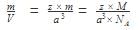
Mass of unit cell = number of atoms in unit cell × mass of each atom = z × m
Where, z = number of atoms in unit cell,
m = Mass of each atom
Mass of an atom can be given with the help of Avogadro number and molar mass as: 
Where, M = molar mass
NA = Avogadro’s number
Volume of unit cell, V = a3
⇒ Density of unit cell = 

Test: Dimensions of Unit Cells (Old NCERT) - Question 4

Volume of a body centred cubic unit cell is

Detailed Solution: Question 4

In a body centered cubic unit cell ,√3a = 4r a= 4r/√3 where a = side of the cube volume = a3 = (4r/√3)3.

Test: Dimensions of Unit Cells (Old NCERT) - Question 5

Density of a unit cell is equal to mass of unit cell divided by

Detailed Solution: Question 5

Volume of unit cell, V = a3

=> Density of unit cell = mass of unit cell /volume of unit cell

Test: Dimensions of Unit Cells (Old NCERT) - Question 6

 Length a in unit cell is along

Detailed Solution: Question 6

The correct answer is option A
Unit cell is essentially considered a cube, so a cube has 3 axes. X,Y,Z so X represents length , Y represents breadth, Z represents height.

Test: Dimensions of Unit Cells (Old NCERT) - Question 7

The number of atoms (z) in simple cubic unit cell is

Detailed Solution: Question 7

The face-centered cubic (fcc) has a coordination number of 12 and contains 4 atoms per unit cell. The body-centered cubic (bcc) has a coordination number of 8 and contains 2 atoms per unit cell. The simple cubic has a coordination number of 6 and contains 1 atom per unit cell.

Test: Dimensions of Unit Cells (Old NCERT) - Question 8

X-ray diffraction studies show that copper crystallizes in an fcc unit cell with cell edge of 3.608 x 10⁻⁸ cm. In a separate experiment, copper is determined to have a density of 8.92 g/cm3, calculate the atomic mass of copper.

Detailed Solution: Question 8
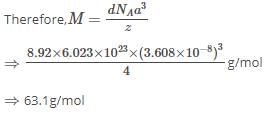
In case of fcc lattice,number of atoms per unit cell,x=4 atoms

∴  Atomic mass of copper =63.1u

Test: Dimensions of Unit Cells (Old NCERT) - Question 9

An element with bcc geometry has atomic mass 50 and edge length 290 pm. The density of unit cell will be

Detailed Solution: Question 9

Length of the edge , a = 290 pm =290 x 10-10 cm 
Volume of unit cell = ( 290 x 10-10 cm )3 = 24.39 x 10⁻²⁴ cm3

Since it is bcc arrangement, 
Number of atoms in the unit cell, Z = 2 
Atomic mass of the element = 50 

Mass of the atom = atomic mass/ Avogadro number = M/No = 50/6.02 x 1023

Mass of the unit cell = Z x M/No = 2 x 50/6.02 x 1023 = 100/6.23 x 1023
Therefore , density = mass of unit cell / volume of unit cell 
= 100/6.023 x 1023 x 24.39 x 10-24 = 6.81 g cm-3

Test: Dimensions of Unit Cells (Old NCERT) - Question 10

The number of octahedral void(s) per atom present in a cubic close-packed structure is 

Detailed Solution: Question 10

The total number of octahedral void(s) per atom present in a cubic close packed structure is 4. Besides the body centre, there is one octahedral void at the centre of each of the 12 edges. It is surrounded by six atoms, four belonging to the same unit cell (2 on the corners and 2 on face centres) and two belonging to two adjacent unit cells. Since each edge of the cube is shared between four adjacent unit cells, so is the octahedral void located on it. Only 1/4 ​th of each void belongs to a particular unit cell. Thus, in cubic close packed structure, octahedral void at the body-centre of the cube is 1.
12 octahedral voids located at each edge and shared between four unit cells=12× 1/4​=3
Total number of octahedral voids =4
We know that in ccp structure, each unit cell has 4 atoms. Thus, the number of octahedral voids is equal to 4/4=1.

446 docs|929 tests
Information about Test: Dimensions of Unit Cells (Old NCERT) Page
In this test you can find the Exam questions for Test: Dimensions of Unit Cells (Old NCERT) solved & explained in the simplest way possible. Besides giving Questions and answers for Test: Dimensions of Unit Cells (Old NCERT), EduRev gives you an ample number of Online tests for practice
Download as PDF