Regulatory Body Exams Exam  >  Regulatory Body Exams Test  >  Mock Test Series for SEBI Grade A Exam 2026  >  SEBI Grade A (IT) Mock Test - 2 - Regulatory Body Exams MCQ

SEBI Grade A (IT) Mock Test - 2 Free Online Test 2026


Full Mock Test & Solutions: SEBI Grade A (IT) Mock Test - 2 (130 Questions)

You can boost your Regulatory Body Exams 2026 exam preparation with this SEBI Grade A (IT) Mock Test - 2 (available with detailed solutions).. This mock test has been designed with the analysis of important topics, recent trends of the exam, and previous year questions of the last 3-years. All the questions have been designed to mirror the official pattern of Regulatory Body Exams 2026 exam, helping you build speed, accuracy as per the actual exam.

Mock Test Highlights:

  • - Format: Multiple Choice Questions (MCQ)
  • - Duration: 100 minutes
  • - Total Questions: 130
  • - Analysis: Detailed Solutions & Performance Insights
  • - Sections covered: Paper - I, Paper - II

Sign up on EduRev for free and get access to these mock tests, get your All India Rank, and identify your weak areas to improve your marks & rank in the actual exam.

SEBI Grade A (IT) Mock Test - 2 - Question 1

The given sentence is divided into four parts; A, B, C and D. Choose the part that contains an error as your answer. If the sentence is error-free, mark E i.e. No error as your answer.

A recent study has shown that (A) / the number of people opting for online banking (B) / are increasing steadily (C) / over the past few years. (D) / No error (E)

Detailed Solution: Question 1

The Correct answer is 'Option 3.'

Key Points

  • Part C of the sentence i.e. 'are increasing steadily' is erroneous.
    • The subject of the sentence is "the number of people," which is singular.
    • The verb in the sentence 'has been' singular to agree with the subject. "Are increasing" is plural and does not agree with the singular subject.
    • Hence, The correct answer is 'C'
  • The correct answer is " A recent study has shown that the number of people opting for online banking has been increasing steadily over the past few years."

Additional Information

  • Option 1: "A recent study has shown that" - This part is grammatically correct.
  • Option 2: "the number of people opting for online banking" - This part is grammatically correct.
  • Option 4: "over the past few years" - This part is grammatically correct.

SEBI Grade A (IT) Mock Test - 2 - Question 2

What will come in blank 6?

Detailed Solution: Question 2

The correct answer is 'challenges'.

Key Points

  • Challenges is the most appropriate word for the given blank.
  • Challenges mean something new and difficult that forces you to make a lot of effort.
    • Example- Are you prepared for the challenges ahead?
  • Problems a thing that is difficult to deal with or to understand.
  • Investigations the action of investigating something or someone; formal or systematic examination or research.
  • Obstacles are something that makes it difficult for you to do something or go somewhere.
  • Hence, the correct answer is option 1.

SEBI Grade A (IT) Mock Test - 2 - Question 3

Two equations I and II are given below in the question. You have to solve these equations and give the answer.

I. x2 - 27x + 182 = 0

II. y2 – 28y + 196 = 0

Detailed Solution: Question 3
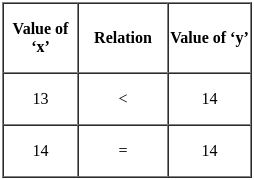
Given:

I. x2 - 27x + 182 = 0

II. y2 – 28y + 196 = 0

Calculation:

I. x2 - 27x + 182 = 0

⇒ x2 – 13x – 14x + 182 = 0

⇒ x(x – 13) – 14(x – 14)= 0

⇒ (x – 13)(x – 14) = 0

⇒ x = 13, 14

II. y2 – 28y + 196 = 0

⇒ y2 – 14y – 14y + 196 = 0

⇒ y(y – 14) – 14(y – 14) =0

⇒ (y – 14)(y – 14) = 0

⇒ y = 14, 14


When we compared the values of ‘x’ and ‘y’ in the table above, we found that there are TWO relations between X and Y i.e. < and =. So, a relation between x and y is “x ≤ y”.

After comparison, for all the values of x and y the relation is “x y”.

SEBI Grade A (IT) Mock Test - 2 - Question 4

In the given questions, two equations numbered l and II are given. You have to solve both the equations and mark the appropriate answer.

I. 6x2 + (1/2) = (7/2)x

II. 12y2 + 2 = 10y

Detailed Solution: Question 4
Calculations:

From I,

6x2 + (1/2) = (7/2)x

⇒ 12x2 - 7x+ 1 = 0

⇒ 12x2 - 4x - 3x + 1 = 0

⇒ 4x(3x - 1) - 1(3x - 1) = 0

⇒ (4x - 1)(3x - 1) = 0

Taking,

⇒ 3x - 1 = 0 or 4x - 1 = 0

⇒ x = 1/3 or x = 1/4

From II,

12y2 + 2 = 10y

12y2 - 10y + 2 = 0

12y2 - 6y - 4y + 2 = 0

⇒ 6y(2y - 1) - 2(2y - 1) = 0

Taking,

⇒ 2y - 1 = 0 or 6y - 2 = 0

⇒ y = 1/2 or y = 1/3

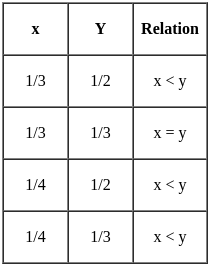
Comparison between x and y (via Tabulation):

​∴ x ≤ y.

SEBI Grade A (IT) Mock Test - 2 - Question 5

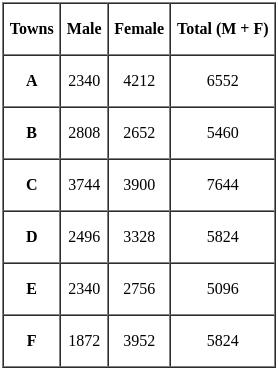
What is the number of female population in the town C and D together?

Detailed Solution: Question 5
Calculation:

Let x be the total number of population

Total number of population = (21/100)x – (15/100)x = 2184

⇒ (6/100)x = 2184

⇒ x = (218400/6) = 36400

Let y be the total male population

Total male population = (24/100)y – (18/100)y = 936

⇒ (6/100)y = 936

⇒ y = (93600/6) = 15600

Total number of female population in town C and D = 3900 + 3328 = 7228

∴ The total number of female population in town C and D is 7228.

SEBI Grade A (IT) Mock Test - 2 - Question 6

In which of the given towns the number of males is the highest?

Detailed Solution: Question 6
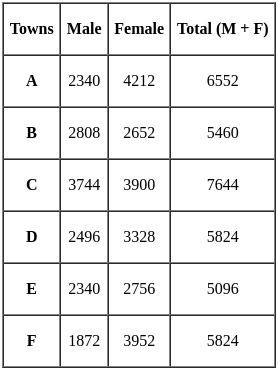
Calculation:

Let x be the total population

Total number of population = (21/100)x – (15/100)x = 2184

⇒ (6/100)x = 2184

⇒ x = (218400/6) = 36400

Let y be the male population

Total number of male population = (24/100)y – (18/100)y = 936

⇒ (6/100)y = 936

⇒ y = (93600/6) = 15600

As per the given table we can deduce that males in town C is the highest

∴ The town in which the number of male is the highest is C.

SEBI Grade A (IT) Mock Test - 2 - Question 7

In which of the given town the difference between the number of male and the number of female is the highest?

Detailed Solution: Question 7
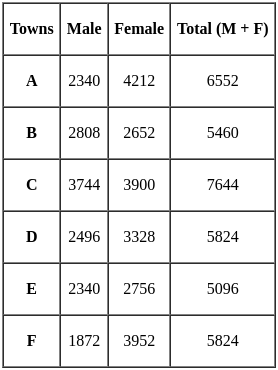
Calculation:

Let x be the total population

Total number of population = (21/100)x – (15/100)x = 2184

⇒ (6/100)x = 2184

⇒ x = (218400/6) = 36400

Let y be the male population

Total number of male population = (24/100)y – (18/100)y = 936

⇒ (6/100)y = 936

⇒ y = (93600/6) = 15600

Difference between the number of male and female in the town A = 4212 – 2340 = 1872

Difference between the number of male and female in the town B = 2808 – 2652 = 156

Difference between the number of male and female in the town C = 3900 – 3744 = 156

Difference between the number of male and female in the town D = 3328 – 2496 = 832

Difference between the number of male and female in the town E = 2756 – 2340 = 416

Difference between the number of male and female in the town F = 3952 – 1872 = 2080

∴ The town in which the difference between the number of male and number of female is the highest is F.

SEBI Grade A (IT) Mock Test - 2 - Question 8

What approximate percentage of the total number of females from all the six towns is more than that of the males from all the six towns?

Detailed Solution: Question 8

Calculation:

Let x be the total population

Total number of population = (21/100)x – (15/100)x = 2184

⇒ (6/100)x = 2184

⇒ x = (218400/6) = 36400

Let y be the male population

Total number of male population = (24/100)y – (18/100)y = 936

⇒ (6/100)y = 936

⇒ y = (93600/6) = 15600

The total number of female in all the six towns = 36400 – 15600 = 20800

⇒ Difference between number of females and males = 20800 – 15600 = 5200

⇒ Required difference = (5200/15600) × 100 = 33.33%

Approximate percentage of the total number of females from all the six towns is 33.33% more than that of the males from all the six towns.

SEBI Grade A (IT) Mock Test - 2 - Question 9

In the following number series, a wrong number is given. Find out the wrong number.

870, 855, 840, 825, 810, 800

Detailed Solution: Question 9

Given:

870, 855, 840, 825, 810, 800

Calculation:

The logic follows here is;

870 - 15 = 855

855 - 15 = 840

840 - 15 = 825

825 - 15 = 810

810 - 15 = 795 ≠ 800

There should be 795 instead of 800.

∴ 800 is the wrong term.

SEBI Grade A (IT) Mock Test - 2 - Question 10

Ram lent Rs.2.7 lakh amount to Pawan and Pooja in ratio of 5 : 4, Pawan and Pooja payback its amount after 3 years at 10% and 15% annual compound interest respectively, At the end of time duration the amount received by Ram from Pawan was how much more than that received from Pooja?

Detailed Solution: Question 10

Given:

Ram lent Rs.2.7 lakh amount to Pawan and Pooja

Lent money to Pawan and Pooja in ratio of 5 : 4

Pooja payback its amount after 3 years at 10% annual compound interest

Pawan payback its amount after 3 year at 15% annual compound interest

Concept:

A = P × (1 + R/100)T

A = Final amount

P = Initial amount

R = Rate of interest

T = Time

Calculation:

Lent money to Pawan and Pooja in ratio of 5 : 4

Lent by Pawan = (5/9) × 270000

⇒ Rs.1,50,000

Lent by Pooja = (4/9) × 270000

⇒ Rs.1,20,000

Pawan payback to Ram = 150000 × (1 + 10/100)3

⇒ 150000 × (11/10) × (11/10) × (11/10)

⇒ Rs.1,99,650

Pooja payback to Ram = 120000 × (1 + 15/100)3

⇒ 120000 × (23/20)3

⇒ 120000 × (23/20) × (23/20) × (23/20)

⇒ Rs.1,82,505

Pawan payback to Ram – Pooja payback to Ram = 199650 – 182505

⇒ Rs.17,145

At the end of time duration the amount received by Ram from Pawan was Rs.17145 more than that received from Pooja.

SEBI Grade A (IT) Mock Test - 2 - Question 11

Find the odd one out.

Detailed Solution: Question 11

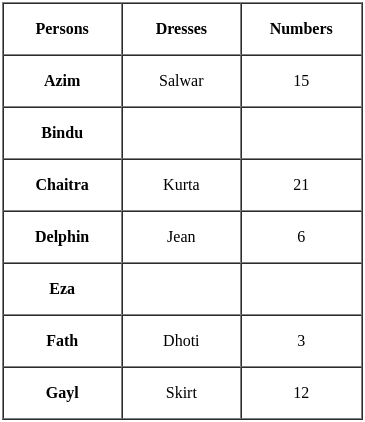
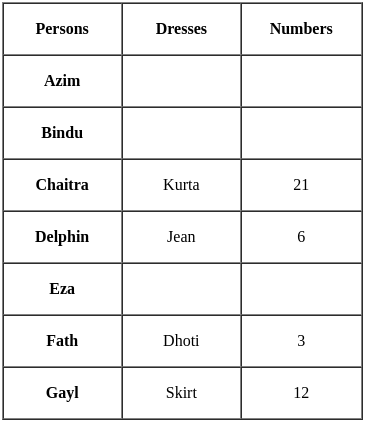
Persons: Azim, Bindu, Chaitra, Delphin, Eza, Fath, and Gayl

Dresses: Jean, Shirt, Kurta, Skirt, Saree, Salwar and Dhoti

Number of dresses: The number of dresses bought by each of them are in the consecutive multiples of 3. The total number of dresses bought by all people cannot exceed 85.

So, 3, 6, 9, 12, 15, 18 and 21 are the number of dresses bought by them.

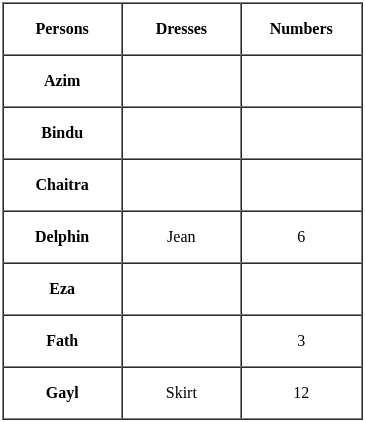
1. Either Eza or Gayl bought 12 Skirts.

2. Delphin bought a number of Jeans, which is higher than only Fath.

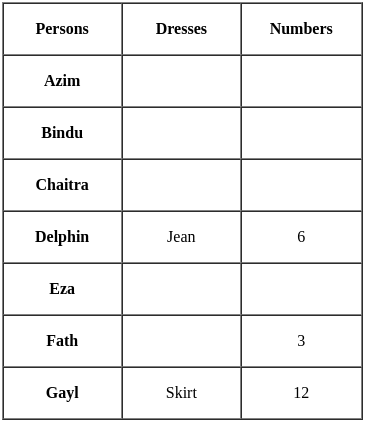
3. So Fath bought 3 dresses and Delphin bought 6 jeans.

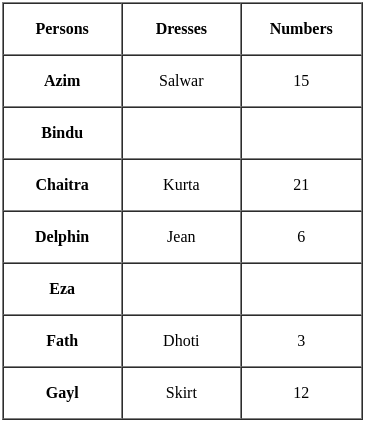
4. The number of Sarees bought is twice the number of Shirts bought.

5. Saree is bought for the second highest number. So, number of Saree is 18 and Shirt is 9.

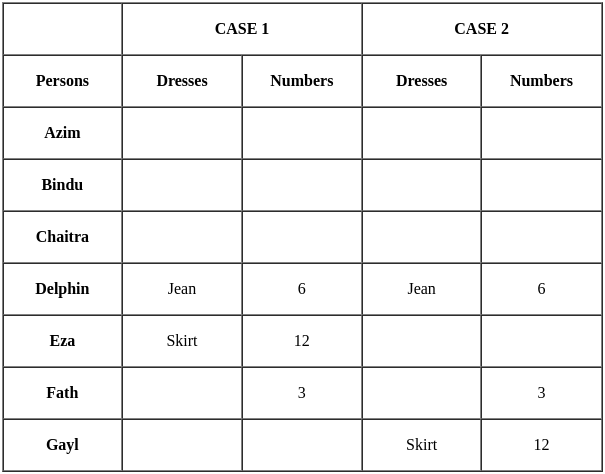
6. Gayl bought twice the number of dresses of Delphin. So, Case 1 is invalid.

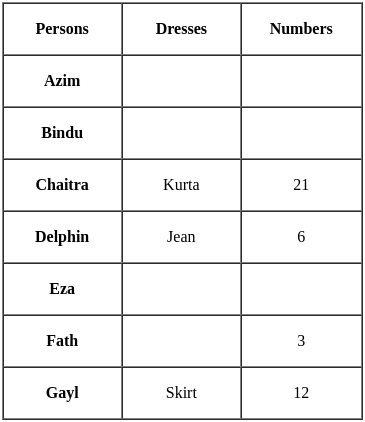
6. Chaithra bought the highest number of dresses but neither bought Saree nor Salwar.

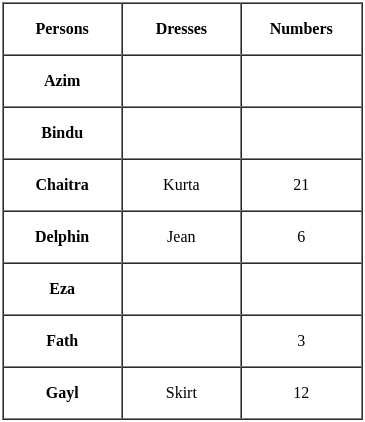
So, the number is 21 and the dress left for it is Kurta.

7. Either Shirt or Dhoti is bought for the lowest number.

As Shirt is already 9, so the number of Dhoti bought is 3.

8. The number of Sarees bought is twice the number of Shirts bought, which is not bought by Azim.

So, he bought 15 salwar.

9. Neither Azim nor Bindu bought 18 dresses.

10. Saree is bought for the second highest number. So, number of Saree is 18 and Shirt is 9.

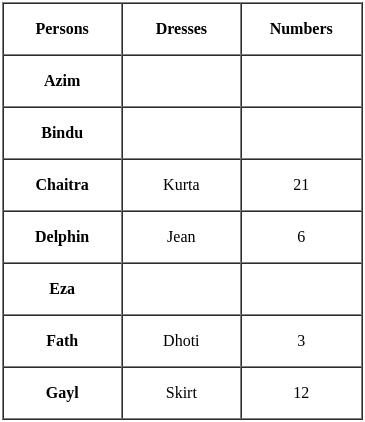
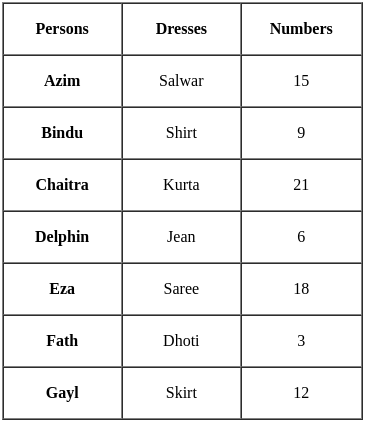
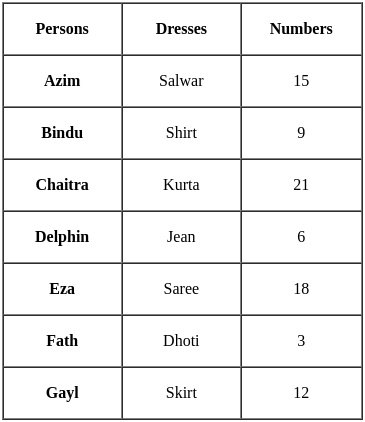
The final arrangement is,

Everyone except Gayl bought an odd number of dresses, whereas Gayl bought an even number of dresses.

So, Gayl is the odd one out.

SEBI Grade A (IT) Mock Test - 2 - Question 12

Who bought the third highest and lowest number of dresses respectively?

Detailed Solution: Question 12
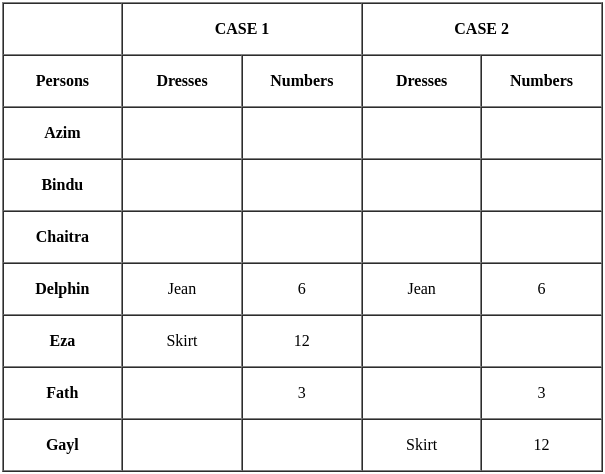
Persons: Azim, Bindu, Chaitra, Delphin, Eza, Fath, and Gayl

Dresses: Jean, Shirt, Kurta, Skirt, Saree, Salwar and Dhoti

Number of dresses: The number of dresses bought by each of them are in the consecutive multiples of 3. The total number of dresses bought by all people cannot exceed 85.

So, 3, 6, 9, 12, 15, 18 and 21 are the number of dresses bought by them.

1. Either Eza or Gayl bought 12 Skirts.

2. Delphin bought a number of Jeans, which is higher than only Fath.

3. So Fath bought 3 dresses and Delphin bought 6 jeans.

4. The number of Sarees bought is twice the number of Shirts bought.

5. Saree is bought for the second highest number. So, number of Saree is 18 and Shirt is 9.

6. Gayl bought twice the number of dresses of Delphin. So, Case 1 is invalid.

6. Chaithra bought the highest number of dresses but neither bought Saree nor Salwar.

So, the number is 21 and the dress left for it is Kurta.

7. Either Shirt or Dhoti is bought for the lowest number.

As Shirt is already 9, so the number of Dhoti bought is 3.

8. The number of Sarees bought is twice the number of Shirts bought, which is not bought by Azim.

So, he bought 15 salwar.

9. Neither Azim nor Bindu bought 18 dresses.

10. Saree is bought for the second highest number. So, number of Saree is 18 and Shirt is 9.

The final arrangement is,

So, Azim and Fath bought the third highest and lowest number of dresses respectively.

SEBI Grade A (IT) Mock Test - 2 - Question 13

If all the odd digits of the number '7125126543456' are increased by 2, after that all the digits are arranged in ascending order from the left end then what will be the sum of the first four digits from the right end?

Detailed Solution: Question 13

Given number:- 7125126543456

If all the odd digits are increased by 2, then

Now all the digits are arranged in ascending order from the left end -

2233445667779

The first four digits from the right end are 9, 7, 7, 7 and their sum is 9 + 7 + 7 + 7 = 30

Hence, the correct answer is 30.

SEBI Grade A (IT) Mock Test - 2 - Question 14

Directions: In the question below are given statements followed by conclusions. You have to take the given statements to be true even if they seem to be at variance with commonly known facts. Read all the conclusions and then decide which of the given conclusions logically follows from the given statements disregarding commonly known facts.

Statement:

I. Only a few Radio are TV

II. Only a few Laptop are Cable

III. All Cables are TV

Conclusion:

I. All Laptop being Cable is a possibility

II. Some Radio being Cable is a possibility

III. All Radio are Laptop

Detailed Solution: Question 14
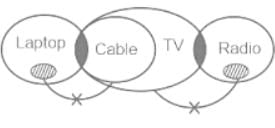
The least possible Venn diagram according to the above statement is:

I. All Laptop being Cable is a possibility → False (As only a few Laptops are Cables, hence the possibility of all will be false.)

II. Some Radio being Cable is a possibility → True (Some Radio being Cable is definitely a possibility as no direct relation is given between them.)

III. All Radio are Laptop → False (All Radio being Laptop is a possibility but its not definite.)

Hence, Only II follows is the correct answer.

SEBI Grade A (IT) Mock Test - 2 - Question 15

If Q and O, interchange their positions then who among the following will be to the North-East of Q?

Detailed Solution: Question 15
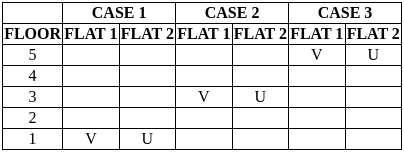
Given:

Ten persons: M, N, O, P, Q, V, W, X, Y and Z

Five different floors of a building

Two flats: flat-1 and flat-2 from west to east such that flat-1 is to the west of flat-2.

Now,

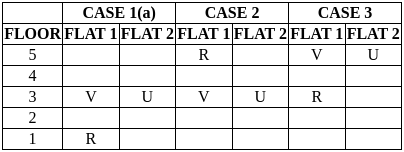
1) V lives on an odd numbered floor but dose not lives on an even numbered flat.

2) More than one floor is there between the floor of M and the floor on which N lives.

3) U lives to the east of V on the same floor.

4) One floor is there between V who is not on the lowermost floor and the floor on which R lives, both lives on the same flat number.

5) M lives to the west of P and dose not lives on an even numbered floor.

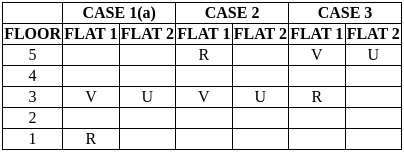
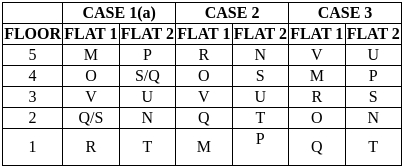
As V cannot be on the lowermost floor thus, CASE 1 gets eliminated

6) O who lives to the North-West of T is not on the fifth floor.

7) Only one floor gap is there between the floor of Q and the floor on which S lives.

8) T is not an immediate neighbour of S. M does not live above Q.

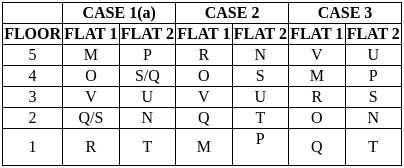
More than one floor is there between the floor of M and the floor on which N lives, also, M lives to the west of P and dose not lives on an even numbered floor.

In CASE 3, there is not a gap of more than one floor between M and N, thus CASE 3 gets eliminated.

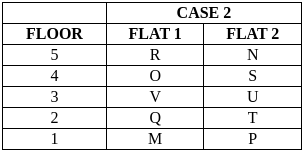
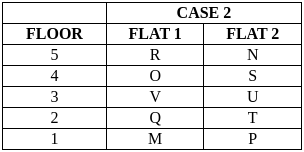
In CASE 1(a), we are not getting the exact position of Q and S, but in CASE 2 all the conditions of the question are being fulfilled, thus we have the final arrangement in CASE 2.

Hence, the correct answer is "N".

SEBI Grade A (IT) Mock Test - 2 - Question 16

Who among the following lives between the one who lives on Floor-2, Flat-1 and Floor-4, Flat-2?

Detailed Solution: Question 16
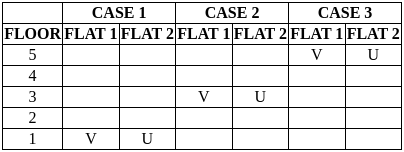
Given:

Ten persons: M, N, O, P, Q, V, W, X, Y and Z

Five different floors of a building

Two flats: flat-1 and flat-2 from west to east such that flat-1 is to the west of flat-2.

Now,

1) V lives on an odd numbered floor but dose not lives on an even numbered flat.

2) More than one floor is there between the floor of M and the floor on which N lives.

3) U lives to the east of V on the same floor.

4) One floor is there between V who is not on the lowermost floor and the floor on which R lives, both lives on the same flat number.

5) M lives to the west of P and dose not lives on an even numbered floor.

As V cannot be on the lowermost floor thus, CASE 1 gets eliminated

6) O who lives to the North-West of T is not on the fifth floor.

7) Only one floor gap is there between the floor of Q and the floor on which S lives.

8) T is not an immediate neighbour of S. M does not live above Q.

More than one floor is there between the floor of M and the floor on which N lives, also, M lives to the west of P and dose not lives on an even numbered floor.

In CASE 3, there is not a gap of more than one floor between M and N, thus CASE 3 gets eliminated.

In CASE 1(a), we are not getting the exact position of Q and S, but in CASE 2 all the conditions of the question are being fulfilled, thus we have the final arrangement in CASE 2.

Hence, the correct answer is "both V and U".

SEBI Grade A (IT) Mock Test - 2 - Question 17

How many such pairs of letters are in the word 'SIGNATURE' each of which has as many letters between them as in the English alphabetical order (both forward and backward)?

Detailed Solution: Question 17
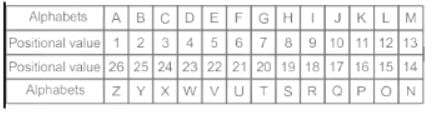
Given word:- SIGNATURE

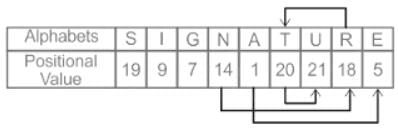
Forward Pair - NR, AE, TU

Backward Pair - TR

Thus, there are four such pairs of letters in the word “SIGNATURE” which have as many letters between them as in the English alphabetical series (both in forward and backward directions).

Hence, the correct answer is Four.

SEBI Grade A (IT) Mock Test - 2 - Question 18

How many person are sitting in between One who faces A and one who faces E?

Detailed Solution: Question 18
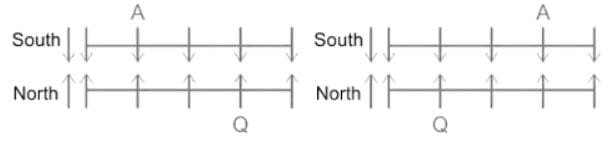
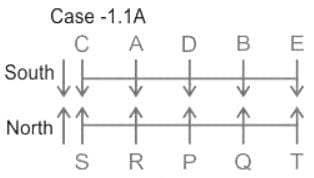
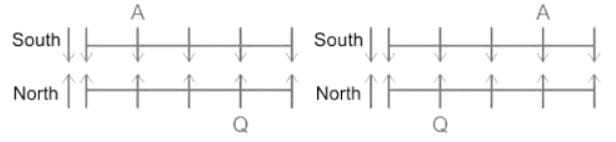
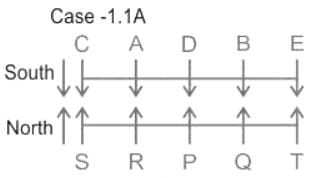
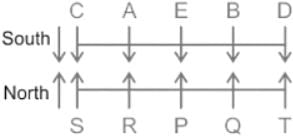
Row 1 A, B, C, D, and E are sitting facing south
Row 2 P, Q, R, S, and T are sitting facing north.

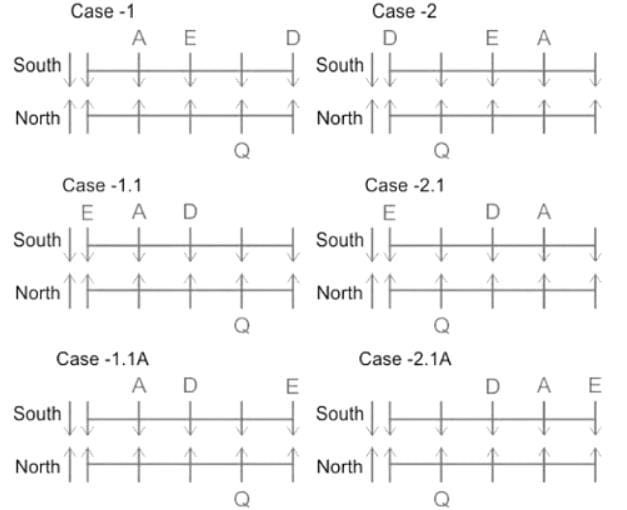
1. A sits second from the end.

2.The number of persons sitting to the right of A is equal to the number of persons sitting to the right of Q.

3. D sits Immediate next to the one who is facing Q.

4. One persons sit between D and E, who does not sit next to C.

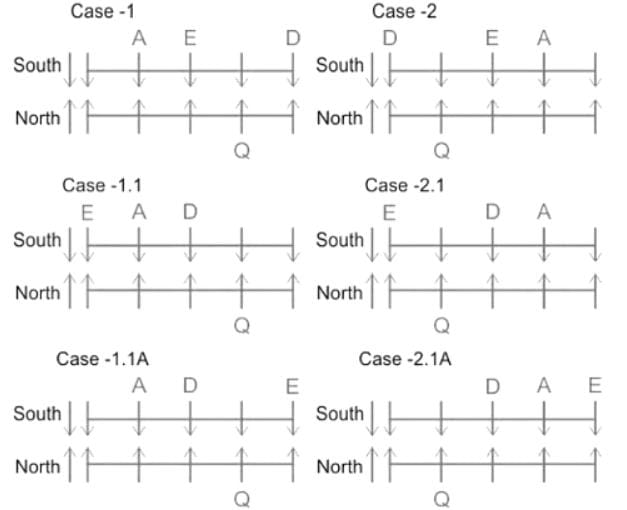
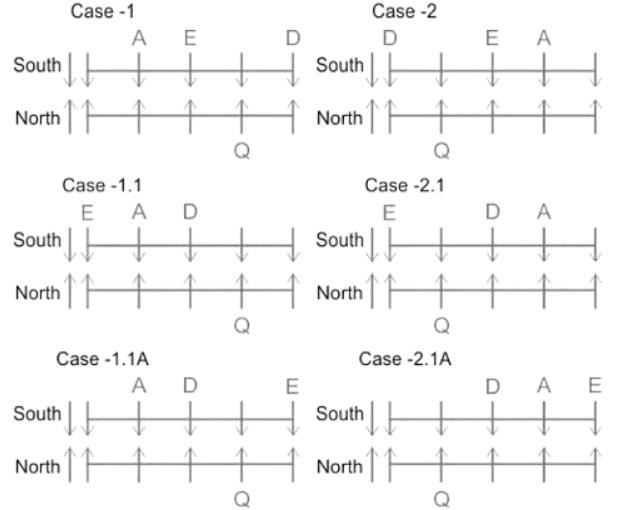
5. S sits three places away from Q. T sits to the right of S. Hence Case 2.1A, case 2.1 and Case 2 gets eliminated.

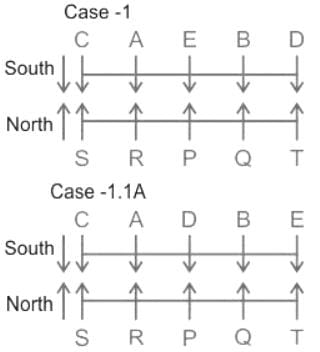
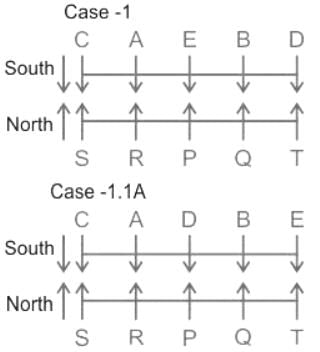
6. Two persons sit between R and T. The person who sits opposite to T sits four places away from C. Case 1.1 gets eliminated.

7.B sits to the left of A. At most two person sits right of D. Hence case 1 gets eliminated

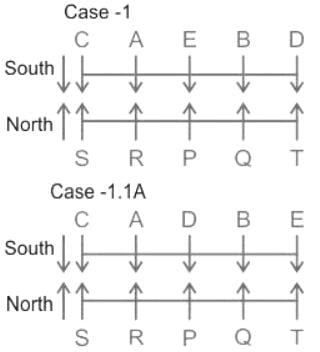
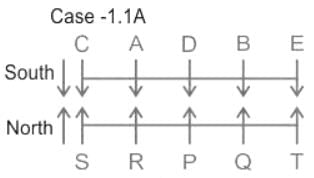
Final arrangement

One who faces A is R and One who faces E is T hence two person sits in between them.

SEBI Grade A (IT) Mock Test - 2 - Question 19

Who is sitting immediate left of R?

Detailed Solution: Question 19

Row 1 A, B, C, D, and E are sitting facing south
Row 2 P, Q, R, S, and T are sitting facing north.

1. A sits second from the end.

2.The number of persons sitting to the right of A is equal to the number of persons sitting to the right of Q.

3. D sits Immediate next to the one who is facing Q.

4. One persons sit between D and E, who does not sit next to C.

5. S sits three places away from Q. T sits to the right of S. Hence Case 2.1A, case 2.1 and Case 2 gets eliminated.

6. Two persons sit between R and T. The person who sits opposite to T sits four places away from C. Case 1.1 gets eliminated.

7.B sits to the left of A. At most two person sits right of D. Hence case 1 gets eliminated

Final arrangement

S is sitting immediate left of R.

SEBI Grade A (IT) Mock Test - 2 - Question 20

If position of D and E are interchanged, then who is sitting exactly opposite to E?

Detailed Solution: Question 20
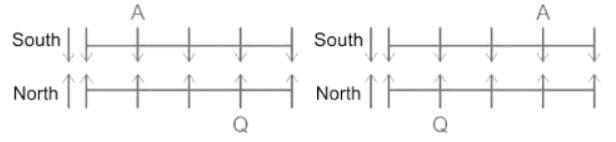
Row 1 A, B, C, D, and E are sitting facing south
Row 2 P, Q, R, S, and T are sitting facing north.

1. A sits second from the end.

2.The number of persons sitting to the right of A is equal to the number of persons sitting to the right of Q.

3. D sits Immediate next to the one who is facing Q.

4. One persons sit between D and E, who does not sit next to C.

5. S sits three places away from Q. T sits to the right of S. Hence Case 2.1A, case 2.1 and Case 2 gets eliminated.

6. Two persons sit between R and T. The person who sits opposite to T sits four places away from C. Case 1.1 gets eliminated.

7. B sits to the left of A. At most two person sits right of D. Hence case 1 gets eliminated

Final arrangement

After interchanging the position we get

P will be exactly opposite to E when position of E and D interchanged.

SEBI Grade A (IT) Mock Test - 2 - Question 21

Which country's premier league viewership reached 1.87 billion people in the 2024-25 season?

Detailed Solution: Question 21

1.87 billion people tuned into the Premier League campaign last season, including 55% of the UK population.

SEBI Grade A (IT) Mock Test - 2 - Question 22

Where was the 2025 World Athletics Championships held in September?

Detailed Solution: Question 22

The 20th edition of the World Athletics Championships was held at the Japan National Stadium in Tokyo from September 13-21, 2025, bringing together over 2000 athletes from approximately 200 countries.

SEBI Grade A (IT) Mock Test - 2 - Question 23

In which city was the 2025 Ryder Cup held in September?

Detailed Solution: Question 23

The 2025 Ryder Cup was held at the Bethpage Black Course in Farmingdale, New York from September 25-28, 2025.

SEBI Grade A (IT) Mock Test - 2 - Question 24

The argument for sum() in MySQL is can be ________________.

Detailed Solution: Question 24

The correct option is (1)

INT

Concept:-

The sum() function calculates the sum of a set of values. MYSQL supports the SQL standard integer types INTEGER (or INT) and SMALLINT. INT in MYSQL is an integer data type, which is a whole number. It allows numbers to be written without fractional parts.

SUM(column), returns the sum of the values for the specified column.

For example, MySQL > SELECT SUM(price) FROM INVENTORY; Output is 4608733.00

Key Points

  • Use SQL's SUM method if you need to add a set of numbers to your table. If there are no rows in the result set, NULL is returned. One of the categories of aggregate functions, it.
  • Multiple Row Functions is another name for aggregate functions. These functions operate on an entire collection of records and give a single value for each column of the records they affect.
  • The string data types are CHAR, VARCHAR, BINARY, VARBINARY, BLOB, TEXT, ENUM, and SET.

SEBI Grade A (IT) Mock Test - 2 - Question 25

Which clause is used to group the result set by one or more columns?

Detailed Solution: Question 25

c) GROUP BY is used to group the result set by one or more columns.

The GROUP BY clause groups rows based on the values in one or more columns and, typically, is used in combination with aggregate functions to return a single result row for each group.

Additional InformationWHERE clause is used to filter the result set of a SELECT, UPDATE, DELETE statement. It is used to specify a condition that rows have to meet in order to be selected or affected.

ORDER BY is used to sort the result set in a specific order. It is used to sort the result set by one or more columns in ascending or descending order.

The FROM clause is used to specify the table or tables from which to retrieve the data and it is usually one of the first clauses in a SELECT statement.

SEBI Grade A (IT) Mock Test - 2 - Question 26

Which of the following statements are true regarding C++?

(a) Overloading a function gives the capability to an existing operator to operate on other data types.

(b) Inheritance in object-oriented programming provides support to reusability.

(c) When object of a derived class is defined, first the constructor of derived class is executed then constructor of a base class is executed.

(d) Overloading is a type of polymorphism.

Choose the correct option from those given below:

Detailed Solution: Question 26

Statement (a): Overloading a function gives the capability to an existing operator to operate on other data types.

This statement is incorrect. Operator overloading is a type of polymorphism in which an operator is overloaded to give a different meaning or user defined meaning. It allows to change the way an operator can work. It gives the capability to an existing operator to operate on other data types.

Statement (b): Inheritance in object-oriented programming provides support to reusability.

This statement is correct. When a class acquires the properties of another class, this is known as inheritance. The class which acquire the properties and method is known as derived class and other one is parent or base class. Inheritance another name for reusability.

Statement (c): When object of a derived class is defined, first the constructor of derived class is executed then constructor of a base class is executed.

This statement is incorrect Constructor is a special member function of class that is automatically executed or called when objects of that class will be created. As when object of derived class is defined, automatically derived class constructor and base class constructor will execute inside them.

Statement (d): Overloading is a type of polymorphism.

This statement is correct. Operator is a type of polymorphism in which an operator is overloaded to give a different meaning or user defined meaning. It allows to change the way an operator can work.

SEBI Grade A (IT) Mock Test - 2 - Question 27

Cryptography is the specialized area of ________.

Detailed Solution: Question 27

The correct answer is Cybersecurity.

Key Points

  • Cryptography is a specialized area of Cybersecurity.
  • Cryptography is also defined as the study of secure communications techniques that allow only the sender and intended recipient of a message to view its contents.
  • It covers the obfuscation of information in images using techniques such as microdots or merging.
  • It is used to protect written documents.
  • The main purpose of cryptography appears to be making content and images undecipherable, the true goal of cryptography in an information technology context is to ensure the confidentiality and integrity of any information technology system.

SEBI Grade A (IT) Mock Test - 2 - Question 28

A queue is also called a _____ system.

I. FIFO

II. LIFO

III. FILO

IV. LILO

Detailed Solution: Question 28

  • Queue is data structure which is First in First Out (FIFO) or Last in Last Out (LILO) which means the element which is inserted first comes out first form the queue or the elements inserted last comes out last from the queue
  • Stack is data structure which is Last in First Out (LIFO) or First in Last Out (FILO) which means the element which is popped last from stack is pushed first in stack, or element which is pushed first in stack is popped last from stack

SEBI Grade A (IT) Mock Test - 2 - Question 29

In a max heap, the keys of _____.

Detailed Solution: Question 29

Heap

  • A heap is a specialized tree-based data structure that satisfies the heap property.
  • A heap can be classified into two categories i.e. Max heap and Min heap.
  • In a max heap, the keys of parent nodes are always greater than or equal to those of the children and the highest key is in the root node.

SEBI Grade A (IT) Mock Test - 2 - Question 30

________ is a network Security device that grants or rejects network access to traffic flows between an untrusted zone and a trusted zone.

Detailed Solution: Question 30

The correct answer is option 3.

Key Points

  • A firewall is a security device that monitors and controls incoming and outgoing network traffic based on predetermined security rules.
  • It acts as a barrier between an untrusted network (like the internet) and a trusted network (like a company's internal network) to prevent unauthorized access to the trusted network.
  • Firewalls can be either hardware or software-based and are an essential component of network security.

Additional Information

  • Hub: It is a network device that connects multiple devices in a network, but it does not provide any security features.
  • Router: It is a network device that directs traffic between networks, but it has limited security features compared to a firewall.
  • Bridge: It is a network device that connects two network segments, but it also does not provide any security features.

View more questions
4 docs|17 tests
Information about SEBI Grade A (IT) Mock Test - 2 Page
In this test you can find the Exam questions for SEBI Grade A (IT) Mock Test - 2 solved & explained in the simplest way possible. Besides giving Questions and answers for SEBI Grade A (IT) Mock Test - 2, EduRev gives you an ample number of Online tests for practice
Download as PDF