CBSE Class 6  >  Class 6 Test  >  Mathematics  >  Test: Fractions - 1 - Class 6 MCQ

Fractions - 1 - Class 6 Mathematics Free MCQ Test with solutions


MCQ Practice Test & Solutions: Test: Fractions - 1 (10 Questions)

You can prepare effectively for Class 6 Mathematics for Class 6 with this dedicated MCQ Practice Test (available with solutions) on the important topic of "Test: Fractions - 1". These 10 questions have been designed by the experts with the latest curriculum of Class 6 2026, to help you master the concept.

Test Highlights:

  • - Format: Multiple Choice Questions (MCQ)
  • - Duration: 15 minutes
  • - Number of Questions: 10

Sign up on EduRev for free to attempt this test and track your preparation progress.

Test: Fractions - 1 - Question 1

What fraction of a roti will each child get if one roti is divided equally among four children?

Detailed Solution: Question 1
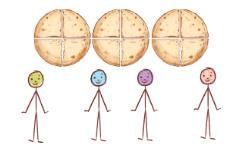
When one roti is divided equally among four children, each child gets 1/4 of the roti. This is because the whole roti is divided into four equal parts.

Test: Fractions - 1 - Question 2

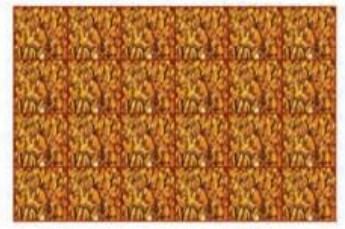
What is the fractional unit of a chikki when the whole chikki is divided into 6 equal parts?
Detailed Solution: Question 2
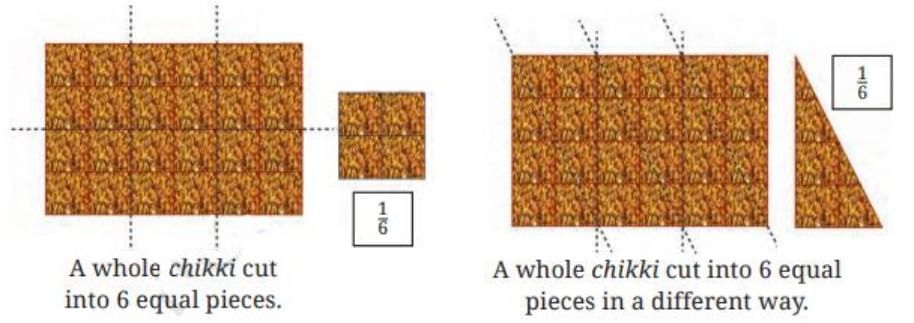
  • Splitting a whole chikki into 6 equal pieces means each piece is one part out of six.
  • The fraction for one part is written as 1/6.
  • Option C, 1/6, correctly represents the size of each piece.

Test: Fractions - 1 - Question 3

Which of the following fractions is greater?

Detailed Solution: Question 3

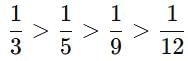
All the numerators are 1, the fraction with the smallest denominator will be the largest. Therefore:

So, the correct answer is A: 1/3.

Test: Fractions - 1 - Question 4

A paper strip is folded to make 1/2, then folded again to make 1/4, and once more to make 1/8.
If a student shades 6 pieces of 1/8, which simplified number does this represent on the number line?

Detailed Solution: Question 4

A paper strip is folded several times:

  • The first fold makes 1/2.
  • The second fold makes 1/4.
  • The third fold makes 1/8.

If a student shades 6 pieces of 1/8, we need to find out how much of the whole strip this represents.

To calculate this:

  • Each piece of 1/8 means there are 8 equal parts in the whole strip.
  • Shading 6 pieces means the student has shaded 6/8 of the strip.

Now, we can simplify 6/8:

  • Divide both the numerator and the denominator by 2.
  • This gives us 3/4.

On a number line, 3/4 represents three-quarters of the whole strip.

Test: Fractions - 1 - Question 5

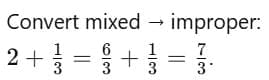
Which improper fraction represents the mixed fraction 

Detailed Solution: Question 5

Test: Fractions - 1 - Question 6

What is the correct order from smallest to largest for the fractions 1/2, 1/4, 1/3?

Detailed Solution: Question 6
To arrange the fractions 1/2, 1/4, and 1/3 from smallest to largest:

  • First, convert each fraction to a common denominator or compare their decimal values:
    • 1/4 = 0.25
    • 1/3 ≈ 0.33
    • 1/2 = 0.5
  • From the values above, the order from smallest to largest is:
    • 1/4
    • 1/3
    • 1/2

Thus, the correct order is 1/4, 1/3, 1/2.

Test: Fractions - 1 - Question 7

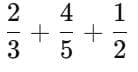
Using Brahmagupta’s method, evaluate:

Detailed Solution: Question 7

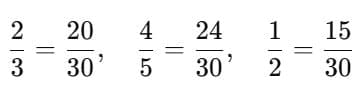
LCM of 3, 5 and 2 = 30

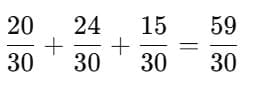
Add the fractions:

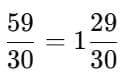
Convert to mixed fraction:

So, option (a) is the correct answer.

Test: Fractions - 1 - Question 8

Subtract using a suitable the method

Detailed Solution: Question 8

Option A is correct: 7/18.

Find the least common multiple (LCM) of the denominators 6 and 9. The LCM is 18.

Convert each fraction to an equivalent fraction with denominator 18. 5/6 = 15/18 and 4/9 = 8/18.

Subtract the numerators over the common denominator: 15/18 - 8/18 = 7/18.

Final answer: 7/18, so the correct option is A.

Test: Fractions - 1 - Question 9

Which of the following fractions is 3/4.

Detailed Solution: Question 9

To find which fraction is equivalent to 3/4​, let's check each option:

  • 6/11​ is not equivalent to 3/4.
  • 9/10​ is not equivalent to 3/4.
  • 15/20​ simplifies to 3/4​ because 15 ÷ 5 = 3 and 20 ÷ 5 = 4.
  • 21/25​ is not equivalent to 3/4.

So, the correct answer is (c) 15/20.

Test: Fractions - 1 - Question 10

Which of the following fractions is already in its lowest terms?

Detailed Solution: Question 10

A fraction is in lowest terms when the numerator and denominator have no common factor except 1.

36/60 — Both are divisible by 12, so not in lowest terms.
12/44 — Both are divisible by 4, so not in lowest terms.
27/45 — Both are divisible by 9, so not in lowest terms.
13/28 — 13 and 28 have no common factor except 1, so it is already in lowest terms.

Therefore, the fraction in lowest terms is 13/28.

32 videos|423 docs|23 tests
Information about Test: Fractions - 1 Page
In this test you can find the Exam questions for Test: Fractions - 1 solved & explained in the simplest way possible. Besides giving Questions and answers for Test: Fractions - 1, EduRev gives you an ample number of Online tests for practice
32 videos|423 docs|23 tests
Download as PDF