NEET Exam  >  NEET Test  >  Chemistry Class 12  >  Test: Characteristics of Halo Compounds - NEET MCQ

Characteristics of Halo Compounds - Free MCQ Practice Test with solutions,


MCQ Practice Test & Solutions: Test: Characteristics of Halo Compounds (10 Questions)

You can prepare effectively for NEET Chemistry Class 12 with this dedicated MCQ Practice Test (available with solutions) on the important topic of "Test: Characteristics of Halo Compounds". These 10 questions have been designed by the experts with the latest curriculum of NEET 2026, to help you master the concept.

Test Highlights:

  • - Format: Multiple Choice Questions (MCQ)
  • - Duration: 15 minutes
  • - Number of Questions: 10

Sign up on EduRev for free to attempt this test and track your preparation progress.

Test: Characteristics of Halo Compounds - Question 1

Which one of the following is likely to give a precipitate with AgNO3 solution?

Detailed Solution: Question 1

  • Tert-butyl chloride forms most stable 3° carbocation. So will give white precipitate of AgCl with AgNO3 solution immediately.
  • (CH₃)₃CCl reacts with AgNO₃ because it forms a stable tertiary carbocation upon ionization. This stable carbocation facilitates the reaction, allowing chloride ions (Cl⁻) to combine with Ag⁺ from AgNO₃, resulting in the formation of a white precipitate of AgCl:

(CH3​)3​CCl+AgNO3​→(CH3​)3​C++AgCl ↓

Hence, option (B) is the answer.

Test: Characteristics of Halo Compounds - Question 2

A solution of (–)-1-chloro-1-phenylethane in toluene racemises slowly in the presence of a small amount of SbCl5, due to the formation of


Detailed Solution: Question 2

During racemisation, carbocation intermediate is formed.

Hence option (A) is the answer.

Test: Characteristics of Halo Compounds - Question 3

In SN2 reactions, the correct order of reactivity for the following compounds: CH3Cl, CH3CH2Cl, (CH3)2CHCl and (CH3)3CCl is

Detailed Solution: Question 3
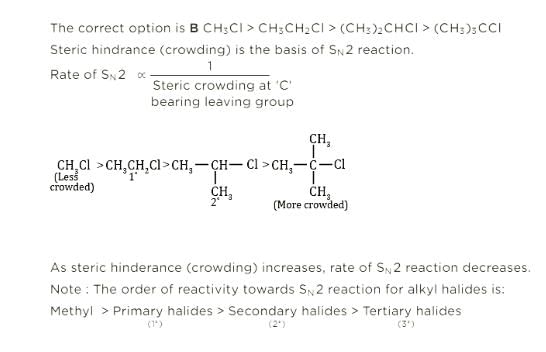
Test: Characteristics of Halo Compounds - Question 4

Elimination of bromine from 2-bromobutane results in the formation of

Detailed Solution: Question 4
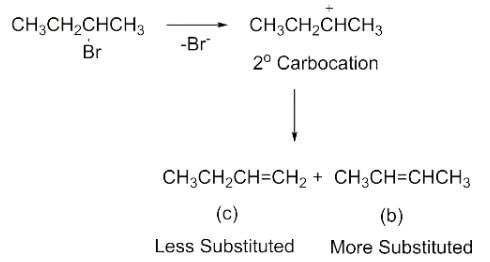
2-bromobutane → CH3CH = CHCH3 + CH3CH2CH=CH2

The major product follows Saytzeff rule.

Hence option (A) is the correct answer.

Test: Characteristics of Halo Compounds - Question 5

Which of the following is a tertiary halogenoalkanes?

Detailed Solution: Question 5

The carbon with which the Br is bonded with another 3 carbon atoms. So haloalkane is Tertiary Haloalkane.

Test: Characteristics of Halo Compounds - Question 6

 Which of the following is not true about optical isomers?

Detailed Solution: Question 6

Superimposable (mirror images of each other) substances are achiral because chiral substances cannot have its own mirror image. And achiral substances do not show optical activity nor any optical isomers. Hence, answer is B.

Test: Characteristics of Halo Compounds - Question 7

 Which of the following is not an aryl halide?

Detailed Solution: Question 7

 Because it is Open chain compound /Aliphatic Compound and not aryl halide as it does not contain halogen atom. It's simply  alkane.

Test: Characteristics of Halo Compounds - Question 8

Pick up the correct statement about alkyl halides.

Detailed Solution: Question 8

In general organic compounds are soluble in organic solvents. Hence alkyl halides are soluble in organic solvents.

Test: Characteristics of Halo Compounds - Question 9

 Which one of the following is 1-bromo-3-methyl butane?

Detailed Solution: Question 9
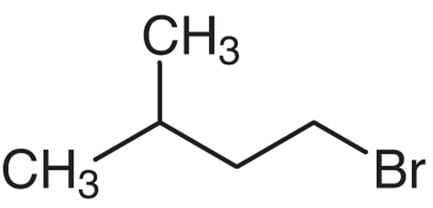
It is 1-bromo-3-methylbutane.

Test: Characteristics of Halo Compounds - Question 10

C5H11Br is least soluble in:

Detailed Solution: Question 10

C5H11Br are only very slightly soluble in water. They are more soluble in organic solvents.

54 videos|290 docs|74 tests
Information about Test: Characteristics of Halo Compounds Page
In this test you can find the Exam questions for Test: Characteristics of Halo Compounds solved & explained in the simplest way possible. Besides giving Questions and answers for Test: Characteristics of Halo Compounds, EduRev gives you an ample number of Online tests for practice
54 videos|290 docs|74 tests
Download as PDF