JEE Exam  >  JEE Test  >  Daily Test Preparation  >  Test: Methods of Preparation of Haloalkanes and Haloarenes(16 Nov) - JEE MCQ

Test: Methods of Preparation of Haloalkanes and Haloarenes(16 Nov) - JEE MCQ


Test Description

10 Questions MCQ Test Daily Test for JEE Preparation - Test: Methods of Preparation of Haloalkanes and Haloarenes(16 Nov)

Test: Methods of Preparation of Haloalkanes and Haloarenes(16 Nov) for JEE 2026 is part of Daily Test for JEE Preparation preparation. The Test: Methods of Preparation of Haloalkanes and Haloarenes(16 Nov) questions and answers have been prepared according to the JEE exam syllabus.The Test: Methods of Preparation of Haloalkanes and Haloarenes(16 Nov) MCQs are made for JEE 2026 Exam. Find important definitions, questions, notes, meanings, examples, exercises, MCQs and online tests for Test: Methods of Preparation of Haloalkanes and Haloarenes(16 Nov) below.
Solutions of Test: Methods of Preparation of Haloalkanes and Haloarenes(16 Nov) questions in English are available as part of our Daily Test for JEE Preparation for JEE & Test: Methods of Preparation of Haloalkanes and Haloarenes(16 Nov) solutions in Hindi for Daily Test for JEE Preparation course. Download more important topics, notes, lectures and mock test series for JEE Exam by signing up for free. Attempt Test: Methods of Preparation of Haloalkanes and Haloarenes(16 Nov) | 10 questions in 20 minutes | Mock test for JEE preparation | Free important questions MCQ to study Daily Test for JEE Preparation for JEE Exam | Download free PDF with solutions
*Multiple options can be correct
Test: Methods of Preparation of Haloalkanes and Haloarenes(16 Nov) - Question 1

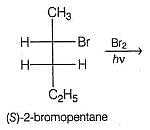
When (S)-2-bromopentane is brominated, several 2,3-dibromopentane are formed, which of the following is not formed?
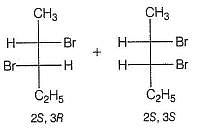
Detailed Solution for Test: Methods of Preparation of Haloalkanes and Haloarenes(16 Nov) - Question 1

During bromination of (S)-2-bromopentane, the configuration at second carbon is not affected. It remains R configuration. The configuration at the third carbon atom can be either S or R.

In options B and C, the configuration at the second carbon atom is R. Hence, they cannot be formed.

Test: Methods of Preparation of Haloalkanes and Haloarenes(16 Nov) - Question 2

The yield of alkyl bromide obtained as a result of heating the dry silver salt of carboxylic acid with bromine in CCI4 is
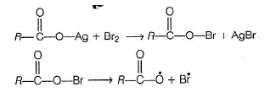
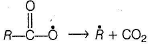
Detailed Solution for Test: Methods of Preparation of Haloalkanes and Haloarenes(16 Nov) - Question 2

The correct answer is (b) 3° > 2° > 1° bromides.

Explanation:

This reaction is the Hunsdiecker reaction, where the dry silver salt of a carboxylic acid is heated with bromine (Br₂) in CCl₄ to yield an alkyl bromide. The mechanism involves free-radical decarboxylation, and the yield of alkyl bromide depends on the stability of the intermediate alkyl radical.

Key Points:

    Reactivity Order:
    The stability of the alkyl radical formed during decarboxylation follows the order:
    3° > 2° > 1°.

    Tertiary (3°) radicals are most stable due to hyperconjugation and inductive effects.

    Primary (1°) radicals are least stable.

    Yield of Alkyl Bromide:
    Since the reaction proceeds via a radical intermediate, the yield of alkyl bromide correlates with radical stability:

    Highest yield for 3° bromide (most stable radical).

    Lowest yield for 1° bromide (least stable radical).

    Mechanism:

    The silver carboxylate (RCOOAg) reacts with Br₂ to form RCOOBr.

    Homolytic cleavage produces R• (alkyl radical) and CO₂.

    The alkyl radical then reacts with Br• to form R-Br.

Why Not Other Options?

(a) & (c): Incorrect because 1° bromides do not form in higher yields than 2° or 3°.

(d): Incorrect because 2° bromides form in higher yields than 1° (but lower than 3°).

Final Answer:

(b) 3° > 2° > 1° bromides (due to radical stability).

Additional Note:

The Hunsdiecker reaction is limited to stable radicals, so 3° and 2° substrates work best, while 1° often gives poor yields or side products.

Test: Methods of Preparation of Haloalkanes and Haloarenes(16 Nov) - Question 3

Which is incorrect about Hunsdiecker's reaction?

Detailed Solution for Test: Methods of Preparation of Haloalkanes and Haloarenes(16 Nov) - Question 3

Except F2, almost all halogens react with RCOOAg giving alkyl halide via Hunsdiecker reaction.

With l2 if RCOOAg is in excess, R— I formed in the first step reacts further with unreacted salt to give ester as
R—COOAg + R—I → R—COOR + AgI

Test: Methods of Preparation of Haloalkanes and Haloarenes(16 Nov) - Question 4

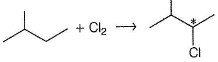
The major product of the following reaction is 
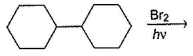
Detailed Solution for Test: Methods of Preparation of Haloalkanes and Haloarenes(16 Nov) - Question 4

Free radical bromination occur. Preferably at highest degree carbon where most stable free radical is formed.

Test: Methods of Preparation of Haloalkanes and Haloarenes(16 Nov) - Question 5

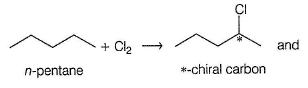
Racemic mixture is obtained due to the halogenation of
Detailed Solution for Test: Methods of Preparation of Haloalkanes and Haloarenes(16 Nov) - Question 5

If free radical halogenation generate a chiral carbon, racemic mixture of halides are always formed due to equal probability of halogenation from both sides of planar free radical.


Test: Methods of Preparation of Haloalkanes and Haloarenes(16 Nov) - Question 6

The reaction of SOCI2 on alkanols to form alkyl chlorides gives good yields because

Detailed Solution for Test: Methods of Preparation of Haloalkanes and Haloarenes(16 Nov) - Question 6


The gaseous byproducts escape out on its own continuously driving the reaction in forward direction.

Test: Methods of Preparation of Haloalkanes and Haloarenes(16 Nov) - Question 7

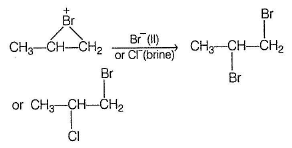
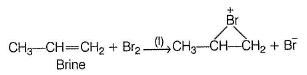
Addition of bromine on propene in the presence of brine yields a mixture of
Detailed Solution for Test: Methods of Preparation of Haloalkanes and Haloarenes(16 Nov) - Question 7


Nucleophilic attack in step-ll occur at the carbon atom which can better accommodate the positive charge. Hence, attack of Br- or Cl- in second step occur at 2° carbon rather that at 1° carbon.

Test: Methods of Preparation of Haloalkanes and Haloarenes(16 Nov) - Question 8

One or More than One Options Correct Type

Direction (Q. Nos. 8-12) This section contains 5 multiple choice questions. Each question has four choices (a), (b), (c) and (d), out of which ONE or MORE THAN ONE are correct.

Q. Which of the following reagents can bring about free radical chlorination of propane?

Detailed Solution for Test: Methods of Preparation of Haloalkanes and Haloarenes(16 Nov) - Question 8

Both SO2CI2 and Cl2 undergo homolytic bond fission when heated or irradiated with light.

*Multiple options can be correct
Test: Methods of Preparation of Haloalkanes and Haloarenes(16 Nov) - Question 9

What is the order of SNreaction of the alkyl halide?

Detailed Solution for Test: Methods of Preparation of Haloalkanes and Haloarenes(16 Nov) - Question 9

Answer: (b) The order of SNreaction of the alkyl halide is RI > RBr > RCl > RF.

Explanation: Iodine is a good nucleophile and a good leaving group. Thus, it eliminates easily from an alkyl halide favouring SNelimination reaction

*Multiple options can be correct
Test: Methods of Preparation of Haloalkanes and Haloarenes(16 Nov) - Question 10

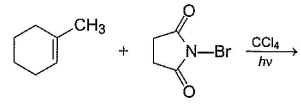
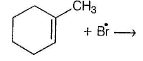
Consider the following reaction,

Q. 

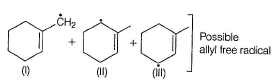
The expected product(s) is/are
Detailed Solution for Test: Methods of Preparation of Haloalkanes and Haloarenes(16 Nov) - Question 10

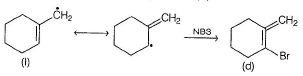
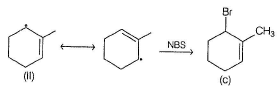
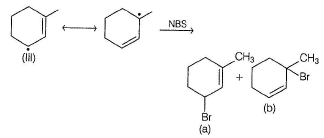
NBS in CCI4 brings about allylic brom ination by free radical mechanism:


360 tests
Information about Test: Methods of Preparation of Haloalkanes and Haloarenes(16 Nov) Page
In this test you can find the Exam questions for Test: Methods of Preparation of Haloalkanes and Haloarenes(16 Nov) solved & explained in the simplest way possible. Besides giving Questions and answers for Test: Methods of Preparation of Haloalkanes and Haloarenes(16 Nov), EduRev gives you an ample number of Online tests for practice
Download as PDF