
Probability-Total Probability & Bayes Theorem(15 Jan) - Free MCQ Practice
MCQ Practice Test & Solutions: Test: Probability-Total Probability & Bayes Theorem(15 Jan) (10 Questions)
You can prepare effectively for JEE Daily Test for JEE Preparation with this dedicated MCQ Practice Test (available with solutions) on the important topic of "Test: Probability-Total Probability & Bayes Theorem(15 Jan)". These 10 questions have been designed by the experts with the latest curriculum of JEE 2026, to help you master the concept.
Test Highlights:
- - Format: Multiple Choice Questions (MCQ)
- - Duration: 20 minutes
- - Number of Questions: 10
Sign up on EduRev for free to attempt this test and track your preparation progress.

A man is known to speak truth 3 out of 4 times. He throws a die and reports that it is a six. Find the probability that it is actually a six.
Detailed Solution: Question 1
Probability that A speaks truth is 5/9 . A coin is tossed and reports that a head appears. The probability that actually there was head is:
Detailed Solution: Question 2

A doctor is to visit a patient. From the past experience, it is known that the probabilities that he will come by train, bus, and scooter or by other means of transport are respectively 0.3, 0.2, 0.1 and 0.4. The probabilities that he will be late are 1/4 , 1/3 and 1/12, if he comes by train, bus and scooter respectively, but if he comes by other means of transport, then he will not be late. When he arrives, he is late. The probability that he comes by bus is:
Detailed Solution: Question 3
A bag ‘A’ contains 2 white and 3 red balls and a bag ‘B’ contains 4 white and 5 red balls. One ball is drawn at random from one of the bags and is found to be red. The probability that it was drawn from bag B is:
Detailed Solution: Question 4
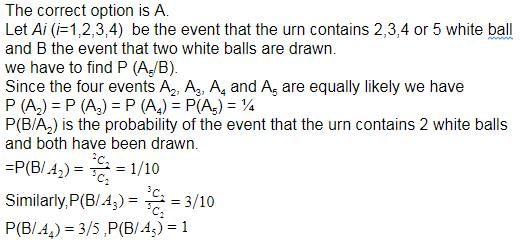
An urn contains five balls. Two balls are drawn and found to be white. The probability that all the balls are white is:
Detailed Solution: Question 5

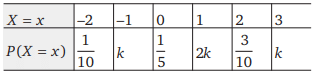
The distribution of a random variable  is given below
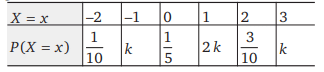
The value of  is
is
Detailed Solution: Question 6
A bag contains 4 red and 4 blue balls. Four balls are drawn one by one from the bag, then find the probability that the drawn balls are in alternate colour.
Detailed Solution: Question 7
 Event that first drawn ball is red, second is blue and so on.
  Event that first drawn ball is blue, second is red and so on.
  and
and 

It has been found that if  and
and  play a game 12 times,
  wins 6 times,
  wins 4 times and they draw twice.
  and
and  take part in a series of 3 games. The probability that they win alternately, is:
Detailed Solution: Question 8


An experiment consists of flipping a coin and then flipping it a second time if head occurs. If a tail occurs on the first flip, then a six-faced die is rolled once. Assuming that the outcomes are equally likely, what is the probability of getting one head and one tail?
Detailed Solution: Question 9

Rajesh doesn't like to study. Probability that he will study is  . If he studied then probability that he will fail is
  and ifhe didn't study then probability that he will fail is
  . If in result Rajesh failed then what is the probability that he didn't studied.
Detailed Solution: Question 10
 Case (ii) He didn't studied and failed, probability of this case is
  . So total probability is
  Then required probability
  .
.