NEET Exam  >  NEET Test  >  Biology Class 12  >  Test: Tools of Recombinant DNA Technology - NEET MCQ

Tools of Recombinant DNA Technology - Free MCQ Practice Test with solutions,


MCQ Practice Test & Solutions: Test: Tools of Recombinant DNA Technology (10 Questions)

You can prepare effectively for NEET Biology Class 12 with this dedicated MCQ Practice Test (available with solutions) on the important topic of "Test: Tools of Recombinant DNA Technology". These 10 questions have been designed by the experts with the latest curriculum of NEET 2026, to help you master the concept.

Test Highlights:

  • - Format: Multiple Choice Questions (MCQ)
  • - Duration: 10 minutes
  • - Number of Questions: 10

Sign up on EduRev for free to attempt this test and track your preparation progress.

Test: Tools of Recombinant DNA Technology - Question 1

Restriction endonuclease

Detailed Solution: Question 1

A restriction endonuclease is an enzyme that cuts the DNA molecule at, or near to, a specific nucleotide sequence to produce discrete DNA fragments that can be separated by gel electrophoresis.

Topic in NCERT: Restriction Enzymes and Their Function

Line in NCERT: "endonucleases make cuts at specific positions within the DNA."

Test: Tools of Recombinant DNA Technology - Question 2

For transformation, micro-particles coated with DNA to be bombarded with gene gun are made up of :

Detailed Solution: Question 2

Biolistics or gene gun is a direct or vectorless way used to introduce alien DNA into host cells. In this method of gene transfer, high velocity micro-particles of gold or tungsten, coated with DNA are bombarded on the plant cells. 

Topic in NCERT: PROCESSES OF RECOMBINANT DNA TECHNOLOGY

Line in NCERT: "cells are bombarded with high velocity micro-particles of gold or tungsten coated with DNA in a method known as biolistics or gene gun."

Test: Tools of Recombinant DNA Technology - Question 3

Two microbes found to be very useful in genetic engineering are

Detailed Solution: Question 3

Escherichia coli and Agrobacterium tumefaciens are the microbes found to be very useful in genetic engineering. 
E. coli is a motile, gram negative, rod shaped bacterium which is a normal inhabitant of human colon. It is most extensively used in bacterial genetics and molecular biology.
Agrobacterium tumefaciens is a soil bacterium. It has Ti plasmid (Tumour inducing plasmid) and it can be used for the transfer of a desired gene in dicot plants.

Topic in NCERT: Vectors for cloning genes in plants and animals

Line in NCERT: "Agrobacterium tumifaciens, a pathogen of several dicot plants is able to deliver a piece of DNA known as 'T-DNA' to transform normal plant cells into a tumor and direct these tumor cells to produce the chemicals required by the pathogen. Similarly, retroviruses in animals have the ability to transform normal cells into cancerous cells." "When this DNA is transferred into Escherichia coli, a bacterium closely related to Salmonella, it could replicate using the new host's DNA polymerase enzyme and make multiple copies."

Test: Tools of Recombinant DNA Technology - Question 4

Gel electrophoresis is used for

Detailed Solution: Question 4

Gel electrophoresis is used to separate macromolecules like DNA, RNA and proteins. DNA fragments are separated according to their size. Proteins can be separated according to their size and their charge (different proteins have different charges).

Topic in NCERT: Gel Electrophoresis

Line in NCERT: "The DNA fragments separate (resolve) according to their size through sieving effect provided by the agarose gel. Hence, the smaller the fragment size, the farther it moves."

Test: Tools of Recombinant DNA Technology - Question 5

A and B in pBR322, shown in the diagram given below, respectively represent recognition sequences of:
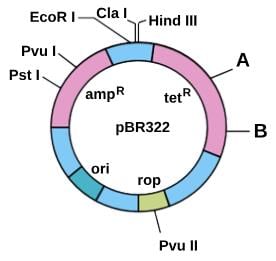
Detailed Solution: Question 5
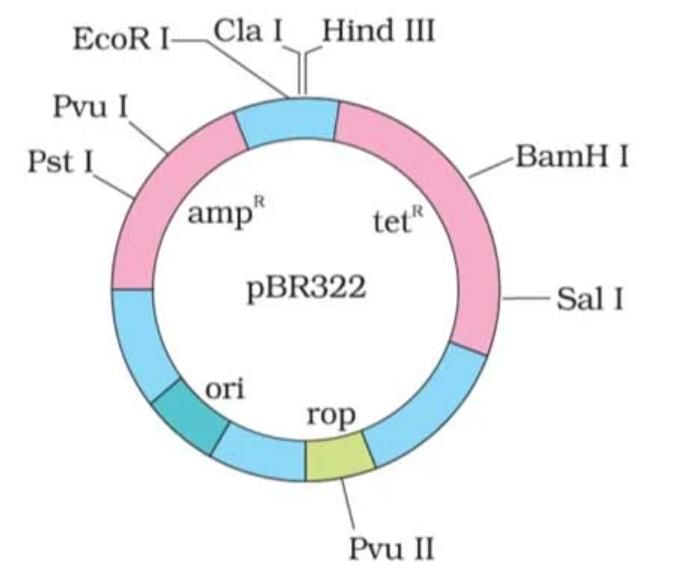
Test: Tools of Recombinant DNA Technology - Question 6

Elution is:

Detailed Solution: Question 6

  • The separated bands of DNA are cut out from the agarose gel and extracted from the gel piece.
  • This step is known as elution.
Topic in NCERT: Elution of DNA Fragments

Line in NCERT: "The separated bands of DNA are cut out from the agarose gel and extracted from the gel piece. This step is known as elution."

Test: Tools of Recombinant DNA Technology - Question 7

What is the primary function of the origin of replication (ori) in a DNA vector?

Detailed Solution: Question 7

The origin of replication (ori) is crucial for initiating the replication of the DNA within the host cells, ensuring that the DNA is copied during cell division.

Ncert Topic: Cloning Vectors

Ncert line: Origin of replication (ori) : This is a sequence from where replication starts and any piece of DNA when linked to this sequence can be made to replicate within the host cells. This sequence is also responsible for controlling the copy number of the linked DNA

Test: Tools of Recombinant DNA Technology - Question 8

Which of the following is NOT considered a useful selectable marker for E. coli?

Detailed Solution: Question 8

The drug resistance gene against penicillin is not typically used as a selectable marker in E. coli, as it does not provide a reliable means of selection compared to other antibiotic resistance genes.

Ncert Topic: Cloning Vectors ( Selectable Marker)

Ncert Line: Normally, the genes encoding resistance to antibiotics such as ampicillin, chloramphenicol, tetracycline or kanamycin, etc., are considered useful selectable markers for E. coli.

Test: Tools of Recombinant DNA Technology - Question 9

Which of the following statements given above is/are correct regarding restriction endonucleases?

i. Hind II was the first restriction endonuclease discovered and cuts DNA at a specific sequence of six base pairs.

ii. The convention for naming these enzymes is the first 2 letters of the name comes from the genus and the second one letter come from the species of the prokaryotic cell from which they were isolated.

iii. Exonucleases and endonucleases are both types of restriction enzymes that function by cutting DNA at specific sites.

iv. Each restriction endonuclease can only recognize and cut palindromic sequences in the DNA.

Detailed Solution: Question 9

Option C is correct.

  • Statement i is correct: Hind II was the first restriction endonuclease characterised and it recognises and cuts a specific six-base-pair DNA sequence.

  • Statement ii is incorrect: the standard naming convention uses the first letter of the genus and the first two letters of the species (for example, Eco from Escherichia coli), not the first two letters of the genus and one letter of the species as stated.

  • Statement iii is incorrect: restriction enzymes are a class of endonucleases that cut within DNA at specific recognition sites; exonucleases remove nucleotides from the ends of DNA and are not restriction enzymes.

  • Statement iv is correct in the standard text: most restriction endonucleases recognise specific palindromic nucleotide sequences and cut at those sites.

Therefore, only statements i and iv are correct, which corresponds to Option C.

Test: Tools of Recombinant DNA Technology - Question 10

Assertion (A): The use of alternative selectable markers in recombinant DNA technology simplifies the identification of recombinant colonies.

Reason (R): These markers allow for the differentiation of recombinants from non-recombinants based solely on color change in the presence of a chromogenic substrate.

Detailed Solution: Question 10

  • Assertion (A) Analysis: The assertion is true because alternative selectable markers indeed facilitate a more efficient identification process for recombinant colonies, reducing the complexity associated with traditional antibiotic selection methods.
  • Reason (R) Analysis: The reason is also true, as it accurately describes how these markers function by enabling visual differentiation through color change.
  • Explanation: The reason directly explains the assertion, as the simplification of the identification process is a direct result of the color change method provided by alternative selectable markers.
  • Ncert line: Selection of recombinants due to inactivation of antibiotics is a cumbersome procedure because it requires simultaneous plating on two plates having different antibiotics. Therefore, alternative selectable markers have been developed which differentiate recombinants from non-recombinants on the basis of their ability to produce colour in the presence of a chromogenic substrate.

69 videos|305 docs|161 tests
Information about Test: Tools of Recombinant DNA Technology Page
In this test you can find the Exam questions for Test: Tools of Recombinant DNA Technology solved & explained in the simplest way possible. Besides giving Questions and answers for Test: Tools of Recombinant DNA Technology, EduRev gives you an ample number of Online tests for practice
69 videos|305 docs|161 tests
Download as PDF