Chemistry Exam  >  Chemistry Test  >  Organic   >  Test: Pericyclic Level - 2 - Chemistry MCQ

Pericyclic Level - 2 - Free MCQ Practice Test with solutions, Chemistry


MCQ Practice Test & Solutions: Test: Pericyclic Level - 2 (30 Questions)

You can prepare effectively for Chemistry Organic Chemistry with this dedicated MCQ Practice Test (available with solutions) on the important topic of "Test: Pericyclic Level - 2". These 30 questions have been designed by the experts with the latest curriculum of Chemistry 2026, to help you master the concept.

Test Highlights:

  • - Format: Multiple Choice Questions (MCQ)
  • - Duration: 90 minutes
  • - Number of Questions: 30

Sign up on EduRev for free to attempt this test and track your preparation progress.

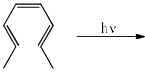
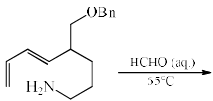
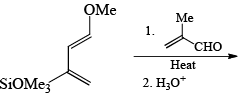
Test: Pericyclic Level - 2 - Question 1

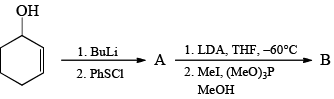
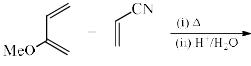
The major product of the following reaction is:

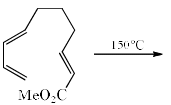
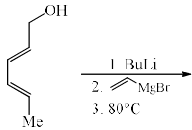
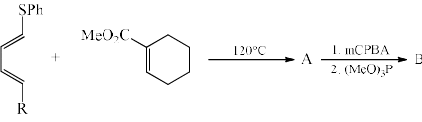
Test: Pericyclic Level - 2 - Question 2

The major product of the following reaction is:

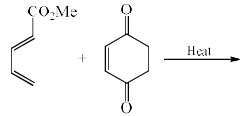
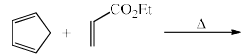
Test: Pericyclic Level - 2 - Question 3

The product of the following reaction is: 

Detailed Solution: Question 3

[4+2] cycloaddition, COOMe remains as it is and stereochemistry of 2 Hydrogen remains cis.

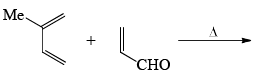
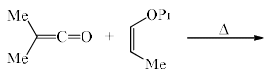
Test: Pericyclic Level - 2 - Question 4

The major product of the following reaction is:

Test: Pericyclic Level - 2 - Question 5

The product of the following reaction is:

Test: Pericyclic Level - 2 - Question 6

The product of the following reaction is:

Test: Pericyclic Level - 2 - Question 7

The product of the following reaction is:

Detailed Solution: Question 7
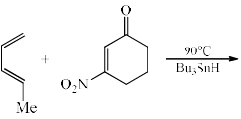
In the given reaction, a benzene ring (C6H6) reacts with ethyl vinyl ketone (CO2Et) under heat (Δ). This is a typical reaction known as the Diels-Alder reaction.

The Diels-Alder reaction involves the reaction of a diene (in this case, the benzene ring acting as the diene) with a dienophile (ethyl vinyl ketone). The product formed in such a reaction is a cyclohexene derivative with the ethyl ester group.

Given the options:

  • Option (a) shows a structure resembling the correct product formed by this reaction.

Therefore, the correct product for this reaction is option (a).

Test: Pericyclic Level - 2 - Question 8

The product of the following reaction is:

Test: Pericyclic Level - 2 - Question 9

The major product of the following reaction is:

Test: Pericyclic Level - 2 - Question 10

The product of the following reaction is:

Test: Pericyclic Level - 2 - Question 11

The major product of the following reaction is:

Test: Pericyclic Level - 2 - Question 12

The major product of the following reaction is:

Test: Pericyclic Level - 2 - Question 13

The major product of the following reaction is:

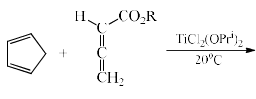
Test: Pericyclic Level - 2 - Question 14

The major product of the following reaction is:

Detailed Solution: Question 14

The reaction proceeds by a Diels-Alder cycloaddition between a conjugated diene and an electron-poor dienophile, giving a bicyclic adduct.

The endo product is favoured because of secondary orbital interactions between the dienophile's carbonyl π* and the diene π system; these interactions stabilise the transition state leading to the endo stereochemistry (the CO2R group oriented toward the newly formed bridging bond).

Coordination of the Lewis acid TiCl2(OPri)2 to the ester carbonyl lowers the dienophile LUMO, accelerating the reaction and further increasing endo selectivity; at 20°C the kinetically controlled endo product is predominant.

Therefore the major product is the endo bicyclic Diels-Alder adduct, which matches option A.

Test: Pericyclic Level - 2 - Question 15

The major product of the following reaction is:

Detailed Solution: Question 15

The major product of the reaction is option B. Here’s why:

  • The reaction involves nucleophilic substitution, which is common in these types of organic reactions.
  • In this scenario, the most suitable leaving group is replaced by the incoming nucleophile.
  • Option B is the structure that results from this substitution, making it the correct major product.

Understanding the mechanism helps to identify the correct product:

  • Electrophilic site: This is where the nucleophile attacks.
  • Leaving group: A good leaving group makes the reaction proceed smoothly.
  • Product formation: The final structure reflects the substitution that has taken place.

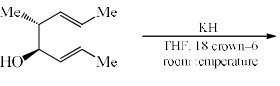
Test: Pericyclic Level - 2 - Question 16

The major product of the following is:

Detailed Solution: Question 16

Six membered transition state of chair form will give option A.

Test: Pericyclic Level - 2 - Question 17

The major product of the following reaction is:

Test: Pericyclic Level - 2 - Question 18

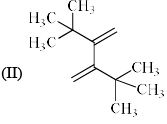
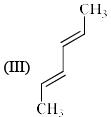
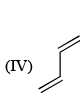
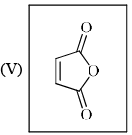
The reactivity of compound I-IV with maleic anhydride (V) follows the order:


Test: Pericyclic Level - 2 - Question 19

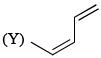
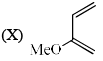
Order of reactivity of the following dienes X, Y and Z in Diels-Alder reaction is:
Test: Pericyclic Level - 2 - Question 20

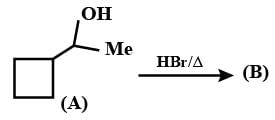
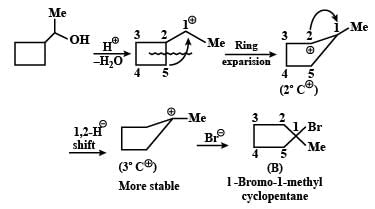
Give the major product and the mechanism involved in the following reaction.
Detailed Solution: Question 20
Test: Pericyclic Level - 2 - Question 21

Amongst the following the compound that does not act as a diene in Diels-Alder reaction is:

Test: Pericyclic Level - 2 - Question 22

In the reaction of Cyclopentadiene with acrylate ester giving diels-Alder reaction products, the interacting frontier orbitals are:

Test: Pericyclic Level - 2 - Question 23

Diels-Alder reaction normally yields endo-adduct as a major product. This is due to:

Test: Pericyclic Level - 2 - Question 24

Diels-Alder reaction is a:

Test: Pericyclic Level - 2 - Question 25

In the [4 + 2] cycloaddition of 1, 3-butadiene and ethylene:
Test: Pericyclic Level - 2 - Question 26

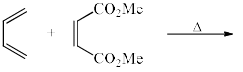
The major product of the reaction is:

Test: Pericyclic Level - 2 - Question 27

The major product of the following reaction is:

Detailed Solution: Question 27

The major product of the reaction is determined by the mechanism involved. Here's a breakdown:

  • The reaction likely proceeds via a nucleophilic substitution mechanism.
  • The substrate is most likely secondary or tertiary, favouring a SN1 mechanism.
  • In a SN1 reaction, the carbocation intermediate forms, which is stabilised by the surrounding groups.
  • The nucleophile then attacks this carbocation to form the product.

Test: Pericyclic Level - 2 - Question 28

The reaction of 1-bromo-2-fluorobenzene with furan in the presence of one equivalent to Mg gives 

Test: Pericyclic Level - 2 - Question 29

The diene which undergoes Diels–Alder reaction with maleic anhydride is:

Test: Pericyclic Level - 2 - Question 30

In a Diels–Alder reaction, the most reactive diene amongst the following is:

39 videos|96 docs|46 tests
Information about Test: Pericyclic Level - 2 Page
In this test you can find the Exam questions for Test: Pericyclic Level - 2 solved & explained in the simplest way possible. Besides giving Questions and answers for Test: Pericyclic Level - 2, EduRev gives you an ample number of Online tests for practice
39 videos|96 docs|46 tests
Download as PDF