SSC CGL Exam  >  SSC CGL Test  >   Previous Year Papers  >  Test: SSC CGL Previous Year Questions: History (2023-20) - 6 - SSC CGL MCQ

SSC CGL Previous Year Questions: History (2023-20) - 6 with solutions -


MCQ Practice Test & Solutions: Test: SSC CGL Previous Year Questions: History (2023-20) - 6 (100 Questions)

You can prepare effectively for SSC CGL SSC CGL Previous Year Papers with this dedicated MCQ Practice Test (available with solutions) on the important topic of "Test: SSC CGL Previous Year Questions: History (2023-20) - 6". These 100 questions have been designed by the experts with the latest curriculum of SSC CGL 2026, to help you master the concept.

Test Highlights:

  • - Format: Multiple Choice Questions (MCQ)
  • - Duration: 60 minutes
  • - Number of Questions: 100

Sign up on EduRev for free to attempt this test and track your preparation progress.

Test: SSC CGL Previous Year Questions: History (2023-20) - 6 - Question 1

In 1342, one of the nobles, Haji Ilyas Khan united Bengal and became its ruler under the title of __________and laid the foundation of the Ilyas Shah dynasty. [SSC CPO 11/11/2022 (Morning)]

Detailed Solution: Question 1

Shams-ud-din Ilyas Shah {(founder of Bengal Sultanate and Ilyas Shahi dynasty (First dynasty of Bengal)}. Dynasties of Bengal Sultanate - Ilyas Shahi (1342-1415), Ganesha (1414 -1435), Restorer of Ilyas Dynasty (Nasiruddin Mahmud Shah-I, 1435 -1487), Habshi rule (Shahzada Barbak, 1487-1494) and Hussain Shahi dynasty (Alauddin Hussain Shah - 1494-1519).

Test: SSC CGL Previous Year Questions: History (2023-20) - 6 - Question 2

Who was the architect of the famous Mysore Palace in Karnataka? [Graduate Level 03/08/2022 (Shift - 3)]

Detailed Solution: Question 2

Henry Irwin. Mysore Palace (also known as Amba Villas) is a historical palace at Mysore in Karnataka. It was the official residence of the Wadiyar dynasty. Mysore Palace was constructed in Indo-Saracenic style architecture.

Test: SSC CGL Previous Year Questions: History (2023-20) - 6 - Question 3

The Vimana in the Dravidian style of temple architecture is usually in which shape? [Higher Secondary 01/08/2022 (Shift - 3)]

Detailed Solution: Question 3

Pyramidal. Gopuram (entrance gateway in the center of the front wall). Antarala (vestibular tunnel), garbhagriha (the innermost sanctuary of a Hindu and Jain temple). Famous Dravidian Temples - Rajarajeswara or Brihadeshwara temple (Rajaraja Chola at Thanjavur), Gangaikondacholapuram temple (Rajendra I), Annamalaiyar Temple (Tiruvannamalai, Tamil Nadu), Meenakshi Temple (Tamil Nadu), Airavatesvara Temple (Tamil Nadu) etc.

Test: SSC CGL Previous Year Questions: History (2023-20) - 6 - Question 4

Consider the following statements about a fort: 1. It was originally known as Mankal. 2. It was built on a hilltop in 1143. In the above mentioned sentences, forts is being talked about? [SSC MTS 05/07/2022 (Evening)]

Detailed Solution: Question 4

Golconda fort (Hyderabad; Built by the Qutb shahi dynasty). Chitradurga fort (Karnataka; built by the Chalukyas and Hoysalas, later the Nayakas of Chitradurga of the Vijayanagar Empire. Daulatabad fort (Maharashtra; built by Yadava dynasty), and Aguada Fort (Goa; built by Portuguese).

Test: SSC CGL Previous Year Questions: History (2023-20) - 6 - Question 5

The ancient Neemrana Baori is located in which of the following districts of Rajasthan? [SSC MTS 11/07/2022 (Evening)]

Detailed Solution: Question 5

Alwar. Famous Baori in India - Chand Baori (Rajasthan), Agrasen Ki Baoli (New Delhi), Rani ki Vav (Gujarat), Pushkarani (Karnataka), Baoli Ghaus Ali Shah (Haryana), Mata Bhavani ni Vav (Gujarat), Rajon ki Baoli (New Delhi), Surya Kund (Gujarat).

Test: SSC CGL Previous Year Questions: History (2023-20) - 6 - Question 6

Which of the following was an integral part of the Indo-Islamic form of architecture? [SSC MTS 18/07/2022 (Morning)]

Detailed Solution: Question 6

Dome (large hemispherical roof), arch, and Muqarnas vault. Styles of Indo-Islamic Architecture: The Imperial Style (Delhi sultanate); The Provincial styles (Mandu, Gujarat, Bengal, and Jaunpur); The Mughal Style (Delhi, Agra, and Lahore); The Deccani style (Bijapur and Golconda).

Test: SSC CGL Previous Year Questions: History (2023-20) - 6 - Question 7

The Mughal emperor Bahadur Shah Zafar died in______. [SSC MTS 25/07/2022 (Afternoon)]

Detailed Solution: Question 7

1862. Bahadur Shah Zafar was a titular Emperor, as the Mughal Empire existed in name only and his authority was limited only to the walled city of Old Delhi (Shahjahanabad). Following his involvement in the Indian Mutiny of 1857, the British exiled him to Rangoon in British-controlled Burma in 1858, after convicting him on several charges.

Test: SSC CGL Previous Year Questions: History (2023-20) - 6 - Question 8

In 1590, the Govind Deva temple of Vrindavan, near Mathura was constructed from ______ sandstone. [SSC MTS 26/07/2022 (Morning)]

Detailed Solution: Question 8

Red. The Govind Deva temple was built by the king of Jaipur, Man Singh, in 1590 in Vrindavan in Uttar Pradesh.

Test: SSC CGL Previous Year Questions: History (2023-20) - 6 - Question 9

King Lalitaditya Muktapida ruled over ______. [SSC CGL 12/04/2022 (Evening)]

Detailed Solution: Question 9

Kashmir. Amad Shah I was the rst independent sultan of Gujarat, who founded Ahmedabad (1411).The Chogyal (king who governs with righteousness) Palden Namgyal Thodup was crushed in 1975 and Sikkim merged with India as its 22nd state. King Mahabali ruled over Kerala.

Test: SSC CGL Previous Year Questions: History (2023-20) - 6 - Question 10

'Rang Ghar', one of Asia's oldest amphitheatres, was built by the king of the ___dynasty. [SSC MTS 18/10/2021 (Evening)]

Detailed Solution: Question 10

Ahom Dynasty. Rang Ghar, constructed by the Ahom King Swargadeo Promotta Singha.

Test: SSC CGL Previous Year Questions: History (2023-20) - 6 - Question 11

Who among the following was the founder of the Bhakti sect named 'Pushtimarg'? [SSC MTS 20/10/2021 (Morning)]

Detailed Solution: Question 11

Vallabhacharya founded the Krishna-centered PushtiMarg sect of Vaishnavism in the Braj region of India, and the philosophy of Shuddha advaita (Pure Nondualism). Pushtimarg is a form of Krishna worship for adoration.

Test: SSC CGL Previous Year Questions: History (2023-20) - 6 - Question 12

Prophet Muhammad founded the faith of Islam in the ______ century. [SSC CGL 24/08/2021 (Morning)]

Detailed Solution: Question 12

Seventh century. Islam is the 2nd largest religion in the world. Largest religion - Christianity.

Test: SSC CGL Previous Year Questions: History (2023-20) - 6 - Question 13

Who among the following was appointed as the curator of ancient monuments in 1880? [SSC CHSL 15/04/2021 (Morning)] 

Detailed Solution: Question 13

HH Cole. He was a British civil servant and inventor who facilitated many innovations in commerce and Education.

Test: SSC CGL Previous Year Questions: History (2023-20) - 6 - Question 14

Which part of India did the Nizams of Asaf Jahi dynasty rule? [SSC CHSL 10/08/2021 (Morning)]

Detailed Solution: Question 14

Deccan provinces. The Asaf Jahi was a Muslim dynasty that ruled the Kingdom of Hyderabad. It was founded by Nizam al-Mulk who was intermittently viceroy of the Deccan (peninsular India) under the Mughal emperors from 1713 to 1721 and who resumed the post again under the title Aaf Jah in 1724.

Test: SSC CGL Previous Year Questions: History (2023-20) - 6 - Question 15

Who among the following was a Portuguese writer who wrote about the trade and society in South India? [SSC CHSL 10/08/2021 (Morning)]

Detailed Solution: Question 15

Duarte Barbosa was the Portuguese writer who visited India during (1500-1516) and wrote about the trade and society in South India in his manuscript, ‘The Book of Duarte Barbosa’.

Test: SSC CGL Previous Year Questions: History (2023-20) - 6 - Question 16

Who among the following did NOT belong to the Rajput kingdom of Marwar? [SSC CPO 24/11/2020 (Morning)]

Detailed Solution: Question 16

Rana Kumbha was associated with the Mewar Kingdom. He belonged to the Sisodia clan. He Built Vijaya Stambha (dedicated to lord Vishnu) within Chittor Fort in 1448 to commemorate his victory over the army of Malwa led by Mahmud Khalji in the Battle of Sarangpur.

Test: SSC CGL Previous Year Questions: History (2023-20) - 6 - Question 17

Khan Bahadur led the revolt of 1857 from: [SSC CGL 24/07/2023 (2nd shift)]

Detailed Solution: Question 17

Bareilly. Bahadur Shah II, the last Mughal Emperor led the revolt from Delhi. Nana Sahib led the revolt from Kanpur, he was the adopted son of Peshwa Baji Rao II.

Test: SSC CGL Previous Year Questions: History (2023-20) - 6 - Question 18

The sepoys of Meerut arrived at the Gates of Red Fort to meet the Mughal emperor, Bahadur Shah on _____________. [SSC MTS 16/05/2023 (Evening)]

Detailed Solution: Question 18

11 May, 1857. The Indian Mutiny began from Meerut on 10 May 1857.

Test: SSC CGL Previous Year Questions: History (2023-20) - 6 - Question 19

Who was the Governor-General when the first railway line was laid ? [SSC Stenographer 13/10/2023 (Evening)]

Detailed Solution: Question 19

Lord Dalhousie (Governor -General of India from 1848 to 1856). He was also known as the father of Indian Railways. The first railway line in India was laid in 1853 from Bombay (now Mumbai) to Thane, a distance of 21 miles (34 km) and was operated by the Great Indian Peninsula Railway Company. Warren Hastings (1772-1785) - First Governor-General of Bengal. Lord Cornwallis (Governor-General, 1786-93) - First to bring into existence and organize civil services. Lord William Bentinck (1828-1835) - First Governor-general of India.

Test: SSC CGL Previous Year Questions: History (2023-20) - 6 - Question 20

Who among the following was the Governor General of India when the Permanent Settlement was introduced in Bengal for revenue collection by the East India Company? [SSC CHSL 14/08/2023 (2nd shift)]

Detailed Solution: Question 20

Lord Cornwallis. Provision of Permanent Settlement - The Zamindars' proprietorship would stay as long as he paid the xed revenue at the said date to the government. Other States where Permanent Settlement Implemented - Bihar, Odisha. Other Settlements Related to Agriculture - Ryotwari System (Sir Thomas Munro), Mahalwari System (Holt Mackenzie).

Test: SSC CGL Previous Year Questions: History (2023-20) - 6 - Question 21

____________ announced the bifurcation of the British Indian Empire into a secular India and Islamic Pakistan. [SSC CGL 14/07/2023 (3rd shift)]

Detailed Solution: Question 21

Lord Louis Mountbatten (last Viceroy of India). Lord Curzon - Viceroy (1899 - 1905): He announced the partition of Bengal Presidency In July 1905.

Test: SSC CGL Previous Year Questions: History (2023-20) - 6 - Question 22

Elphinstone was the Governor of which province of India during 1819-27? [SSC CGL 20/07/2023 (1st shift)]

Detailed Solution: Question 22

Bombay. Elphinstone: Known for the compilation of the Elphinstone code (a uniform scheme of criminal law). In 1808 he was sent to negotiate an alliance with the Afghan ruler Shah Shoja to prevent a Napoleonic advance upon India.

Test: SSC CGL Previous Year Questions: History (2023-20) - 6 - Question 23

Who designed the administrative code to separate revenue administration from judicial administration? [SSC CGL 21/07/2023 (2nd shift)]

Detailed Solution: Question 23

Lord Cornwallis. He introduced Permanent settlement in 1793 in Bengal. He is known as 'the Father of civil service in India', Governor general of Bengal (1786-93).

Test: SSC CGL Previous Year Questions: History (2023-20) - 6 - Question 24

Governor general Lord Dalhousie described the Kingdom of _______"as a cherry that will drop into our mouth one day". [SSC MTS 08/05/2023 (Evening)]

Detailed Solution: Question 24

Awadh. Lord Dalhousie said this in 1851. Awadh Kingdom was formally annexed to the British Empire in 1856. The doctrine declared that if an Indian ruler died without a male heir his kingdom would “lapse”, that is, become part of Company territory. One kingdom after another was annexed simply by applying this doctrine:- Satara (1848), Sambalpur (1850), Udaipur (1852), Nagpur (1853) and Jhansi (1854).

Test: SSC CGL Previous Year Questions: History (2023-20) - 6 - Question 25

Under ________ (Governor General from 1813 to 1823) a new policy of "paramountcy" was initiated. Now the Company claimed that its authority was paramount or supreme, hence its power was greater than that of Indian states. [SSC CHSL 17/03/2023 (2nd Shift)]

Detailed Solution: Question 25

Lord Hastings (Anglo-Nepal War took place between 1814 and 1816). Lord Amherst was Governor-General of India from 1823 to 1828.

Test: SSC CGL Previous Year Questions: History (2023-20) - 6 - Question 26

_________ introduced the daroga system, replacing zamindari thanedars under the direct control of the district head and on its payroll. [Graduate Level 05/08/2022 (Shift - 3)]

Detailed Solution: Question 26

Lord Cornwallis - Cornwallis Code (1793), Father of Civil Services in India, Third Anglo-Mysore War (1789 - 1792) - (Lord Cornwallis and Tipu sultan), Permanent Settlement (1793) in Bengal.

Test: SSC CGL Previous Year Questions: History (2023-20) - 6 - Question 27

Match the following Acts/Policies with the respective years in which they were put into place.
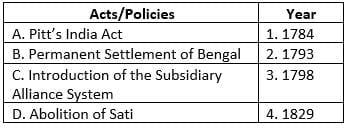
[SSC CHSL Tier II 10/01/2024]

Detailed Solution: Question 27

Major acts/policies with respective year during British rule : Regulating Act (1773), Pitt's India Act (1784), The act of good governance (1858), The Prevention of seditious meetings Act (1907), The Explosives Substances Act (1908), Rowlatt Act (1919), Permanent settlement (1793), Cornwallis Code (1793).

Test: SSC CGL Previous Year Questions: History (2023-20) - 6 - Question 28

When was the Defence of India Act enacted? [SSC MTS 12/09/2023 (2nd Shift)]

Detailed Solution: Question 28

1915. The Defence of India Act (1915) - It was an emergency law that gave the British government in India wide powers to suppress dissent and maintain public order during World War I. It was passed by the then Governor General of India Lord Hardinge.

Test: SSC CGL Previous Year Questions: History (2023-20) - 6 - Question 29

In India which Act divided the powers between the Central and units in terms of three lists? [SSC CHSL 09/08/2023 (3rd shift)]

Detailed Solution: Question 29

1935. Government of India Act, 1935 : Contain three lists, Federal List (for Centre containing 59 items), Provincial List (for provinces containing 54 items) and the Concurrent List (for both containing 36 items). The seventh schedule (Article 246) deals with the division of powers between the union and the states.

Test: SSC CGL Previous Year Questions: History (2023-20) - 6 - Question 30

In which of the following years did the East India Company abolish the diarchy system of Bengal? [SSC CHSL 11/08/2023 (1st shift)]

Detailed Solution: Question 30

1772. The system of Dual Government: Introduced in Bengal by Robert Clive of British East India Company. It lasted from 1765 to 1772. Under this system, the administration of Bengal was divided into Nizamat and Diwani. The Diwani was carried out by the company and the Nizamat by the Nizam.

View more questions
313 docs|325 tests
Information about Test: SSC CGL Previous Year Questions: History (2023-20) - 6 Page
In this test you can find the Exam questions for Test: SSC CGL Previous Year Questions: History (2023-20) - 6 solved & explained in the simplest way possible. Besides giving Questions and answers for Test: SSC CGL Previous Year Questions: History (2023-20) - 6, EduRev gives you an ample number of Online tests for practice
Download as PDF