SSC CGL Exam  >  SSC CGL Test  >   Previous Year Papers  >  Test: SSC CGL Previous Year Questions: Biology (2023-20) - 1 - SSC CGL MCQ

SSC CGL Previous Year Questions: Biology (2023-20) - 1 with solutions -


MCQ Practice Test & Solutions: Test: SSC CGL Previous Year Questions: Biology (2023-20) - 1 (100 Questions)

You can prepare effectively for SSC CGL SSC CGL Previous Year Papers with this dedicated MCQ Practice Test (available with solutions) on the important topic of "Test: SSC CGL Previous Year Questions: Biology (2023-20) - 1". These 100 questions have been designed by the experts with the latest curriculum of SSC CGL 2026, to help you master the concept.

Test Highlights:

  • - Format: Multiple Choice Questions (MCQ)
  • - Duration: 60 minutes
  • - Number of Questions: 100

Sign up on EduRev for free to attempt this test and track your preparation progress.

Test: SSC CGL Previous Year Questions: Biology (2023-20) - 1 - Question 1

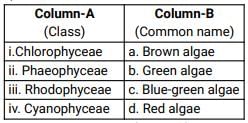
Match the columns.

[SSC CGL 14/07/2023 (1st shift)]

Detailed Solution: Question 1

The correct one-to-one match is i-b, ii-a, iii-d, iv-c.

Chlorophyceae: common name green algae; main pigment chlorophyll; stored food starch; example Spirogyra.

Phaeophyceae: common name brown algae; characteristic pigment fucoxanthin (with chlorophylls); stored food mannitol and laminarin; example Sargassum.

Rhodophyceae: common name red algae; dominant pigments include phycoerythrin; stored food floridean starch; example Gracilaria.

Cyanophyceae: common name blue-green algae; pigments include chlorophyll a and phycobilins (phycocyanin/phycoerythrin); stored food is glycogen/cyanophycean starch; example Nostoc.

From these standard class-to-common-name correspondences the matching becomes i-b, ii-a, iii-d, iv-c, therefore Option B is the correct choice.

Test: SSC CGL Previous Year Questions: Biology (2023-20) - 1 - Question 2

Select the INCORRECT statement with regards to vitamins.
[SSC CHSL Tier II 02/11/2023]

Detailed Solution: Question 2

Gut bacteria help in supplying essential nutrients, synthesising vitamin K, aiding in the digestion of cellulose. Vitamins A, D, E, and K are fat-soluble and vitamins C and B (complex group vitamins) are water-soluble.

Test: SSC CGL Previous Year Questions: Biology (2023-20) - 1 - Question 3

Which essential micronutrient plays a clear role in the synthesis, storage, and secretion of insulin in the hexameric form as well as in the conformational integrity of insulin?
[SSC Stenographer 12/10/2023 (Evening)]

Detailed Solution: Question 3

Micronutrients are vitamins and minerals needed by the body in very small amounts. Role of some micronutrients in our body: Fluoride inhibits the initiation and progression of dental caries (tooth decay) and stimulates new bone formation. Selenium (Se) plays a critical role in reproduction, thyroid hormone metabolism, DNA synthesis, and protection from oxidative damage and infection. Phosphorus is a component of bones, teeth, DNA, and RNA.

Test: SSC CGL Previous Year Questions: Biology (2023-20) - 1 - Question 4

Which of the following was the first B vitamin discovered in 1897 that is essential in amino acid and carbohydrate metabolism and is active in energy production reactions?
[SSC CPO 03/10/2023 (Afternoon)]

Detailed Solution: Question 4

Casimir Funk is considered the 'Father of vitamin therapy'. Vitamin B: B1 (thiamine), B2 (riboflavin), B3 (niacin), B5 (pantothenic acid), B6 (pyridoxine), B7 (biotin), B9 (folic acid), B12 (cobalamin). Fat-soluble vitamins: A, D, E, and K. Water-soluble vitamins: B and C.

Test: SSC CGL Previous Year Questions: Biology (2023-20) - 1 - Question 5

Which of the following vitamins prevents major birth defects of the brain and spine of a newborn baby?
[SSC MTS 12/09/2023 (2nd Shift)]

Detailed Solution: Question 5

Folic Acid (Vitamin - B9) : It helps to prevent and cure low levels of folates. Folates play an important role in forming red blood cells and maintaining brain health. Sources - Dark green leafy vegetables, beans, peanuts, fruits, whole grains.

Test: SSC CGL Previous Year Questions: Biology (2023-20) - 1 - Question 6

Which essential amino acid is necessary for the production of our brain’s chemical messengers including melatonin, dopamine, noradrenaline and thyroxine?
[SSC CHSL 17/08/2023 (1st shift)]

Detailed Solution: Question 6

Phenylalanine is an essential amino acid to make proteins and other vital molecules such as neurotransmitters and hormones. Leucine amino acids can be used by skeletal muscle to give energy during exercise. Tryptophan is an amino acid needed for normal growth in infants and for the production and maintenance of the body's proteins, muscles, enzymes, and neurotransmitters.

Test: SSC CGL Previous Year Questions: Biology (2023-20) - 1 - Question 7

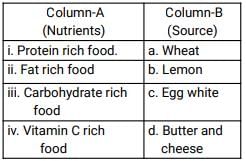
Which of the following is the correct match of column-A with column-B?

[SSC CGL 17/07/2023 (1st shift)]

Detailed Solution: Question 7

i-c, ii-d, iii-a, iv-b. Important Nutrients in Food and their functions: Carbohydrates - One of the main sources of energy for human beings. Three types of carbohydrates in food - Fiber, Sugar, and Starch. Iron - It is a constituent of our red blood cells whose function is to carry oxygen from our lungs to organs, muscles, and cells.

Test: SSC CGL Previous Year Questions: Biology (2023-20) - 1 - Question 8

Which of the following vitamins helps our body to use calcium for bones and teeth?
[SSC MTS 19/06/2023 (Morning)]

Detailed Solution: Question 8

Vitamin D (Calciferol).
It helps prevent osteoporosis (a disease that thins and weakens the bones, making them brittle and more likely to break). Source: Oily fish, egg yolks, red meat, etc.

Test: SSC CGL Previous Year Questions: Biology (2023-20) - 1 - Question 9

Which among the following is a fat-soluble vitamin?
[SSC CHSL 20/03/2023 (1st Shift)]

Detailed Solution: Question 9

Vitamin D promotes calcium absorption in the intestine and maintains adequate serum calcium and phosphate concentrations to enable normal bone mineralization and prevent hypocalcemic tetany (involuntary contraction of muscles, leading to cramps and spasms).

Test: SSC CGL Previous Year Questions: Biology (2023-20) - 1 - Question 10

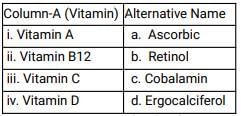
Match Column-A with Column-B


[SSC CGL 01/12/2022 (Shift - 3)]

Detailed Solution: Question 10

- Vitamin A is known as Retinol. So, the match is i-b.
- Vitamin B12 is known as Cobalamin. So, the match is ii-c.
- Vitamin C is known as Ascorbic Acid. So, the match is iii-a.
- Vitamin D is known as Ergocalciferol. So, the match is iv-d.
Therefore, the correct matching is: i-b, ii-c, iii-a, iv-d. The correct answer is D.

Test: SSC CGL Previous Year Questions: Biology (2023-20) - 1 - Question 11

Which of the following statements is correct?
I. Adolescence is the period of transition between childhood and adulthood and is crucial for mental well-being.
II. Adolescents generally fall in the age group of 10 to 19 years and their nutrition requirements are higher than those of adults.
[SSC CGL 02/12/2022 (Shift - 3)]

Detailed Solution: Question 11

Adolescence is the period of transition between childhood and adulthood and is a crucial developmental stage for mental well-being. The nutrition requirements of adolescents are higher than adults, and adolescents are generally grouped in the age group of 10 to 19 years.

Test: SSC CGL Previous Year Questions: Biology (2023-20) - 1 - Question 12

Nuts, vegetable oil, and fish are rich sources of _________.
[SSC CPO 11/11/2022 (Morning)]

Detailed Solution: Question 12

Most common forms of carbohydrates are sugars, fibers, and starches. Minerals essential for health include iron, calcium, magnesium, zinc, potassium, etc.

Test: SSC CGL Previous Year Questions: Biology (2023-20) - 1 - Question 13

Which of the following vitamins is absent in eggs?
[Higher Secondary 01/08/2022 (Shift - 3)]

Detailed Solution: Question 13

Vitamin C (ascorbic acid) is found in citrus fruits (oranges), peppers, strawberries, blackcurrants, broccoli, brussels sprouts, potatoes, etc.

Test: SSC CGL Previous Year Questions: Biology (2023-20) - 1 - Question 14

Which of the following is a micronutrient, and plays a role in cell division, cell growth, wound healing, and the breakdown of carbohydrates?
[Higher Secondary 03/08/2022 (Shift - 4)]

Detailed Solution: Question 14

Functions of Macronutrients in Plants: Nitrogen (required in large amounts, taken in the form of ions, required for the division of cells), Phosphorus (a constituent of cell membranes), Magnesium (involved in the activation of enzymes in respiration and photosynthesis and helps in the synthesis of DNA and RNA), Sulfur (an important constituent of amino acids, coenzymes, and vitamins), Potassium (required for the opening and closing of stomata).

Test: SSC CGL Previous Year Questions: Biology (2023-20) - 1 - Question 15

What components are often called the building blocks of the body that play a vital role in helping to repair and strengthen muscle tissues after exercise?
[SSC CHSL 03/06/2022 (Morning)]

Detailed Solution: Question 15

Three important building blocks of the body are amino acids, lipids, and nucleotides. Uses: development of muscles and organs, production of hormones and antibodies, storage of fat, and production of energy.

Test: SSC CGL Previous Year Questions: Biology (2023-20) - 1 - Question 16

Which is a major essential lipophilic (fat-soluble) vitamin required for the protection of cell membranes and the formation of red blood cells (RBCs)?
[SSC CHSL 10/06/2022 (Evening)]

Detailed Solution: Question 16

Vitamin E (Tocopherol) is a nutrient that's important to vision, reproduction, and the health of blood, brain, and skin.

Test: SSC CGL Previous Year Questions: Biology (2023-20) - 1 - Question 17

A typical adult human body contains about ______ of magnesium.
[SSC CGL 13/04/2022 (Evening)]

Detailed Solution: Question 17

Magnesium is required for the proper growth and maintenance of bones. Magnesium helps keep blood pressure normal, bones strong, and the heart rhythm steady.

Test: SSC CGL Previous Year Questions: Biology (2023-20) - 1 - Question 18

Starch and sugar in our food are forms of _____.
[SSC MTS 06/10/2021 (Morning)]

Detailed Solution: Question 18

Carbohydrates are the main source of energy for the body. They are sugars, starches, and dietary fibers found in plant foods and dairy products.

Test: SSC CGL Previous Year Questions: Biology (2023-20) - 1 - Question 19

When the breakdown of food (glucose) occurs without the use of oxygen, it is called:
[SSC MTS 18/10/2021 (Afternoon)]

Detailed Solution: Question 19

Aerobic respiration is the process by which organisms use oxygen to turn fuel, such as fats and sugars, into chemical energy. Cellular respiration is the process by which organisms combine oxygen with foodstuff molecules. Capillary respiration is the process where blood flows through capillaries and collects oxygen from the alveoli.

Test: SSC CGL Previous Year Questions: Biology (2023-20) - 1 - Question 20

Which organism among the following breaks down the food material outside the body and then absorbs it?
[SSC MTS 27/10/2021 (Afternoon)]

Detailed Solution: Question 20

Mushrooms, Yeast, and Bread mold are saprophytic. They break down food outside the body and absorb the simpler digested particles.

Test: SSC CGL Previous Year Questions: Biology (2023-20) - 1 - Question 21

What happens to the guard cells when water flows into them?
[SSC CGL 27/07/2023 (3rd shift)]

Detailed Solution: Question 21

Guard cells are specialized plant cells in the epidermis of leaves, stems, and other organs that are used to control gas exchange. They are kidney-shaped cells that surround the stomata. They contain chloroplasts, which are not present in other epidermal cells. Function: To open and close the stomata, help regulate transpiration, and protect the stomatal pore.

Test: SSC CGL Previous Year Questions: Biology (2023-20) - 1 - Question 22

The broad, green part of the leaf is called ______.
[SSC MTS 17/05/2023 (Afternoon)]

Detailed Solution: Question 22

The venation of leaves is the process of arrangement of veins and veinlets. The middle part of the vein of lamina is called the midrib. Petiole (mesopodium) lifts the lamina above the level of the stem.

Test: SSC CGL Previous Year Questions: Biology (2023-20) - 1 - Question 23

Which of the following pairs of plastids and the substances they store is NOT correct?[SSC CPO 10/11/2022 (Evening)]

Statements:
I. Chloroplasts – Store starch
II. Chromoplasts – Store pigments
III. Leucoplasts – Store proteins, starch, and oils

Detailed Solution: Question 23

  1. Chloroplasts – Store starch (Incorrect)
    Chloroplasts are primarily involved in photosynthesis, producing glucose, which is later stored as starch in other organelles like amyloplasts (a type of leucoplast). Hence, saying that chloroplasts "store" starch is incorrect.

  2. Chromoplasts – Store pigments (Correct)
    Chromoplasts contain pigments like carotenoids (yellow, orange, and red pigments) that give color to fruits, flowers, and aging leaves.

  3. Leucoplasts – Store proteins, starch, and oils (Correct)
    Leucoplasts are colorless plastids responsible for the storage of different substances:

    • Amyloplasts store starch.

    • Elaioplasts store oils and fats.

    • Proteinoplasts store proteins.

Since Statement I is incorrect, while Statements II and III are correct, the correct answer is "Only I"

Test: SSC CGL Previous Year Questions: Biology (2023-20) - 1 - Question 24

Which of the following is NOT the manifestation of Iron-deficiency anemia (IDA)?
[SSC CPO 05/10/2023 (Evening)]

Detailed Solution: Question 24

Blindness. Iron-deficiency anemia (IDA): It is the most common nutritional disorder. Vulnerable groups: Women in childbearing age, adolescent girls, pregnant women, and school-age children. IDA occurs when hemoglobin production is considerably reduced and it results in low levels of hemoglobin in blood.

Test: SSC CGL Previous Year Questions: Biology (2023-20) - 1 - Question 25

Which is the most obvious symptom of infantile jaundice that usually appears between the second and fourth day after birth?
[SSC MTS 05/09/2023 (1st Shift)]

Detailed Solution: Question 25

Jaundice (Hyperbilirubinemia) is a non-infectious disease wherein the liver is affected resulting in a yellowish discoloration of the skin and the white part of the eyes. It is caused due to the accumulation of bilirubin in the blood and blood tissues. It is classified into three categories: Hepatocellular, Hemolytic, and Obstructive jaundice. Symptoms: Fever, Abdominal pain, Weight loss, Drowsiness, and Vomiting.

Test: SSC CGL Previous Year Questions: Biology (2023-20) - 1 - Question 26

Lack of functional small intestine can cause a malabsorption disorder leading to diarrhoea, malnutrition, weight loss, etc. This particular condition is known as:
[SSC MTS 12/09/2023 (3rd Shift)]

Detailed Solution: Question 26

Short bowel syndrome. Hypoglycaemia, or a "hypo", is an abnormally low level of glucose in blood. Hyperglycaemia, or a "hyper", can happen when blood glucose (sugar) levels are too high.

Test: SSC CGL Previous Year Questions: Biology (2023-20) - 1 - Question 27

Vitamin B1 deficiency causes which nutritional disorder that causes problems with peripheral nerves and wasting?
[SSC MTS 14/09/2023 (3rd Shift)]

Detailed Solution: Question 27

Vitamin B1 deficiency leads to a condition called beriberi.

  • Beriberi affects the peripheral nerves, causing problems like numbness and tingling.
  • This condition can also result in muscle wasting and weakness.
  • There are two main types of beriberi: wet, which affects the heart and circulation, and dry, which affects the nerves.
  • It is important to maintain a diet with sufficient Vitamin B1 to prevent this disorder.

Test: SSC CGL Previous Year Questions: Biology (2023-20) - 1 - Question 28

Which of the following diseases is transmitted by the bite of an infected female phlebotomine sandfly, characterized by irregular fever, weight loss, and enlargement of the spleen and liver?
[SSC CHSL 03/08/2023 (1st shift)]

Detailed Solution: Question 28

It is caused by protozoan parasites, which are transmitted by the bite of infected female phlebotomine sandflies. Japanese encephalitis is spread through mosquito bites, and anaplasmosis is caused by a bacterium.

Test: SSC CGL Previous Year Questions: Biology (2023-20) - 1 - Question 29

An excessive amount of cadmium in the human body causes:
[SSC CHSL 04/08/2023 (2nd shift)]

Detailed Solution: Question 29

Itai-itai is the severe form of chronic cadmium intoxication, characterized by osteomalacia with severe bone pain and renal tubular dysfunction. Minamata is a neurological disease caused by mercury poisoning.

Test: SSC CGL Previous Year Questions: Biology (2023-20) - 1 - Question 30

Which type of surveillance is specifically aimed at identifying missing cases of disease?
[SSC CHSL 09/08/2023 (1st shift)]

Detailed Solution: Question 30

Sentinel surveillance is conducted at specific sites or in specific populations and may be passive or active. It helps to identify missing cases of disease.

View more questions
313 docs|325 tests
Information about Test: SSC CGL Previous Year Questions: Biology (2023-20) - 1 Page
In this test you can find the Exam questions for Test: SSC CGL Previous Year Questions: Biology (2023-20) - 1 solved & explained in the simplest way possible. Besides giving Questions and answers for Test: SSC CGL Previous Year Questions: Biology (2023-20) - 1, EduRev gives you an ample number of Online tests for practice
Download as PDF