SSC CGL Exam  >  SSC CGL Test  >   Previous Year Papers  >  Test: SSC CGL Previous Year Questions: Biology (2023-20) - 4 - SSC CGL MCQ

SSC CGL Previous Year Questions: Biology (2023-20) - 4 with solutions -


MCQ Practice Test & Solutions: Test: SSC CGL Previous Year Questions: Biology (2023-20) - 4 (100 Questions)

You can prepare effectively for SSC CGL SSC CGL Previous Year Papers with this dedicated MCQ Practice Test (available with solutions) on the important topic of "Test: SSC CGL Previous Year Questions: Biology (2023-20) - 4". These 100 questions have been designed by the experts with the latest curriculum of SSC CGL 2026, to help you master the concept.

Test Highlights:

  • - Format: Multiple Choice Questions (MCQ)
  • - Duration: 60 minutes
  • - Number of Questions: 100

Sign up on EduRev for free to attempt this test and track your preparation progress.

Test: SSC CGL Previous Year Questions: Biology (2023-20) - 4 - Question 1

Breakdown of pyruvate into lactic acid and energy in lack of Oxygen takes place in which of the following?
[SSC CHSL 13/03/2023 (2nd Shift)]

Detailed Solution: Question 1

Anaerobic respiration - It is the partial breakdown of glucose into acid or alcohol along with carbon dioxide in the absence of oxygen. Anaerobic respiration in muscles - In this anaerobic process, glucose is partially oxidized to pyruvate, which further converts into lactic acids in muscles.

Test: SSC CGL Previous Year Questions: Biology (2023-20) - 4 - Question 2

Which of the following is correct regarding the respiration?
I. Regular traditional breathing exercise (pranayama) can increase the capacity of lungs to take in more air.
II. During inhalation, ribs move up and outwards and diaphragm moves down.
[SSC CHSL 16/03/2023 (3rd Shift)]

Detailed Solution: Question 2

The lungs and respiratory system allow us to breathe. They bring oxygen into our bodies (called inspiration, or inhalation) and send carbon dioxide out (called expiration, or exhalation). This exchange of oxygen and carbon dioxide is called respiration.

Test: SSC CGL Previous Year Questions: Biology (2023-20) - 4 - Question 3

What is the network of air tubes for gas exchange in insects?
[SSC MTS 27/10/2021 (Evening)]

Detailed Solution: Question 3

Gills are evaginated respiratory surfaces used for breathing in water. The diaphragm, located below the lungs, is the major muscle of respiration. Spiracles are the small opening on the lateral side of the body through which air enters the tracheal system.

Test: SSC CGL Previous Year Questions: Biology (2023-20) - 4 - Question 4

Identify the function of lipase in the process of digestion.
[SSC CGL 20/07/2023 (1st shift)]

Detailed Solution: Question 4

Lipase is the enzyme that breaks down the lipids present in the form of emulsified fat and converts them into fatty acids and glycerol.
Digestion of protein is done by several enzymes such as Pepsin, Trypsin, Chymotrypsin.

Test: SSC CGL Previous Year Questions: Biology (2023-20) - 4 - Question 5

In humans, the digestion of carbohydrates like starch, begins in which of the following parts?
[SSC CHSL 14/03/2023 (2nd Shift)]

Detailed Solution: Question 5

Organs in the digestive system - mouth, pharynx (throat), oesophagus, stomach, small intestine, large intestine, rectum, and anus. Rectum is the terminal part of the intestine from the sigmoid colon to the anus. Small intestine is the longest part of the digestive system. Oesophagus is a muscular tube, which connects the mouth to the stomach.

Test: SSC CGL Previous Year Questions: Biology (2023-20) - 4 - Question 6

In ruminants like cattle, bacteria present in _______ helps in digestion of cellulose.
[SSC CHSL 17/03/2023 (4th Shift)]

Detailed Solution: Question 6

Rumen is the first chamber of the stomach of ruminants like cattle. It is a large, muscular sac that is filled with bacteria, protozoa, and other microorganisms. These microorganisms help to digest the cellulose in the food that the ruminant eats.

Test: SSC CGL Previous Year Questions: Biology (2023-20) - 4 - Question 7

Which of the following animals have a single opening in their digestive system that serves both as a mouth and an anus?
[SSC CGL 01/12/2022 (Shift - 4)]

Detailed Solution: Question 7

These are also known as flatworms belonging to Animalia Kingdom and they include many free-living and parasitic life forms.
The term arachnid refers to a class of animals that includes spiders, scorpions, mites, and ticks.

Test: SSC CGL Previous Year Questions: Biology (2023-20) - 4 - Question 8

Which food requires a longer small intestine to digest food?
[SSC CGL 13/12/2022 (3rd Shift)]

Detailed Solution: Question 8

Grass has cellulose (takes a long time to digest) so it requires longer intestines in organisms to digest. Meat (lamb, chicken, etc) is easy to digest so it requires a short intestine (in organisms) to digest.
The function of the long intestine: absorbing water and electrolytes, producing and absorbing vitamins, and forming and propelling feces toward the rectum for elimination.

Test: SSC CGL Previous Year Questions: Biology (2023-20) - 4 - Question 9

Which of the following is NOT a function of calcium in our body?
[SSC CPO 10/11/2022 (Evening)]

Detailed Solution: Question 9

Examples of digestive enzymes include amylase, gelatinase, lactase, lipase, maltase, peptidase, and protease.

Test: SSC CGL Previous Year Questions: Biology (2023-20) - 4 - Question 10

Which of the following is able to regenerate our digestive system with good microbes that will neutralize the harmful ones?
[Higher Secondary 05/08/2022 (Shift - 2)]

Detailed Solution: Question 10

Yogurt is one of the best sources of probiotics. Antibiotics are medicines that fight bacterial infections in people and animals. Prosthesis or a prosthetic implant is an artificial device that replaces a missing body part, which may be lost through trauma, disease, or a condition present at birth.

Test: SSC CGL Previous Year Questions: Biology (2023-20) - 4 - Question 11

Where are villi present in the human alimentary canal?
[SSC MTS 07/07/2022 (Morning)]

Detailed Solution: Question 11

Small intestine - It receives secretions from the liver and the pancreas. Villi are small finger-like projections found inside the inner walls of the small intestine. They increase the surface area for absorption of nutrients from the food.

Test: SSC CGL Previous Year Questions: Biology (2023-20) - 4 - Question 12

Metabolic reactions in our body are carried out by :
[SSC CHSL 31/05/2022 (Morning)]

Detailed Solution: Question 12

Metabolism is the chemical reaction in the body's cells that change food into energy. The nucleus controls all the metabolic activities of the cell.

Test: SSC CGL Previous Year Questions: Biology (2023-20) - 4 - Question 13

A large, muscular sheet called ______ forms the floor of the chest cavity.
[SSC MTS 08/10/2021 (Morning)]

Detailed Solution: Question 13

It is the major muscle of respiration. Upon inhalation, the diaphragm contracts and flattens and the chest cavity enlarges.

Test: SSC CGL Previous Year Questions: Biology (2023-20) - 4 - Question 14

Which of the following is the indigestible portion of our diet essential to the health of the digestive system?
[SSC MTS 08/10/2021 (Morning)]

Detailed Solution: Question 14

It includes all plant products like grains, nuts, legumes, fruits, etc. They are indigestible but act as a source of food for the beneficial bacteria present in our gut. Consumption of roughage maintains body weight and also reduces risk factors of heart disease.

Test: SSC CGL Previous Year Questions: Biology (2023-20) - 4 - Question 15

Which of the following organs secretes hydrochloric acid that helps our body in killing pathogenic bacteria?
[SSC CGL 16/08/2021 (Evening)]

Detailed Solution: Question 15

Examples of Pathogenic bacteria: Pseudomonas aeruginosa - can cause pneumonia and blood infections. Mycobacterium tuberculosis - causes tuberculosis. Listeria - causes foodborne infections and u-like symptoms. Salmonella - causes typhoid. E.coli - causes intestinal infections with symptoms like fever and diarrhoea.

Test: SSC CGL Previous Year Questions: Biology (2023-20) - 4 - Question 16

Identify the type of cell that is long and branched.
[Matric Level 28/06/2023 (Shift - 1)]

Detailed Solution: Question 16

The neural system of all animals is composed of highly specialized cells called neurons which can detect, receive, and transmit different kinds of stimuli. This system is divided into two parts: the Central Nervous System (CNS) and the Peripheral Nervous System (PNS). The CNS consists of the brain and spinal cord. The PNS consists mainly of nerves.

Test: SSC CGL Previous Year Questions: Biology (2023-20) - 4 - Question 17

Which one of the following is a degenerative disorder of the brain and one of several conditions that cause dementia, a progressive decline of mental functions resulting in memory loss and confusion?
[SSC CHSL 04/07/2019 (Evening)]

Detailed Solution: Question 17

Schizophrenia is a mental disorder that affects a person's thoughts, emotions, and behavior. Amnesia can be caused by brain injury, stroke, and Alzheimer's Disease. Concussion is a mild traumatic brain injury that can cause temporary symptoms such as headache, dizziness, and memory loss.

Test: SSC CGL Previous Year Questions: Biology (2023-20) - 4 - Question 18

The vertebrae are a part of which of the following body systems in humans?
[SSC CGL 17/08/2021 (Afternoon)]

Detailed Solution: Question 18

Spinal cord. The spine is composed of 33 vertebrae, divided into five sections: the cervical, thoracic, and lumbar spine sections and the sacrum and coccyx bones.

Test: SSC CGL Previous Year Questions: Biology (2023-20) - 4 - Question 19

Which is the only living representative of Sphenopsida that has an underground, creeping and perennial rhizome that gives off aerial as well as underground branches?
[SSC CGL 14/07/2023 (4th shift)]

Detailed Solution: Question 19

Equisetum - The aerial branches are herbaceous and usually grow to a height of 10-60 cm, but they can attain more height in some species. The pteridophytes are classified into Psilopsida (Psilotum), Lycopsida (Selaginella, Lycopodium), Sphenopsida (Equisetum) and Pteropsida (Dryopteris, Pteris, Adiantum).

Test: SSC CGL Previous Year Questions: Biology (2023-20) - 4 - Question 20

Which is a multicellular filamentous green alga consisting of thin unbranched chains of cylindrical cells and found in floating masses near the surface of streams and ponds?
[Matric Level 28/06/2023 (Shift - 4)]

Detailed Solution: Question 20

Spirogyra. Sargassum and Laminaria are the brown seaweed/algae found in brackish or salt water (rarely found in freshwater). Polysiphonia are red algae which are found in salt water. Ectocarpus is a genus of filamentous, marine brown algae. Chlorella is a genus of about 13 species of single-celled green algae of the division Chlorophyta.

Test: SSC CGL Previous Year Questions: Biology (2023-20) - 4 - Question 21

Which is a perennial carnivorous plant of the sundew family that attracts prey and usually traps insects and then breaks them down with digestive enzymes?
[SSC CHSL 27/05/2022 (Evening)]

Detailed Solution: Question 21

It is native to North Carolina and South Carolina.
Phytoplankton is the autotrophic component of the plankton community and a key part of ocean and freshwater ecosystems.
Bladderwort is an aquatic carnivorous plant with highly divided, underwater leaf-like stems and numerous small "bladders".

Test: SSC CGL Previous Year Questions: Biology (2023-20) - 4 - Question 22

What is the nut of an oak tree called?
[SSC CGL 11/04/2022 (Afternoon)]

Detailed Solution: Question 22

Acorn, or oaknut, is the nut of the oaks and their close relatives (genera Quercus and Lithocarpus, in the family Fagaceae).
The kola nut is the fruit of the kola tree (Cola acuminata and Cola nitida), indigenous to West Africa.
Macadamia is a genus of four species of trees in the flowering plant family Proteaceae.
The chestnuts are the deciduous trees and shrubs in the genus Castanea, in the beech family Fagaceae.

Test: SSC CGL Previous Year Questions: Biology (2023-20) - 4 - Question 23

Camellia sinensis is a plant that produces ______.
[SSC CGL 12/04/2022 (Afternoon)]

Detailed Solution: Question 23

Jute is extracted from the bark of the white jute plant (Corchorus capsularis) and to a lesser extent from tossa jute (C. olitorius).
Sugarcane, (Saccharum officinarum), perennial grass of the family Poaceae, primarily cultivated for its juice from which sugar is processed.
The two most popular coffee are - Coffee arabica (commonly known simply as "Arabica"), and Coffea canephora (known as "Robusta").

Test: SSC CGL Previous Year Questions: Biology (2023-20) - 4 - Question 24

Which of the following is the middle layer in the root apical meristem that gives rise to the cortex?
[SSC CGL 21/04/2022 (Afternoon)]

Detailed Solution: Question 24

Periblem. Calyptrogen is a layer of rapidly dividing cells at the tip of a plant root, from which the root cap is formed. Dermatogen is the outer primary meristem of a plant or plant part that, according to the histogen theory, gives rise to epidermis. Plerome is the central core of the primary meristem of a plant or plant part that according to the histogen theory gives rise to the stele.

Test: SSC CGL Previous Year Questions: Biology (2023-20) - 4 - Question 25

Plants grown at which of the following places take up carbon dioxide during the night?
[SSC CGL 18/08/2021 (Morning)]

Detailed Solution: Question 25

Deserts. The plants that grow in deserts are referred to as Xerophytes. These are the plants that perform photosynthesis to absorb carbon dioxide during nighttime to prevent loss of water.

Test: SSC CGL Previous Year Questions: Biology (2023-20) - 4 - Question 26

Which of the following is NOT a storage root?
[SSC CGL 18/08/2021 (Morning)]

Detailed Solution: Question 26

Breathing root. These roots grow upward or erect as they grow above the surface of the soil. They follow the negative geotropism to avail oxygen, hence these roots are called breathing roots. They are also called pneumatophores. These are common features in mangroves.

Test: SSC CGL Previous Year Questions: Biology (2023-20) - 4 - Question 27

Which of the following is NOT a member of the Arthropoda phylum?
[SSC Stenographer 12/10/2023 (Morning)]

Detailed Solution: Question 27

Pila - It belongs to the phylum Mollusca and class Gastropoda. Phylum Arthropoda - This is the largest phylum of Kingdom Animalia. They are bilaterally symmetrical, triploblastic, segmented and coelomate animals. The body consists of the head, thorax and abdomen. Excretion takes place through malpighian tubules. Examples - Apis (Honey bee), Bombyx (Silkworm), Laccifer (Lac insect).

Test: SSC CGL Previous Year Questions: Biology (2023-20) - 4 - Question 28

Which of the following is NOT a Protozoan?
[SSC Stenographer 13/10/2023 (Afternoon)]

Detailed Solution: Question 28

Scypha (Kingdom: Animalia). Protozoans (Kingdom: Protista) - All protozoans are heterotrophs and live as parasites. Major groups of protozoans: Amoeboid protozoans - These organisms live in freshwater, sea water or moist soil. Flagellated protozoans - The members of this group are either free-living or parasitic. Ciliated protozoans - These are aquatic, actively moving organisms because of the presence of thousands of cilia. Sporozoans - This includes diverse organisms that have an infectious spore-like stage in their life cycle.

Test: SSC CGL Previous Year Questions: Biology (2023-20) - 4 - Question 29

Match the animals in column A with the phylum they belong to in column B.
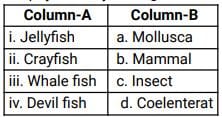

[SSC CGL 19/07/2023 (1st shift)]

Detailed Solution: Question 29

- i - d: The first animal belongs to Phylum Chordata. This phylum includes animals with a backbone, such as mammals, birds, and fish.
- ii - c: The second animal belongs to Phylum Arthropoda. This is the largest animal phylum, including insects, arachnids, and crustaceans.
- iii - b: The third animal is part of Phylum Annelida. This phylum consists of segmented worms like earthworms and leeches.
- iv - a: The fourth animal belongs to Phylum Mollusca, which includes soft-bodied animals, often with shells, like snails and clams.

Test: SSC CGL Previous Year Questions: Biology (2023-20) - 4 - Question 30

Identify an organism that has a well-defined muscular pharynx.
[SSC CGL 20/07/2023 (2nd shift)]

Detailed Solution: Question 30

Adamsia - It is a species of sea anemone in the family Hormathiidae. It is commonly known as the cloak anemone or the hermit-crab anemone. Ctenoplana - It is the genus of comb jellies and the only genus in the Ctenoplanidae family. Gorgonia - It is a genus of soft corals, sea fans in the family Gorgoniidae.

View more questions
313 docs|325 tests
Information about Test: SSC CGL Previous Year Questions: Biology (2023-20) - 4 Page
In this test you can find the Exam questions for Test: SSC CGL Previous Year Questions: Biology (2023-20) - 4 solved & explained in the simplest way possible. Besides giving Questions and answers for Test: SSC CGL Previous Year Questions: Biology (2023-20) - 4, EduRev gives you an ample number of Online tests for practice
Download as PDF