NEET Exam  >  NEET Test  >  Topic-wise MCQ Tests  >  Test: Hormones of Heart, Kidney & GI Tract - NEET MCQ

Hormones of Heart, Kidney & GI Tract - Free MCQ Practice Test with solutions,


MCQ Practice Test & Solutions: Test: Hormones of Heart, Kidney & GI Tract (10 Questions)

You can prepare effectively for NEET Topic-wise MCQ Tests for NEET with this dedicated MCQ Practice Test (available with solutions) on the important topic of "Test: Hormones of Heart, Kidney & GI Tract". These 10 questions have been designed by the experts with the latest curriculum of NEET 2026, to help you master the concept.

Test Highlights:

  • - Format: Multiple Choice Questions (MCQ)
  • - Duration: 10 minutes
  • - Number of Questions: 10

Sign up on EduRev for free to attempt this test and track your preparation progress.

Test: Hormones of Heart, Kidney & GI Tract - Question 1

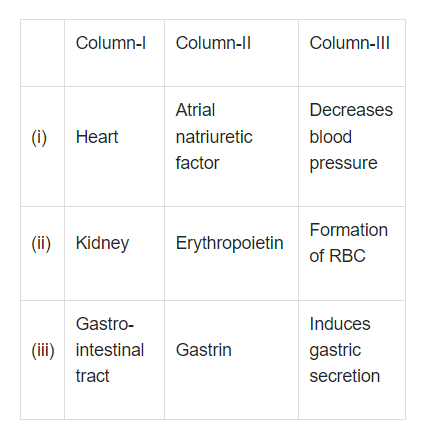
Find out the correct match from the following table  -
Detailed Solution: Question 1

To find the correct match from the table:


- Option D: (i), (ii), and (iii) - Correct

All the match are correct

Test: Hormones of Heart, Kidney & GI Tract - Question 2

Assertion: Cholecystokinin (CCK) acts on the gall bladder to stimulate the release of bile juice.
Reason: CCK also inhibits the secretion of pancreatic enzymes.

Detailed Solution: Question 2

(C) The assertion is correct, but the reason is incorrect. (CCK stimulates both bile release and pancreatic enzyme secretion.)

Test: Hormones of Heart, Kidney & GI Tract - Question 3

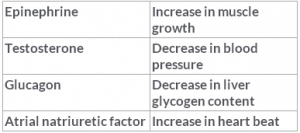
Choose the correct answer among the following options:
Detailed Solution: Question 3

Epinephrine (one of the catecholamines) increases the heart beat during any stress or emergency conditions.

Testosterone is responsible for muscle growth.

Glucagon helps in decreasing liver glycogen content.

Atrial Natriuretic Factor takes part in decreasing the Blood Pressure by RAAS.

Test: Hormones of Heart, Kidney & GI Tract - Question 4

Which of the following hormones stimulates the secretion of pancreatic enzyme from the pancreas?

Detailed Solution: Question 4

Cholecystokinin, is secreted in large amounts by the stomach in response to gastric distention and irritation. In addition to stimulating acid secretion by the parietal cell, gastrin stimulates pancreatic acinar cells to secrete digestive enzymes.

Test: Hormones of Heart, Kidney & GI Tract - Question 5

Which one of the following part is an endocrine gland?

Detailed Solution: Question 5

Brunner's gland are present in small intestine and secrete intestinal juice through ducts.
Crypts of Lieberkühn, also known as Paneth cells, are tubular glands present in small intestine and secrete intestinal juice.
Pars radiata (medullary rays) are the extensions of medulla into cortex of kidney.
Juxtaglomerulus is present in kidneys and consists of juxtaglomerular cells or JG cells that secrete enzyme renin and hormone erythropoietin. Hence, juxtaglomerulus is endocrine (ductless glands) as it secretes a hormone.
So, the correct answer is 'Juxtaglomerulus'.

Test: Hormones of Heart, Kidney & GI Tract - Question 6

Which of the following hormones is involved in neutralizing stomach acid?

Detailed Solution: Question 6

(B)  Secretin is a hormone released by the small intestine in response to acidic chyme entering from the stomach. It stimulates the pancreas to secrete water and bicarbonate ions, which neutralize the stomach acid in the small intestine. Thus, Secretin plays a role in neutralizing stomach acid.

Test: Hormones of Heart, Kidney & GI Tract - Question 7

Match the following hormones to their functions.

Hormones:.

  1. Gastrin
  2. Secretin
  3. Cholecystokinin (CCK)
  4. Gastric Inhibitory Peptide (GIP)

Functions:

A. Stimulates the secretion of hydrochloric acid and pepsinogen in the stomach.
B. Stimulates the release of bile from the gall bladder and pancreatic enzymes.
C. Inhibits gastric motility and acid secretion.
D. Stimulates the secretion of bicarbonate ions and water from the pancreas.


Detailed Solution: Question 7

A) 1-A, 2-D, 3-B, 4-C

Solution:

  1. Gastrin stimulates the secretion of hydrochloric acid and pepsinogen in the stomach (Function A).
  2. Secretin stimulates the secretion of bicarbonate ions and water from the pancreas to neutralize stomach acid (Function D).
  3. Cholecystokinin (CCK) stimulates the release of bile from the gall bladder and pancreatic enzymes (Function B).

Test: Hormones of Heart, Kidney & GI Tract - Question 8

Erythropoietin is a

Detailed Solution: Question 8

Erythropoietin (EPO) is a peptide hormone that is produced naturally by the human body. EPO is released from the kidneys and acts on the bone marrow to stimulate red blood cell production.

Test: Hormones of Heart, Kidney & GI Tract - Question 9

Which hormone inhibits gastric secretion and motility?

Detailed Solution: Question 9

(C) Gastric Inhibitory Peptide (GIP) is a hormone that inhibits gastric secretion and motility. It slows down gastric emptying and decreases the secretion of gastric acid, helping to regulate the rate at which food moves from the stomach into the small intestine.

Test: Hormones of Heart, Kidney & GI Tract - Question 10

Assertion: The atrial natriuretic factor (ANF) is secreted by the atrial wall of the heart and helps in reducing blood pressure.
Reason: ANF causes constriction of blood vessels, which lowers blood pressure.

Detailed Solution: Question 10

(C) The assertion is correct, but the reason is incorrect. (ANF causes dilation of blood vessels, not constriction, to lower blood pressure.)

6 docs|803 tests
Information about Test: Hormones of Heart, Kidney & GI Tract Page
In this test you can find the Exam questions for Test: Hormones of Heart, Kidney & GI Tract solved & explained in the simplest way possible. Besides giving Questions and answers for Test: Hormones of Heart, Kidney & GI Tract, EduRev gives you an ample number of Online tests for practice
Download as PDF