Chemistry Exam  >  Chemistry Test  >  Physical   >  Test: Conductance - 1 - Chemistry MCQ

Conductance - 1 - Free MCQ Practice Test with solutions, Chemistry Physical


MCQ Practice Test & Solutions: Test: Conductance - 1 (20 Questions)

You can prepare effectively for Chemistry Physical Chemistry with this dedicated MCQ Practice Test (available with solutions) on the important topic of "Test: Conductance - 1". These 20 questions have been designed by the experts with the latest curriculum of Chemistry 2026, to help you master the concept.

Test Highlights:

  • - Format: Multiple Choice Questions (MCQ)
  • - Duration: 60 minutes
  • - Number of Questions: 20

Sign up on EduRev for free to attempt this test and track your preparation progress.

Test: Conductance - 1 - Question 1

The cell constant of a conductivity cell is defined as:

Where l = distance between electrodes and A = area of cross-section of each of the electrodes

Detailed Solution: Question 1

  • The cell constant is a multiplier constant specific to a conductivity sensor.
  • The measured current is multiplied by the cell constant to determine the electrical conductivity of the solution.
  • The cell constant, known as K, refers to a theoretical electrode consisting of two 1 cm square plates 1 cm apart.
  • A cell constant has units of 1/cm (per centimeter), where the number refers to the ratio of the distance between the electrode plates to the surface area of the plate.

Test: Conductance - 1 - Question 2

The unit of molar conductivity is:

Detailed Solution: Question 2

  • The molar conductivity of an electrolytic solution is the conductance of the volume of the solution containing a unit mole of electrolyte that is placed between two electrodes of unit area cross-section or at a distance of one-centimeter apart.
  • The unit of molar conductivity is S⋅m2⋅mol-1.

Test: Conductance - 1 - Question 3

Molar conductivity is defined as:

Where k = conductivity, G = conductance, l = distance between two electrodes and Vm = volume of solution containing 1 mol of electrolyte

Detailed Solution: Question 3

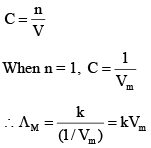
  • The molar conductivity of an electrolytic solution is the conductance of the volume of the solution containing a unit mole of electrolyte that is placed between two electrodes of unit area cross-section or at a distance of one-centimeter apart.

    Where C = concentration of electrolyte

Test: Conductance - 1 - Question 4

For a dilute solution of a strong electrolyte, the variation of molar conductivity with concentration is given by:

Detailed Solution: Question 4
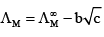
 
It is Debye-Huckle Onsager Equation.

Test: Conductance - 1 - Question 5

Which of the following ion is expected to have least value of molar conductivity at infinite dilution in an aqueous solution:

Detailed Solution: Question 5

  •  Na+ has lower molar conductance than the ions that are greater in size than Na such as K+, Cs+ as the molar conductance is inversely proportional to the solvation of ions.
  • Smaller the ion, the greater will be the solvation, and hence lower will be the molar conductance.

Test: Conductance - 1 - Question 6

Detailed Solution: Question 6

Test: Conductance - 1 - Question 7

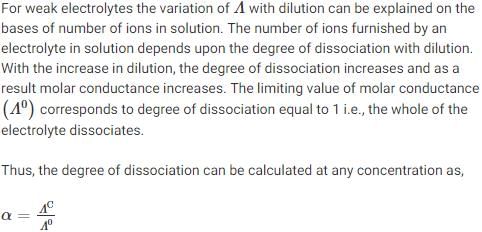
The degree of dissociation of a weak electrolyte is given by:

Detailed Solution: Question 7
Test: Conductance - 1 - Question 8

Which of the following ion has highest molar conductivity at infinite dilution in an aqueous solution:

Detailed Solution: Question 8

Exceptionally high values are found for H+ (349.8 S·cm2/mol) and OH (198.6 S·cm2/mol), which are explained by the Grotthuss proton-hopping mechanism for the movement of these ions.

Test: Conductance - 1 - Question 9

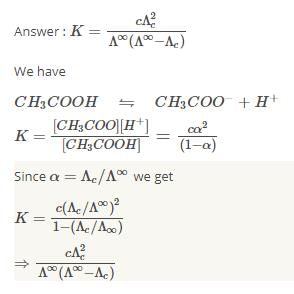
The equilibrium constant of acetic acid in an aqueous solution of concentration C is given by

Detailed Solution: Question 9
Test: Conductance - 1 - Question 10

Molar conductivity of Fe2(SO4)3 is given by:

Test: Conductance - 1 - Question 11

Equivalent conductivity of Fe2(SO4)3 is related to molar conductivity by the expression:

Detailed Solution: Question 11

  • Equivalent conductivity (Λeq) measures conductivity per equivalent of solute, while molar conductivity (Λm) measures conductivity per mole of solute.
  • Fe2(SO4)3 dissociates into 2 Fe3+ ions and 3 SO42- ions, yielding 6 equivalents per mole (2 x 3 + 3 x 2).
  • The relationship is:Λeq = Λ/ Number of Equivalents per Mole
  • For Fe2(SO4)3, Λeqm/6.

Test: Conductance - 1 - Question 12

Which of the following expressions is correct:

Detailed Solution: Question 12

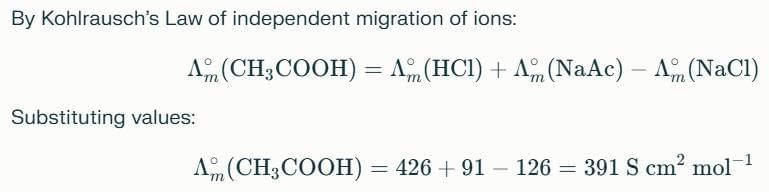
According to kholaraus law,
NH4OH = NH4 + OH
i.e. NH4 + Cl + Na + OH – Na – Cl = NH4Cl + NaOH - NaCl

Test: Conductance - 1 - Question 13

If x is the specific resistance of the electrolyte solution and y is he molarity of the solution, then is given by:

Detailed Solution: Question 13

Molar conductivity is defined as the conductivity of an electrolyte solution divided by the molar concentration of electrolyte.

= (k × 1000)/M

= 1/x × 1000/y

= 1000/xy

Test: Conductance - 1 - Question 14

When a conductance cell was filled with a 0.0025 M solution of K2SO4, its resistance was 326 Ω. The specific conductance of the solution, if cell constant is 4.

Detailed Solution: Question 14

Understand the Relationship: The specific conductance (κ) is related to the resistance (R) and the cell constant (k) by the formula: κ = k / R

Given Values:

Resistance (R) = 326 ohms

Cell constant (k) = 4

Substitute the Values into the Formula: Using the values we have: κ = 4 / 326

Calculate Specific Conductance: Now, perform the division: κ = 4 / 326 ≈ 0.01227 S/m

κ ≈ 1.227 × 10⁻² S/m

Final Answer: Thus, the specific conductance of the solution is: κ ≈ 1.20 × 10⁻² S/m


Test: Conductance - 1 - Question 15

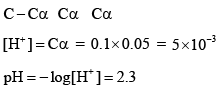
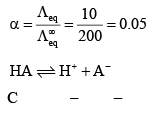
Equivalent conductance of 0.1 M HA (weak acid) solution is 10 cm2 equivalent–1. The pH of HA solution is(molar conductivity at infinite dilution is 200).

Detailed Solution: Question 15

Test: Conductance - 1 - Question 16

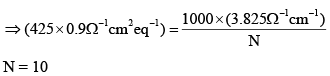
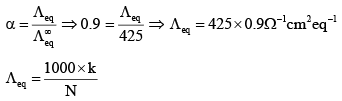
For HCl solution at 25ºC, the equivalent conductivity at infinite dilution is 425 Ω-1 cm2 eq-1. The specific conductance of a solution of HCl is 3.825 Ω-1 cm-1. If the apparent degree of dissociat ion is 90%, the normality of solution is

Detailed Solution: Question 16

Test: Conductance - 1 - Question 17

The conductance at infinite dilution follow the order

Detailed Solution: Question 17

  • Smaller the ion, the greater will be the solvation, and hence lower will be the molar conductance.

Test: Conductance - 1 - Question 18

The correct relation which depicts the Debye-Huckel Onsager Theory for strong electrolytes is:

Detailed Solution: Question 18

  • The Debye-Huckel was proposed by Peter Debye and Erich Huckel as a theoretical explanation for departure from ideality in solutions of electrolytes, further modified by Lars Onsager in 1927.
  • Onsager was able to derive a theoretical expression to account for the empirical relation known as Kohlrausch's law for the molar conductivity,
    Am = Amo - K(c)½

For stronger electrolytes:
Am = Amo - (A + BAmo)(c)1/2ac

Test: Conductance - 1 - Question 19

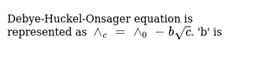
The unit of A in Debye-Huckel-Onsager equation for strong electrolytes is:

Detailed Solution: Question 19
The influence of ion-ion interactions on the conductivity of strong electrolytes was studied by Debye and Huckel.
They considered that each ion is surrounded by an ionic atmosphere of opposite sign, and derived an expression relating the molar conductance of strong electrolytes with the concentration by assuming complete dissociations.
It was further developed by Onsager. For a uni-univalent electrolyte the Debye Huckel and Onsager equation is given below.


Where A and B are constants which depend only in the nature of the solvent and temperature.

Test: Conductance - 1 - Question 20

Which of the following solutions will show the minimum value of transference number of Cl–1 ions:

Detailed Solution: Question 20

  • Because tH+ has a maximum value of transference no. as compared to other cations.
  • Hence, tCl- will be minimum in 0.1 M HCl solution.

84 videos|147 docs|67 tests
Information about Test: Conductance - 1 Page
In this test you can find the Exam questions for Test: Conductance - 1 solved & explained in the simplest way possible. Besides giving Questions and answers for Test: Conductance - 1, EduRev gives you an ample number of Online tests for practice
84 videos|147 docs|67 tests
Download as PDF