
GATE ECE (Electronics) Test: Amplitude Modulation Free Online Test 2026
MCQ Practice Test & Solutions: Test: Amplitude Modulation (20 Questions)
You can prepare effectively for Electronics and Communication Engineering (ECE) GATE ECE (Electronics) Mock Test Series 2027 with this dedicated MCQ Practice Test (available with solutions) on the important topic of "Test: Amplitude Modulation ". These 20 questions have been designed by the experts with the latest curriculum of Electronics and Communication Engineering (ECE) 2026, to help you master the concept.
Test Highlights:
- - Format: Multiple Choice Questions (MCQ)
- - Duration: 60 minutes
- - Number of Questions: 20
Sign up on EduRev for free to attempt this test and track your preparation progress.

A carrier is simultaneously modulated by two sine waves with modulation indices of 0.4 and 0.3. The resultant modulation index will be
Detailed Solution: Question 1

In a DSB-SC system with 100% modulation, the power saving is
Detailed Solution: Question 2

A 10 kW carrier is sinusoidally modulated by two carriers corresponding to a modulation index of 30% and 40% respectively. The total radiated power(is
Detailed Solution: Question 3

In amplitude modulation, the modulation envelope has a peak value which is double the unmodulated carrier value. What is the value of the modulation index ?
Detailed Solution: Question 4

 Thus α = 1, therefor modulation index is 1 or 100% modulation.
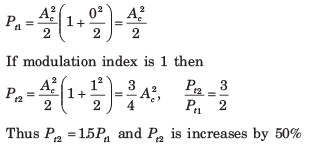
If the modulation index of an AM wave is changed from 0 to 1, the transmitted power
Detailed Solution: Question 5
A diode detector has a load of 1 kΩ shunted by a 10000 pF capacitor. The diode has a forward resistance of 1 Ω. The maximum permissible depth of modulation,so as to avoid diagonal clipping, with modulating signal frequency fo 10 kHz will be
Detailed Solution: Question 6


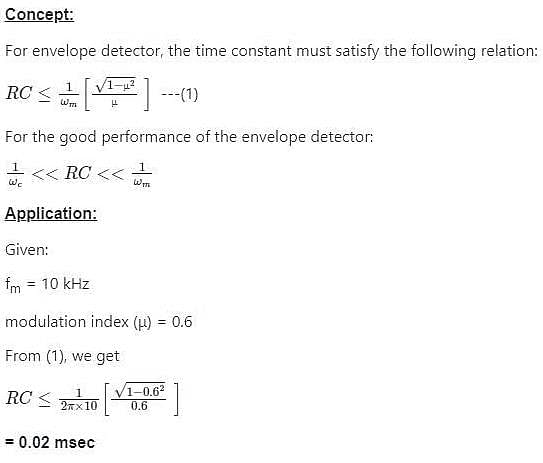
In an amplitude modulated signal, modulating frequency is 10 kHz and modulation index is 0.6. What should be the best suited RC time constant for the envelop detector?
Detailed Solution: Question 7
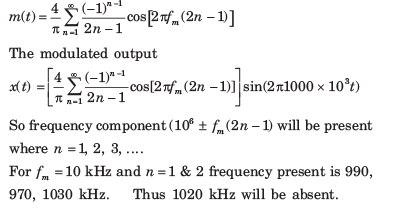
A 1 MHz sinusoidal carrier is amplitude modulated by a symmetrical square wave of period 100 μ sec. Which of the following frequencies will NOT be present in the modulated signal?
Detailed Solution: Question 8

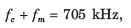
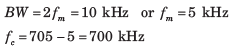
For an AM signal, the bandwidth is 10 kHz and the highest frequency component present is 705 kHz. The carrier frequency used for this AM signal is
Detailed Solution: Question 9
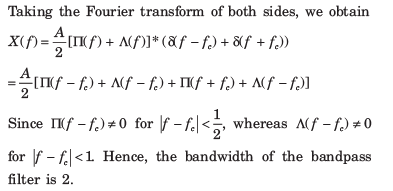
A message signal m(t) = sinct + sinc2(t) modulates the carrier signal (t) = Acos2πfct . The bandwidth of the modulated signal is
Detailed Solution: Question 10

Consider the system shown in figure . The average value of m(t) is zero and maximum value of
|m(t)| is M. The square-law device is defined by y(t) = 4x(t) +10 x(t).
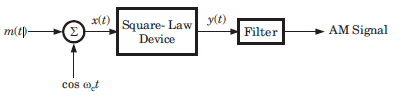
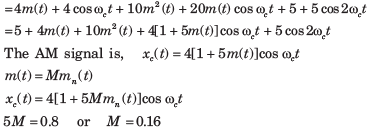
Que: The value of M, required to produce modulation index of 0.8, is
|m(t)| is M. The square-law device is defined by y(t) = 4x(t) +10 x(t).
Detailed Solution: Question 11

Consider the system shown in figure . The average value of m(t) is zero and maximum value of
|m(t)| is M. The square-law device is defined by y(t) = 4x(t) +10 x(t).
Let W be the bandwidth of message signal m(t). AM signal would be recovered if
|m(t)| is M. The square-law device is defined by y(t) = 4x(t) +10 x(t).
Detailed Solution: Question 12
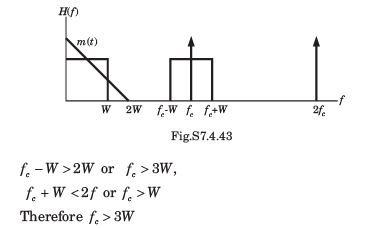
A super heterodyne receiver is designed to receive transmitted signals between 5 and 10 MHz. High-side tuning is to be used. The tuning range of the local oscillator for IF frequency 500 kHz would be
Detailed Solution: Question 13
A super heterodyne receiver uses an IF frequency of 455 kHz. The receiver is tuned to a transmitter having a carrier frequency of 2400 kHz. High-side tuning is to be used. The image frequency will be
Detailed Solution: Question 14

In the circuit shown in fig, the transformers are center tapped and the diodes are connected as shown in a bridge. Between the terminals 1 and 2 an a.c. voltage source of frequency 400 Hz is connected. Another a.c. voltage of 1.0 MHz is connected between 3 and 4. The output between 5 and 6 contains components at
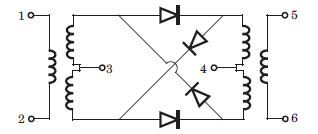
Detailed Solution: Question 15
A superheterodyne receiver is to operate in the frequency range 550 kHz-1650 kHz, with the intermediate frequency of 450 kHz. Let R = cmax / cmin denote the required capacitance ratio of the local oscillator and I denote the image frequency (in kHz) of the incoming signal. If the receiver is tuned to 700 kHz, then
Detailed Solution: Question 16
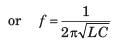
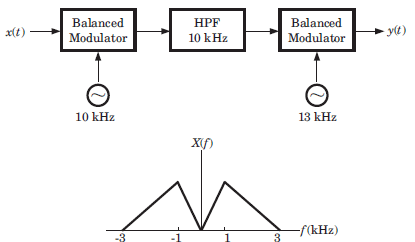
Consider a system shown in Figure . Let X( f ) and Y( f ) denote the Fourier transforms of x(t) and y(t) respectively. The ideal HPF has the cutoff frequency 10 kHz. The positive frequencies where Y( f ) has spectral peaks are
Detailed Solution: Question 17
Detailed Solution: Question 18
What is the carrier frequency in an AM wave when its highest frequency component is 850Hz and the bandwidth of the signal is 50Hz?
Detailed Solution: Question 19
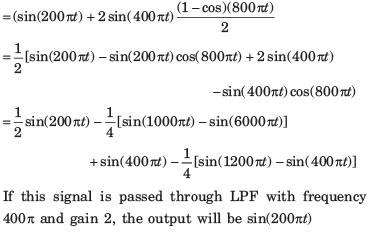
Suppose we wish to transmit the signal x(t) = sin 200πt + 2 sin 400πt using a modulation that create the signal g(t) = x(t) sin 400πt. If the product g(t) sin 400πt is passed through an ideal LPF with cutoff frequency 400π and pass band gain of 2, the signal obtained at the output of the LPF is
Detailed Solution: Question 20

26 docs|263 tests |
