HTET Exam  >  HTET Test  >   PGT Mock Test Series 2026  >  HTET PGT Physics Test - 2 - HTET MCQ

HTET PGT Physics Test - 2 Free Online Test 2026


MCQ Practice Test & Solutions: HTET PGT Physics Test - 2 (150 Questions)

You can prepare effectively for HTET HTET PGT Mock Test Series 2026 with this dedicated MCQ Practice Test (available with solutions) on the important topic of "HTET PGT Physics Test - 2". These 150 questions have been designed by the experts with the latest curriculum of HTET 2026, to help you master the concept.

Test Highlights:

  • - Format: Multiple Choice Questions (MCQ)
  • - Duration: 150 minutes
  • - Number of Questions: 150

Sign up on EduRev for free to attempt this test and track your preparation progress.

HTET PGT Physics Test - 2 - Question 1

One of the following techniques is not mentioned by Sigmund Freud for dwelling out the repressed unconscious feelings

Detailed Solution: Question 1
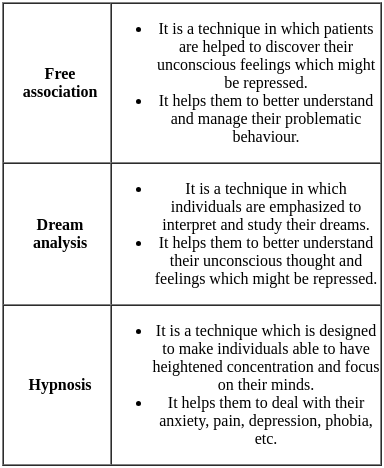
Sigmund Freud, the propounder of 'the psychoanalytic theory of personality development' has devised psychoanalytic therapy for which he has designed some techniques for dwelling out the repressed unconscious feelings of individuals.

Key Points

Let's understand these techniques:

Hint

Gestaltism is a school of psychology, established by 'M.Wertheimer'. It emphasizes the idea that 'the whole is more than the sum of its parts'.

Hence, it could be concluded that 'Gestaultism' is not mentioned by Sigmund Freud for dwelling the repressed unconscious feelings.

HTET PGT Physics Test - 2 - Question 2

Children at ______________stage acquire the ability to think hypothetically and think about abstract concepts.

Detailed Solution: Question 2

Piaget’s theory of cognitive development focuses on the child's thoughts, perceptions, and acquisition of knowledge at each stage.

Key Points Formal Operational Stage: The formal operational stage begins around 11 years of age and continues till 15 years.

  • Here, children are able to perform higher-order mental operations.
  • Their thought is flexible and they can deal effectively with complex problems involving reasoning.
  • It is the most crucial stage where mental capabilities can be developed to the maximum level.
  • Ability to think hypothetically and think about abstract concepts and problem-solving enhance effectively.
  • For example, children begin to have the ability to think about consequences and outcomes before taking an action.

Thus, it is concluded that Children at the Formal operational stage acquire the ability to think hypothetically and think about abstract concepts.

Additional Information

  • Sensorimotor Stage: The first stage of cognitive development as proposed by Piaget is known as the sensorimotor stage. It extends from birth to two years of age.
  • Pre-operational Stage: This is the second stage of cognitive development which is basically a pre-logical stage as logic has not yet fully developed. It extends from two to seven years of age.
  • Concrete Operational Stage: The concrete operational stage starts from seven years of age and continues till 11 years. Children develop logical thinking but they still find difficulty in applying logic to hypothetical situations.

HTET PGT Physics Test - 2 - Question 3

Sunita always do whatever she wants to do without thinking about the consequences. So as per Sigmund Frued, the dominance is of _________.

Detailed Solution: Question 3
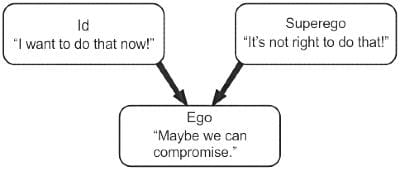
Psychoanalytical Theory: ​This theory was developed by the famous psychologist Sigmund Freud. This theory has described three major parts of the personality structure which include Id, Ego, and Superego.
The Id: This is the most important part, which develops with the birth of the child. It can be thought of as a storehouse of biologically the urge to eat, drink, eliminate, and be sexually stimulated. The sexual energy is called the libido. According to Freud, the Id operates on a ‘pleasure principle’.The id satisfies its fundamental urges immediately and as they arose without regard to rules, the realities of life, or morals of any kind.
The Ego:

  • This part develops from the school year of life of the child—as a result of social contacts.
  • The ego consists of behaving and thinking which constitute the function of the person.
  • The ego motives of the Id and channel behaviour into a more socially acceptable frame.
  • It keeps a person working for a living, getting along with people, and generally adjusting to the realities of life.
  • Freud characterized the ego as working in the service of the ‘reality principle’.
  • That is, the ego tries to satisfy the id’s urge for pleasure, but only in realistic ways. The ongoing tension between insistent urges of the id and the constraints of reality helps the ego develop certain skills to safeguard the self-image.
  • These skills are called ego defense mechanisms

The Superego:

  • This part of the personality is called the conscience.
  • The superego may indicate as ‘wrong’ certain things that the ego would otherwise do to satisfy the id.
  • However, ‘ego ideal’- a set of values and moral ideals that are pursued because they are perceived to be worthy. In other words, the superego operates ‘moral principle’.


Hence, we can conclude that as per Sigmund Freud, the dominance is of the id when Sunita always does whatever she wants to do without thinking about the consequences.Additional Information

  • Freud believed that the diverse nature of these three parts conflicts with one another, which leads to three types of anxiety.

(1) Reality anxiety-arising when the individual faces dangers or threats in the external world.
(2) Neurotic anxiety-arising when the individual’s Id impulses threaten through his ego controls and result in behaviour that leads to punishment and
(3) Moral anxiety occurs when the individual does something or even when doing something conflicts with his superego or moral values and arouses guilty feelings

HTET PGT Physics Test - 2 - Question 4

Psychosexual theory is given by?

Detailed Solution: Question 4

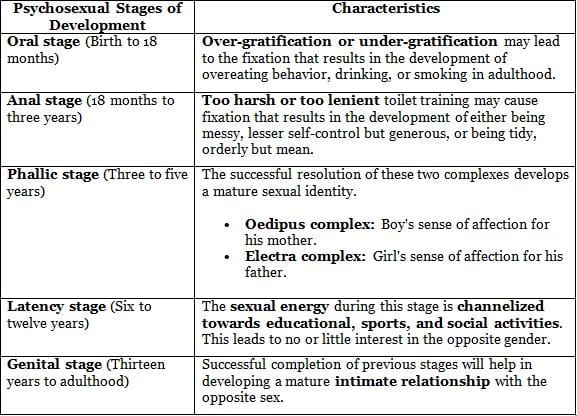
Psychosexual Theory of Development:

  • Freud believed that personality gets well established during childhood, largely before the age of five years.
  • He proposed five stages of psychosexual development which include oral stage, anal stage, phallic stage, latency stage, and genital stage.

Key Points

Hence, it could be concluded that the Psychosexual theory is given by Sigmund Freud.

HTET PGT Physics Test - 2 - Question 5

The method of study used by Behaviorists was:

Detailed Solution: Question 5

Behaviourism or the behaviourist approach lays stress on the role of environmental stimuli in determining the way we act. Learning-changes in behaviour because of experiences (excluding changes due to fatigue, injury, or drug effects) - is at the centre of this approach.

Key Points

  • Behaviour, according to this approach, is not just a manifestation of underlying mental events, but has a unique meaning.
  • Overt behaviour, that is, behaviour which can be observed and hence quantified remains the focus of the discipline.
  • Behaviourism stands apart from other approaches by its emphasis on the relationship between observable behaviour (responses) and environmental events (stimuli).
  • J.B Watson with the assertion that the study of inner consciousness is not the appropriate direction for the development of psychology. The science should be completely replaced with overt, observable behaviour as a legitimate subject matter of true science, by Watson.

Important PointsThe characteristics of the observation method of data collection are:

  • It involves both mental and physical activity. It avoids manipulations.
  • Observation is made on a selective basis i.e. the researcher selects a relevant sample.
  • The observer may see many things but attention has to be drawn only on the items useful/relevant for the study.
  • Observation takes place in natural surroundings. It helps the researcher to determine the reality by himself or herself
  • It involves few or no controls on the surroundings. It could be the observation of fewer items/subjects and it must serve the formulated research purpose.
  • The collection and recording of data are not selective, it is done as it is observed in a natural environment rather than creating an artificial/laboratory environment.

Therefore, it can be concluded that the method of study used by Behaviorists was observation.

Additional Information

  • Case study: intensive study of a single case where the purpose of the study is to explore the uniqueness of the single case.
  • Introspection: it is the examination or observation of one's own mental and emotional processes.
  • Survey: is the process of conducting research using surveys in the defined population.

HTET PGT Physics Test - 2 - Question 6

वचन संबंधी सही असंगत युग्म का चयन कीजिए।

Detailed Solution: Question 6

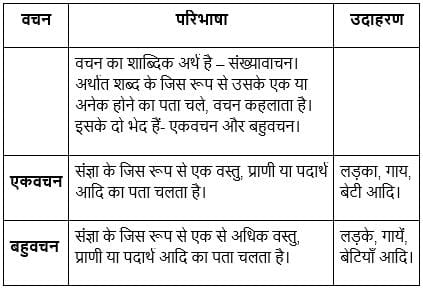
दिए गए विकल्पों में सही उत्तर विकल्प 4 सेना – सेनियां हैं। दिए गए अन्य विकल्प इसके असंगत उत्तर होंगे।

स्पष्टीकरण:

उपरोक्त सभी विकल्पों में असंगत युग्म ‘सेना – सेनियां’ है। इसलिए विकल्प 4 इसका सही उत्तर है दिए गए अन्य विकल्प-युग्म सुमेलित हैं, इसलिए असंगत उत्तर होंगे।

विशेष:

HTET PGT Physics Test - 2 - Question 7

‘देवत्व’ निम्नलिखित में से किस प्रत्यय का उदाहरण है?

Detailed Solution: Question 7

प्रमुख बिंदु

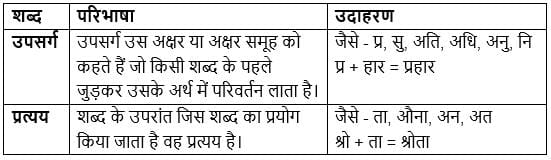
  • ‘देवत्व’ शब्द ‘देव’ मूल शब्द में ‘त्व’ प्रत्यय के योग से बना है। जो भाववाचक तद्धित प्रत्यय का उदाहरण है।
  • भाववाचक तद्धित प्रत्यय- जो प्रत्यय संज्ञा तथा विशेषण के साथ जुडकर भाववाचक संज्ञा को बनाते हैं, उसे भाववाचक तद्धित प्रत्यय कहते हैं। जैसे- बुलावा, छुटकारा, ऊंचाई, मोटापा आदि।

अन्य विकल्प:

  • कर्तृवाचक तद्धित प्रत्यय- संज्ञा के अंत में आर, आरी, इया, एरा, हारा, वाला, हार, दार इत्यादि प्रत्ययों के योग से कर्तृवाचक तद्धित प्रत्यय बनते हैं। जैसे- सुनार, पालनहार, दरकार आदि।
  • संबंधवाचक तद्धित प्रत्यय- जिन प्रत्ययों के लगने से संबंध का पता लगता है, उसे संबंध वाचक तद्धित प्रत्यय कहते हैं। इसमें कभी-कभी आदि स्वर की वृद्धि हो जाती है। संज्ञा के अन्त में आल, हाल, ए, एरा, एल, औती, जा इत्यादि तद्धित-प्रत्यय लगाकर सम्बन्धवाचक तद्धितान्त संज्ञाएँ बनायी जाती हैं। जैसे- चचेरा, ममेरा, ससुराल आदि।
  • स्थानवाचक तद्धित प्रत्यय- जिन प्रत्ययों के प्रयोग से स्थान का पता चलता है, वहाँ पर स्थानवाचक तद्धित प्रत्यय होता है। संज्ञा के अन्त में ई, वाला, इया, तिया इन प्रत्ययों को लगाकर स्थानवाचक संज्ञाएँ बनायी जाती हैं। जैसे- गुजराती, चारागाह, अगाड़ी आदि।

अतिरिक्त जानकारी

HTET PGT Physics Test - 2 - Question 8

जब कार्यक्रम समाप्त हुआ तो सब लोग चले गए।’ रेखांकित वाक्य में कौन सा उपवाक्य होगा?

Detailed Solution: Question 8

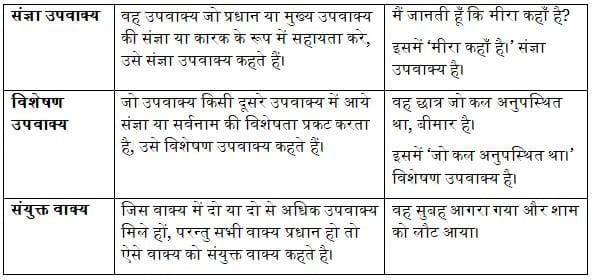
दिए गए विकल्पों मे सही उत्तर विकल्प 1 ‘क्रिया-विशेषण उपवाक्य’ है। अन्य विकल्प इसके अनुचित उत्तर हैं।

मुख्य बिंदु

जब कार्यक्रम समाप्त हुआ तो सब लोग चले गए।’ इसमें रेखांकित वाक्य ‘क्रिया-विशेषण उपवाक्य’ का उदाहरण है। इसलिए विकल्प 1 सही उत्तर है।

अतिरिक्त जानकारी

HTET PGT Physics Test - 2 - Question 9

‘प्रत्युप्तन्नमति' शब्द में प्रयुक्त उपसर्ग है :

Detailed Solution: Question 9

‘प्रत्युप्तन्नमति' शब्द में प्रयुक्त उपसर्ग है - प्रति
मुख्य बिंदु

  • प्रति + उत्पन्न + मति = प्रत्युप्तन्नमति
  • 'प्रति' उपसर्ग, 'उत्पन्न' मूलशब्द और 'मति' प्रत्यय
  • 'प्रत्युप्तन्नमति' का अर्थ - जो तुरंत ही कोई उपयुक्त बात या काम सोच ले।

महत्वपूर्ण बिंदु

  • उपसर्ग शब्द के शुरू में जुड़ता है।

अतिरिक्त जानकारी
कुछ महत्वपूर्ण उपसर्ग शब्द:-​

  • प्रति (प्रत्येक) - प्रतिदिन, प्रत्येक, प्रतिकूल, प्रतिहिंसा, प्रतिरूप।
  • प्र (आगे) - प्रदान, प्रबल, प्रयोग, प्रसार, प्रहार, प्रयत्न।
  • अनु (पीछे) - अनुचर, अनुकरण, अनुकूल, अनुनाद, अनुभव।
  • निर् (बिना) - निराकार, निरादर, नीरोग, नीरस, निरीह, निरक्षर।
  • उप (सहायक) - उपभोग, उपवन, उपमन्त्री, उपयोग, उपनाम, उपहार।
  • सम् (अच्छी तरह) - सन्तोष, संगठन,संलग्न, संकल्प, संशय, संरक्षा।
  • अनु (पीछे) - अनुचर, अनुकरण, अनुकूल, अनुनाद, अनुभव।

HTET PGT Physics Test - 2 - Question 10

वाक्य-विन्यास की दृष्टि से शुद्ध वाक्य का चयन करें-

Detailed Solution: Question 10

वाक्य-विन्यास की दृष्टि से शुद्ध वाक्य है- स्वांत्र्योत्तर काल को जीवनी विधा का उत्कर्ष काल कहा जा सकता है।
प्रमुख बिंदु

वाक्य विन्यास की परिभाषा और उदाहरण:
वाक्य विन्यास: वाक्य विन्यास (Sentence Structure) का अर्थ है वाक्य में शब्दों का सही और उचित क्रम में व्यवस्थित करना ताकि वाक्य का अर्थ स्पष्ट और सुसंगठित हो। सही वाक्य विन्यास से वाक्य का भाव और संदेश स्पष्ट रूप से समझ में आता है।

उदाहरण:

  1. सही वाक्य विन्यास: राम स्कूल जा रहा है।
    • गलत वाक्य विन्यास: स्कूल राम जा रहा है।
  2. सही वाक्य विन्यास: मुझे खाना पसंद है।
    • गलत वाक्य विन्यास: खाना पसंद है मुझे।
  3. सही वाक्य विन्यास: वह बाजार गया है।
    • गलत वाक्य विन्यास: बाजार गया है वह।
  4. सही वाक्य विन्यास: मैंने किताब पढ़ी।
    • गलत वाक्य विन्यास: किताब पढ़ी मैंने।
  5. सही वाक्य विन्यास: वह संगीत सुन रहा है।
    • गलत वाक्य विन्यास: संगीत सुन रहा है वह।

HTET PGT Physics Test - 2 - Question 11

Fill in the blanks with the most appropriate choices

Will you ________ my dog while I am on tour?

Detailed Solution: Question 11

Key Points

  • In the given sentence, 'look after' is the correct answer.
  • Look after - to take care of someone or something.
    • Example: We look after our neighbor's cat while they are away.
  • The correct sentence is: Will you look after my dog while I am on tour?

Additional Information

Let's understand the usage and meaning of the other options:

  • Look at - to direct your eyes towards someone or something so that you can see them
    • Example: He turned and looked at her.
  • Look out - to be careful or to pay attention to something dangerous.
    • Example: Look out! There's a car coming!
  • ​Look up - To search for a fact or some information using book, computer, etc.
    • Example: Could you look up the President's birthday on the internet?

HTET PGT Physics Test - 2 - Question 12

Transform the given sentence into simple. ‘She said that she was coming’.

Detailed Solution: Question 12

The correct answer is 'She is coming'.

Key Points

  • This sentence removes the reported speech and directly states the action, simplifying the statement.
  • Changes the past-report format to a present simple structure, making it more straightforward.
  • By stating "She is coming," it cuts down on unnecessary words, providing clarity.
  • The new sentence is easy to understand, without additional layers of complexity.
  • It maintains the essence of the original sentence by conveying the same action of her coming.

Therefore, the correct answer is 'Option 3'.

Additional Information

  • Option 1: Retains the past tense and reported speech structure, not simplifying the sentence enough.
  • Option 2: Changes the meaning slightly, making it less clear and indirect.
  • Option 4: Alters the original meaning by specifying a time frame that was not present in the initial sentence.

HTET PGT Physics Test - 2 - Question 13

Questions are in Indirect Speech followed by four alternatives in Direct Speech. Select the one which best expressed the same sentence in Direct Speech.

He said that he would go as soon as it was possible.

Detailed Solution: Question 13

The correct answer is 'He said, "I shall go as soon as it is possible".'

Key Points

  • The given sentence is an assertive sentence and it is in indirect speech.
  • The basic rules for changing or converting indirect speech into direct speech:
    • ​Put a comma before the statement and insert inverted commas in place of the conjunction 'that'.
    • Change would into shall because we use shall with I and we.

Hence, the correct answer is: He said, "I shall go as soon as it is possible."

HTET PGT Physics Test - 2 - Question 14

Select the most appropriate ANTONYM of the given word.

Identical

Detailed Solution: Question 14

The correct answer is 'Option 4' i.e. 'Different'.

Key Points

  • "Identical" means exactly the same or alike in every detail.
  • It's derived from the Latin word 'identicus', meaning 'the same'.
  • This word is used to describe things that are so similar that they can't be distinguished from each other. (समान).
  • Looking at the options provided, the most appropriate antonym is: Different
  • This word means not the same as another or each other; unlike in nature, form, or quality.(अलग)
  • It's the opposite of identical because it indicates a lack of similarity.

Therefore, the correct answer is: 'Different'.

Additional Information

  • Let's look at the other options:
    • Original - This word refers to something that is the first of its kind, not derived or copied.(मूल) While it can be seen as an antonym in certain contexts (as in an "original" idea vs an "identical" copy), it's not as directly opposite as "different".
    • Synonymous - This means having the same or nearly the same meaning as another word in the same language. (पर्यायी).
    • Equivalent - This means equal in value, amount, function, meaning, etc.(समतुल्य).

HTET PGT Physics Test - 2 - Question 15

He said, "I saw her the day before yesterday".

(Choose the correct one in indirect speech.)

Detailed Solution: Question 15

The correct answer is 'He said that he had seen her two days before.'

Key Points

  • Indirect speech is a means of expressing the content of statements, questions or other utterances, without quoting them explicitly as is done in direct speech. For example, "He said 'I love chocolate'" in direct speech becomes "He said that he loved chocolate" in indirect speech.
  • In the transition from direct to indirect speech, it's necessary to adjust the tenses to match the time when the words were actually spoken.
  • This process is known as "backshifting." In this case, the present perfect "I saw" becomes the past perfect "he had seen" in indirect speech.
  • The phrase "the day before yesterday" in indirect speech would typically be rendered as "two days before."
  • This is because the reference point for "yesterday" shifts from the speaker's current time frame to the time frame when the speech was reported.

Therefore, the correct answer is Option 2.

HTET PGT Physics Test - 2 - Question 16

Some parts of the sentence have errors and some have none. Find out which part of the sentence has an error. The number of parts is your answer. If there is no error, your answer is D i.e. No error.

We prefer to work (A)/with a comparatively smaller(B)/number of clients. (C)/No error (D)

Detailed Solution: Question 16

The correct answer is ‘Part B’.
Key Points
  • The above sentence is grammatically incorrect.
  • The error lies in part B of the given sentence.
  • The given above sentence is an example of a comparative degree of adjective.
  • As per the general rule, if 'comparatively' is used before an adjective or an adverb, it should be used in positive degree and not in the comparative degree.
  • Let’s have a look at the structural form of the given rule:
    • Subject + verb + comparatively + positive degree + object.
  • Example:
    • Their outward journey was comparatively easy. (correct)
    • Their outward journey was comparatively easier. (incorrect)
  • According to the explanation and example that are given above, ‘comparatively small’ is the correct use in place of “comparatively smaller”.

Correct sentence: We prefer to work with a comparatively small number of clients.Additional Information

  • As per the general rule, the other superlative characteristic of using the word ‘the’ before the adjective.
  • Let’s have a look at the structural form of the given rule:
    • Subject + verb + the + superlative degree +of/in + object.
  • Example:
    • That was the shortest movie in the series. (correct)
    • That was shortest movie in the series. (incorrect)

HTET PGT Physics Test - 2 - Question 17

Who among the following served as the Governor of Haryana from 1980 to 1984 ?

Detailed Solution: Question 17

G. D. Tapase served as the Governor of Haryana from 1980 to 1984.Key Points

  • Article 153 of the Indian constitution states that there shall be a Governor for each state.
  • The Governor acts as the agent of the central government.
  • The Governor of a state is appointed by the Indian President.
  • The Haryana was carved out from Punjab on 1st November 1966.

Additional Information

  • Dharma Vira was appointed as the first Governor of Haryana from 1966 to 1967.
  • Mahabir Prasad served as the Governor of Haryana from 1995 to 2000.
  • Bandaru Dattatreya (As of Feb 2022) is the current Governor of Haryana.

HTET PGT Physics Test - 2 - Question 18

If 2a + 5b = 12 and ab = 3, find the value of 4a2 + 25b2.

Detailed Solution: Question 18

Given:

2a+5b = 12, ab = 3

Formula used:

(a + b)2 = a2 + b2 + 2ab

Calculation:

Take the square of the expression, (2a+5b)

⇒ (2a+5b)2=(2a)2 + (5b)2 + 2 × (2a) × (5b)

⇒ (2a+5b)2 = 4a2 + 25b2 + 20ab

It is given that (2a + 5b) = 12 and ab = 3

On substituting the values in the expression

⇒ 4a2 + 25b2 + 20 × 3 = (12)2

⇒ 4a2 + 25b2 = (144 - 60)

4a2 + 25b2 = 84

∴ The value of is 84.

HTET PGT Physics Test - 2 - Question 19

Maharishi Dayanand visited Haryana for the first time in __________ city.

Detailed Solution: Question 19
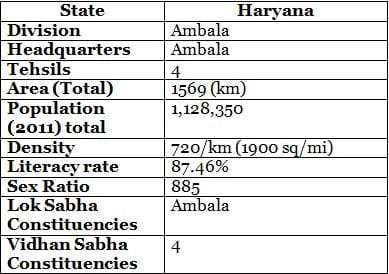
The correct answer is Ambala.

Key Points

  • Ambala is a municipal corporation in the Haryana state. It is located on the border in proximity to both state's capital Chandigarh and the Indian state of Punjab.
  • Because It has a large Indian Air Force and Indian Army presence within its cantonment area known as "Twin City".
  • It surrounded Tangri and Ghaggar river to the north and to the south and separates the Ganges river from the Indus river.

Additional Information

HTET PGT Physics Test - 2 - Question 20

Simplify:

Detailed Solution: Question 20

Simplify:

Formula used:

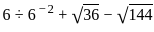
a ÷ a−b = ab

√a = a1/2

Calculations:

6 ÷ 6−2 = 6 × 62

⇒ 6 × 36 = 216

√36 = 6

√144 = 12

⇒ 216 + 6 - 12

⇒ 210

∴ The answer is 210.

HTET PGT Physics Test - 2 - Question 21

Two astronauts are floating in gravitational free space after having lost contact with their spaceship. The two will:

Detailed Solution: Question 21
Concept

Gravitational free space means a region without any gravitational force.

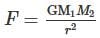
According to Newton's law of Gravitation, every body attracts every other body in the universe with a force that is directly proportional to the product of their masses and inversely proportional to the square of the distance between the centers of two bodies.

The mathematical form of this law is:

where M1 and M2 are the mass of body 1 and body 2 respectively,

r is the distance between the centers of two bodies and

 is a universal gravitational constant and its value is the same in the whole universe.

Gravitational force is always attractive in nature.

Calculation

Both the astronauts are in the condition of weightlessness.

The gravitational force between them pulls towards each other.

HTET PGT Physics Test - 2 - Question 22

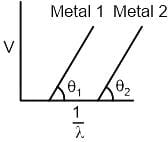
V (stopping potential) is plotted against 1/λ, where λ is the wavelength of incident radiations, for two metals
Detailed Solution: Question 22
CONCEPT:

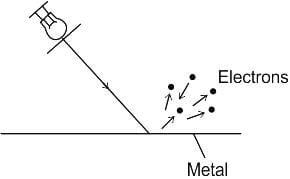
  • Photoelectric effect: The photoelectric effect is a phenomenon where electrons are ejected from a metal surface when the light of sufficient frequency is incident on it.
    • ​Einstein suggested that light behaved like a particle and that each particle of light had energy called the photon.
    • When a photon falls on the metal surface, the photon’s energy is transferred to the electron.
    • Some part of the energy gets utilized in removing the electron from the metal surface, and the remaining goes into giving kinetic energy for the ejected electron.
  • Therefore, the total energy of photon = energy utilized to eject an electron + maximum kinetic energy of the electron. This is given by the equation:

⇒ E = W + EK
Where E is the energy of the photon, W is the minimum energy required to emit an electron, and KE is the maximum kinetic energy achieved by the ejected electron.

EXPLANATION:

  • The kinetic energy of the photoelectron is given by

⇒ KE = - (hc/ λ) ϕ
Where λ =Wavelength, ϕ =Work function
We know the value of kinetic energy =e V, the above equation can be written as
 eV = - (hc/ λ) ϕ
⇒ (hc/ λ) = eV + ϕ
 eV = - (hc/ λ) ϕ
V =  hc/e x 1/λ - ϕ/e
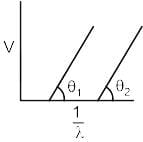
Comparing the above equation with the equation of straight line Y = mX +C
The slope of the graph is given as,
⇒ m = hc/e
 ⇒ tanθ = hc/e =  constant [Slope of V vs 1/λ graph]
For the line slope is constant
∴ θ is the same for all metals (θ1 = θ2)
Hence, option 3 is the answer

HTET PGT Physics Test - 2 - Question 23

The ratio for the speed of the electron in the 3rd orbit of He+ to the speed of the electron in the 3rd orbit of hydrogen atom will be :

Detailed Solution: Question 23

Concept:

The formula for the speed of an electron in the nth orbit of a hydrogen-like atom:

Calculation:

For He+ ( Z= 2) in the 3rd orbit, the speed is proportional to 2/3

For H ( Z=1) in the 3rd orbit, the speed is proportional to 1/3

⇒ Required ratio

=

= 2 ∶ 1

∴ the Correct answer is 2 : 1

HTET PGT Physics Test - 2 - Question 24

A particle of mass 2 kg is moving along the x-axis under the action of a conservative force F(x). The potential energy of the particle as a function of position x is given by U(x) = x2 + 4x +15 where x is in meter. At x = 2 m, the particle has a kinetic energy of 18 J. Then the maximum speed of the particle is -

Detailed Solution: Question 24

Concept:

According to Work-Energy Theorem for a particle or a system, the work done by all the forces (external as well as internal, conservative and non-conservative, pseudo forces) is equal to the change in kinetic energy of the particle or the system.

When no net external force is acting work done by non-conservative forces is zero, then,

or KEf + Uf = KEi + Ui

The term (KE + U = E) is the total mechanical energy of the system.

Calculation:

Given:

Mass of the particle (m) = 2 kg

Potential energy as a function of position x : U(x) = x2 + 4x +15

At x = 2 m, the kinetic energy of the particle = 18 J

Since the forces are conservative, hence its mechanical energy must remain constant.

∴ Mechanical energy at (x = 2) = KE(x = 2) + U(x = 2)

⇒ E(x = 2) = 18 + (22 + 4(2) + 15)

⇒ E(x = 2) = 45 J

Now, the particle will have maximum speed where its kinetic energy is maximum or potential energy is minimum.

⇒ Minimum value of potential energy will occur when x2 + 4x +15 is minimum

⇒ x2 + 4x +15 = (x + 2)2 + 11 which will be minimum at (x = - 2) and will have minimum value 11.

Now, KEmax = E - Umin

⇒ (1/2)mvmax2 = 45 - 11

Putting value of m = 2,

vmax = √34 m/s

HTET PGT Physics Test - 2 - Question 25

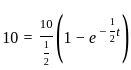
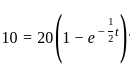
A radioactive substance is being produced at a constant rate of 10 nuclei/s. The decay constant of the substance is 1/2 s–1. After what time the number of radioactive nuclei will become 10? Initially there are no nuclei present.

Detailed Solution: Question 25
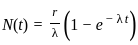
Calculation:

Here,

  • Production rate: r = 10 nuclei/s
  • Decay constant: λ = 1/2 s-1
  • We want to find the time t when the number of radioactive nuclei becomes N(t) = 10
  • Initially, there are no radioactive nuclei present.

The formula to describe the number of radioactive nuclei at time t is,

Dividing both sides by 20,

Simplifying,

We know that ln(2) = approx 0.693, so

∴ The correct option is 3

HTET PGT Physics Test - 2 - Question 26

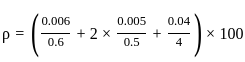
A silver wire has a mass (0.6 ± 0.006) g, radius (0.5 ± 0.005) mm and length (4 ± 0.04) cm. The maximum percentage error in the measurement of its density will be

Detailed Solution: Question 26
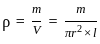
Calculation:

Formula for density

∴ Percentage error in

⇒ ρ = 4%

∴ , the maximum percentage error in the measurement of density is 4%.

HTET PGT Physics Test - 2 - Question 27

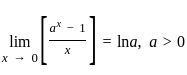
Evaluate:

Detailed Solution: Question 27

Concept:

Calculation:

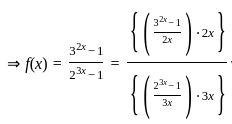
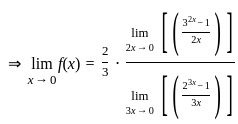
Here, we to have to find the value of

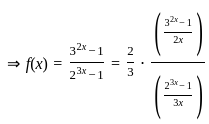
Let now f(x) can be re-written as:

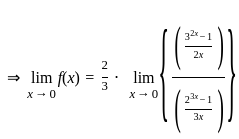
On further simplification we get

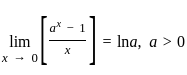
When x → 0 then 2x → 0 and 3x → 0 and as we know that,

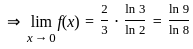
As we know that,

HTET PGT Physics Test - 2 - Question 28

If the uncertainties in velocities of two particles A and B with mass 1.0 × 10⁻²⁷ kg and 1.0 × 10⁻³¹ kg respectively are same, the ratio of uncertainties in the positions of A and B is:

Detailed Solution: Question 28
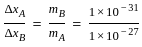
Concept:

Heisenberg’s Uncertainty Principle:

It states that it is impossible to determine simultaneously, the exact position and exact momentum (or velocity) of an electron. Mathematically, it can be given as
Δx X Δp x ≥ h/4π
Δx X Δv x ≥ h/4πm

where ∆x is the uncehrtainty in position and ∆px (or ∆vx) is the uncertainty in momentum (or velocity) of the particle. If the position of the electron is known with a high degree of accuracy (∆x is small), then the velocity of the electron will be uncertain [∆(vx) is large]. On the other hand, if the velocity of the electron is known precisely (∆(vx) is small), then the position of the electron will be uncertain

(∆x will be large).

Calculation:

For the same velocities of two particles:

Δx = h/nπ x 1/mΔ v ⇒ Δx∝ 1/m

The ratio of uncertainties in positions for A and B is:

 = 10 - 4 = 1/10000 = 1 : 10000

HTET PGT Physics Test - 2 - Question 29

Sound waves are longitudinal mechanical waves that can travel through solids, liquids, or gases.

  1. The speed v of a sound wave in a fluid having bulk modulus B and density ρ is,​
  2. The speed of longitudinal waves in a metallic bar is,
  3. For gases, since B = γP, the speed of sound is,

Detailed Solution: Question 29

Explanation:

Sound waves are longitudinal mechanical waves.

The speed of sound is defined as the distance through which a sound wave’s point, such as a compression or a rarefaction, travels per unit of time.

  • The speed of sound, is the speed at which sound waves propagate through different materials.
  • For gases, since B = γP, the speed of sound is,
  • In particular, for dry air at a temperature of 0°C, the modern value for the speed of sound is 331.29 meters per second.
  • The speed v of a sound wave in a fluid having bulk modulus B and density ρ is,
  • The speed of sound in liquid water at 8°C is about 1,439 meters per second.
  • The speed of longitudinal waves in a metallic bar is,
    • Where, ρ = density

HTET PGT Physics Test - 2 - Question 30

The electric field at a distance of 3R/2 from the center of a charged conducting spherical shell of radius R is E. The electric field at a distance R/2 from the center of the sphere is -

Detailed Solution: Question 30
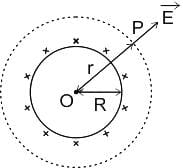
Concept:

Electric field due to solid or hollow conducting sphere or shell

For outside point (r>R);

E = q/4πϵ0r2

For a point on the surface (r=R)

put; r = R

E = q/4πϵ0R2

Where;

q → Charge enclosed

ϵ0 → Permittivity of free space

r → Distance from the centre of the shell

For inside point (r < R)

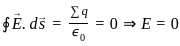
Since, the charge inside the conducting sphere or shell is zero, i.e ∑q = 0

Hence, E = 0

Calculation:

Given;

The radius of the shell = R

The electric field at a distance of 3R/2 from the centre of a charged conducting spherical shell is E

Let;

The electric field at a distance R/2 from the centre of the sphere is E'

Electric field ar a point r < R

Since, the charge inside the conducting sphere or shell is zero, i.e ∑q = 0

So

View more questions
23 tests
Information about HTET PGT Physics Test - 2 Page
In this test you can find the Exam questions for HTET PGT Physics Test - 2 solved & explained in the simplest way possible. Besides giving Questions and answers for HTET PGT Physics Test - 2, EduRev gives you an ample number of Online tests for practice
Download as PDF