HTET Exam  >  HTET Test  >   PGT Mock Test Series 2026  >  HTET PGT Physics Test - 3 - HTET MCQ

HTET PGT Physics Test - 3 Free Online Test 2026


MCQ Practice Test & Solutions: HTET PGT Physics Test - 3 (150 Questions)

You can prepare effectively for HTET HTET PGT Mock Test Series 2026 with this dedicated MCQ Practice Test (available with solutions) on the important topic of "HTET PGT Physics Test - 3". These 150 questions have been designed by the experts with the latest curriculum of HTET 2026, to help you master the concept.

Test Highlights:

  • - Format: Multiple Choice Questions (MCQ)
  • - Duration: 150 minutes
  • - Number of Questions: 150

Sign up on EduRev for free to attempt this test and track your preparation progress.

HTET PGT Physics Test - 3 - Question 1

The subjective method of personality measurement is-

Detailed Solution: Question 1

The personality of a person is generally perceived as his physical get-up, behaviour, and the status he enjoys in society.

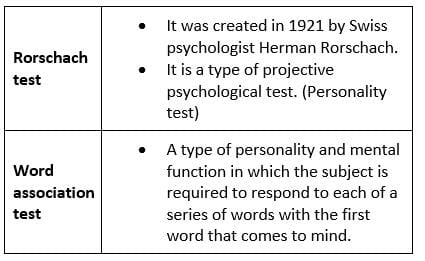
Key PointsPersonality measurement refers to the measurement of a person's characteristics. Personal history is the subjective method of personality measurement.

  • The subjective method means that which individual is permitted to disclose what he knows about himself.
  • It includes traits, attitudes, personal experiences, aims, needs, and interests.
  • The subjective method includes personal history, case history, interview, and the questionnaire.
  • Personal history includes the events of a person's life that occur in their life.
  • In these experiences throughout his life, his present aims interests, and attitudes are included.
  • The individual has freedom in selecting experiences that are important to him and these reveal his personality.

Thus, it is concluded that the subjective method of personality measurement is personal history.

Additional Information

HTET PGT Physics Test - 3 - Question 2

In which stage of psychosexual development, the child's erogenous zone is the genital region?

Detailed Solution: Question 2

Freud believed that personality gets well established during childhood, largely before the age of five years. He proposed five stages of psychosexual development which include oral stage, anal stage, phallic stage, latency stage, and genital stage.

Key Points

  • Each stage of psychosexual development is defined in terms of the mode of reaction of a particular zone of the body.
  • During the first 18 months of life of a new born baby, the mouth works as the principal region of dynamic activity. Hence this stage is called oral stage.
  • The oral stage is followed by deriving pleasure around the eliminative functions, it is therefore, called the anal stage.
  • This lasts for another 18 months and is succeeded by the phallic stage in which the sex organs become the leading erogenous zones.
  • During these stages, the mucous membrane of the mouth, anus and external genitalia become the focus of child's erotic life depending on the stage of development.
  • At the close of the fifth year, the child goes into latency period, where the sexual urges are held in a state of repression.
  • With the onset of adolescence the pregenital impulses are reactivated and the person passes into the genital stage of development.

Hence, the correct answer is Phallic Stage.

HTET PGT Physics Test - 3 - Question 3

Kohler and Kofka believed learning to a function of

Detailed Solution: Question 3

There are many learning theories in psychology that are related to different schools of psychology such as cognitive, humanistic, behavioristic, etc.

  • These theories are propounded by eminent psychologists to provide a framework to understand different aspects of human behavior.

Key Points

  • German psychologists Wertheimer, Kohler, Koffka, and Lewin have studied the nature of perception and are the leaders of gestalt psychology.
  • The ‘Insight Theory of Learning’ or ‘Learning by insightis promoted by Wolfgang Kohler, a Gestalt theorist.
  • Kohler and Kofka believed learning to be a function of insight. In his theory, he has proposed the term ‘Insight’ that doesn't take place with trial & error, rather than it is a sudden reorganization of experience.

Important Points

As per ‘Theory of Insightful Learning’:

  • The solution to a problem arrives ‘all of a sudden’ flash of insight when a person is struggling.
  • Insight enhances an individual's ability to perceive and understand something or someone instinctively.
  • Insight doesn't rely on behavior or observation, it is the sudden realization of a problem's solution using intuition.

Kohler demonstrated the following experiment based on insight:

  • He kept chimpanzees in a closed room where food was kept out of their reach, and items like boxes, stick was there.
  • The chimpanzee would roam inside the room to reach the food.
  • They would ‘suddenly’ stand on a box and use the stick to bring food close to them.
  • It should be noted that it was not the result of trial and error instead, the chimpanzee suddenly came up with the idea to use boxes and stick.

Hence, it could be concluded that Kohler and Kofka believed learning to be a function of insight.

Hint

  • Skinner believed learning to be a function of imitation.
  • Thorndike believed learning to be a function of trial effort​.

HTET PGT Physics Test - 3 - Question 4

Which of the following is not an example of Bandura’s observational learning?

Detailed Solution: Question 4

Observational learning is a form of learning where organisms learn by observing behaviours and the consequences of the behaviour of others around them. The change in the behaviour of one person comes simply by being exposed to another person’s behaviour, this another/second person is known as the model.

Key Points

Four Factors that Influence Observational Learning

  • Attention: Attention is a process of listening to or looking at something for effective learning. It is essential to give attention to the performance of a model.
  • Retention: It is the ability to remember what was being attempted, if an individual can remember, then it is easy to repeat the action.
  • Reproduction: When an individual translates the images or descriptions into actual behaviour, it is known as the ability to reproduce the behaviour of the model with accuracy.
  • Motivation: The capability of retention and reproduction of the model will not happen if there is a lack of motivation.

NOTE: Packing the school bag on the ringing of the school bell is an example of Pavlov’s classical conditioning theory.

Hence, from the above table and explanation, it can be concluded that packing the school bag on the ringing of the school bell is not an example of Bandura’s observational learning.

HTET PGT Physics Test - 3 - Question 5

Which of the following is not a characteristics of personality?

Detailed Solution: Question 5

The term “personality” is derived from the Latin word “persona” which means the mask worn by the Roman actors. It is the totality of everything about a person, i.e., his physical, emotional, mental, social, ethical, and spiritual make-up.

  • Personality is the dynamic organization within the individual of those psycho-physical systems that determine his unique adjustment to his environment.

Key PointsCharacteristics of personality:

  • It is the total sum of all the innate and acquired capacities, tendencies, aptitudes, and instincts of the individual.
  • It means that each capacity and aptitude of a person that either he acquires through experiences and learning new skills becomes part of his personality.
  • Learning is a process that includes the modification of behavioural patterns through practice and experiences. After learning new skills and knowledge, it reflects in the personality of an individual i.e., his way of speaking, thinking, and doing any kind of mechanical work.
  • So, learning through experience contributes to personality development, which can be seen and observed in one's personality.
  • It is a stable system of complex characteristics by which the life pattern of the individual may be identified.
  • It means that the characteristics of one's personality like politeness, honesty, optimism, etc. help to know the life pattern of an individual i.e. if a person is polite towards others it shows that he is being raised into a moral and ethical environment.
  • The personality of an individual includes the unique pattern or traits which make an individual distinguishable from others. Such as one person is brave, strong, and honest as compared to the other.

Hence, it can be concluded that learning through experience does not contribute to the development of personality is not a characteristic of personality.

HTET PGT Physics Test - 3 - Question 6

‘Law of effect’ is the outcome of following learning theory.

Detailed Solution: Question 6

The "Law of Effect" is a fundamental principle in the field of psychology and learning theory. It was proposed by psychologist Edward Thorndike in the early 20th century.

Key Points

  • The "Law of Effect" is a key component of the stimulus-response theory, also known as the associationistic or connectionist theory of learning.
  • According to Thorndike, the law states that behaviors followed by positive consequences (satisfying states of affairs) are more likely to be repeated, while behaviors followed by negative consequences (annoying or discomforting states of affairs) are less likely to be repeated.
  • This theory posits that learning occurs through the establishment of associations between stimuli and responses. Positive outcomes strengthen the connection between a stimulus and a response, leading to an increased likelihood of the behavior being repeated.

In conclusion, the "Law of Effect" is a central concept in the stimulus-response theory of learning, proposed by Edward Thorndike.

HTET PGT Physics Test - 3 - Question 7

Which type of motivation is associated with activities that are enjoyable or satisfying in themselves?

Detailed Solution: Question 7
Motivation involves the existence of a need that moves or drives an individual towards a goal for the satisfaction of the desired need.

  • The word motivation has been derived from the Latin word "movers" which means "to move". Motivation is an internal force that accelerates a response or behavior.
  • It provides energy and helps in satisfying the needs of the learner and It is the internal factor or condition of learning.

Key Points

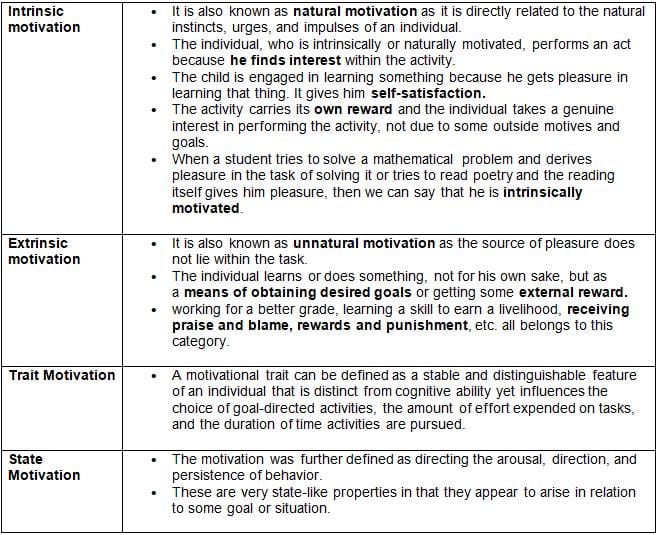
Motivation can be broadly classified into two kinds:

Hence from the above-mentioned points, it is clear that intrinsic motivation is associated with that are enjoyable or satisfying in themselves.

HTET PGT Physics Test - 3 - Question 8

Who spoke about including productive work as the medium of education in the education process compulsorily?

Detailed Solution: Question 8

Mahatma Gandhi, the father of modern India, is one of the greatest teachers of mankind. According to him, education means 'an all-round drawing out of the best in the child's and man's body, mind and spirit'. Hence, he believed in the total development of the human personality through education.

Key Points

  • In his view, vocational efficiency, cultural, spiritual, and character development are the aims of education.
  • In order to promote vocational efficiency, Gandhiji laid emphasis on economic activities in his educational system.
  • He spoke about including productive work as the medium of education in the education process compulsorily.
  • Thus, he emphasized craft-centered education, which included training of both the mind and the body.
  • For example, subjects such as arithmetic, science, environment, etc. should be taught through carpentry, missionary, farming, and other productive work.
  • "True education", he emphasizes, "must stimulate spiritual, intellectual, and physical facilities of the children".
  • By introducing craft, he tried to remove the gap between manual and intellectual labor, the educated and uneducated mass, and promote the dignity of labor, social solidarity, and national integration.

Hence, we conclude that Mahatma Gandhi spoke about including productive work as the medium of education in the education process compulsorily.

Additional Information

  • Rabindranath Tagore is a world-famous poet and is popularly known as "Gurudev", the respected teacher. He was awarded the Nobel prize for his book "Geetanjali".
  • Jawaharlal Nehru was the first prime minister of India and was one of the most prominent leaders of the Indian independence movement. He succeeded his father as president of the Congress in 1929.
  • Dr. B.R. Ambedkar was known for being one of the main architects of India. He is even known for serving as the chairman of the Drafting Committee of the Constituent Assembly.

HTET PGT Physics Test - 3 - Question 9

At what age does the child develop his fluent speech without any errors?

Detailed Solution: Question 9

The development of language in a child is a gradual process, and it varies from child to child. As children grow, they learn and acquire language skills, such as speaking, listening, reading, and writing.

  • The age at which a child develops fluent speech without any errors depends on various factors, such as exposure to language, the environment at home, the child's physical and mental health, and the opportunities for interaction with peers and adults.

Key Points

  • The process of developing fluent speech without any errors is known as achieving "language proficiency." While the age at which this occurs can vary from person to person, research suggests that most children develop language proficiency by around 12 years of age or above.
  • In the early stages of language development, children typically make mistakes and errors as they learn to communicate effectively.
  • However, as they continue to be exposed to the language and interact with others, they gradually improve their language skills and begin to speak fluently and accurately.
  • By around 12 years of age, most children have achieved language proficiency, meaning that they are able to use language effectively and accurately in a variety of contexts.
  • It is important to note that the age at which language proficiency is achieved can vary depending on a number of factors, including the child's exposure to language, their cognitive and developmental abilities, and their social and cultural context.

Hence, it is clear that at 12 years and above, the child develops his fluent speech without any errors.

HTET PGT Physics Test - 3 - Question 10

Rehabilitation Council of India (RCI) Act (1992) deals with

Detailed Solution: Question 10

Rehabilitation Council of India, commonly known as RCI, is a statutory body of government. It regulates the training programmes and courses for the education of disabled, disadvantaged, and special children.

  • Children with special needs refer to those children who have special educational needs due to learning and physical disabilities.
  • Special education is instruction designed for students with disabilities or talents, who also have special learning needs. Some of these students have difficulties in formal institutions so they need special education provisions to function in their classrooms.

Key Points

Aims of Rehabilitation Council of India in the context of Special Education:

  • To help the learners function as independently as possible.
  • To regulate training policies and programs in the field of disability rehabilitation.
  • To standardize training courses for professionals working with people with disabilities.
  • To train individual through vocational method so than they can carry on an independent life.

Hence, it could be concluded that Rehabilitation Council of India deals with Special education.

Additional Information

  • Integrated education: It emphasizes the placement of children with disabilities in mainstream schools. The school system remains rigid and as a result, very few children with disabilities are able to cope with the demands of such a rigid system.
  • Distance Education: It is a process to create and provide access to learning when the source of information and the learners are separated by time and distance, or both.
  • Inclusive Education: It means education for all children in school as It refers to the inclusion of all children in the education system, regardless of their differences and disabilities.

HTET PGT Physics Test - 3 - Question 11

“Instrumental conditioning” is also called as _____

Detailed Solution: Question 11

Operant conditioning, also known as instrumental conditioning, is a method of learning normally attributed to B.F. Skinner, where the consequences of a response determine the probability of it being repeated.

Key Points

  • It is called instrumental because the key feature of this form of learning is that some action or some behavior of the learning is instrumental in bringing about a change in the environment that makes the action more likely (or less likely) to occur again in the future.
  • In operant conditioning, the end result or consequence of behavior determines if it will be repeated in the future or not.
  • Operant conditioning can be defined as a principle of learning in which behavior is maintained or changed through its positive or negative consequences.
  • According to the principles of operant conditioning, positive consequences lead to the repetition of the behavior, whereas, negative consequences will lead to avoidance of behavior.
  • Factors that increase the probability of repetition of behavior have been termed as reinforcement. Whereas, factors that weaken or suppress the targeted behavior has been termed as punishment.

From the above-mentioned points, it is clear that “Instrumental conditioning” is also called as 'Operant Conditioning'.

Additional Information

  • “Instrumental conditioning” is also known as Type R conditioning as the creature release response and gets a reinforcement. This conditioning strength is determined by the number of responses released i.e. response rate.
  • Classical conditioning: Ivan Pavlov, a Russian psychologist has propounded the 'Theory of Classical Conditioning'. Theory emphasizes that behavior is learned by a repetitive association between the response and the stimulus.

HTET PGT Physics Test - 3 - Question 12

Principle of Social Learning was developed by;

Detailed Solution: Question 12

The principle of social learning, often associated with social learning theory, is a concept that highlights how individuals acquire new knowledge, behaviors, attitudes, and skills through observing, imitating, and interacting with others in their social environment.

Key Points

  • Principle of Social Learning was developed by Albert Bandura's.
  • This is a comprehensive framework that explains how individuals learn and develop through social interactions, observation, and cognitive processes.
  • This theory underscores the joint influence of environmental and cognitive factors on human behavior.
  • It highlights observational learning, reciprocal determinism, self-efficacy, modeling, and vicarious reinforcement, all illustrating how personal factors, actions, and surroundings interact and shape behavior.

Hence, Albert Bandura is the correct answer.

Hint

  • Edward Thorndike's Law of Effect - It states that behaviors followed by positive outcomes are more likely to be repeated.​
  • Ivan Pavlov's classical conditioning - It involves pairing a neutral stimulus with an unconditioned stimulus to create a conditioned response.
  • Carl Rogers' self-actualization theory - It posits that individuals have an innate drive to fulfill their unique potential.

HTET PGT Physics Test - 3 - Question 13

The ability to 'Operate on operations' is acquired in:

Detailed Solution: Question 13

Piaget is best known for his groundbreaking work in understanding how children develop intellectually and how they construct knowledge about the world. He proposed a comprehensive theory of cognitive development, which has had a significant impact on education and psychology.

Key Points

  • Piaget proposed four stages of cognitive development, and the ability to "operate on operations" is a characteristic of the formal operational stage, which typically begins around age 11 and continues into adulthood.
  • During the formal operational stage, individuals develop the capacity for abstract and hypothetical thinking.
  • They can manipulate and reason about abstract concepts, hypothetical situations, and possibilities beyond what is directly experienced.
  • This ability allows individuals to think logically and systematically about concrete and abstract problems.

Thus, it is concluded that The ability to 'Operate on operations' is acquired in Formal -operational stage.

HTET PGT Physics Test - 3 - Question 14

Who among the following is not the chief exponents of the trait theory of personality?

Detailed Solution: Question 14
A trait is a dimension of personality that can be measured and must describe the consistent behaviour of an individual.

  • A trait as a dimension is conceived quantitatively as a continuous scale of measurement from the extensive positive end to the extreme negative end.
  • To be a meaningful measure of human personality, a trait must be a distinctive and ‘enduring’ characteristic of an individual.
  • According to trait theorists, if we confine ourselves to a few basic characteristics that are consistent and distinctive of the human personality, describing them should become simpler.
  • Theorists often distinguish between the readily observed traits and those which are "deeper" and nearer to the core personality.
  • One of the approaches to the trait theory describes the readily observable traits as ‘surface traits’ and the deeper ones as ‘source traits’.

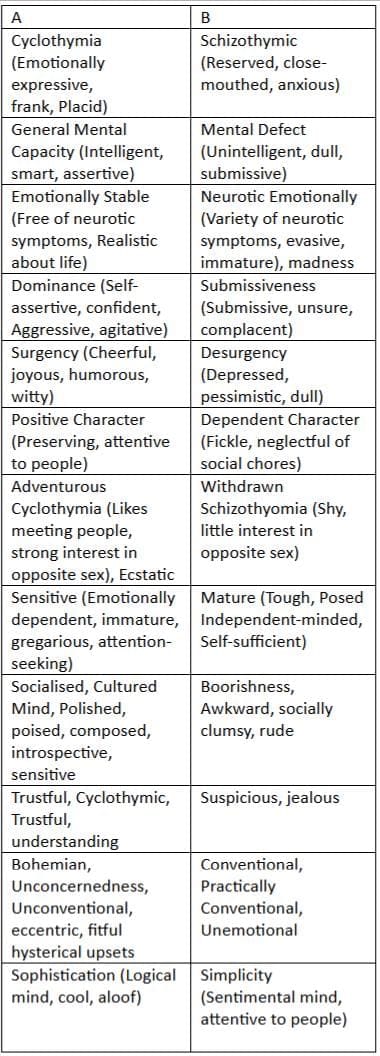
G.W. Allport, R.B. Cattell and H.J. Eysenck are the chief exponents of the trait theory of personality. Twelve Basic Traits:

Hence, Sigmund Freud is not the chief exponent of the trait theory of personality.

HTET PGT Physics Test - 3 - Question 15

Who gave the following recommendation?

'Health and physical education should continue to be compulsory subjects from the primary to the secondary stages.'

Detailed Solution: Question 15

The National Curriculum Framework 2005 (NCF 2005) is the fourth National Curriculum Framework published in 2005 by the National Council of Educational Research and Training (NCERT) in India. Its predecessors were published in 1975, 1988, 2000.

Key PointsThis NCF 2005, draws attention to four other curricular areas: work, the arts and heritage crafts, health and physical education, and peace.

  • It also recommended that health and physical education should continue to be compulsory subjects from the primary to the secondary stages.
  • It is widely acknowledged that health is influenced by biological, social, economic, cultural, and political forces.
  • Access to basic needs like food, safe drinking water supply, housing, sanitation, and health services influences the health status of a population, and these are reflected through mortality and nutritional indicators.
  • Health is a critical input for the overall development of the child, and it influences enrolment, retention, and school completion rates significantly.
  • This curriculum area adopts a holistic definition of health within which physical education and yoga contribute to the physical, social, emotional, and mental development of a child.

Thus, it is clear that the NCF 2005, gave the recommendation 'Health and physical education should continue to be compulsory subjects from the primary to the secondary stages.'

HTET PGT Physics Test - 3 - Question 16

'जिसने प्रतिष्ठा पा ली हो' वाक्यांश के लिए एक शब्द होगा -

Detailed Solution: Question 16

'जिसने प्रतिष्ठा पा ली हो' वाक्यांश के लिए एक शब्द होगा - 'लब्धप्रतिष्ठ'

मुख्य बिंदु

  • 'लब्धप्रतीष्ठ' विकल्प 1 :- वर्तनीगत अशुद्धि
  • लब्ध का अर्थ होता है, अर्जित हुआ, कमाया हुआ।
  • प्रतिष्ठान का अर्थ है:- स्थापना
  • प्रतिष्ठित:- जो बहुत सम्मानीय हो (पहले से के सन्दर्भ में)

अतिरिक्त जानकारी

HTET PGT Physics Test - 3 - Question 17

क्रिया विशेषण शब्द होते है।

Detailed Solution: Question 17

सही उत्तर है - "क्रिया की विशेषता बताने वाले" lमुख्य बिंदु

  • 'क्रिया की विशेषता बताने वाले' शब्दों को 'क्रियाविशेषण' कहते हैं l
    • जैसे : - हिरण तेज़ भागता है। इस वाक्य में भागना क्रिया है। तेज़ शब्द हमें क्रिया कि विशेषता बता रहा है कि वह कितनी तेज़ भाग रहा है।
  • अन्य विकल्प :-
    • संज्ञा या सर्वनाम का वाक्य के अन्य शब्दों से सम्बन्ध बताने वाले - संबंधबोधक/ कारक कहते है l
    • दो क्रियाओ को आपस में जोड़ने वाले, क्रिया और विशेषण दोनों का मेल करने वाले - गलत विकल्प है l

अतिरिक्त जानकारी

  • जिस शब्द से किसी काम का करना या होना प्रकट होता हो, उसे क्रिया कहते हैं।
    • जैसे- पढ़ना, लिखना, खाना, आना इत्यादि।
  • किसी संज्ञा तथा सर्वनाम की विशेषता बताने वाले शब्द को विशेषण कहते हैं l
    • 'क्रिया विशेषण' क्रिया तथा विशेषण शब्दों को मिलाकर बना है l

HTET PGT Physics Test - 3 - Question 18

"रस का अक्षय पात्र सदा का"- रेखांकित शब्द का अर्थ है?

Detailed Solution: Question 18

"रस का अक्षय पात्र सदा का"- रेखांकित शब्द का अर्थ है- अविनाशी

अक्षय-

  • अर्थ-
    • अविनाशी (कभी नष्ट न होने वाला)
  • विलोम-
    • क्षय, क्षयशील, नश्वर

प्रमुख बिंदु
"रस का अक्षय पात्र सदा का,
छोटा मेरा खेत चौकोना।-

  • रचनाकार-उमाशंकर जोशी
  • विधा-काव्य
  • यह 'छोटा मेरा खेत' कविता की पंक्तियाँ हैं।
  • भाव-
    • कवि कहता है कि उसका कविता रूपी खेत छोटा-सा है, उसमें रस कभी समाप्त नहीं होता।

महत्वपूर्ण बिंदु
उमाशंकर जोशी-

  • जन्म-1911-1988 ई.
  • इनका जन्म गुजरात में हुआ।
  • बीसवीं सदी की गुजराती कविता को नई भंगिमा प्रदान की।
  • इनका उपनाम 'वासुकी' है।
  • प्रमुख काव्य रचनाएं-
    • विश्वशांति (6 खंडों में)
    • गंगोत्री
    • निशीथ
    • गुलेपोलांड
    • प्राचीना
    • आतिथ्य और वसंत वर्ष
    • महाप्रस्थान आदि।

HTET PGT Physics Test - 3 - Question 19

The following sentence has been split into four segments. Identify the segment that contains a grammatical error.

Children listens to people / speaking around them / for a long time before / they begin to speak.

Detailed Solution: Question 19

The erroneous part is option 1) i.e. 'Children listens to people.'

Key Points

  • The error lies in the part 'Children listens to people.'
  • According to the rules of subject-verb agreement, a plural verb is used with a plural subject.
  • Here, the subject "Children" is plural, so the verb should also be in the plural form "listen" instead of "listens".
  • Example:
    • His children are very precious to him.
  • Therefore in the given sentence, we need to use 'Children listen' in place of 'Children listens' to make the sentence grammatically correct.
  • Hence, the correct answer is option 1.

Correct sentence: Children listen to people speaking around them for a long time before they begin to speak.

HTET PGT Physics Test - 3 - Question 20

How many positive integers less than 200 are NOT divisible by three or more primes?

Detailed Solution: Question 20

Concept:
Division rule: If a finite set A is a union of disjoint with subset 'd' element each, then
n = |A|/d
If |A| is not divisible by d, then,

where [A] is the greatest integers function of A.
Calculation:
To calculate the required number, we determine every possible combination of three primes that divides at least one of the integer below 200.
|A1| = [(199 / lcm (2, 3, 5)] = 6
|A2| = [(199 / lcm (2, 3, 7)] = 4
|A3| = [(199 / lcm (2, 3, 11)] = 3 
|A4| = [(199 / lcm (2, 3, 13)] = 2
|A5| = [(199 / lcm (2, 3, 17)] = 1 
|A6| = [(199 / lcm (2, 3, 19)] = 1
|A7| = [(199 / lcm (2, 3, 23)] = 1 
|A8| = [(199 / lcm (2, 3, 29)] = 1
|A9| = [(199 / lcm (2, 3, 31)] = 1 
|A10| = [(199 / lcm (2, 5, 7)] = 2
|A11| = [(199 / lcm (2, 5, 11)] = 1 
|A12| = [(199 / lcm (2, 5, 13)] = 1
|A13| = [(199 / lcm (2, 5, 17)] = 1 
|A14| = [(199 / lcm (2, 5, 19)] = 1
|A15| = [(199 / lcm (2, 7, 11)] = 1
|A16| = [(199 / lcm (2, 7, 13)] = 1
|A17| =  [(199 / lcm (3, 5, 7)] = 1
|A18| =  [(199 / lcm (3, 5, 11)] = 1
|A19| = [(199 / lcm (3, 5, 13)] = 1
Therefore, number divisible by three primes
= 6 + 4 + 3 +  2 × 2 + 14 × 1 = 31
Hence, the number of integers less than 200  which are not divisible three primes|
= 199 - 31
= 168
Additional Information
The number of elements in the union of sets is calculated by the inclusion-exclusion principle.
n (A∪B) = n (A) + n (B) - n (A∪B)
For two sets:
|
A ∪ B ∪ C| = |A| + |B| + |C| - |A∪B| - |B∪C| - |C∪A| + |A ∩ B ∩ 

HTET PGT Physics Test - 3 - Question 21

Four runners started running simultaneously from a point on a circular track. They took 400 seconds, 600 seconds, 720 seconds and 900 seconds to complete one round. After how much time did they meet at the starting point for the first time since the race started?

Detailed Solution: Question 21

Given:

four runners to complete 1 round takes 400 sec, 600 sec, 720 sec, and 900 sec respectively

Concept used:

Lowest Common Multiple ( L.C.M )

Calculation:

When the four runners will meet at the starting point, they would have completed different numbers of rounds

Hence, the time at which they will meet will be the L.C.M of the individual time taken by them

⇒ L.C.M. of 400, 600, 720, and 900 = 3600 sec.

Hence, they will meet after 3600 seconds.

HTET PGT Physics Test - 3 - Question 22

In a right triangle, ABC ∠A = 90° and AD is perpendicular to BC. If ∠CAD = 60° and BC = 6 cm, then what is AB equal to?

Detailed Solution: Question 22
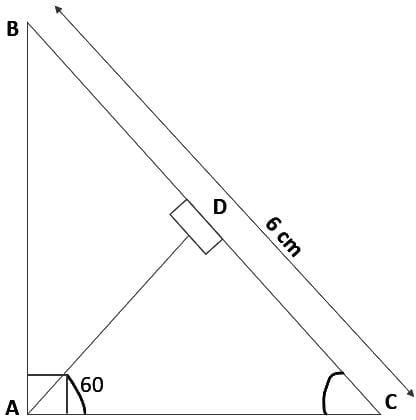
Formula used:

sin 30= 1/2 = P/H

Calculation:

In Δ ACD

If ∠ CAD = 600, ∠ ADC = 900

Then ∠ ACD = 300

In Δ ABC

sin 300 = P \ H

⇒ 1/2 = P/6,

⇒ P = 3cm

∴ The length of AB is 3 cm.

HTET PGT Physics Test - 3 - Question 23

The area of Agroha passed under Muslim rule after the defeat of which ruler in the Second Battle of Tarain (1192).

Detailed Solution: Question 23

The correct answer is Prithvi Raj III.

Key Points

  • The Second Battle of Tarain (1192) was fought between the Ghurid forces of Muhammad Ghuri and the Rajput Confederacy of Prithviraj Chauhan.
    • Prithviraj Chauhan was also known as Prithviraja III.
  • Agroha is a town in Haryana state of northern India.
    • It is situated in Hisar district in between Hisar city and Fatehabad.
    • The area of Agroha passed on to the Muslim rule after the defeat of Prithvi Raj III in the Second Battle of Tarain (1192).
    • After the Battle of Tarain, Sultan Shihab-ud-Din Muhammad Ghuri placed one of his ablest generals in the Indian campaigns. But it appears that any meaningful control could not be established.
    • Jatus, a Rajput, extended his power in Fatehabad area including Agroha.
  • Prithviraj Chauhan
    • ​He was a king from the Chauhan (Chahamana) dynasty who ruled the territory of Sapadalaksha.
    • He led a coalition of several Rajput kings and defeated the Ghurid army led by Muhammad Ghori near Taraori in 1191 AD.
    • He was captured near Sirsa and executed after the second battle of Tarain.
    • He has been mentioned in several medieval kavyas (epic poems) by Hindu and Jain authors. These include Prithviraja Vijaya, Hammira Mahakavya and Prithviraj Raso.

HTET PGT Physics Test - 3 - Question 24

In an office, all the employees are standing in a row. One worker is 47th from both the ends. How many staff members are there in that office?

Detailed Solution: Question 24
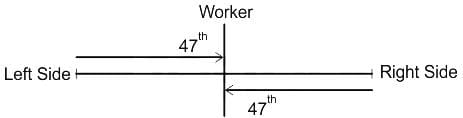
Formula used:
Total number of person in row = (rank from the left side + rank from the right side) - 1
As per the given information:
In an office, all the employees are standing in a row. One worker is 47th from both the ends.


Total number of person in a row = (47 + 47) - 1 = 93
Hence, the correct answer is "93".

HTET PGT Physics Test - 3 - Question 25

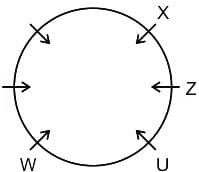
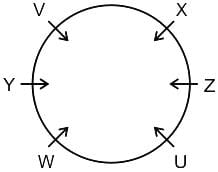
U, V, W, X, Y and Z are sitting in a circle, facing the middle of the circle. V is to the left of Y, W is to the right of Y, Z is in the middle of U and X. U is to the immediate right of W. Who is to the immediate left of V?

Detailed Solution: Question 25
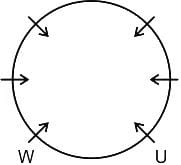
Given that: U, V, W, X, Y and Z are sitting in a circle, facing the middle of the circle.

  • U is to the immediate right of W.

  • Z is in the middle of U and X.

  • W is to the right of Y.
  • V is to the left of Y.

  • X is the immediate left of V.

Hence, "option D" is the correct answer.

HTET PGT Physics Test - 3 - Question 26

The area of ​​a square piece of glass is 676 cm2, which is placed on a table. The width between the piece of glass and one side of the table is 9 cm. Find the length of the table?

Detailed Solution: Question 26

Given:

The area of a square piece of glass = 676 cm2

Width between the piece of glass and one side of the table = 9 cm

Formula Used:

Area of a square = Side2

Calculation:

Side of the square piece of glass = √(676)

⇒ Side of the square piece of glass = 26 cm

Length of the table = Side of the square piece of glass + 2 × Width between the piece of glass and one side of the table

⇒ Length of the table = 26 cm + 2 × 9 cm

⇒ Length of the table = 26 cm + 18 cm

⇒ Length of the table = 44 cm

The length of the table is 44 cm.

HTET PGT Physics Test - 3 - Question 27

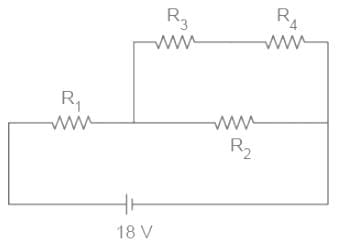
In the given circuit the internal resistance of the 18 V cell is negligible. If R1 = 400 Ω, R3 = 100 Ω and R4 = 500 Ω and the reading of an ideal voltmeter across R4 is 5 V, then the value of R2 will be:
Detailed Solution: Question 27
Concept:

Ohm’s Law states that the current flowing through a conductor is directly proportional to the potential difference applied across its ends, provided the temperature and other physical conditions remain unchanged. Mathematically it can be represented as,

V = IR

Calculation:

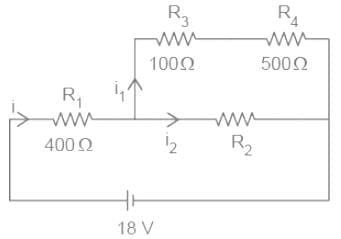
The circuit with value is given in the below diagram:

From question, the voltage across R4 is 5 V (V4).

According to ohm’s law,

V = IR

Where,

V = Voltage (Volts)

R = Resistance (Ohms)

Now, the current i1 is:
 i1 = V4/R4
⇒ i1 = 5/500

The potential difference across R3 and R4 is:
⇒ V2 = (R3 + R4) i1
⇒ V2 = (100 + 500)1/100
⇒ V2 = (600/100)
∴ V2 = 6 V
The potential difference across R1 is:
V1 = 18 - 6 = 12 V
The current across R1 is:
i = V1/R1

⇒ i = 12/400

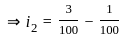
The current through R2 is:

i2 = i - i1

Now, the voltage across R2 is:

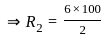
∴ R2 = 300 Ω

HTET PGT Physics Test - 3 - Question 28

Rutherford scattering proved the:

Detailed Solution: Question 28
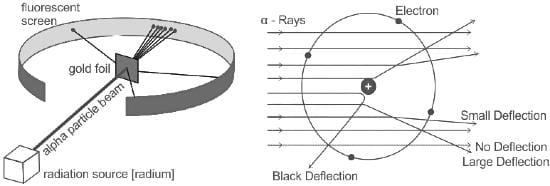
Concept

Rutherford scattering experiment:

  • Rutherford conducted an experiment by bombarding a thin sheet of gold with α-particles.
  • And then studied the trajectory of these particles after their interaction with the gold foil.

The observations made by Rutherford led him to conclude that:

  • A major fraction of the α-particles bombarded towards the gold sheet passed through the sheet without any deflection, and hence most of the space in an atom is empty.
  • Some of the α-particles were deflected by the gold sheet by very small angles, and hence the positive charge in an atom is not uniformly distributed. The positive charge in an atom is concentrated in a very small volume.
  • Very few of the α-particles were deflected back, that is only a few α-particles had nearly 180o angle of deflection. So the volume occupied by the positively charged particles in an atom is very small compared to the total volume of an atom.

According to the Rutherford atomic model:

  • The positive charge and most of the mass of an atom are concentrated in an extremely small volume. He called this region of the atom is called the nucleus.
  • Rutherford’s model proposed that the negatively charged electrons surround the nucleus of an atom. He also claimed that the electrons surrounding the nucleus revolve around it at very high speed in circular paths. He named these circular paths orbits.
  • Electrons being negatively charged and nuclei being a densely concentrated mass of positively charged particles are held together by a strong electrostatic force of attraction.

Explanation

  • According to the Rutherford atomic model, positive charge and most of the mass of an atom is concentrated in an extremely small volume.
  • He called this region of the atom is called the nucleus. Hence, Rutherford's scattering proved the presence of a nucleus.

Additional Information

  • Rutherford's experiment failed to explain certain things.
    • The Rutherford model was not in accordance with Maxwell’s theory and could not explain the stability of an atom.
    • One of the drawbacks of the Rutherford model was also that he did not say anything about the arrangement of electrons in an atom which made his theory incomplete.
    • Although the early atomic models were inaccurate and failed to explain certain experimental results, they formed the base for future developments in the world of quantum mechanics

HTET PGT Physics Test - 3 - Question 29

Measure of two quantities along with the precision of respective measuring instrument is
A = 2.5 m s–1 ± 0.5 m s–1
B = 0.10 s ± 0.01 s
The value of A B will be

Detailed Solution: Question 29
Given:

A = 2.5 m s–1, ΔA = 0.5 m s–1

B = 0.10 s, ΔB = 0.01 s

Let X = A × B = 0.25 m

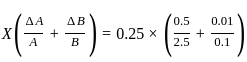
and relative error in X, ΔX/X = ΔA/A + ΔB/B

ΔX =

= 0.075 ≈ 0.08 (rounded off to two decimal places as ΔB has two decimal places)

So, value of X = X ± ΔX = 0.25 ± 0.08 m

So, the correct answer is option (1).

HTET PGT Physics Test - 3 - Question 30

Which of the following quantity remains conserved when the moon revolves around the earth?

Detailed Solution: Question 30

Concept

Angular momentum:

  • Angular momentum is the property of any rotating object given by moment of inertia times angular velocity.
    • It is a vector quantity.
    • Its SI unit is kg-m2/sec.
  • If I and ω are the moment of inertia and the angular velocity respectively, then the angular momentum is given as,

⇒ L = Iω

⇒ L = rP

Where r = radius of rotation and P = linear momentum

Conservation of angular momentum:

  • According to the conservation of angular momentum, if the total external torque on the system of particles is zero, then the total angular momentum of the system remains conserved.

Explanation

  • When the moon revolves around the earth, its direction of motion continuously changes so the velocity and the linear momentum also change continuously.
  • Since no torque acts on the moon when it revolves around the earth, so according to the conservation of angular momentum the angular momentum of the moon will remain conserved. Hence, option 3 is correct.

View more questions
23 tests
Information about HTET PGT Physics Test - 3 Page
In this test you can find the Exam questions for HTET PGT Physics Test - 3 solved & explained in the simplest way possible. Besides giving Questions and answers for HTET PGT Physics Test - 3, EduRev gives you an ample number of Online tests for practice
Download as PDF