HTET Exam  >  HTET Test  >   PGT Mock Test Series 2026  >  HTET PGT Physics Test - 4 - HTET MCQ

HTET PGT Physics Test - 4 Free Online Test 2026


MCQ Practice Test & Solutions: HTET PGT Physics Test - 4 (150 Questions)

You can prepare effectively for HTET HTET PGT Mock Test Series 2026 with this dedicated MCQ Practice Test (available with solutions) on the important topic of "HTET PGT Physics Test - 4". These 150 questions have been designed by the experts with the latest curriculum of HTET 2026, to help you master the concept.

Test Highlights:

  • - Format: Multiple Choice Questions (MCQ)
  • - Duration: 150 minutes
  • - Number of Questions: 150

Sign up on EduRev for free to attempt this test and track your preparation progress.

HTET PGT Physics Test - 4 - Question 1

Instrumental conditioning is also called as

Detailed Solution: Question 1

Another term for operant conditioning is Instrumental conditioning. B.F. Skinner was the main proponent of operant conditioning or instrumental conditioning. It is called instrumental because the key feature of this form of learning is that some action or some behavior of the learning is instrumental in bringing about a change in the environment that makes the action more likely (or less likely) to occur again in the future.

  • In operant conditioning, the end result or consequence of behavior determines if it will be repeated in the future or not.
  • Operant conditioning can be defined as a principle of learning in which behavior is maintained or changed through its positive or negative consequences.
  • According to the principles of operant conditioning, positive consequences lead to the repetition of the behavior, whereas, negative consequences will lead to avoidance of behavior.
  • Factors that increase the probability of repetition of behavior have been termed as reinforcement. Whereas, factors that weaken or suppress the targeted behavior has been termed as punishment.
  • It is also known as Type R conditioning as the creature release response and gets a reinforcement. This conditioning strength is determined by the number of responses released i.e. response rate.

From the above, it is clear that Instrumental conditioning is also called as R-Type Conditioning.

HTET PGT Physics Test - 4 - Question 2

Out of the following which one is the subject matter for the study of Gestalt Psychologist?

Detailed Solution: Question 2

Gestalt is the German word that means shape, form, or whole. It is a psychological term that means unified whole.

Key Points Gestalt psychology is a school of thought that looks at the human mind and behavior as a whole.

  • The founder of Gestalt psychology is Max Wertheimer.
  • Gestalt Psychologist was interested in looking at the totality of mind and behavior.
  • Organisms perceive entire patterns or configurations, not merely individual components.
  • When trying to make sense of the world around us, Gestalt psychology suggests that we do not simply focus on every small component.
  • When trying to make sense of the world around us.
  • It suggests that we do not simply focus on every small component.

Thus, it is concluded that mental and behavioral processes as a whole are the subject matter for the study of Gestalt Psychologists.

HTET PGT Physics Test - 4 - Question 3

Child centred education refers to

Detailed Solution: Question 3

Child-centred education puts learners in the centre and gives primacy to a child's experiences and needs. It strongly believes that when children are given the freedom to work at their own pace, they develop the ability to assimilate the concepts efficiently.

Key Points

Characteristics of the child-centred teaching and learning​:

  • It stresses the importance of enquiry, observation and investigation.
  • It takes into account the learner's capabilities, capacities and learning styles.
  • It encourages the experience and learning of a child.
  • It uses methods like experiential learning, problem-solving, concept mapping and creative writing.
  • It emphasises providing ample opportunities to the children to foster their own strategy of learning to perform a task.
  • In this method, teachers facilitate students as a facilitator by providing with proper environment and materials to learn at their own pace.
  • Students work in flexible, cooperative groupings to solve problems to demonstrate an understanding of the task that ensures their holistic development.

Hint

  • In the teacher-centered class, the teacher asks different forms of questions, such as closed-ended, open-ended, or partially close-ended questions.
  • It is a self-reporting instrument that can be used to measure knowledge levels, opinions, attitudes, beliefs, ideas, feelings, and perceptions of students.

Hence, it could be concluded that child-centred education refers to encourage the experience and learning of a child.

HTET PGT Physics Test - 4 - Question 4

According to Urie Bronfenbrenner ______ system is the small immediate environment the child lives in.

Detailed Solution: Question 4
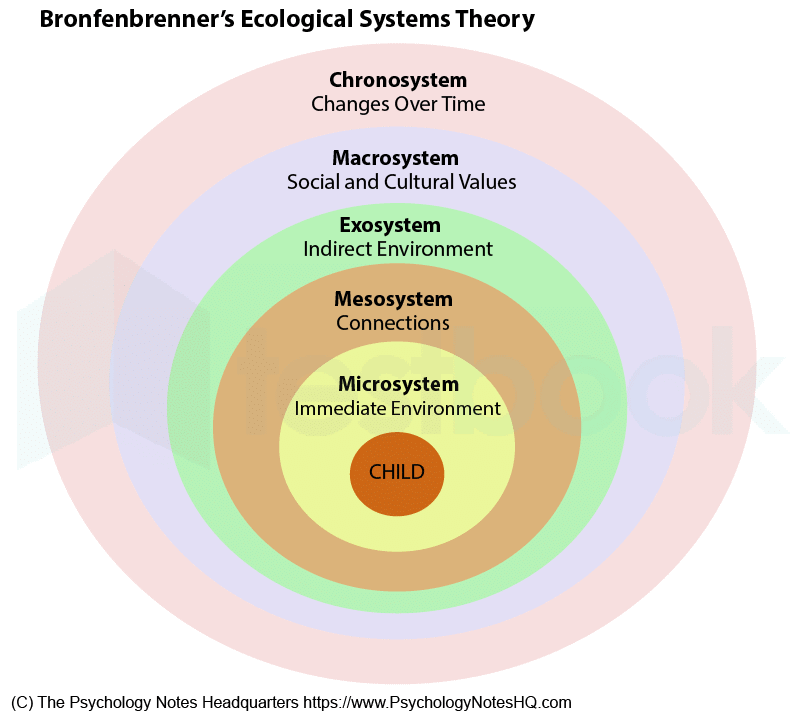
Urie Bronfenbrenner (1979) has proposed one of the most influential theories explaining the role of context in our development. His theory is known as “Ecological System Theory”. Now we will discuss this theory in detail.

Key Points

  • The ecological system theory proposed that human development is influenced by many socio-cultural or environmental forces.
  • It suggests that there is no single factor that affects the development of the individual significantly rather it is result of interacting factors.
  • He has envisioned the environment consisting of five structures namely, microsystem, mesosystem, exosystem, macrosystem and chronosystem.
  • Microsystem level: This is the immediate environmental structure where an individual have direct interaction with their significant others such as parents, sibling, teachers, and peers.

Important PointsOther systems in ecological theory are explained below:

  • Mesosystem: This is the second level structure of this model. This level is comprised of connections between microsystems. For example, how parents of a child relate to the teachers or how parents treat their child’s friends affect child’s behaviour.
  • Exosystem: It includes those social contexts on which a developing individual have no control. Events occurring in this social context can affect mesosystem and the experiences of developing person such as, parent’s transfer, work schedule, availability of maternity, paternity leave or availability of hospital.
  • Macrosystem: It includes cultural values, customs and laws. It is the outermost level and does not have specific context.
  • Chronosystem: The term ‘chrono’ refers to time. According to Bronfenbrenner, it is a temporary level; it changes quickly and refers to any socio-historical events such as war or economic condition of the country.
  • The image below summarises the theory.

Therefore, it can be concluded that it is in Bronfenbrenner's theory that Microsystem is a system having small immediate environment the child lives in.

HTET PGT Physics Test - 4 - Question 5

स्वेच्छा का संधि विच्छेद है:

Detailed Solution: Question 5

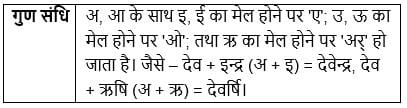
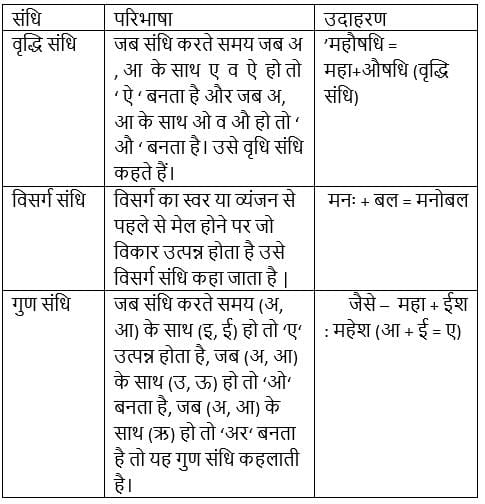
स्वेच्छा का संधि विच्छेद “स्व + इच्छा” है। यह गुण संधि का उदाहरण है। अतः विकल्प 4 सही उत्तर होगा।

विशेष :

HTET PGT Physics Test - 4 - Question 6

किस शब्द की संधि सही नहीं है?

Detailed Solution: Question 6

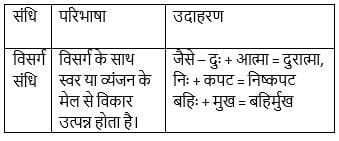
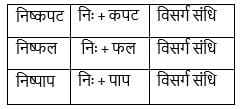
मनोभाव शब्द का संधि विच्छेद सही नहीं है। अन्य विकल्प में शब्द का संधि विच्छेद सही है। अतः सही उत्तर विकल्प (3) मनोभाव = मनः + भाव होगा ।
प्रमुख बिंदुसही संधि विच्छेद :-

  • मनोभाव = मनः + भाव (विसर्ग संधि)

महत्वपूर्ण बिंदु


अतिरिक्त जानकारी

HTET PGT Physics Test - 4 - Question 7

'सर मुंडाते ही ओले पड़ना' मुहावरे का उपयुक्त भावार्थ है

Detailed Solution: Question 7

इसका सही उत्तर 'कार्यारंभ होते ही विघ्न पड़ना' है।

मुख्य बिंदु

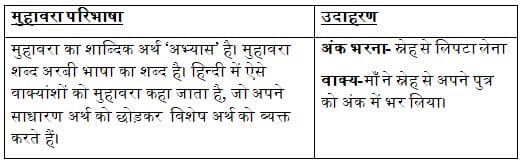
  • 'सर मुंडाते ही ओले पड़ना' मुहावरे का अर्थ है- कार्यारंभ होते ही विघ्न पड़ना।
  • वाक्य प्रयोग - नरेश ने कल ही कार खरीदी थी और रात की आंधी में उसके ऊपर पेड़ गिर गया, उसके तो सिर मुड़ाते ही ओले पड़ गए।

अतिरिक्त जानकारी

HTET PGT Physics Test - 4 - Question 8

'क्या' कौन सा सर्वनाम है?

Detailed Solution: Question 8

'क्या' 'प्रश्नवाचक' सर्वनाम है।

जैसे- क्या तुमने परीक्षा पास की?

मुख्य बिंदुप्रश्नवाचक सर्वनाम- जिस सर्वनामो से प्रश्न करने जैसे शब्द प्रयुक्त हों, प्रश्नवाचक सर्वनाम कहलाते है।
जैसे- कौन, क्या आदि।

  • उदाहरण- शादी में कौन-कौन जा रहा है।

संबंधवाचक सर्वनाम- जिन सर्वनाम से एक-दूसरे से संबंध दिखाया जाए, संबंध वाचक सर्वनाम कहते है।
जैसे- जो, सो आदि।

  • उदाहरण- जो हुआ सो हुआ, अब भूल जाओ।

निजवाचक सर्वनाम- निजवाचक सर्वनाम - 'आप'।
यहाँ 'आप' शब्द 'स्वयं' के लिए प्रयोग किया जाता है।

  • उदाहरण- तुम अपने 'आप' चले जाना।

पुरुषवाचक सर्वनाम- पुरुषों (स्त्री या पुरुष) के नामे के बदले आते है, पुरुषवाचक सर्वनाम कहलाते है।
जैसे- मै, हम, तुम आदि।

  • उदाहरण- तुम यहाँ बैठकर पंचायत मत करो।

अतिरिक्त जानकारीसर्वनाम - संज्ञा के स्थान पर प्रयोग होने वाले शब्दों को सर्वनाम कहते है।
जैसे- मैं, तुम, हम, वे, आदि।

सर्वनाम के भेद- 6 भेद

  1. पुरुषवाचक सर्वनाम
  2. निश्चयवाचक सर्वनाम
  3. अनिश्चयवाचक सर्वनाम
  4. संबंधवाचक सर्वनाम
  5. प्रश्नवाचक सर्वनाम
  6. निजवाचक सर्वनाम

निश्चयवाचक सर्वनाम- निकट या दूर की वस्तुओं के लिये कोई निश्चित संकेत जिन शब्दों से प्रकट होता है, निश्चयवाचक सर्वनाम कहलाते है।
जैसे- यह, वह, ये, वे आदि।

  • उदाहरण- वह आदमी काम पर जा रहा है।

अनिश्चयवाचक सर्वनाम- जिन सर्वनामों से कोई निश्चित वस्तु या व्यक्ति का बोध नहीं होता, अनिश्चयवाचक सर्वनाम कहलाते है।
जैसे- कोई, कुछ आदि।

  • उदाहरण- कोई कुछ कहेगा तो मैं उसको पीट दूँगा।

HTET PGT Physics Test - 4 - Question 9

विधायक में कौन सी संधि है ?

Detailed Solution: Question 9

दिए गए विकल्पों में विधायक शब्द का सही संधि विच्छेद विधै + अक है तथा यहाँ अयादि संधि है। अतः सही विकल्प अयादि संधि है।प्रमुख बिंदु
स्पष्टीकरण
अयादि संधि -
जब संधि करते समय ए , ऐ , ओ , औ के साथ कोई भिन्न स्वर हो तो (ए का अय), (ऐ का आय), (औ – आव) बन जाता है। यही अयादि संधि कहलाती है।

  • जब संधि करते समय ए , ऐ , ओ , औ के साथ कोई अन्य स्वर हो तो (ए का अय), (ऐ का आय), (ओ का अव), (औ – आव) बन जाता है। यही अयादि संधि कहलाती है।
  • य , व् से पहले व्यंजन पर अ , आ की मात्रा हो तो अयादि संधि हो सकती है लेकिन अगर और कोई विच्छेद न निकलता हो तो + के बाद वाले भाग को वैसा का वैसा लिखना होगा।

अयादि संधि के उदाहरण

  • चे + अन : चयन (ए + अ = अय)

जैसा कि आप ऊपर दिए गए उदाहरण में देख सकते हैं कि एवं ये दोनों स्वर शब्दों में है। जब शब्दों की संधि की जाती है तो इन ही दोनों स्वरों के कारण शब्दों में परिवर्तन आता है। जब संधि होती है तो एवं मिलकर अय बनाते हैं। चे एवं अन से मिलकर चयन बनता है। अतएव यह उदाहरण अयादि संधि के अंतर्गत आएगा।

  • पो + अन : पवन (ओ + अ = अव)

जैसा कि आप ऊपर दिए गए उदाहरण में देख सकते हैं कि एवं ये दोनों स्वर शब्दों में है। जब शब्दों की संधि की जाती है तो इन ही दोनों स्वरों के कारण शब्दों में परिवर्तन आता है। जब संधि होती है तो एवं मिलकर अव बनाते हैं। पो एवं अन से मिलकर पवन बनता है। अतएव 
अतिरिक्त जानकारी​​​

HTET PGT Physics Test - 4 - Question 10

निम्नाकिंत वाक्यों में क्रिया-विशेषण वाक्य कौन-सा है ?

Detailed Solution: Question 10

लड़का रोते-रोते घर पहुँचा यह एक क्रिया विशेषण वाक्य का उदाहरण है, अन्य विकल्प यहाँ असंगत है। अत: सही विकल्प 3)लड़का रोते-रोते घर पहुँचा ही होगा।
महत्वपूर्ण बिंदु

  • उक्त वाक्य में लड़के की 'रोते-रोते' विशेषता बताई गयी है और "घर जाना: उसकी क्रिया

प्रमुख बिंदु

  • जिन शब्दों से क्रिया की विशेषता का पता चलता है, उन शब्दों को हम क्रिया विशेषण कहते हैं।
  • जैसे: हिरण तेज़ भागता है। इस वाक्य में भागना क्रिया है।

HTET PGT Physics Test - 4 - Question 11

Select the most appropriate synonym of the given word.

Conceal

Detailed Solution: Question 11

The correct answer is 'Option 4' i.e 'Hide'.

Key Points

  • The word "Conceal" means to hide or keep secret.
  • "Hide" is the correct synonym for "conceal".
  • Both words mean to prevent something from being seen or known about.(छुपाना)

Therefore, the correct answer is: 'Hide'.

Additional Information

  • Explanation of the words:
    • "Manifest" :It means to display or show (a quality or feeling) by one's acts or appearance; demonstrate.(स्पष्ट)
    • "Disclose" : It means to make (secret or new information) known, or to reveal(प्रकट करना)
    • "Confess" means to admit or state that one has committed a crime or is at fault in some way. (कबूल करना)

HTET PGT Physics Test - 4 - Question 12

A sentence has been given with a blank to be filled with an appropriate option. Choose the correct alternative.

________ months later, Steve returned to New York to look for a job.

Detailed Solution: Question 12

The correct answer is "A few."
Key Points

  • Let us understand the usage of the following:
    • A little and a few are quantifiers meaning ‘some’.
    • We use a little with singular uncountable nouns. We use a few with plural countable nouns.
  • ​In the given sentence, the noun is months which is a countable noun.
  • Thus, we will use the quantifier "a few"
  • Thus, the correct sentence will be: A few months later, Steve returned to New York to look for a job.

Hence, the correct answer will be option 2.

Additional Information

  • "Few" without the article "a" means almost none or not enough, not many.
  • "The few" is incorrect because it implies a specific group of people or things that are few in number.

HTET PGT Physics Test - 4 - Question 13

The first two words of the following question bears a relationship between them, choose the alternative which has the similar relationship with the third word.

Botany : Plants :: Geology : ?

Detailed Solution: Question 13

Given: Botany : Plants

Study of Plants is called Botany.

Similarly,

Geology : Earth

Study of Earth is called Geology.

Hence, Earth is correct. Additional Information

Study of Birds is called Ornithology.

Study of Reptiles is called Herpetology.

​Study of Animals is called Zoology.

HTET PGT Physics Test - 4 - Question 14

Three numbers are in the ratio of 1 ∶ 4 ∶ 2. Their average is 14. Find the largest number.

Detailed Solution: Question 14

Concept Used:

If two values are in ratio a:b then their values must and bx for any constant x.

Average = sum of all observations ÷ number of observations

Calculation:

Let the number be x, 4x and 2x.

Given: Average = 14

⇒ (x + 4x + 2x) ÷ 3 = 14

⇒ 7x = 14 × 3

⇒ x = 2 × 3 = 6

Hence, the largest number is 4×6 = 24.

HTET PGT Physics Test - 4 - Question 15

Select the option that is embedded in the given figure (rotation is NOT allowed).

Detailed Solution: Question 15
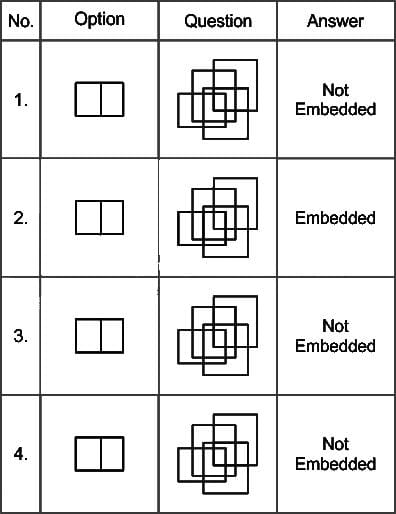
We consider the given options and see whether the pattern can be embedded without rotation:


Hence, the correct answer is "option (2)".

HTET PGT Physics Test - 4 - Question 16

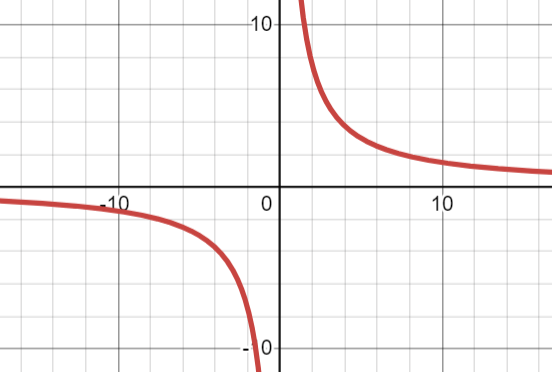
The curve given by xy = 15 is symmetrical about what?

Detailed Solution: Question 16

Concept use:
Symmetry defines that the shape is identical on both sides when it is divided by a line. The symmetry of different shapes, regular or irregular.
Explanation:
The curve given by xy = 15 is symmetrical about about the line x = y.

Option (B) is true.

HTET PGT Physics Test - 4 - Question 17

A body is executing simple harmonic motion. When its displacements from the mean position are 4 cm and 5 cm, then it has velocities of 10 cm/s and 8 cm/s respectively. The time period of this simple harmonic motion is:

Detailed Solution: Question 17

Concept

  • Simple Harmonic Motion (SHM): The Simple Harmonic Motion is studied to discuss the periodic Motion Mathematically.
    • In Simple Harmonic motion, the motion is between two extreme points, and the restoring force responsible for the motion tends to bring the object to the mean position.
    • The motion of a Simple pendulum and a block attached to spring are common examples of SHM.

Mathematically, SHM is Defined as:

x = A Sin (ωt + ɸ)

Where x is the displacement of the body from mean position, at time t, ɸ is phase difference.

A is Amplitude of Motion, that is the Maximum distance the body in SHM can move from mean Position.

  • Frequency: The number of oscillations made per unit of time is called frequency.

f = 1/T

T is the time period of Motion

  • Angular Frequency (ω): The number of angular displacement made per unit time is called angular frequency.

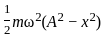
  • Kinetic Energy of the body in SHM is,

K =

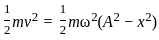
Also, Kinetic Energy K = 1/2 mv2

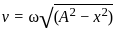
The above result is relationship between velocity and displacement.

Calculation

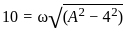
Kinetic Energy when body is moving with velocity 10 cm /s

Displacement from mean position x = 4 cm

So, we can say

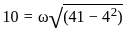
-- (1)

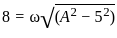
Also, when displacement is 5 cm, velocity is 8 cm / s

--- (2)

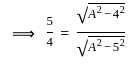
Dividing (1) by (2)

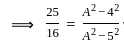
⇒ 25 A2 - 25 × 52 = 16A2 - 16 × 42

⇒ 9 A2 = 625 - 256 = 36

⇒ A2 = 41 -- (3)

Putting (3) in (1) we get

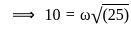
⇒ 10 = ω 5

⇒ ω = 0.5

⇒ 2 π / T = 0.5

⇒ T = 2 π × 0.5 = π

So, the correct option is π second.

HTET PGT Physics Test - 4 - Question 18

The magnetic moment of an electron (e) revolving in an orbit around nucleus with an orbital angular momentum is given by:

Detailed Solution: Question 18

Concept

Magnetic Moment (μ): The magnetic moment of an electron in a circular orbit is related to its charge, velocity, and the radius of the orbit.

It is given by μ = (current) × (area of the loop).

The orbital angular momentum (L) of the electron is quantized and given by

L = nħ,

Where n is the principal quantum number and ħ = h / 2π is the reduced Planck's constant.

The relationship between the magnetic moment μ and the orbital angular momentum L is expressed as:

μ = (e / 2m) × L,

Where e is the charge of the electron, and m is its mass.

This ratio of the magnetic moment to the angular momentum is known as the gyromagnetic ratio or g-factor.

Calculation

Here,

Orbital angular momentum, L = nħ

Electron charge, q

Electron mass, m

⇒ Magnetic moment formula:

μ = (q / 2m) × L

∴ The correct option is 2.

HTET PGT Physics Test - 4 - Question 19

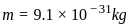
An electron is allowed to rotate on a metallic circle of the perimeter of 20 π made from copper wire of resistance 0.0171 Ω per unit length and rotates with speed 15 m/s, what will be the potential difference per unit length of the circle

Detailed Solution: Question 19
CONCEPT:

Ohms law:

  • It states that under constant physical conditions like temperature, pressure the potential difference between ends of a conductor is directly proportional to the amount of current flowing through it and is given by

⇒ V ∝ I
⇒ V = I R
Where R = Resistance and I = Current

  • The amount of current produced by an electron revolving in an orbit of radius 'r' with velocity 'V' is given by

⇒ I = eV/2πr
Where V = Velocity and r = radius
CALCULATION :
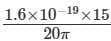
Given - R = 0.0171 Ω, V = 15 m/s, 2πr = 20 π, e = 1.6× 10⁻¹⁹ Columb

  • The amount of current produced will

⇒ I =  = 3.81 x 10⁻²⁰ A

  • The amount of potential difference between both the end of unit length of the circle will be

⇒ V = IR
⇒ V = 3.81 × 10-20 × 0.0171 = 6.53 × 10⁻²² V
Hence,option1 is the answer

HTET PGT Physics Test - 4 - Question 20

Two charges of equal magnitude 2 μC but opposite in sign are separated by a distance of 16 cm. Calculate the electric field at an equatorial point which is at a distance of 18 cm away from the center of the dipole

Detailed Solution: Question 20
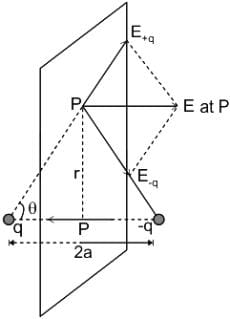
CONCEPT:

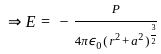
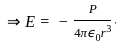
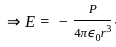
  • The electric field for the points on the equatorial plane is given by

  • if the value of r >>>>a the electric field is given by

Where P = Diploe momentum, r = Distance, and a = Half of distance between both the charge.

CALCULATION:
Given - q = 2μC = 2 × 10⁻⁶ C, 2a = 16cm = 16 × 10-2 m , a = 8 × 10⁻² m, r = 18 cm = 18 × 10-2 m,

  • The diploe momentum can be calculated as

⇒ P = 2a × q = 2 × 10-6 × 16 × 10-2 = 32× 10-8 C-m

  • The electric field for the points on the equatorial plane is given by

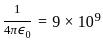
Substitute the given values in the above equation


Hence option 2 is the answer

HTET PGT Physics Test - 4 - Question 21

The radius of the earth is 6.4 x 10⁶ m. The specific charge of the proton is 9.6 x 10⁷ Ckg-1. What should be the value of the minimum magnetic field at the equator of the earth such that a proton moving with velocity 1.92 x 10⁷ ms-1 may revolve around the earth?

Detailed Solution: Question 21
Concept:

  • When the charge moves inside the magnetic field, the field exerts forces on the charge.
  • The magnetic force on moving charge in the magnetic fields is denoted by:
    • F = qVB
    • Where, q = charge, v = velocity of charge, B = magnetic field,
  • Centripetal force is a force that acts on a body moving in a circular path and is directed toward the center around which the body is moving.
    • F = mv2/r
    • Where, m = mass of the body, v = velocity of the body, r = radius of the circular path.
  • Specific charge = q/m

Calculation:
Given, radius of the earth = 6.4 x 10⁶ m, specific charge of proton, q/m  = 9.6 x 10⁷ Ckg-1, velocity 1.92 x 10⁷ ms-1
For a proton to revolve around the earth, the minimum magnetic field at the equator of the earth is,
qVB = mv2/r
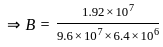
⇒ B = mv/qr
Putting the value, we get

⇒ B = 3.12 x 10⁻⁸ T

HTET PGT Physics Test - 4 - Question 22

A thermally insulated vessel contains 150 g of water at 0°C. Then the air from the vessel is pumped out adiabatically. A fraction of water turns into ice and the rest evaporates at 0°C itself. The mass of evaporated water will be closest to:
(Latent heat of vaporization of water = 2.10 × 10⁶ J kg-1 and Latent heat of Fusion of water = 3.36 × 10⁵ J kg-1)

Detailed Solution: Question 22
Concept:

Vaporisation is the phase change from liquid to vapour. Evaporation is the process of vaporisation occurring from the free surface of a liquid.

The latent heat of vapourization of a substance is defined as the heat required to change one mole of liquid at its boiling point under standard atmospheric pressure. It increases as the temperature is decreased.

The latent heat of fusion of a substance is associated with melting of a solid or freezing a liquid.

Calculation:

Let 'm' gram of water evaporates.

The heat required to convert water into water vapour is:

ΔQreq = mLv

Where Lv is Latent heat of vaporization of water

Mass that converts into ice = (150 – m)

The heat released during water to ice process is:

ΔQrel = (150 – m)Lf

Where Lf is Latent heat of Fusion of water

The energy required is equal to energy released.

ΔQrel = ΔQreq

⇒ mLv = (150 – m)Lf

⇒ mLv = 150Lf – mLf

⇒ mLv + mLf = 150Lf

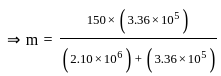
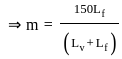
⇒ m(Lv + Lf) = 150Lf

From question, we know that,

Lf = 3.36 × 10⁵ J kg-1

Lv = 2.10 × 10⁶ J kg-1

On substituting the values, in the equation above,

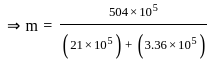
⇒ m = 504 x 105/24.36 x 105

⇒ m = 504/24.36 = 20.69

Thus, the mass of evaporated water will be closest to 20 g.

HTET PGT Physics Test - 4 - Question 23

Five moles of an ideal gas has pressure Po, volume Vo and temperature To. The gas is expanded to volume 3Vo along a path so that the pressure P is changed as function of volume V as P = Po (V/Vo). The pressure is then reduced to Po maintaining the volume constant. The gas undergoes an isobaric compression till the volume & temperature become Vo & To respectively. The total work done by the gas during the entire process is

Detailed Solution: Question 23

Concept:

The quantity of energy transferred by the force to move an object is termed as work done.

Work done by force (F) = change in kinetic energy

where f is force and d is distance.

Solution:

Work Done = p dV = dV = 4 p0V0

Work Done = 0 as V = constant

Work Done = p dV = dV = -2 p0V0

So, the total work done in the entire process is

WTotal = 2 p0V0

The correct answer is option (4).

HTET PGT Physics Test - 4 - Question 24

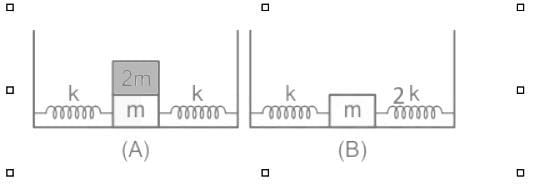
In figure (A), mass '2 m' is fixed on mass ‘m', which is attached to two springs of spring constant k. In figure (B), mass 'm' is attached to two springs of spring constant 'k' and '2k'. If mass 'm' in (A) and in (B) are displaced by distance 'x' horizontally and then released, then time period T1 and T2 corresponding to (A) and (B) respectively follow the relation.
Detailed Solution: Question 24
Concept:
Simple Harmonic Motion (SHM):
The motion of a mass attached to a spring and displaced from its equilibrium position can be described as simple harmonic motion (SHM).
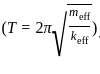
The time period T of SHM is given by the formula:

Formula:
Where:

  • meff = the effective mass.
  • k eff = the effective spring constant.

Calculation:
For System (A):
The system consists of mass m with an additional mass 2m fixed on top, and it is attached to two springs with spring constant k on both sides.

  • The effective mass of the system is the sum of the masses: meff = m + 2m = 3m
  • Since the two springs are attached in parallel (both act simultaneously on the mass m), the effective spring constant is: k eff = k + k = 2k)
  • The time period ( T1) for this system is:

For System (B):

The system consists of mass m attached to two springs with spring constants k and 2k on either side.

  • Since the two springs are attached in parallel, the effective spring constant is: k eff = k + 2k = 3k
  • The effective mass remains m .
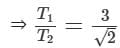
  • The time period T2 for this system is: T2 

∴ The correct option is 1

HTET PGT Physics Test - 4 - Question 25

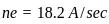
If a current of 18.2 Ampere per second flows through a copper conductor and the average collision time of electrons is 0.25 μs, then the value of conductivity of the copper conductor is ______.

Detailed Solution: Question 25

Given:

Concept:

Electrical Conductivity is given as

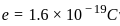
where e is electronic charge , m is mass of electron

Explanation:

Substitute all given values we get,

Hence, the correct answer is Option-1-.

HTET PGT Physics Test - 4 - Question 26

In an electric dipole value of charge is 3.2 × 10⁻¹⁹ coulomb and distance between charges is 2.4 Å It is placed in electric field of 4 × 10⁵volt/m, then dipole moment of dipole is:

Detailed Solution: Question 26

CONCEPT:

  • Electric dipole: When two equal and opposite charges are placed at a very small distance to each other then this arrangement is called an electric dipole.
  • Electric dipole moment: It is defined as the product of the magnitude of one charge and the distance between the charges in an electric dipole.

⇒ P = q × 2r -----(3)

Where 2r = distance between the two charges

CALCULATION:

Given q = 3.2 × 10⁻¹⁹ coulomb, 2r = 2.4 Å = 2.4 × 10⁻¹⁰ m and E = 4 × 10⁵ volt/m

  • The dipole moment does not depend on the electric field, therefore the dipole moment of a dipole is

⇒ P = q × 2r

⇒ P = 3.2 × 10−19 × 2.4 × 10-10

⇒ P = 7.68 × 10⁻²⁹ C-m

  • Hence, option 3 is correct.

HTET PGT Physics Test - 4 - Question 27

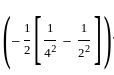
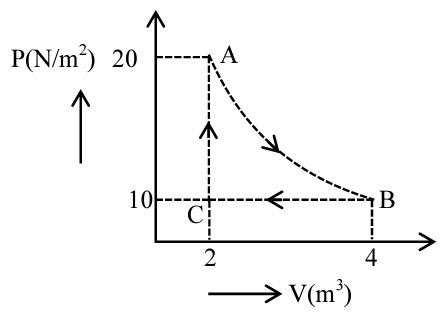
A real gas within a closed chamber at 27°C undergoes the cyclic process as shown in figure. The gas obeys PV3 = RT equation for the path A to B. The net work done in the complete cycle is (assuming R = 8J/molK):
Detailed Solution: Question 27

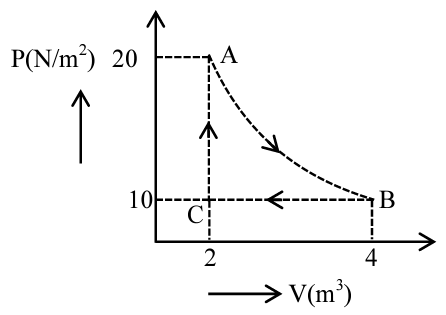
In a cyclic process, the net work done is the area enclosed by the cycle on the PV diagram:

Wnet = Area enclosed by the cycle on PV diagram
WAB =

=

= 8 × 300 ×

= 225 J

WBC = = 10(2 - 4) = -20J

Wcycle = 205 J

∴ The correct option is 2

HTET PGT Physics Test - 4 - Question 28

A uniform disc of mass M and radius R is supported vertically by a pivot at its periphery as shown. A particle of mass M is fixed to the rim and raised to the highest point above the centre. The system is then released from rest and it can rotate about its pivot freely. The angular speed of the system when the attached object is directly beneath the pivot is
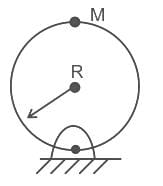
Detailed Solution: Question 28

Concept:

Conservation of Energy:

  • The principle of conservation of energy states that the total energy of an isolated system remains constant.
  • For a rotating system, the potential energy (PE) converts into kinetic energy (KE).
  • The rotational kinetic energy is given by , where:
    • I is the moment of inertia (kg·m²)
    • ω is the angular speed (rad/s)
  • Moment of Inertia: The moment of inertia of a uniform disc about an axis through its center and perpendicular to its plane is .
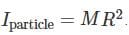
  • The moment of inertia of a particle of mass M at a distance R from the axis is
  • Potential Energy: The gravitational potential energy is given by , where:
    • m is the mass (kg)
    • g is the acceleration due to gravity (9.8 m/s²)
    • h is the height (m)

Calculation:

Given,

Mass of the disc, M = M

Radius of the disc, R = R

Mass of the particle, m = M

Acceleration due to gravity, g = 9.8 m/s²

Potential energy at the highest point:

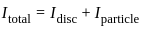
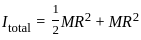
Total moment of inertia:

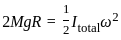
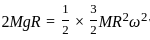
At the lowest point, all potential energy converts to rotational kinetic energy:

HTET PGT Physics Test - 4 - Question 29

A proton, a deuteron and an α particle are moving with the same momentum in a uniform magnetic field. The ratio of magnetic forces acting on them is _______ and their speeds are in the ratio ______.

Detailed Solution: Question 29
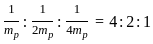
Concept:

  • Magnetic Force on a Charged Particle:
    • The magnetic force acting on a charged particle moving in a uniform magnetic field is given by the formula:

F = qvB

  • The momentum of a particle is given by:

p = mv
Calculation:
Momentum is the same for all particles.
Velocity ratio:
⇒ vp: vd: vα =
Magnetic force ratio:
⇒ F ∝ qv
Thus, for the proton, deuteron, and α-particle:
⇒ Fp: Fd: Fα = evp: evd: 2evα
⇒ Fp: Fd: Fα =
The ratio of magnetic forces is 2 : 1 : 1 and the ratio of their speeds is 4 : 2 : 1.

HTET PGT Physics Test - 4 - Question 30

Which of the following materials is the most suitable for making a permanent magnet?

Detailed Solution: Question 30

The correct answer is Steel.

Concept:

Permanent Magnet:

  • A permanent magnet is a material, that produces a persistent magnetic field without the need for an external power source.
  • These magnets are characterized by their ability to retain their magnetization indefinitely, or for extended periods, once they have been magnetized.
  • Permanent magnets are commonly used in various applications such as electric motors, generators, magnetic sensors, speakers, and magnetic levitation systems.

Explanation:

  1. Steel- steel can be a permanent magnet, it needs to be exposed to a strong external magnetic field. When steel is placed in a strong magnetic field, the magnetic domains within the steel align with the external magnetic field.
  2. copper- Copper is not used as a material for permanent magnets because it is not inherently ferromagnetic, meaning it doesn't possess the necessary magnetic properties to create a permanent magnetic field.
  3. Nickel- Nickel itself is not typically used as a material for permanent magnets because it does not naturally possess strong magnetic properties.
  4. Soft iron- Soft iron is not used to create permanent magnets. Soft iron exhibits ferromagnetism, meaning it can be temporarily magnetized when exposed to an external magnetic field.

Additional InformationTypes of magnets:

  • Temporary Magnets: Temporary magnets acquire magnetism when they are exposed to a magnetic field but lose it when the field is removed. Materials like soft iron can exhibit temporary magnetism.
  • Electromagnets: Electromagnets are created by wrapping a coil of wire around a ferromagnetic core and passing an electric current through the wire. They can be turned on and off by controlling the flow of electricity. Electromagnets are widely used in various applications such as electric motors, relays, and MRI machines.
  • Ferromagnets: Ferromagnetic materials are characterized by their strong attraction to magnetic fields and the ability to retain magnetization. Common ferromagnetic materials include iron, nickel, and cobalt.
  • Neodymium Magnets: Neodymium magnets are a type of rare-earth magnet, known for their strong magnetic field. They are made of an alloy of neodymium, iron, and boron (NdFeB) and are commonly used in applications where strong magnets are needed, such as speakers, headphones, and magnetic therapy products.

Hence, steel is most suitable for making permanent magnets.

View more questions
23 tests
Information about HTET PGT Physics Test - 4 Page
In this test you can find the Exam questions for HTET PGT Physics Test - 4 solved & explained in the simplest way possible. Besides giving Questions and answers for HTET PGT Physics Test - 4, EduRev gives you an ample number of Online tests for practice
Download as PDF