HTET Exam  >  HTET Test  >   PGT Mock Test Series 2026  >  HTET PGT Physics Test - 5 - HTET MCQ

HTET PGT Physics Test - 5 Free Online Test 2026


MCQ Practice Test & Solutions: HTET PGT Physics Test - 5 (150 Questions)

You can prepare effectively for HTET HTET PGT Mock Test Series 2026 with this dedicated MCQ Practice Test (available with solutions) on the important topic of "HTET PGT Physics Test - 5". These 150 questions have been designed by the experts with the latest curriculum of HTET 2026, to help you master the concept.

Test Highlights:

  • - Format: Multiple Choice Questions (MCQ)
  • - Duration: 150 minutes
  • - Number of Questions: 150

Sign up on EduRev for free to attempt this test and track your preparation progress.

HTET PGT Physics Test - 5 - Question 1

Who has classified introvert personality and extrovert personality?

Detailed Solution: Question 1

Personality: Personality also refers to the pattern of thoughts, feelings, social adjustments, and behaviours consistently exhibited over time that strongly influences one's expectations, self-perceptions, values, and attitudes.

  • Personality is psychophysical that includes mental and physical aspects and both explain total personality.
  • Personality theories are attempts to understanding both the characteristics and the way of development of personality.

Key Points

JUNG Classification of Personality:

  • His personality theory is known as an analytic theory or analytical psychology.
  • Carl Jung suggested that all human beings share certain unconscious ideas because we are all human and were created from similar evolutionary circumstances and common ancestors.
  • The unconscious that we all share is called the collective unconscious.
  • Each individual has his own self-actualization. Jung expressed libido in a very comprehensive way, he equated libido as life energy.
  • In light of libido, Jung proposed two types of personalities— extroverts and introverts.
  • The persons in whom life energy (libido) flows inward are known as introvert while, persons whom the life energy flows outward are termed as an extrovert.
  • In other words, the extraversion orients a person toward the external world while the introversion drives a person toward the inner, subjective world.
  • According to Jung introvert and extrovert function under four aspects-sensations, feelings, thinking, and intuition.

Additional Information

FREUD:

  • The first modern theory of personality was developed by Sigmund Freud (1923) that is known as the psychoanalytic or psychodynamic theory of personality.
  • According to Freud, our most behaviour is caused by thoughts, ideas, and wishes that are created in a person‘s brain.
  • These are not easily accessible by the conscious part of the mind but the unconscious mind.
  • According to him, the mind could be divided into three abstract categories- the id, the ego, and the superego.

ALLPORT:

  • Gordon Allport (1897-1967) was the first personality theorist who adapted the trait theory of personality.
  • The trait theory is one of the most important and largest fields of personality psychology.
  • According to this theory, personality is a composition of broad traits.

MUNN:

  • Personality may be defined as the characteristics, and integration of an individual’s, structure, attitudes, capacities, abilities, and aptitudes

From the above, we can conclude that Carl Jung classified introverted and extroverted personalities.

HTET PGT Physics Test - 5 - Question 2

16 PF test is based on

Detailed Solution: Question 2

16 PF is 16 personality factors. It is a self-report personality test. Cattell's personality factors are included in the Sixteen Personality Factor Questionnaire (16PF) that is widely used today for career counseling in education. In business, it is used in personnel selection, especially for choosing managers. It is also used in clinical diagnosis and to plan therapy by assessing anxiety, adjustment, and behavioral problems.

Important Points

16 PF test is based on Cattell’s theory: Cattell developed an assessment based on these 16 personality factors. The test is known as the 16PF Personality Questionnaire and is still frequently used today, especially in career counseling, marital counseling, and in business for employee testing and selection.

Key Points

Raymond Cattell described the following 16 personality dimensions:-

  1. Abstractedness: Imaginative versus practical
  2. Apprehension: Worried versus confident
  3. Dominance: Forceful versus submissive
  4. Emotional stability: Calm versus high-strung
  5. Liveliness: Spontaneous versus restrained
  6. Openness to change: Flexible versus attached to the familiar
  7. Perfectionism: Controlled versus undisciplined
  8. Privateness: Discreet versus open
  9. Reasoning: Abstract versus concrete
  10. Rule-consciousness: Conforming versus non-conforming
  11. Self-reliance: Self-sufficient versus dependent
  12. Sensitivity: Tender-hearted versus tough-minded
  13. Social boldness: Uninhibited versus shy
  14. Tension: Inpatient versus relaxed
  15. Vigilance: Suspicious versus trusting
  16. Warmth: Outgoing versus reserved

Hence, we can conclude that the 16 PF test is based on Cattell’s theory.

Additional Information

Hans Eysenck (1916-1997): British psychologist Hans Eysenck developed a model of personality basic upon just three universal traits; Introversion/Extroversion, Neuroticism/Emotional stability, and Psychoticism.

Allport’s theory: Allport categorized the personal dispositions into three groups,

  • Cardinal traits
  • Central traits
  • Secondary traits

HTET PGT Physics Test - 5 - Question 3

In the Identity vs. Confusion crisis of adolescents, _______play a crucial role.

Detailed Solution: Question 3

A well-developed identity is comprised of goals, values, and beliefs to which a person is committed. It is the awareness of the consistency in self over time, and the recognition of this consistency by others. Identity development is vital to a person’s understanding of self and participation in their social systems.

Key PointsErik Erikson, a developmental psychologist has proposed the 'Theory of Psychosocial Development', in which he has covered human personality development in a series of eight stages that take place from infancy to late adulthood.

  • According to Erikson, persons who fail to develop a sense of identity suffer from role confusion, uncertainty about who they are, where they are going, where they belong from?
  • Erikson (1968) has coined this period of development as ‘identity crisis’, a crucial turning point in which an individual must develop in one way or another, ushering the adolescent toward growth and differentiation.
  • Those experiencing identity confusion do not have a clear sense of who they are or their role in society. At this stage, children explore their independence and develop a sense of self.
  • They feel insecure and confused about themselves and the future. If an adolescent resolve this crisis, then a sense of fidelity would develop. If they are unable to resolve they develop an identity crisis.
  • Parents or teachers may use this information to help recognize an adolescent whose transition may appear to be stalled in role confusion and assist them in seeking ways to carve out and create their identity and self-worth.
  • The parents and teachers are expected to be responsive to the needs of the adolescents and help them achieve their goals and aspirations that provide him or her meaningful identity.

​Thus, it is concluded that in the Identity vs. Confusion crisis of adolescents, parents and teachers play a crucial role.

Additional Information Stages of 'Theory of Psychosocial Development':

  • Stage 1: Trust vs. Mistrust
  • Stage 2: Autonomy vs. Shame and Doubt
  • Stage 3: Initiative vs. Guilt
  • Stage 4: Industry vs. Inferiority
  • Stage 5: Identity vs. Role Confusion
  • Stage 6: Intimacy vs. Isolation
  • Stage 7: Generativity vs. Stagnation
  • Stage 8: Integrity vs. Despair

HTET PGT Physics Test - 5 - Question 4

Children learn language through operant conditioning, which theorist has highlighted this statement in his / her theory of development for children?

Detailed Solution: Question 4

Key Points
  • The statement that children learn language through operant conditioning is associated with the behaviorist theory of development, and the theorist who highlighted this perspective is B.F. Skinner.
  • Skinner proposed the theory of operant conditioning, which emphasizes the role of reinforcement and punishment in shaping behavior, including language acquisition.
  • According to Skinner, children acquire language by being reinforced for producing language correctly and punished (or receiving no reinforcement) for language errors.
  • This perspective focuses on observable behaviors and the environmental factors that influence language development.

Thus, B. F. Skinner is the correct answer.

HTET PGT Physics Test - 5 - Question 5

At which stage does the Oedipus complex occur?

Detailed Solution: Question 5

Psychosexual Stages of Development: Freud believed that personality gets well established during childhood, largely before the age of five years.

  • He proposed five stages of psychosexual development which include the oral stage, anal stage, phallic stage, latency stage, and genital stage.
  • According to stages of Psychosexual Development, the Oedipus complex occur at the Phallic stage.

Key Points

Following are the characteristics of the Phallic stage:-

  • Oedipus's complex experience as a male child involves a child developing a more profound attachment towards his mother as compared to his father, a feeling of rivalry for the father, as well as a threat of getting punished by the father for having a desire for his mother.
  • Electra complex-experienced by a female child. It involves a child developing a more profound attachment towards her father, a feeling of rivalry for the mother, and a threat of getting punished by the mother for having this feeling towards her father.
  • Successful resolution of this complex develops a mature sexual identity.

Hence, we can conclude that the Oedipus complex occurs at the Phallic stage of Psychosexual Development.

HTET PGT Physics Test - 5 - Question 6

A collection of students' work on a variety of task throughout the meant for keeping a record of their performance is known as a-

Detailed Solution: Question 6

A portfolio is a tool for assessing a variety of skills not usually testable in a single setting of the traditional written paper and pencil tests. It keeps the students’ work of language use and uses it for assessing the learners’ achievement.

Key Points

  • A collection of students' work on a variety of tasks throughout the meant for keeping a record of their performance is known as portfolio.
  • It provides evidence of a learner’s abilities, thoughts, and attitudes.
  • A portfolio shows children's gradual progress and paves way for development.
  • It assesses team-based activities, social projects, and peer-related behavior and represents a blend of the instructional process and the evaluation process.
  • It provides an insight into a child’s emotional, social and psychological development.

Hence, it could be concluded that a collection of students' work on a variety of tasks throughout the meant for keeping a record of their performance is known as portfolio.

HTET PGT Physics Test - 5 - Question 7

Which one of the following is the correct logical order of the observational learning process according to the Learning Theory of Bandura?

Detailed Solution: Question 7
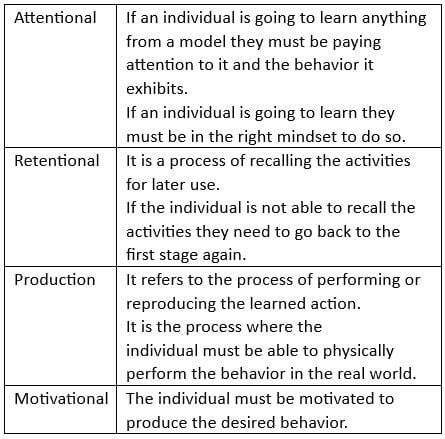
According to Bandura, learning can occur outside the boundaries of pleasure and pain. Thus, people learn a great deal simply by watching or observing others, by reading about what people do, and by making general observations of the world.Key PointsObservational learning depends on the existence of an appropriate model in one’s environment. That is, the child picks up behavior while the appropriate model is performing an activity. Logical order of the Observational learning process is Attentional → Retentional → Production → Motivational.

Thus, it is concluded that Attentional → Retentional → Production → Motivational is the correct logical order of the observational learning process according to the Learning Theory of Bandura

HTET PGT Physics Test - 5 - Question 8

Which of the following clinical procedures are based in part on classical conditioning ?

Detailed Solution: Question 8

Ivan Petrovich Pavlov discovered the phenomenon of classical conditioning. Classical Conditioning emphasises that learning as a habit development is founded on the principle of association and substitution.

A systematic desensitization technique in which a therapist walks the client through a series of steps designed to lessen fear and anxiety.

Key Points

Ivan Pavlov, a Russian physiologist, first described classical conditioning as a form of unconsciously or automatically learned behavior. By associations between an unconditioned stimulus and a neutral stimulus, this learning process produces a conditioned response.

Thus, Systematic desensitization is the clinical procedures based on the part of classical conditioning.

  • To assist patients in changing unhelpful behaviour’s, behavioural treatments employ the concepts of classical conditioning. The idea behind these therapies is that we learn from our surroundings.
  • There are various forms of behavioural therapy, including cognitive behavioural therapy and exposure therapy.
  • Wolpe developed this method, which is based on the behavioural principle of counter conditioning, to help individuals overcome their dread of phobic stimuli.
  • Systematic desensitization is a behavioural treatment technique in which a person overcomes maladaptive anxiety evoked by a scenario or an object by gradually approaching the feared situation in a psycho physiological condition that inhibits the anxiety.

Additional Information

  • Token economics is a subfield of economics that is concerned with the production, transmission, and consumption of tokenized products and services.
  • Two chair techniques- Individuals are invited to move between seats representing different perspectives or portions of themselves in two-chair activities. Two chairs, for example, could represent the portion of the self that wants to modify behavior and the half that does not, or one's 'logical' versus 'emotional' side.
  • Transference- When a student is interested in the subject, eager to learn, has prior understanding of it, and is able to relate new material to what they already know, they are more likely to transfer what they have learned. The student must then be able to retrieve and apply this information to new learning.

HTET PGT Physics Test - 5 - Question 9

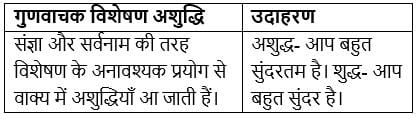
निम्नलिखित में से किस वाक्य में गुणवाचक विशेषण अशुद्ध है?

Detailed Solution: Question 9
प्रमुख बिंदु

  • वाक्य- यह एक नया इमारत है।
  • इस वाक्य में नया शब्द में गुणवाचक विशेषण अशुद्ध है।
  • नया शब्द के स्थान पर नई शब्द होगा।
  • शुद्ध वाक्य- यह एक नई इमारत है।

अतिरिक्त जानकारी

HTET PGT Physics Test - 5 - Question 10

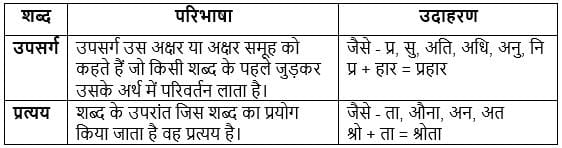
'चौमासा' में कौन-सा उपसर्ग प्रयोग हुआ है?

Detailed Solution: Question 10

'चौमासा' में 'चौ' उपसर्ग प्रयोग हुआ है। 'चौ' उपसर्ग से बनने वाले अन्य शब्द - चौपाई, चौराहा, चौपाल आदि हैं। अन्य विकल्प गलत हैं। अतः सही विकल्प 'चौ' है।

अतिरिक्त जानकारी

HTET PGT Physics Test - 5 - Question 11

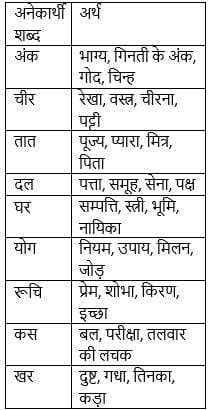
‘खंड’ का एक अर्थ है-

Detailed Solution: Question 11

‘खंड’ का एक अर्थ है- 'दिशा'
अन्य 'खंड' के अर्थ- प्रदेश, भाग, खांड, वर्षा आदि
प्रमुख बिंदु
अनेकार्थी शब्द- जिन शब्दों के एक से ज्यादा अर्थ होते है, उनको अनेकार्थी शब्द कहते है।

  1. जैसे- 'कलि'- कलह, दुःख, पाप, सूरमा, काला आदि।
  2. 'कक्ष'- कमरा, काँख, लता, बाजू आदि।
  3. 'कंस'- काँसा, सुराही, मंजीरा, कृष्ण के मामा आदि।

अतिरिक्त जानकारी
अन्य अनेकार्थी शब्द-

गलती अंक

  • 'खंड' के अनेक अर्थ में से एक अर्थ 'दिशा' भी है।
  • शेष अन्य विकल्प जैसे, 'कलह', 'काँख', तथा 'काँसा' के अन्य अर्थ होगे।
  • जैसे- 'खंड' के अर्थ- भाग, हिस्सा आदि।
  • 'कलह' के अर्थ- कलि, क्लेश आदि।

HTET PGT Physics Test - 5 - Question 12

वाक्यांश और उसके लिए दिए गए शब्द के असंगत मेल का चयन कीजिए:

Detailed Solution: Question 12

दिए गए विकल्पों में सही उत्तर विकल्प 2 'जो खुशी के पीछे पागल हो - अनसूया' होगा। अन्य विकल्प इसके असंगत उत्तर हैं।
प्रमुख बिंदु

  • दिए गए विकल्पों में विकल्प 'जो खुशी के पीछे पागल हो - अनसूया' असंगत है।
  • अनसूया के लिए उचित वाक्यांश - 'ईर्ष्या या द्वेष से रहित' होता है।
  • जो खुशी के पीछे पागल हो उसके लिए एक शब्द 'अनुमत्त' होगा।
  • अन्य विकल्प अपने सही क्रम हैं।

अतिरिक्त जानकारी

HTET PGT Physics Test - 5 - Question 13

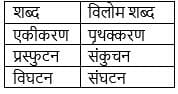
निम्न दिये गये विकल्पों में से 'खण्डन' का विलोम है :

Detailed Solution: Question 13

दिए गए विकल्पों में से 'खण्डन' का विलोम "मण्डन" है।
प्रमुख बिंदु
अन्य विकल्प -

महत्वपूर्ण बिंदु

  • खण्डन का अर्थ - तोड़ने-फोड़ने या काट-छाँट करने की क्रिया।
  • मण्डन का अर्थ - सजाना।
  • प्रस्फुटन का अर्थ- खिलना।
  • संकुचन का अर्थ - सिकुड़ना
  • एकीकरण का अर्थ - दो या दो से अधिक वस्तुओं को मिलाकर एकरूप देना।
  • पृथक्करण का अर्थ - अलग करने की क्रिया।
  • विघटन का अर्थ - अलग करना।
  • संघटन का अर्थ - मेल, संयोग।

अतिरिक्त जानकारी

  • जो शब्द किसी दूसरे शब्द का उल्टा अर्थ बताते हैं,
  • उन्हें विलोम शब्द या विपरीतार्थक शब्द या विरुद्धार्थी शब्द कहते है।

जैसे-

  • हार- जीत, आय- व्यय, आजादी- गुलामी, नवीन- प्राचीन आदि।

HTET PGT Physics Test - 5 - Question 14

In the given sentence there might be an error. Find out which part of the sentence has an error. lf there is no error, mark your answer as (d) i.e. ‘No error’.

She is (a)/ the taller (b)/ of the two women. (c)/ No Error (d)

Detailed Solution: Question 14

The correct answer is '(d) No error.'

Key Points

  • An adjective is a part of speech that modifies a noun or a pronoun.
    • Example: What a pale girl Mandhira is?
  • In the comparative degree, the second lower or higher degree of the quality is suggested, and in it, there is a sense of comparison of the same quality in two things. A sentence is of the comparative degree when a comparison is made between two people, and one person is of a higher degree in terms of quality.
  • The use of 'the' is used before a comparative degree.
    • Example: Cristiano is the better of the two players.
  • In the given sentence, a comparison is made between two people, the pronoun 'she' is of the higher quality 'taller' than two women.
  • Thus, the sentence is of a comparative degree.
  • All the options are grammatically correct. So, no change is required in this sentence.

Hence, option 3 (d) No error is the correct answer.

Complete Sentence: She is (a)/ the taller (b)/ of the two women. (c)/ No Error (d)

Additional Information

  • In a positive degree, some special quality of a thing is pointed out; it is a basic, not compared form of an adjective or adverb. In other words, when we are talking about the quality of one person or thing then we use a positive degree.
    • Example: Rima is a brave girl.
  • In the superlative degree, the third and the highest degree of the same quality amongst at least three or more things.
    • Example: Ranu is the best girl in the class.

HTET PGT Physics Test - 5 - Question 15

A series is given with one term missing. Select the correct alternative from the given ones that will complete the series.

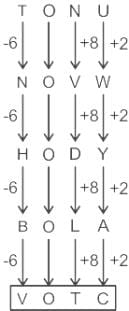
TONU, NOVW, HODY, BOLA, ?

Detailed Solution: Question 15
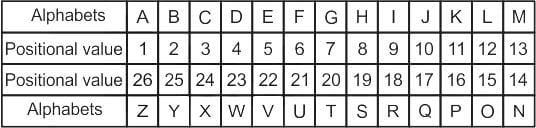
The positions of the letters according to the English alphabet series:

The pattern for this is as follows;

Hence, "VOTC" is the correct answer.

HTET PGT Physics Test - 5 - Question 16

If a + b + c =10 and ab + bc + ca = 30, then the value of a2 + b2 + c2 is:

Detailed Solution: Question 16

GIVEN:

a + b + c =10

ab + bc + ca = 30

FORMULA USED:

(a + b + c)2 = (a2 + b2 + c2 + 2(ab + bc + ca))

CALCULATIONS:

⇒ a + b + c =10 & ab + bc + ca = 30

⇒ (a + b + c)2 = a2 + b2 + c2 + 2(ab + bc + ca)

⇒ 102 = a2 + b2 + c2 + 2(30)

⇒ 100 - 60 = a2 + b2 + c2

⇒ a2 + b2 + c2 = 40

∴ The value of a2 + b2 + c2 is 40.

HTET PGT Physics Test - 5 - Question 17

Assertion (A) : In order to melt gold, Goldsmith blow the outermost zone of the flame using a metal pipe.

Reason (R) : The outermost zone is the nearest and not too hot to blow.

Detailed Solution: Question 17
Concept:
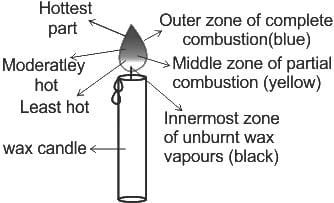
A flame has different zones characterized by varying temperatures. From the innermost to the outermost zones, these are:

1. Innermost or Dark Zone: This is the coolest part of the flame, with the lowest temperature.

2. Luminous Zone: This zone is brighter and hotter than the innermost zone. It's where incomplete combustion occurs, giving the flame its light.

3. Outermost or Non-luminous Zone: This is the hottest part of the flame. It's where complete combustion occurs, meaning it's where the flame gets enough oxygen to burn the fuel completely, producing the most heat.

Explanation:

  • The assertion (A) that "In order to melt gold, Goldsmiths blow the outermost zone of the flame using a metal pipe" is true. Goldsmiths indeed use the outermost zone of the flame to melt gold because it is the hottest part of the flame and provides the heat necessary to melt the metal.
  • The reason (R) that "The outermost zone is the nearest and not too hot to blow" is false. The outermost zone of a flame is not the nearest; it's the farthest from the source. Moreover, it is the hottest part of the flame, not the coolest.
  • So, the correct answer is: 3) (A) is true but (R) is false.

Additional Information

Goldsmiths use a process known as blowtorching, where they blow air or oxygen into the flame, which increases the temperature even further. This technique helps them to work with metals like gold, which have high melting points.

HTET PGT Physics Test - 5 - Question 18

If the mobilities of electrons and holes are 0.40 m2 per V-s and 0.20 m2 per V-s respectively, find the resistivity of an intrinsic semiconductor with an intrinsic concentration of 2.5 × 10¹⁹ per m3.

Detailed Solution: Question 18

Concept
The conductivity of a semiconductor is given by the formula
Conductivity, σ = q(nμe + pμp)
Where q is the electrical charge, n is the density of electrons, p is the density of holes, μe is the mobility of electrons and μp is the mobility of holes.
Calculation
​Given that:
Mobility of electrons, μe = 0.40 m2 per V-s
Mobility of holes, μp = 0.20 m2 per V-s
In an intrinsic semiconductor, n = p
Intrinsic concentration, n = p = 2.5 × 10¹⁹ per m3
Charge, q = 1.6 × 10⁻¹⁹ C
Conductivity, σ = q(nμe + pμp) = qn(μe + μp)
⇒ σ = 1.6 × 10-19 × 2.5 × 1019 (0.40 + 0.20)
⇒ σ = 2.4 Ω-1 m-1
We know that conductivity is the reciprocal of resistivity.
Thus, resistivity ρ = 1/σ
⇒ ρ = 1/σ = 1/2.4 = 0.416 ≈ 0.42 Ωm

HTET PGT Physics Test - 5 - Question 19

A stone is projected from a horizontal plane. It attains maximum height 'H' & strikes a stationary smooth wall & falls on the ground vertically below the maximum height. Assume the collision to be elastic the height of the point on the wall where ball will strike is:
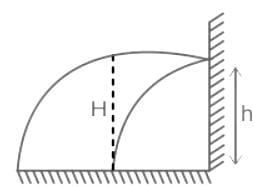
Detailed Solution: Question 19

Concept:
Projectile Motion and Elastic Collision:

  • In projectile motion, a stone is projected with an initial velocity at an angle to the horizontal.
  • Maximum height (H) is attained when the vertical component of the velocity becomes zero.
  • An elastic collision is one in which there is no net loss in kinetic energy in the system as the result of the collision.
  • After the collision, the stone will fall vertically downwards from the point of collision.

Calculation:
Given,
Maximum height, H
At maximum height, the vertical component of velocity (vy) = 0
The stone hits the wall at some height and falls vertically downwards.
To find the height of the point on the wall where the ball strikes:
Let the initial vertical component of velocity be v0y.
At maximum height, the time to reach H:

During this time, the horizontal distance covered (range) is:

Since the stone strikes the wall and falls vertically, the height of the point on the wall where the ball strikes is half of the maximum height:
Height = H/2
∴ The height of the point on the wall where the ball will strike is

HTET PGT Physics Test - 5 - Question 20

400 J of work is done on a gas to reduce its volume by compression adiabatically. What is the change in internal energy of the gas?

Detailed Solution: Question 20

CONCEPT:

First Law of Thermodynamics:

  • It is a statement of conservation of energy in the thermodynamical process.
  • According to it heat given to a system (ΔQ) is equal to the sum of increase in its internal energy (ΔU) and the work done (ΔW) by the system against the surroundings.

ΔQ = ΔU + ΔW

EXPLANATION:

Given, ΔW = 400 J

For the adiabatic process,

Δ Q = 0

As work is done on the gas, so

ΔW = +400 J

Change in internal energy,

ΔU = ΔQ – ΔW = 0 – (400)

ΔU = -400 J

HTET PGT Physics Test - 5 - Question 21

Three kids A, B and C are playing in a merry-go-round turning at a constant velocity, in a park. They are located at radial distances RA, RB and RC from the centre of merry-go-round such that RA < RB < RC. Who will experience the highest acceleration?

Detailed Solution: Question 21

The correct answer is option 1) i.e. A

CONCEPT:

  • ​Centripetal acceleration: The acceleration associated with a change in velocity in a circular motion is called centripetal acceleration. It is directed towards the centre of the circular path.
    • The centripetal acceleration of an object moving with a velocity v in a circular path of radius r is given as

ac =

EXPLANATION:

The merry-go-round rotates about a fixed centre.

In the given scenario, the merry-go-round is turning with a constant velocity (v). Therefore, every person will experience a centripetal acceleration.

Considering the centripetal acceleration, ac =

For constant velocity, ac

Since RA < RB < RC, the centripetal acceleration will be maximum at the least distance i.e. RA.

Therefore, A experiences maximum acceleration.

HTET PGT Physics Test - 5 - Question 22

If a fielder can throw a ball to a maximum horizontal distance of 120 m, then how high (in m) can he throw if he throws vertically with the same velocity?
(use g = 10 m/s2)

Detailed Solution: Question 22
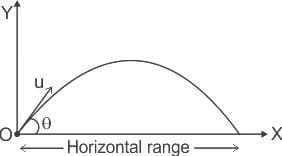
Concept:

Horizontal range:

It is the horizontal distance traveled by a body during the time of flight.

The mathematical expression of the horizontal range is

Calculation:

Given - R = 120 m

As we know that sin θ is maximum at 90°. Therefore horizontal range will be maximum at 45°.

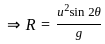
⇒ u2 = 120 x 10 = 1200 m2/s2

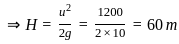
  • The ball will achieve the maximum height when it is thrown vertically upward.
  • For such motion, the final velocity 'v' is zero at the maximum height 'H'.
  • Use kinematics equation to find the maximum height

⇒ v2 = u2 - 2gH

⇒ -u2 = -2gH

HTET PGT Physics Test - 5 - Question 23

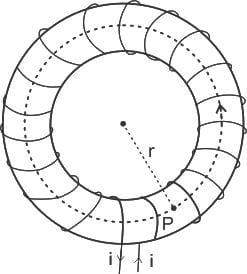
Consider an ideal toroid with an average radius 16.0 cm with 240 turns. A current of 10 A is maintained in it. The magnitude of the magnetic field inside the toroid is [() = 10-7 Tm/A:

Detailed Solution: Question 23

Concept:

  • If a solenoid is bent in a circular shape and the ends are joined, we get a toroid.
  • The magnetic field inside a toroid at point P is,
  • Where μ0 = permeability of vacuum, N = total number of turns, i = current, r = average radius.

Calculation:

Given, average radius, r = 16.0 cm = 0.16 m, N = 240, i = 10 A, = 10-7 Tm/A

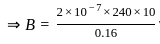
The magnetic field inside a toroid at point P is,

= 3 × 10⁻³ T = 3.0 mT

Additional Information

  • A solenoid is a wire wound closely in the form of a helix.
  • The magnetic field inside a solenoid is
  • B = μ0ni

HTET PGT Physics Test - 5 - Question 24

A wave in a string has an amplitude of 2 cm. The wave travels in the + ve direction of x axis with a speed of 128 m/sec. and it is noted that 5 complete waves fit in 4 m length of the string. The equation describing the wave is:

Detailed Solution: Question 24
CONCEPT:

  • Wave: It is a disturbance in a medium that carries energy without a net movement of particles.
    • It may take the form of elastic deformation, a variation of pressure, electric or magnetic intensity, electric potential, or temperature.

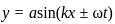
Equation of Wave:

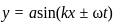
where, a = amplitude of the wave, ω = angular frequency = 2πf, k = wave number = ω /c.

CALCULATION:

Given that,

a = 2 cm = 0.02 m, v = 128 m/s, total number of waves = 5λ (as one wave completes λ so 5 will be 5λ), length(l) = 4 m

5λ = 4 ⇒ 4/5 = 0.8

λ = 0.8 m

for velocity we have,

v = λ × f

f = 128/0.8 = 160 Hz

ω = 2πf = 2 × 3.14 × 160 = 1005 rad/sec

k = ω /c = 1005/128 = 7.85

.......(1)

putting all the values in the equation

y = 0.02 sin(7.85x - 1005t).....(negative sign cause wave travels in +ve x-axis).

The correct option is 3.

HTET PGT Physics Test - 5 - Question 25

In Young's double slit experiment, the fringe width is 2 mm. The separation between the 13th bright fringe and the 4th dark fringe from the centre of the screen on same side will be

Detailed Solution: Question 25

Answer : 2

Solution :

Given: Fringe width W = 2 mm

The distance of the nth bright fringe from centre of the screen yn = ... (i)

The distance of the nth dark fringe from centre of the screen y'n = (2n - 1) .... (ii)

Substituting, n = 13 in (i) and n = 4 in (ii) we get
y13 = and y'4 =

∴ The separation between the 13th bright fringe and the 7th dark fringe is

Y13 - Y'4

=

=

=

but W = 2 mm

∴ Y13 - Y'4 = × 2 = 19 mm

HTET PGT Physics Test - 5 - Question 26

The electric flux passing through a surface of area A = 8j m2 in an electric field vector E = 2i + 3j - 4k V/m (bold is for vectors) is:

Detailed Solution: Question 26

Given:

Electric field vector E = 2i + 3j - 4k V/m

Surface Area A=8j

Concept:

The total number of electric field lines passing a given area in a unit of time is defined as the electric flux. The mathematical relationship between enclosed charge and electric flux is called Gauss’s law (case of an electric field).

Explanation:

Hence, the correct answer is Option-1-.

HTET PGT Physics Test - 5 - Question 27

A galvanometer coil has resistance 20 Ω and the metre shows full scale deflection for a current of 2 mA. How will you convert the metre into an ammeter of range 0 to 6 A?

Detailed Solution: Question 27
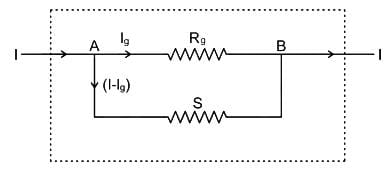
CONCEPT:

  • A galvanometer can be converted into an ammeter by connecting a shunt resistance in parallel to it.
  • The shunt resistance should have very low resistance.
  • So, the ammeter (the parallel combination of galvanometer and shunt resistance) will have low resistance.
  • To convert a galvanometer into an ammeter of current rating ‘I’, a small resistance ‘S’ (shunt resistance) is connected in parallel across the galvanometer.

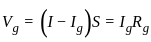
Vg = (I - Ig) S = Ig Rg

Where Vg is the voltage across the galvanometer, I is the current in the circuit, Ig is the current in the galvanometer, Rg is the resistance of the galvanometer and S is the resistance of the shunt.

CALCULATION:
Given:
Galvanometer coil has resistance Rg = 20 Ω
Full-scale deflection current Ig = 2 mA
Ammeter range I = 6 A
S = IgRg/(I - Ig)
⇒ S = 0.002 × 20/(6 - 0.002)

⇒ S = 6.66 mΩ

HTET PGT Physics Test - 5 - Question 28

The threshold frequency of a metal with work function 6.63 eV is:

Detailed Solution: Question 28

Calculation:

ϕ0 = hv0...... ( the relation between the work function and threshold frequency)

⇒ 6.63 ×1.6 × 10-19 = 6.63 × 10⁻³⁴v0

⇒ v0 =

v0 = 1.6 × 10¹⁵ Hz

∴ The threshold frequency of a metal with work function 6.63 eV is 1.6 × 10¹⁵ Hz

HTET PGT Physics Test - 5 - Question 29

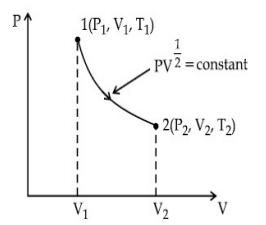
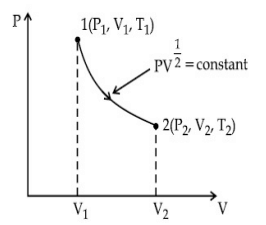
Thermodynamic process is shown below on a P-V diagram for one mole of an ideal gas. If V2 = 2V1 then ratio of temperature T2/T1 is:
Detailed Solution: Question 29
Concept:

We know that for a polytropic process equation is given as:

PVγ = K -----(1)

Where P = pressure, V = volume, K = constant, γ = ratio of specific heats

PV = nRT ⇒ P = nRT/V -----(2)

Calculations:

Given:

Here, V2 = 2V1 Then find T2/ T1 = ?

PV1/2 = K where γ = 1/2

From equation(1) and (2) we get: nRT/V1/2 = K -----(3)

From equation (3) we get: T ∝ V1/2 -----(4)

⇒T2 / T1 = (V2 / V1)1/2 -----(4)

Put V2 = 2V1 in equation (4) we get:

T2 / T1 = (2V / V)1/2 = √2

Hence, option (2) is correct.

HTET PGT Physics Test - 5 - Question 30

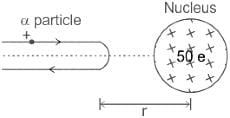
An alpha particle with kinetic energy 20 MeV is heading towards a stationary tin nucleus of atomic number 50, Compute the distance of closest approach?
Detailed Solution: Question 30
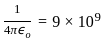
Concept:

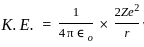
  • The closest distance of approach of the α particle will be when the whole kinetic energy of the α particle will be converted into potential energy.

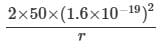
  • Where, r = Closest distance of approach, e = Charge of a electron, Z = Atomic number, K.E. = 20 × 1.6 × 10-13 J

Calculation:

Given: e = 1.6 × 10⁻¹⁹ Coulombs, K.E. = 32 × 10-13j J, Z = 50 and

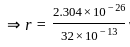
32 x 10-13 = 9 x 10⁹

⇒ r = 7.2 x 10 -15 m
r = 7.2 fm

  • Hence the closet distance of approach of the α particle will be 7.2 femtometer

View more questions
23 tests
Information about HTET PGT Physics Test - 5 Page
In this test you can find the Exam questions for HTET PGT Physics Test - 5 solved & explained in the simplest way possible. Besides giving Questions and answers for HTET PGT Physics Test - 5, EduRev gives you an ample number of Online tests for practice
Download as PDF