Mechanical Engineering Exam  >  Mechanical Engineering Test  >  GATE Mechanical (ME) Mock Test Series 2027  >  Test: Properties of Fluids & Turbulent Flow in Pipes - 2 - Mechanical Engineering MCQ

GATE Mechanical (ME) Test: Properties of Fluids & Turbulent Flow in Pipes


MCQ Practice Test & Solutions: Test: Properties of Fluids & Turbulent Flow in Pipes - 2 (15 Questions)

You can prepare effectively for Mechanical Engineering GATE Mechanical (ME) Mock Test Series 2027 with this dedicated MCQ Practice Test (available with solutions) on the important topic of "Test: Properties of Fluids & Turbulent Flow in Pipes - 2". These 15 questions have been designed by the experts with the latest curriculum of Mechanical Engineering 2026, to help you master the concept.

Test Highlights:

  • - Format: Multiple Choice Questions (MCQ)
  • - Duration: 90 minutes
  • - Number of Questions: 15

Sign up on EduRev for free to attempt this test and track your preparation progress.

Test: Properties of Fluids & Turbulent Flow in Pipes - 2 - Question 1

Kinematic viscosity of air at 20°C is given to be 1.6 × 10⁻⁵m2/s. Itskinematic viscosity at 70°C will be vary approximately  

Detailed Solution: Question 1

Given:

T₁ = 20°C → 273 + 20 = 293 K
ν₁ = 1.6 × 10⁻⁵ m²/s
T₂ = 70°C → 273 + 70 = 343 K
Since kinematic viscosity (ν) is proportional to T³/², we use:

(ν₁ / T₁³/²) = (ν₂ / T₂³/²)

Rearranging for ν₂:

ν₂ = ν₁ × (T₂ / T₁)³/²

Substituting values:

ν₂ = 1.6 × 10⁻⁵ × (343 / 293)³/²

ν₂ = 2.02 × 10⁻⁵ m²/s

Final Answer:
ν₂ = 2.02 × 10⁻⁵ m²/s

Test: Properties of Fluids & Turbulent Flow in Pipes - 2 - Question 2

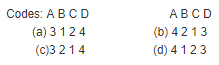
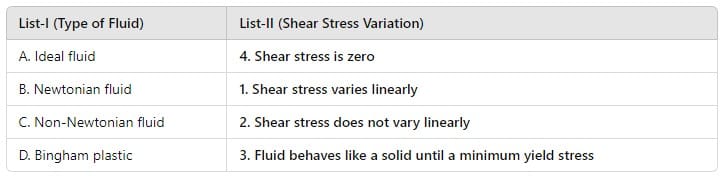
Match List-I (Type of fluid) with List-II (Variation of shear stress) and select the correct answer: 


Detailed Solution: Question 2
Step 1: Understanding Each Fluid Type
Ideal Fluid:
An ideal fluid has zero viscosity, meaning no shear stress is present.
Correct match → (4) Shear stress is zero.

Newtonian Fluid:
A Newtonian fluid follows Newton’s law of viscosity, meaning shear stress is directly proportional to the rate of strain.
Correct match → (1) Shear stress varies linearly with the rate of strain.

Non-Newtonian Fluid:
A Non-Newtonian fluid does not obey Newton’s law of viscosity, meaning shear stress does not vary linearly with strain rate.
Correct match → (2) Shear stress does not vary linearly with the rate of strain.

Bingham Plastic:
A Bingham plastic behaves like a solid until a certain yield stress is exceeded. After that, it flows like a Newtonian fluid.
Correct match → (3) Fluid behaves like a solid until a minimum yield stress, beyond which it exhibits a linear relationship between shear stress and the rate of strain.

Step 2: Matching List-I with List-II

Thus, the correct order is:
A → 4, B → 1, C → 2, D → 3

Test: Properties of Fluids & Turbulent Flow in Pipes - 2 - Question 3

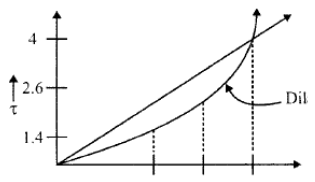
In an experiment, the following shear stress - time rate of shearstrain values are obtained for a fluid: 
Time rate of shear strain (1/s):       0     2       3     4
Shear stress (kPa):                        0    1.4    2.6   4

Detailed Solution: Question 3
Ans. (d)

*Answer can only contain numeric values
Test: Properties of Fluids & Turbulent Flow in Pipes - 2 - Question 4

A plate having an area of 0.6 m2 is sliding down the inclined plate at 300 to the horizontal with a velocity of 0.36 m/s. There is a cushion of fluid 1.8 mm thick between the plane and the plate. Find the viscosity of the fluid if the weight of the plate is 280 N.


Detailed Solution: Question 4
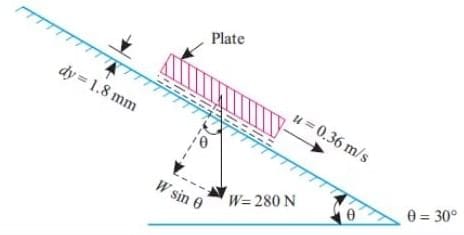
  • Area of plate, A = 0.6 m²
  • Weight of plate, W = 280 N
  • Velocity of plate, u = 0.36 m/s
  • Thickness of film, t = dy = 1.8 mm = 1.8 × 10⁻³ m

Viscosity of the fluid, μ:
Component of W along the plate:
W sinθ = 280 sin 30° = 140 N

Shear force on the bottom surface of the plate:
F = 140 N

Shear stress:
τ = F / A = 140 / 0.6 = 233.33 N/m²


Where,

  • du = change of velocity = u - 0 = 0.36 m/s
  • dy = t = 1.8 × 10⁻³ m

Using the shear stress equation:

233.33 = μ × (0.36 / 1.8 × 10⁻³)

Solving for μ:

μ = (233.33 × 1.8 × 10⁻³) / 0.36

μ = 1.166 N·s/m² = 11.66 poise

*Answer can only contain numeric values
Test: Properties of Fluids & Turbulent Flow in Pipes - 2 - Question 5

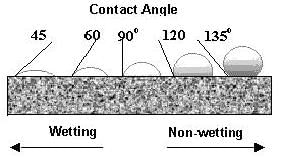
A clean tube of diameter 2.5 mm is immersed in a liquid with a coefficient of surface tension = 0.4 N/m. The angle of the liquid with the glass can be assumed to be 135 degrees . The density of the liquid = 13600 kg/m3 . What would be the level of the liquid in the tube relative to the free surface of the liquid inside the tube.


Detailed Solution: Question 5

Given Data:

  • Diameter of tube, d = 2.5 mm = 2.5 × 10⁻³ m
  • Surface tension, σ = 4 N/m
  • Contact angle, θ = 135°
  • Density of liquid, ρ = 13600 kg/m3
  • Acceleration due to gravity, g = 9.81 m/s2

Step 1: Capillary Rise (or Fall) Formula
The capillary rise or fall is given by the formula:
h = (4σ cosθ) / (w × d)
where:
w = ρ × g (Specific weight of the liquid)
d = Diameter of the tube
Step 2: Substituting the Values
w = ρ × g = 13600 × 9.81 = 133416 N/m3
h = (4 × 4 × cos 135°) / (133416 × 2.5 × 10-3)
h = (16 × (-0.707)) / (133416 × 2.5 × 10-3)
h = (-11.31) / (333.54)
h = -3.39 × 10⁻³ m or -3.39 mm

Step 3: Interpretation
The negative sign indicates a capillary depression (fall in liquid level).
Final Answer: The capillary fall is 3.39 mm.

Test: Properties of Fluids & Turbulent Flow in Pipes - 2 - Question 6

The capillary rise at 200C in clean glass tube of 1 mm diameter containing water is approximately 

Detailed Solution: Question 6
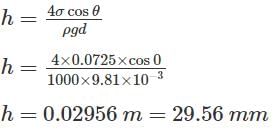

For water and glass, Contact Angle (θ)=0º and Surface tension is 0.0725 N/m
For mercury and glass, Contact Angle (θ)=128º and Surface tension is 0.52 N/m

Test: Properties of Fluids & Turbulent Flow in Pipes - 2 - Question 7

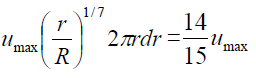
In fully-developed turbulent pipe flow, assuming 1/7th power law, the ratio of time mean velocity at the centre of the pipe to that averagev elocity of the flow is:  

Detailed Solution: Question 7
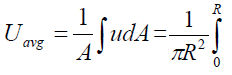
Ans. (d) =


or without calculating this we may say that it must be less than one and option (d) is only choice.

Test: Properties of Fluids & Turbulent Flow in Pipes - 2 - Question 8

A U-tube is made up of two capillaries of diameters 1.0 mm and 1.5 mm respectively. The U tube is kept vertically and partially filled with water of surface tension 0.0075kg/m and zero contact angles.
Calculate the difference in the level of the menisci caused by the capillarity.


Detailed Solution: Question 8

Given Data:

  • Diameter of first capillary tube = 1.0 mm = 0.001 m
  • Diameter of second capillary tube = 1.5 mm = 0.0015 m
  • Surface tension of water = 0.0075 kg/m (or N/m)
  • Contact angle = 0° (assumed to be perfectly wetting)
  • Density of water (ρ) = 1000 kg/m³
  • Acceleration due to gravity (g) = 9.81 m/s²

We need to calculate the difference in the liquid levels due to capillarity.

Step 1: Calculate Capillary Rise in Each Tube
The capillary rise (h) in a tube is given by the formula:
h = (4σ) / (ρ g d)
where:
σ = Surface tension = 0.0075 N/m
ρ = Density of water = 1000 kg/m³
g = Acceleration due to gravity = 9.81 m/s²
d = Diameter of the tube
For the First Capillary (d = 0.001 m):
h₁ = (4 × 0.0075) / (1000 × 9.81 × 0.001)
h₁ = (0.03) / (9.81)
h₁ = 3.06 mm
For the Second Capillary (d = 0.0015 m):
h₂ = (4 × 0.0075) / (1000 × 9.81 × 0.0015)
h₂ = (0.03) / (14.715)
h₂ = 2.04 mm

Step 2: Calculate the Difference in Liquid Levels
Difference in menisci levels due to capillarity:
Δh = h₁ - h₂
Δh = 3.06 - 2.04
Δh = 1 mm

Final Answer:
The difference in liquid levels due to capillarity is 1 mm.

Test: Properties of Fluids & Turbulent Flow in Pipes - 2 - Question 9

A metal plate 1.25 m × 1.25 m × 6 mm thick and weighting 90 N is placed midway in the 24 mm gap between the two vertical plane surfaces. The Gap is filled with an oil of specific gravity 0.85 and dynamic viscosity 3.0N.s/m2. Determine the force required to lift the plate with a constant velocity of 0.15 m/s.


Detailed Solution: Question 9

Given Data:

  • Plate dimensions = 1.25 m × 1.25 m × 6 mm
  • Weight of plate = 90 N
  • Gap between vertical plates = 24 mm = 0.024 m
  • The plate is placed midway, so each gap = 0.012 m
  • Oil dynamic viscosity = 3.0 N·s/m²
  • Velocity of plate = 0.15 m/s
  • Specific gravity of oil = 0.85 (not needed in this calculation)

We need to determine the force required to lift the plate with a constant velocity.

Step 1: Calculate Shear Stress
Shear stress (τ) is given by:
τ = (μ × V) / h
where:
μ = dynamic viscosity = 3.0 N·s/m²
V = velocity of plate = 0.15 m/s
h = gap on one side = 0.012 m
τ = (3.0 × 0.15) / 0.012
τ = 0.45 / 0.012
τ = 37.5 N/m²

Step 2: Calculate Force Due to Viscosity
Force (F) is given by:
F = τ × Area
Area of the plate:
Area = 1.25 × 1.25 = 1.5625 m²
F = 37.5 × 1.5625
F = 58.59 N
Since there is oil on both sides of the plate, the total force required is:
Total force = 58.59 × 2 = 117.18 N

Step 3: Calculate Total Force Required to Lift the Plate
The total force required is the sum of viscous force and the weight of the plate:
Total Force = 117.18 + 90
Total Force = 168.08 N

Final Answer:
Force required to lift the plate = 168.08 N

Test: Properties of Fluids & Turbulent Flow in Pipes - 2 - Question 10

In order to form a stream of bubbles, air is introduced through a nozzle into a tank of water at 20°C. If the process requires 3.0 mm diameter bubbles to be formed, by how much the air pressure at the nozzle must exceed that of the surrounding water? What would be the absolute pressure inside the bubble if the surrounding water is at 100.3 kN/m2? (σ = 0.0735 N/m)


Detailed Solution: Question 10

Given Data:

  • Diameter of bubble = 3.0 mm = 0.003 m
  • Surface tension of water at 20°C = 0.0735 N/m
  • Surrounding water pressure = 100.3 kN/m² = 100300 N/m²

We need to determine:
The excess air pressure required at the nozzle
The absolute pressure inside the bubble
Step 1: Calculate the Excess Pressure Required
The pressure inside a bubble due to surface tension is given by Laplace’s equation:
Pinside = P_surrounding + (4 × σ) / d

Substituting the values:
Pinside = 100300 + (4 × 0.0735) / 0.003
Pinside = 100300 + (0.294) / 0.003
Pinside = 100300 + 98
Pinside = 100398 N/m²
Pinside = 100.398 kN/m²

Step 2: Calculate the Excess Pressure at the Nozzle
Excess pressure required at the nozzle:
Pexcess = P_inside - P_surrounding
Pexcess = 100398 - 100300
Pexcess = 98 N/m²
Pexcess = 0.098 kN/m²

Final Answer:
Absolute pressure inside the bubble = 100.398 kN/m²
Excess pressure required at the nozzle = 0.098 kN/m²

Test: Properties of Fluids & Turbulent Flow in Pipes - 2 - Question 11

A 400 mm diameter shaft is rotating at 200 rpm in a bearing of length 120 mm. If the thickness of oil film is 1.5 mm and the dynamic viscosity of the oil is 0.7 Ns/m2 determine:
(i) Torque required overcoming friction in bearing;
(ii) Power utilization in overcoming viscous resistance;


Detailed Solution: Question 11

Given Data:

  • Diameter of shaft = 400 mm = 0.4 m
  • Rotational speed = 200 rpm
  • Bearing length = 120 mm = 0.12 m
  • Oil film thickness = 1.5 mm = 0.0015 m
  • Dynamic viscosity = 0.7 Ns/m²

Step 1: Calculate Tangential Velocity
U = (π × D × N) / 60
U = (3.1416 × 0.4 × 200) / 60
U = 4.188 m/s

Step 2: Calculate Shear Rate
Shear rate = U / h
Shear rate = 4.188 / 0.0015
Shear rate = 2792 s⁻¹

Step 3: Calculate Shear Stress
τ = μ × Shear rate
τ = 0.7 × 2792
τ = 1954.4 N/m²

Step 4: Calculate Viscous Force
F = τ × L
F = 1954.4 × 0.12
F = 234.53 N/m

Step 5: Calculate Torque
T = F × (D / 2)
T = 234.53 × (0.4 / 2)
T = 58.97 Nm

Step 6: Calculate Power Utilization
Angular velocity (ω) = (2π × N) / 60
ω = (2 × 3.1416 × 200) / 60
ω = 20.94 rad/s

Power (P) = T × ω
P = 58.97 × 20.94
P = 1.235 kW

Final Answer:
Torque required = 58.97 Nm
Power utilized = 1.235 kW

Test: Properties of Fluids & Turbulent Flow in Pipes - 2 - Question 12

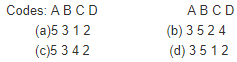
Match List-I (Physical properties of fluid) with List-II (Dimensions/Definitions) and select the correct answer:  
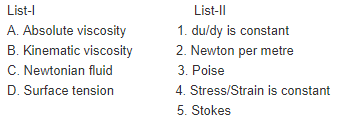
Detailed Solution: Question 12
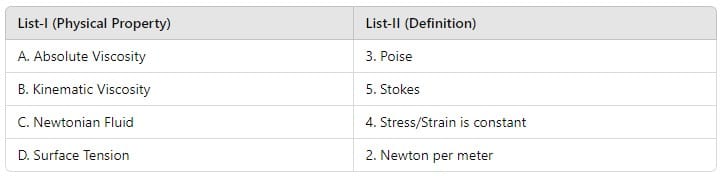
1. Absolute Viscosity (A)

  • Absolute viscosity (also called dynamic viscosity) is measured in Poise.
  • It represents the internal resistance to fluid flow.
  • Correct match → (3) Poise

2. Kinematic Viscosity (B)

  • Kinematic viscosity is the ratio of absolute viscosity to density.
  • It is measured in Stokes (St).
  • Correct match → (5) Stokes

3. Newtonian Fluid (C)

  • A Newtonian fluid follows Newton's Law of Viscosity, which states that shear stress is proportional to strain rate.
  • This means stress/strain rate is constant.
  • Correct match → (4) Stress/Strain is constant

4. Surface Tension (D)

  • Surface tension is a force per unit length and is measured in Newton per meter.
  • Correct match → (2) Newton per meter

Test: Properties of Fluids & Turbulent Flow in Pipes - 2 - Question 13

Fluids that require a gradually increasing shear stress to maintain a constant strain rate are known as

Detailed Solution: Question 13
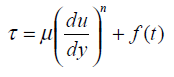
Ans. (a)

where f(t) is increasing

Test: Properties of Fluids & Turbulent Flow in Pipes - 2 - Question 14

Consider the following statements:  
1. Gases are considered incompressible when Mach number isless than 0.2
2. A Newtonian fluid is incompressible and non-viscous
3. An ideal fluid has negligible surface tension
Which of these statements is /are correct?

Detailed Solution: Question 14

  • A gas is often considered incompressible when the Mach number is less than 0.2. This is because the changes in density are usually negligible at this speed.
  • A Newtonian fluid is characterised by a constant viscosity regardless of the applied stress. However, it is not necessarily incompressible or non-viscous.
  • An ideal fluid is defined as having no viscosity and no surface tension.

The correct choice is 1 and 3, since:

  • Statement 1 is correct: Gases are considered incompressible at low Mach numbers.
  • Statement 3 is correct: An ideal fluid typically has negligible surface tension.

Test: Properties of Fluids & Turbulent Flow in Pipes - 2 - Question 15

At the interface of a liquid and gas at rest, the pressure is:  

Detailed Solution: Question 15

At the interface between a liquid and a gas at rest, the pressure difference is influenced by the shape of the interface.

  • The pressure is higher on the concave side of the interface. This is due to the curvature affecting pressure distribution.
  • This phenomenon is explained by the Young-Laplace equation, which relates surface tension and curvature to pressure difference.
  • The pressure difference is crucial in understanding processes like bubble formation and capillary action.

In simple terms, when you have a curved interface, the side that bends inward (concave) experiences more pressure than the side that bulges outward (convex).

30 docs|220 tests
Information about Test: Properties of Fluids & Turbulent Flow in Pipes - 2 Page
In this test you can find the Exam questions for Test: Properties of Fluids & Turbulent Flow in Pipes - 2 solved & explained in the simplest way possible. Besides giving Questions and answers for Test: Properties of Fluids & Turbulent Flow in Pipes - 2, EduRev gives you an ample number of Online tests for practice
Download as PDF