
GATE Mechanical (ME) Test: Pressure & Its Measurements, Reciprocating Pumps,
MCQ Practice Test & Solutions: Test: Pressure & Its Measurements, Reciprocating Pumps, Flow Around Submerged Bodies - Drag & Lift - 1 (15 Questions)
You can prepare effectively for Mechanical Engineering GATE Mechanical (ME) Mock Test Series 2027 with this dedicated MCQ Practice Test (available with solutions) on the important topic of "Test: Pressure & Its Measurements, Reciprocating Pumps, Flow Around Submerged Bodies - Drag & Lift - 1". These 15 questions have been designed by the experts with the latest curriculum of Mechanical Engineering 2026, to help you master the concept.
Test Highlights:
- - Format: Multiple Choice Questions (MCQ)
- - Duration: 60 minutes
- - Number of Questions: 15
Sign up on EduRev for free to attempt this test and track your preparation progress.

Which one of the following pairs is not correctly matched?
Detailed Solution: Question 1
If a reciprocating pump having a mechanical efficiency of 80% delivers water at the rate of 80 kg/s with a head of 30 m, the brake power of thepump is:
Detailed Solution: Question 2

A ping-pong ball, having a diameter of 3.6 cm and weighing 2.4 g is served with a horizontal velocity of 10 m/sec and a spin that gives rise to a coefficient of lift of 0.2. Assuming the density of air to be 0.00129 gf/cc, the lift experienced by the ball is nearly
Detailed Solution: Question 3
An inverted U-tube manometer is used to measure the pressure difference between two pipes A and B, as shown in the figure. Pipe A is carrying oil(specific gravity=0.8) and pipe B is carrying water. The densities of air and water are 1.16 kg/m3 and 1000 kg/m3, respectively. The pressure difference between pipes A and B is _____kPa.
Acceleration due to gravity:g = 10 m/s2
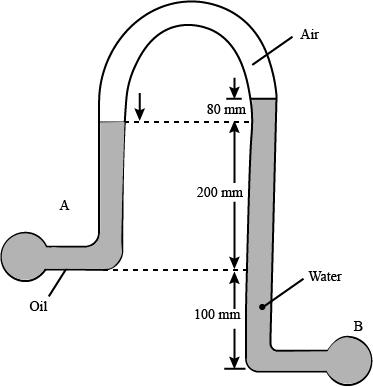
Acceleration due to gravity:g = 10 m/s2
Detailed Solution: Question 4
What will be the discharge of a single-acting pump if it has one cylinder of area 0.5 m2 and stroke of length 20 cm and if the pump has 180 rpm of speed?
A single-acting reciprocating pump has a 15 cm piston with a crank radius of 15cm. The delivery pipe is 10 cm in diameter. At a speed of 60 rpm, 310 litres/minute of water is lifted to a height of 15 cm. Find the coefficient of discharge.
Detailed Solution: Question 6
Consider the following coefficients: (Re = Reynolds number)
1. 1.328 Re_ (0.5) for laminar flow
2. 2.072 Re_ (0.2) for turbulent flow
3. 0.072 Re _ (0.2) for turbulent flow
4. 1.028 Re _ (0.5) for laminar flow
The coefficient of drag for a flat would include
1. 1.328 Re_ (0.5) for laminar flow
2. 2.072 Re_ (0.2) for turbulent flow
3. 0.072 Re _ (0.2) for turbulent flow
4. 1.028 Re _ (0.5) for laminar flow
The coefficient of drag for a flat would include
Detailed Solution: Question 7
An automobile moving at a velocity of 40 km/hr is experiencing a wind resistance of 2 kN. If the automobile is moving at a velocity of 50 km/hr,the power required to overcome the wind resistance is:
Detailed Solution: Question 8

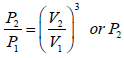
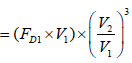
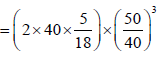
Improved streaming produces 25% reduction in the drag coefficient of a torpedo. When it is travelling fully submerged and assuming the driving power to remain the same, the crease in speed will be:
Detailed Solution: Question 9
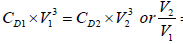
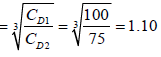
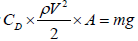
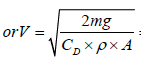
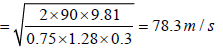
A parachutist has a mass of 90 kg and a projected frontal area of 0.30m2 in free fall. The drag coefficient based on frontal area is found to be 0.75. If the air density is 1.28 kg/m3, the terminal velocity of the parachutist will be:
Detailed Solution: Question 10
A cube of edge length 0.5 m is floating in water with 40% of its volume submerged. The density of the cube is:
Detailed Solution: Question 11
A submarine is submerged at a depth H below the surface of the ocean where the absolute pressure is measured to be 5.5 MPa. The density of seawater is 1025 kg/m³, atmospheric pressure is 101 kPa, and g = 9.81 m/s². What is the depth H? (Round off to the nearest integer)
Detailed Solution: Question 12
A cylindrical tank of radius 1 m and height 2 m is filled with oil of density 850 kg/m³. The hydrostatic force on the bottom surface is:
Detailed Solution: Question 13
A mercury barometer reads 760 mm Hg. If the local gravity increases by 1%, what will be the new height of the mercury column? (Assume the density of mercury and atmospheric pressure remain constant)
Detailed Solution: Question 14
A square gate of 3 m × 3 m is submerged horizontally in water. The plane of the gate is at 2 m below the surface. The hydrostatic force on the gate is:
Detailed Solution: Question 15
30 docs|220 tests |
