
GATE Mechanical (ME) Test: Boundary Layer Theory, Laminar Flow - 2 Free
MCQ Practice Test & Solutions: Test: Boundary Layer Theory, Laminar Flow - 2 (30 Questions)
You can prepare effectively for Mechanical Engineering GATE Mechanical (ME) Mock Test Series 2027 with this dedicated MCQ Practice Test (available with solutions) on the important topic of "Test: Boundary Layer Theory, Laminar Flow - 2". These 30 questions have been designed by the experts with the latest curriculum of Mechanical Engineering 2026, to help you master the concept.
Test Highlights:
- - Format: Multiple Choice Questions (MCQ)
- - Duration: 90 minutes
- - Number of Questions: 30
Sign up on EduRev for free to attempt this test and track your preparation progress.

Which one of the following is the characteristic of a fully developed laminar flow?
Detailed Solution: Question 1
The MINIMUM value of friction factor ‘f’ that can occur in laminar flow through a circular pipe is:
Detailed Solution: Question 2
 Where Max. Re = 2000.
A smooth flat plate with a sharp leading edge is placed along a gas stream flowing at U = 10 m/s. The thickness of the boundary layer at section r - s is 10 mm, the breadth of the plate is 1 m (into the paper) and the density of the gas ρ = 1.0 kg/m3 . Assume that the boundary layer is thin, two-dimensional, and follows a linear velocity distribution, u = U(y/δ), at the section r - s , where y is the height from plate.
The integrated drag force (in N) on the plate, between p - s , is:
Detailed Solution: Question 3
Detailed Solution: Question 4
In the region of the boundary layer nearest to the wall where velocityis not equal to zero, the viscous forces are:
Detailed Solution: Question 5
The hydrodynamic boundary layer thickness is defined as the distance from the surface where the
Detailed Solution: Question 6
Assertion (A): The 'dimples' on a golf ball are intentionally provided.
Reason (R): A turbulent boundary layer, since it has more momentumthan a laminar boundary layer, can better resist an adverse pressure gradient.
Detailed Solution: Question 7
During the flow over a circular cylinder, the drag coefficient dropssignificantly at a critical Reynolds number of 2 × 10⁵. This is due to
Detailed Solution: Question 8
What is the commonly used boundary layer control method to prevent separation?
Detailed Solution: Question 9
Prandtl number of a flowing fluid greater than unity indicates that hydrodynamic boundary layer thickness is:
Detailed Solution: Question 10
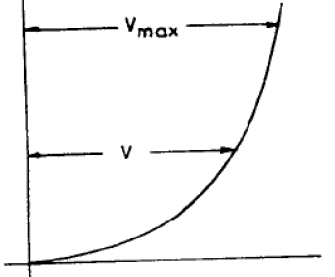
Velocity defect in boundary layer theory is defined as
Detailed Solution: Question 11
Velocity distribution in a turbulent boundary layer follows
Detailed Solution: Question 12
Assertion (A): The thickness of boundary layer cannot be exactlydefined.
Reason (R): The Velocity within the boundary layer approaches theinviscid velocity asymptotically.
Reason (R): The Velocity within the boundary layer approaches theinviscid velocity asymptotically.
Detailed Solution: Question 13
The equation of the velocity distribution over a plate is given byu = 2y – y2 where u is the velocity in m/s at a point y meter from theplate measured perpendicularly. Assuming μ = 8.60 poise, the she arstress at a point 15 cm from the boundary is:
Detailed Solution: Question 14
How is the displacement thickness in boundary layer analysis defined?
Detailed Solution: Question 15
Consider the following statements comparing turbulent boundarylayer with laminar boundary layer:
1. Turbulent boundary layers are thicker than laminar boundary layer
2. Velocity in turbulent boundary layers is more uniform3. In case of a laminar boundary layer, the thickness of the boundarylayer increases more rapidly as the distance from the leading edgeincreases.
4. For the same local Reynolds number. Shear stress at the boundaryis less in the case of turbulent boundary layer.
Of these statements:
1. Turbulent boundary layers are thicker than laminar boundary layer
2. Velocity in turbulent boundary layers is more uniform3. In case of a laminar boundary layer, the thickness of the boundarylayer increases more rapidly as the distance from the leading edgeincreases.
4. For the same local Reynolds number. Shear stress at the boundaryis less in the case of turbulent boundary layer.
Of these statements:
Detailed Solution: Question 16
Assertion (A): In an ideal fluid, separation from a continuous surfacewould not occur with a positive pressure gradient.
Reason (R): Boundary layer does not exist in ideal fluid.
Reason (R): Boundary layer does not exist in ideal fluid.
Detailed Solution: Question 17
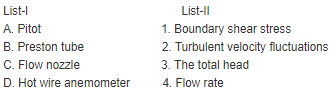
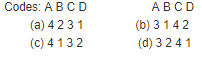
Match List-I (Device) with List-II (Use) and select the correct answer using the codes given below the Lists:
Detailed Solution: Question 18
Detailed Solution: Question 19
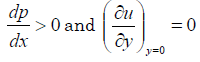
Flow separation is likely to take place when the pressure gradient inthe direction of flow is:
Detailed Solution: Question 20
Detailed Solution: Question 21

The ratio of the thickness of thermal boundary layer to the thickness of hydrodynamic boundary layer is equal to (Prandtl number)n, where nis:
Detailed Solution: Question 22
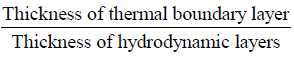

Hydrodynamic and thermal boundary layer thickness is equal forPrandtl number
Detailed Solution: Question 23

Which non-dimensional number relates the thermal boundary layerand hydrodynamic boundary layer?
Detailed Solution: Question 24

Consider the following statements pertaining to boundary layer:
1. Boundary layer is a thin layer adjacent to the boundary where maximum viscous energy dissipation takes place.
2. Boundary layer thickness is a thickness by which the ideal flow isshifted.
3. Separation of boundary layer is caused by presence of adverse pressure gradient.
Which of these statements are correct?
1. Boundary layer is a thin layer adjacent to the boundary where maximum viscous energy dissipation takes place.
2. Boundary layer thickness is a thickness by which the ideal flow isshifted.
3. Separation of boundary layer is caused by presence of adverse pressure gradient.
Which of these statements are correct?
Detailed Solution: Question 25
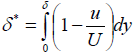
In a convective heat transfer situation Reynolds number is very largebut the Prandtl number is so small that the product Re × Pr is less thanone in such a condition which one of the following is correct?
Detailed Solution: Question 26
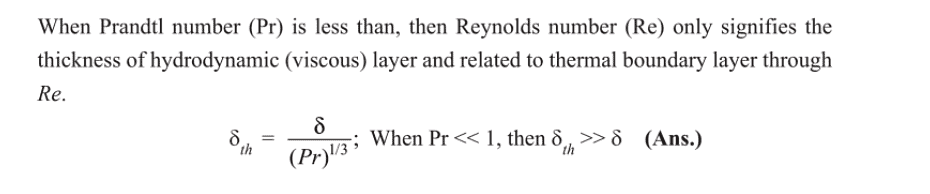
Which one of the following is the correct relationship between the boundary layer thickness δ, displacement thickness δ* and the momentum thickness θ?
Detailed Solution: Question 27
For linear distribution of velocity in the boundary layer on a flat plate,what is the ratio of displacement thickness (δ*) to the boundary layer thickness (δ)?
Detailed Solution: Question 28
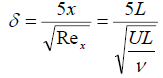
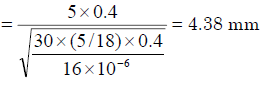
A flat plate, 2m × 0.4m is set parallel to a uniform stream of air (density1.2kg/m3 and viscosity 16 centistokes) with its shorter edges along theflow. The air velocity is 30 km/h. What is the approximate estimated thickness of boundary layer at the down stream end of the plate?
Detailed Solution: Question 29
The ‘velocity defect law’ is so named because it governs a
Detailed Solution: Question 30
30 docs|220 tests |
