
Quantitative MCQ - 22 Regulatory Body Exams MCQs & solutions - Free
MCQ Practice Test & Solutions: Quantitative MCQ - 22 (30 Questions)
You can prepare effectively for Regulatory Body Exams NABARD Grade A & Grade B Preparation with this dedicated MCQ Practice Test (available with solutions) on the important topic of "Quantitative MCQ - 22". These 30 questions have been designed by the experts with the latest curriculum of Regulatory Body Exams 2026, to help you master the concept.
Test Highlights:
- - Format: Multiple Choice Questions (MCQ)
- - Duration: 30 minutes
- - Number of Questions: 30
Sign up on EduRev for free to attempt this test and track your preparation progress.

In a class, there are 32 boys and 28 girls. The average age of the boys in the class is 14 years and the average age of the girls in the class is 13 years. What is the average age of the whole class? (Rounded off to two digits after decimal)
Detailed Solution: Question 1

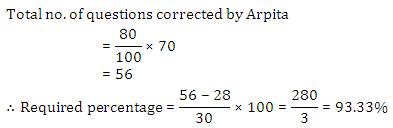
In a test consisting of 70 questions carrying one mark each, Arpita answers 70% of the first 40 questions correctly. What percent (approx.) of the other 30 questions does she need to answer correctly to score 80% on the entire test?
Detailed Solution: Question 2


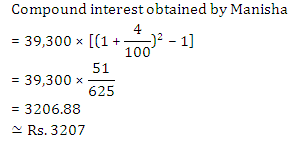
Manisha invests an amount of Rs. 39,300 for 2 years at the rate of 4 pcpa. What amount of approximate compound interest will she obtain at the end of 2 years?
Detailed Solution: Question 3
Directions (4-8): Study the graphs carefully to answer the questions that follow:
Total number of children in 6 different schools and the percentage of girls in them

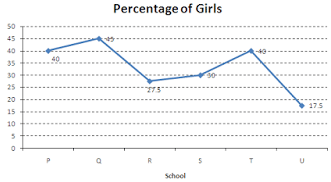
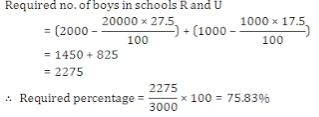
What is the total percentage of boys in schools R and U together? (rounded off to two digits after decimal)
Detailed Solution: Question 4
Directions (4-8): Study the graphs carefully to answer the questions that follow:
Total number of children in 6 different schools and the percentage of girls in them
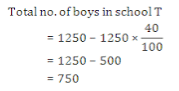
What is the total number of boys in School T?
Detailed Solution: Question 5
Directions (4-8): Study the graphs carefully to answer the questions that follow:
Total number of children in 6 different schools and the percentage of girls in them
The total number of students in school R is approximately what percent of the total number of students in school S?
Detailed Solution: Question 6

Directions (4-8): Study the graphs carefully to answer the questions that follow:
Total number of children in 6 different schools and the percentage of girls in them
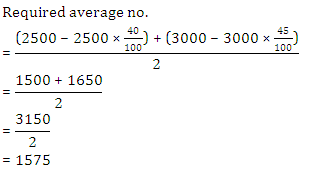
What is the average number of boys in schools P and Q together?
Detailed Solution: Question 7
Directions (4-8): Study the graphs carefully to answer the questions that follow:
Total number of children in 6 different schools and the percentage of girls in them
What is the ratio of the number of girls in school P to the number of girls in school Q?
Detailed Solution: Question 8

Directions (9-14): What should come in place of the question mark (?) in the following number series?
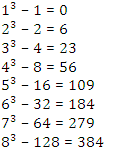
0, 6, 23, 56, 109, 184, 279, ?
Detailed Solution: Question 9
Directions (9-14): What should come in place of the question mark (?) in the following number series?
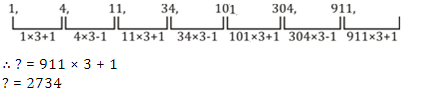
1, 4, 11, 34, 101, 304, 911, ?
Detailed Solution: Question 10
Directions (9-14): What should come in place of the question mark (?) in the following number series?
12, 12, 18, 36, 90, 270, ?
Detailed Solution: Question 11

Directions (9-14): What should come in place of the question mark (?) in the following number series?
15, 30, ?, 40, 8, 48
Detailed Solution: Question 12

Directions (9-14): What should come in place of the question mark (?) in the following number series?
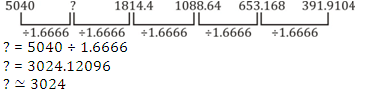
5040, ?, 1814.4, 1088.64, 653.184, 391.9104
Detailed Solution: Question 13
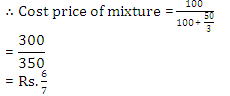
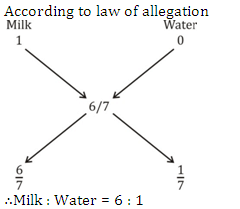
In what ratio should milk and water be mixed so that after selling the mixture at the cost price a profit of 50/3% is made?
Detailed Solution: Question 14

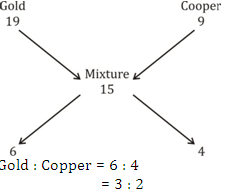
Gold is 19 times as heavy as water and copper is 9 times as heavy as water. In what ratio should these metals be mixed so that the mixture may be 15 times as heavy as water?
Detailed Solution: Question 15
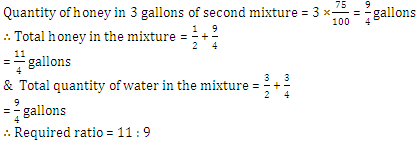
There are two mixtures of honey and water, the quantity of honey in them being 25% and 75% of the mixture respectively. If 2 gallons of the first are mixed with three gallons of the second, what will be the ratio of honey to water in the new mixture?
Detailed Solution: Question 16

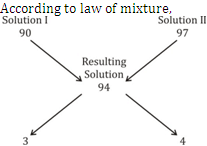
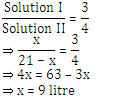
Two solutions of 90% and 97% purity are mixed resulting in 21 litres of the mixture of 94% purity. How much is the quantity of the first solution in the resulting mixture?
Detailed Solution: Question 17
Directions (18,19): Simplify the following questions and find the value of question mark (?)
65% of 780 + 78% of 650 = ?
Detailed Solution: Question 18

Directions (18,19): Simplify the following questions and find the value of question mark (?)
0.01 × 0.1 – 0.001 ÷ 10 + 0.01 = ?
Detailed Solution: Question 19


Directions (20-24): What approximate value should come in place of the question mark (?) in the following questions? (You are not expected to calculate the exact value)
31.85 ÷ 3.96 × 15 = ?
Detailed Solution: Question 20


Directions (20-24): What approximate value should come in place of the question mark (?) in the following questions? (You are not expected to calculate the exact value)
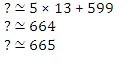
4.99 × 12.865 + 599 = ?
Detailed Solution: Question 21
Detailed Solution: Question 22


Directions (20-24): What approximate value should come in place of the question mark (?) in the following questions? (You are not expected to calculate the exact value)
1584 ÷ 24.89% of 352.02= ?
Detailed Solution: Question 23

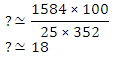
Detailed Solution: Question 24

Directions (25-29): Study the following graph carefully to answer the questions that follow:
Cost of three different fruits (in rupees per kg.) in five different cities.
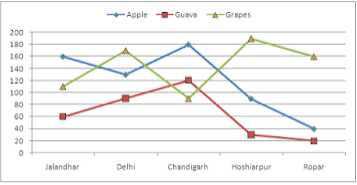
In which city is the difference between the cost of one kg. of apple and cost of one kg. of guava second lowest?
Detailed Solution: Question 25

Directions (25-29): Study the following graph carefully to answer the questions that follow:
Cost of three different fruits (in rupees per kg.) in five different cities.
Cost of one kg. of guava in Jalandhar is approximately what percent of the cost of two kgs. Of grapes in Chandigarh?
Detailed Solution: Question 26
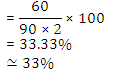
Directions (25-29): Study the following graph carefully to answer the questions that follow:
Cost of three different fruits (in rupees per kg.) in five different cities.
What will be the average of the total amount paid for 3 kgs. of apples and2 kgs.of guavas in Delhi and Chandigarh together?
Detailed Solution: Question 27
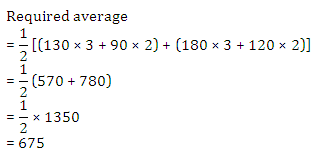
Directions (25-29): Study the following graph carefully to answer the questions that follow:
Cost of three different fruits (in rupees per kg.) in five different cities.
Ravinder had to purchase 45 kgs. of grapes from Hoshiarpur. The shopkeeper gave him the discount of 4% per kg. What amount did he pay to the shopkeeper after the discount?
Detailed Solution: Question 28

Directions (25-29): Study the following graph carefully to answer the questions that follow:
Cost of three different fruits (in rupees per kg.) in five different cities.
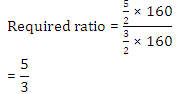
What is the respective ratio between the cost of 5/2kg. of grapes from Ropar and the cost of 3/2 kg. of apples from Jalandhar?
Detailed Solution: Question 29
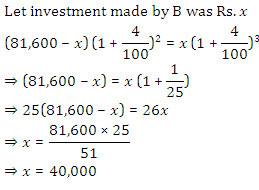
Two friends A and B jointly lent out Rs 81,600 at 4% per annum C.I. after 2 years, A gets the same amount as B gets after 3 years. The investment made by B was
Detailed Solution: Question 30
849 videos|1347 docs|489 tests |
