IGCSE Class 5  >  Class 5 Test  >  Year 5 Mathematics (Cambridge)  >  Test: Fractions, Greater than, Less than, Equal - Class 5 MCQ

Fractions, Greater than, Less Equal - Free MCQ Practice Test with solutions,


MCQ Practice Test & Solutions: Test: Fractions, Greater than, Less than, Equal (15 Questions)

You can prepare effectively for Class 5 Year 5 Mathematics IGCSE (Cambridge) with this dedicated MCQ Practice Test (available with solutions) on the important topic of "Test: Fractions, Greater than, Less than, Equal". These 15 questions have been designed by the experts with the latest curriculum of Class 5 2026, to help you master the concept.

Test Highlights:

  • - Format: Multiple Choice Questions (MCQ)
  • - Duration: 20 minutes
  • - Number of Questions: 15

Sign up on EduRev for free to attempt this test and track your preparation progress.

Test: Fractions, Greater than, Less than, Equal - Question 1

Which of the following represents an addition of fractions with a common denominator?

Detailed Solution: Question 1

The addition of 2/5 + 1/5 is straightforward because both fractions already share the same denominator. Adding fractions with common denominators simply requires summing the numerators while keeping the denominator constant, resulting in 3/5.

Test: Fractions, Greater than, Less than, Equal - Question 2

How is the fraction 3/4 converted to a percentage?

Detailed Solution: Question 2

To convert 3/4 into a percentage, divide 3 by 4 to get 0.75, and then multiply by 100. Therefore, 0.75 × 100 = 75%. This conversion is essential for interpreting fractions in terms of percentage, which is frequently used in assessments and real-life applications.

Test: Fractions, Greater than, Less than, Equal - Question 3

If you multiply a unit fraction 1/5 by 4, what is the result?

Detailed Solution: Question 3

Multiplying the unit fraction 1/5 by 4 results in 4/5. This operation effectively scales the fraction up, demonstrating how multiplication affects fractions. Understanding this concept is vital in various applications, including cooking and dividing resources.

Test: Fractions, Greater than, Less than, Equal - Question 4

How do you find a common denominator for adding the fractions 7/18 and 5/27?

Detailed Solution: Question 4

The least common multiple (LCM) of the denominators 18 and 27 is 54. To add the fractions, convert each to have a denominator of 54. This method ensures that both fractions are expressed in terms of the same base, facilitating accurate addition.

Test: Fractions, Greater than, Less than, Equal - Question 5

What symbol is used to represent a quantity that is less than another quantity?

Detailed Solution: Question 5

The symbol "<" denotes="" that="" one="" quantity="" is="" less="" than="" another.="" for="" example,="" in="" the="" inequality="" 3="">< 5,="" it="" indicates="" that="" 3="" is="" less="" than="" 5.="" understanding="" these="" symbols="" is="" essential="" for="" comparing="" numbers="" and="" working="" with="" inequalities="" in="">

Test: Fractions, Greater than, Less than, Equal - Question 6

What is the ratio of red counters to blue counters if there are 2 red and 3 blue counters?

Detailed Solution: Question 6

The ratio of red to blue counters is expressed as 2:3, indicating that for every 2 red counters, there are 3 blue counters. Ratios are useful for comparing quantities and understanding proportions in various contexts, such as recipes or mixing solutions.

Test: Fractions, Greater than, Less than, Equal - Question 7

Convert the decimal 0.8 into a percentage.

Detailed Solution: Question 7

To convert a decimal into a percentage, you multiply it by 100. Thus, 0.8 × 100 = 80%. This conversion is important in various applications, such as finance and statistics, where percentages are often more intuitive than decimals.

Test: Fractions, Greater than, Less than, Equal - Question 8

If a class of 30 students includes 9 nine-year-old boys and 9 nine-year-old girls, what is the proportion of nine-year-olds?

Detailed Solution: Question 8

The total number of nine-year-olds is 18 (9 boys + 9 girls). The proportion of nine-year-olds in the class is calculated as 18/30, which simplifies to 3/5. This reflects the fraction of the class that falls into this age group, highlighting the concept of proportions in demographic studies.

Test: Fractions, Greater than, Less than, Equal - Question 9

Which of the following is not an equivalent fraction for 1/3?

Detailed Solution: Question 9
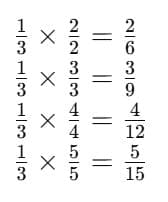
To find which fraction is not equivalent to 1/3, we compare each option:

Equivalent fractions of 1/3 are found by multiplying the numerator and denominator by the same number:

All are equivalent fraction of 1/3 except 2/3. So, the correct option is option (b) 2/3

Test: Fractions, Greater than, Less than, Equal - Question 10

If you have 1/2 of a chocolate bar and you divide it among 3 people, how much chocolate does each person get?

Detailed Solution: Question 10

Dividing 1/2 by 3 means calculating 1/2 ÷ 3, which is the same as multiplying 1/2 by the reciprocal of 3, or 1/3. Therefore, 1/2 × 1/3 = 1/6. Each person receives 1/6 of the chocolate bar. This illustrates how division of fractions works in practical scenarios.

Test: Fractions, Greater than, Less than, Equal - Question 11

Which of the following symbols is used to represent the concept of "greater than" in mathematical comparisons?

Detailed Solution: Question 11

The symbol ">" is used to indicate that one quantity is greater than another. For example, if we say 5 > 3, it means that 5 is greater than 3. Understanding these symbols is crucial for comparing numbers, fractions, and other quantities in mathematics.

Test: Fractions, Greater than, Less than, Equal - Question 12

What is the common denominator of the fractions 2/3 and 4/9 when adding them?

Detailed Solution: Question 12

To find a common denominator for 2/3 and 4/9, we can convert 2/3 to a fraction with 9 as the denominator. This gives us 2/3 = 6/9. Now we can add 6/9 and 4/9, as they share the same denominator of 9. The common denominator for these fractions is 9, but in terms of addition, it becomes 18 when considering both fractions' equivalent forms for clarity in operations.

Test: Fractions, Greater than, Less than, Equal - Question 13

If 1/2 of a cake is shared equally among 4 people, how much cake does each person receive?

Detailed Solution: Question 13

When 1/2 of a cake is divided among 4 people, each person gets 1/2 ÷ 4, which is the same as 1/2 × 1/4 = 1/8. This division shows how we can share portions of a whole, and it’s a practical application of fractions in real-life scenarios, such as sharing food.

Test: Fractions, Greater than, Less than, Equal - Question 14

In a class of 30 students, if 9 are nine-year-old boys and 9 are nine-year-old girls, what proportion of the class is not nine years old?

Detailed Solution: Question 14

To find the proportion of students who are not nine years old, we first calculate the total number of nine-year-olds: 9 boys + 9 girls = 18 nine-year-olds. Therefore, the number of students not nine years old is 30 - 18 = 12. The proportion is then 12/30, which simplifies to 2/5. Understanding proportions helps in analyzing data, such as demographics in a classroom.

Test: Fractions, Greater than, Less than, Equal - Question 15

Which of the following statements about ratios is true?

Detailed Solution: Question 15

Ratios can indeed be expressed as fractions or percentages, making them versatile for comparing quantities. For instance, a ratio of 2:3 can be written as 2/5 or converted into a percentage (40% for the first part). Understanding ratios is essential for various applications, from cooking recipes to financial analysis.

46 docs|21 tests
Information about Test: Fractions, Greater than, Less than, Equal Page
In this test you can find the Exam questions for Test: Fractions, Greater than, Less than, Equal solved & explained in the simplest way possible. Besides giving Questions and answers for Test: Fractions, Greater than, Less than, Equal, EduRev gives you an ample number of Online tests for practice
Download as PDF