CBSE Class 7  >  Class 7 Test  >  Mathematics Olympiad   >  Test: Parallel and Intersecting Lines - Class 7 MCQ

Parallel and Intersecting Lines - Class 7 Mathematics Olympiad Free MCQ


MCQ Practice Test & Solutions: Test: Parallel and Intersecting Lines (15 Questions)

You can prepare effectively for Class 7 Mathematics Olympiad Class 7 with this dedicated MCQ Practice Test (available with solutions) on the important topic of "Test: Parallel and Intersecting Lines". These 15 questions have been designed by the experts with the latest curriculum of Class 7 2026, to help you master the concept.

Test Highlights:

  • - Format: Multiple Choice Questions (MCQ)
  • - Duration: 20 minutes
  • - Number of Questions: 15

Sign up on EduRev for free to attempt this test and track your preparation progress.

Test: Parallel and Intersecting Lines - Question 1

If two lines are parallel, what can be said about the corresponding angles formed when a transversal crosses them?

Detailed Solution: Question 1
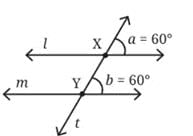
When two parallel lines are intersected by a transversal, the corresponding angles are equal. 

Test: Parallel and Intersecting Lines - Question 2

 If angle a measures 120°, what is the measure  of angle b if angles a and b are a linear pair?

Detailed Solution: Question 2

If angle a measures 120°, then angle b can be calculated as follows:

  • Angles a and b form a linear pair, which means they are supplementary.
  • Supplementary angles add up to 180°.
  • To find angle b, subtract angle a from 180°:
  • b = 180° - 120° = 60°.

Therefore, the measure of angle b is 60°.

Test: Parallel and Intersecting Lines - Question 3

If two angles are alternate interior angles and are equal, what can we conclude about the two lines they are between?

Detailed Solution: Question 3

If the alternate interior angles formed by a transversal intersecting two lines are equal, it can be concluded that those two lines are parallel. 

Test: Parallel and Intersecting Lines - Question 4

What type of angles are formed by two intersecting lines?

Detailed Solution: Question 4
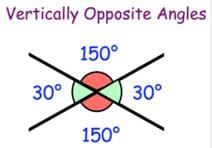
Vertically opposite angles are formed when two lines intersect. These angles are opposite each other at the intersection point and are always equal, which is a key property in geometry.

Test: Parallel and Intersecting Lines - Question 5

What do we call a line that intersects two or more other lines?

Detailed Solution: Question 5

Transversal is the term used for a line that intersects two or more other lines. This type of line creates various angles and can help in understanding relationships between the intersected lines.

Test: Parallel and Intersecting Lines - Question 6

What is the sum of the interior angles on the same side of a transversal when it intersects two parallel lines?

Detailed Solution: Question 6

The interior angles on the same side of a transversal that intersects two parallel lines are supplementary, meaning they add up to 180°

Test: Parallel and Intersecting Lines - Question 7

What is the measure of each angle when four angles are formed by two perpendicular lines?

Detailed Solution: Question 7

When two lines are perpendicular, they meet each other at a right angle.
A right angle measures 90°

At the point where the two perpendicular lines cross:

  • They form four angles
  • All four angles are equal 
  • Each angle is a right angle, so each measures 90°

Therefore, the correct answer is: Option C 90°

Test: Parallel and Intersecting Lines - Question 8

What are linear pairs of angles?

Detailed Solution: Question 8

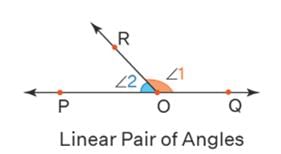
A linear pair of angles consists of two adjacent angles whose non-common arms form a straight line, meaning their measures add up to 180°. In other words, the two angles are next to each other (adjacent) and together form a straight angle. This is the correct definition of a linear pair, so option d is correct.

Test: Parallel and Intersecting Lines - Question 9

What term is used to describe two lines that intersect at a single point on a flat surface?

Detailed Solution: Question 9
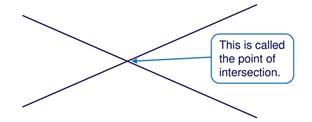
The term intersecting lines refers to two lines that cross each other at one point, known as the point of intersection.

Test: Parallel and Intersecting Lines - Question 10

Two lines intersect. One of the angles at the intersection is 90°. If this angle is increased by 10°, what is the measure of the angle adjacent to it in a linear pair?

  • 80°
  • 90°
  • 100°
  • 110°

Detailed Solution: Question 10

  • The original angle is 90°.
  • After increasing by 10°, it becomes 100°.
  • Angles in a linear pair sum to 180°.
  • Adjacent angle = 180 - 100 = 80°.

Therefore, the measure of the angle adjacent to the increased angle is 80°.

Test: Parallel and Intersecting Lines - Question 11

If one angle of a linear pair is three times the other, what are the measures of the two angles?

Detailed Solution: Question 11

Let the smaller angle be x.
Then the larger angle = 3x

Since they form a linear pair:
x + 3x = 180°
4x = 180°
x = 180° ÷ 4
x = 45°

So, the angles are 45° and 135°

Test: Parallel and Intersecting Lines - Question 12

Which of the following are examples of parallel lines in real-world objects?

Detailed Solution: Question 12

Parallel lines are lines in a plane that stay the same distance apart and never meet. In a book, the top and bottom edges and the left and right edges form pairs of parallel lines because they remain equidistant. Likewise, the horizontal lines on a notebook page run straight across and stay the same distance apart. The spokes of a wheel radiate from the centre and meet at a point, and the diagonal of a square is a single line rather than a pair of lines.

Test: Parallel and Intersecting Lines - Question 13

If the sum of two adjacent angles is 180°, then the angles form a:

Detailed Solution: Question 13

Two adjacent angles whose sum is 180° form a linear pair.

Test: Parallel and Intersecting Lines - Question 14

Which type of lines never intersect, no matter how far they are extended?

Detailed Solution: Question 14
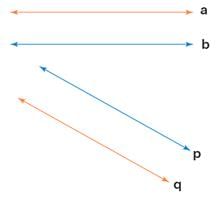
Parallel lines are defined as lines that never meet or intersect, regardless of how far they are extended. 

Test: Parallel and Intersecting Lines - Question 15

What type of angles are formed outside two lines when a transversal intersects them?

Detailed Solution: Question 15

Exterior angles are the angles that lie outside the region between the two lines and are formed at the intersections where the transversal crosses each line.

28 videos|105 docs|48 tests
Information about Test: Parallel and Intersecting Lines Page
In this test you can find the Exam questions for Test: Parallel and Intersecting Lines solved & explained in the simplest way possible. Besides giving Questions and answers for Test: Parallel and Intersecting Lines, EduRev gives you an ample number of Online tests for practice
28 videos|105 docs|48 tests
Download as PDF