CBSE Class 7  >  Class 7 Test  >  Science (Curiosity) - New NCERT  >  Test: Life Processes in Plants - Class 7 MCQ

Life Processes in Plants - Class 7 Science Free MCQ Test with solutions


MCQ Practice Test & Solutions: Test: Life Processes in Plants (15 Questions)

You can prepare effectively for Class 7 Science (Curiosity) Class 7 - New NCERT with this dedicated MCQ Practice Test (available with solutions) on the important topic of "Test: Life Processes in Plants". These 15 questions have been designed by the experts with the latest curriculum of Class 7 2026, to help you master the concept.

Test Highlights:

  • - Format: Multiple Choice Questions (MCQ)
  • - Duration: 20 minutes
  • - Number of Questions: 15

Sign up on EduRev for free to attempt this test and track your preparation progress.

Test: Life Processes in Plants - Question 1

What role do stomata play in the life of a plant?

Detailed Solution: Question 1

Stomata are tiny openings on leaves that let gases like carbon dioxide in and oxygen out. They also help control water loss.

Test: Life Processes in Plants - Question 2

How do plants ensure that non-green parts receive the nutrients they need?

Detailed Solution: Question 2

  • Plants have two main types of vascular tissue: xylem and phloem.
  • Xylem transports water and minerals from the roots to the leaves.
  • Phloem is responsible for transporting nutrients, particularly glucose produced during photosynthesis, from the leaves to non-green parts of the plant.
  • This distribution ensures that all parts, including roots and fruits, receive the necessary energy to grow and function.

Test: Life Processes in Plants - Question 3

Which part of the plant is primarily responsible for the absorption of water and minerals?

Detailed Solution: Question 3

Roots take in water and minerals from the soil, which are needed for the plant's growth.

Test: Life Processes in Plants - Question 4

What process do plants use to convert sunlight into chemical energy?

Detailed Solution: Question 4

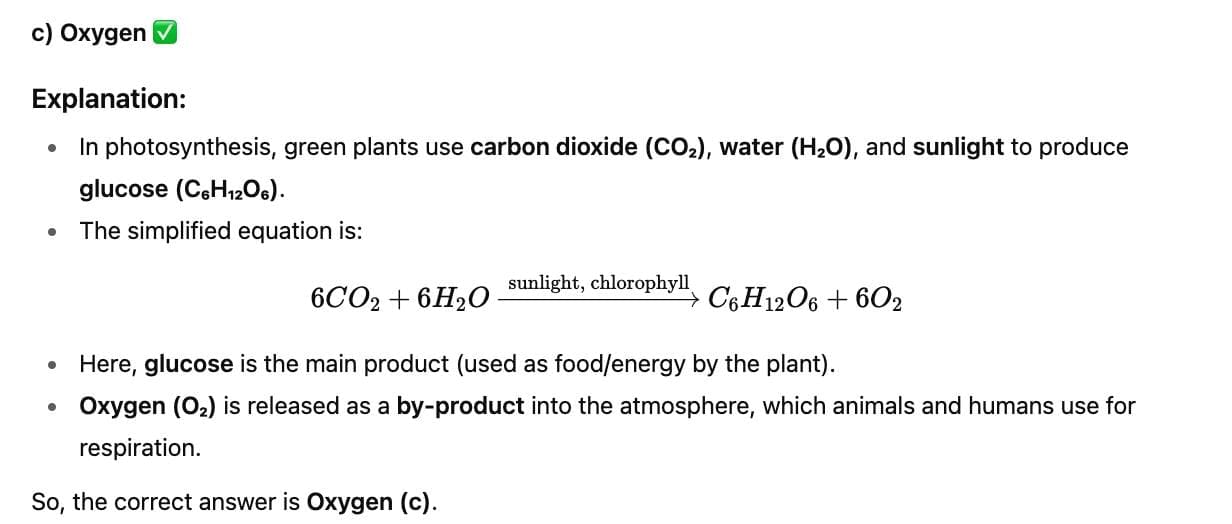
  • Photosynthesis is the process by which plants convert sunlight into chemical energy.
  • It occurs mainly in the leaves, using chlorophyll, the green pigment that captures sunlight.
  • During this process, plants take in carbon dioxide from the air and water from the soil.
  • Using sunlight, they transform these raw materials into glucose, a type of sugar, and release oxygen as a byproduct.
  • This process is essential for the survival of plants and provides oxygen for other living organisms.

Test: Life Processes in Plants - Question 5

Which vascular tissue is responsible for transporting water and minerals in plants?

Detailed Solution: Question 5

Xylem carries water and minerals from the roots to the rest of the plant.

Test: Life Processes in Plants - Question 6

What is the main by-product of photosynthesis?

Detailed Solution: Question 6

Why are other options incorrect?

a) Glucose

  • Glucose is not a by-product.

  • It is the main product of photosynthesis. Plants make glucose (a sugar) as food, which can later be stored as starch or used for energy.

b) Carbon dioxide

  • Carbon dioxide is not produced in photosynthesis.

  • Instead, plants take in CO2 from the air as a raw material.

  • Without CO2, the process cannot happen.

d) Nitrogen

  • Nitrogen is not involved in photosynthesis at all.

  • Plants do need nitrogen, but they get it from the soil in the form of nitrates, not from the photosynthesis process.

Test: Life Processes in Plants - Question 7

During which process do plants release carbon dioxide?

Detailed Solution: Question 7

Plants release carbon dioxide when they break down food to get energy, a process called respiration.

Test: Life Processes in Plants - Question 8

What is the significance of the word equation for photosynthesis?

Detailed Solution: Question 8

The word equation shows what plants need (carbon dioxide and water) and what they produce (glucose and oxygen).

Test: Life Processes in Plants - Question 9

What is the primary function of chlorophyll in plants?

Detailed Solution: Question 9

Chlorophyll captures sunlight, which helps plants make food in the process called photosynthesis.

Test: Life Processes in Plants - Question 10

What is starch, and why is it important for plants?

Detailed Solution: Question 10

Starch is a type of sugar that plants store as energy, which they can use later.

Test: Life Processes in Plants - Question 11

What is the primary process by which plants produce their own food?

Detailed Solution: Question 11

Photosynthesis is the process by which plants make their food using sunlight, carbon dioxide, and water.

Test: Life Processes in Plants - Question 12

During photosynthesis, what gas do plants take in that is essential for the production of food?

Detailed Solution: Question 12

Plants take in carbon dioxide during photosynthesis to make food.

Test: Life Processes in Plants - Question 13

Which process in plants is directly responsible for the upward movement of water from roots to leaves?

Detailed Solution: Question 13

Transpiration pull is created when water evaporates from the leaves through stomata.
This evaporation lowers the water potential in leaf cells, pulling more water upward from the roots through the xylem.
It is the main driving force for the long-distance transport of water in tall plants.

Test: Life Processes in Plants - Question 14

What is the role of xylem in plants?

Detailed Solution: Question 14

Xylem carries water and minerals from the roots to other parts of the plant.

Test: Life Processes in Plants - Question 15

What colour change indicates the presence of starch when iodine is added to a leaf?

Detailed Solution: Question 15

When iodine solution is added to a leaf containing starch, it reacts with the starch to form a blue-black complex, indicating the presence of starch in the leaf. 

87 videos|255 docs|12 tests
Information about Test: Life Processes in Plants Page
In this test you can find the Exam questions for Test: Life Processes in Plants solved & explained in the simplest way possible. Besides giving Questions and answers for Test: Life Processes in Plants, EduRev gives you an ample number of Online tests for practice
Download as PDF