NEET PG Exam  >  NEET PG Test  >  Topic Wise MCQs  >  Test: Hansen’s Disease - 1 - NEET PG MCQ

Hansen’s Disease - 1 - Free MCQ Practice Test with solutions, NEET PG


MCQ Practice Test & Solutions: Test: Hansen’s Disease - 1 (20 Questions)

You can prepare effectively for NEET PG Topic Wise MCQs for NEET PG with this dedicated MCQ Practice Test (available with solutions) on the important topic of "Test: Hansen’s Disease - 1". These 20 questions have been designed by the experts with the latest curriculum of NEET PG 2026, to help you master the concept.

Test Highlights:

  • - Format: Multiple Choice Questions (MCQ)
  • - Duration: 20 minutes
  • - Number of Questions: 20

Sign up on EduRev for free to attempt this test and track your preparation progress.

Test: Hansen’s Disease - 1 - Question 1

Leprosy does not involve:

Detailed Solution: Question 1

CNS is typically seen as not playing a role in leprosy. Instances of involvement of the cerebral cortex are uncommon.

Test: Hansen’s Disease - 1 - Question 2

Skin smear is negative in which leprosy?

Detailed Solution: Question 2

Neuritic leprosy affects the surface nerve trunks present in the skin. It is more easily differentiated from the indeterminate type since the neuritic form displays nerve involvement without the characteristic skin lesions. The SSS test includes both clinical and bacteriological assessments and can identify pure neuritic cases solely when the bacterial count exceeds 10,000. When comparing neuritic and indeterminate types, neuritic is the preferable choice due to its clinical skin involvement.

Test: Hansen’s Disease - 1 - Question 3

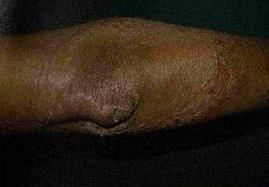
A patient of leprosy presents with le­sions as shown. The likely diagnosis is:
Detailed Solution: Question 3

The image depicts an annular, punched-out lesion of BB Hansen, characterised by a raised edge and a clear central area.

  • Observe the distinct features that are typical of BB Hansen.

Test: Hansen’s Disease - 1 - Question 4

All are true about lepromatous leprosy except: 

Detailed Solution: Question 4

The presence of granulomas beneath the skin is indicative of tuberculoid leprosy.

Test: Hansen’s Disease - 1 - Question 5

A 45-year-old male had multiple hypo­esthetic mildly erythematous large plaques with elevated margins on trunk and extremities. His ulnar and lateral popliteal nerves on both sides were enlarged. The most probable diagnosis is

Detailed Solution: Question 5

In queries of this nature, the initial step is to determine whether the patient leans more towards the lepromatous or tuberculoid spectrum. Signs such as:

  • Multiple lesions
  • Symmetrical nerve involvement

indicate borderline leprosy (BL). It cannot be lepromatous leprosy (LL) since LL does not present with hypoesthesia. Therefore, this would suggest a progression towards the lepromatous side, specifically BL.

Test: Hansen’s Disease - 1 - Question 6

Multiple hypoesthetic, hypopigmen­ted macules on right lateral forearm with numerous acid-fast bacilli is indicative of: 

Detailed Solution: Question 6

In scenarios like these, the first step is to determine whether the patient leans towards the lepromatous or tuberculoid spectrum.

  • Multiple lesions, hypoesthesia, segmented lesions, and a high number of acid-fast bacilli indicate borderline leprosy.
  • It cannot be lepromatous leprosy (LL) as LL is characterised by the absence of hypoesthesia or hypopigmentation.
  • It cannot be indeterminate leprosy, which also lacks hypoesthesia and does not present with numerous bacilli.
  • It cannot be tuberculoid leprosy, which typically features a single lesion and is paucibacillary.

Therefore, the most accurate conclusion is that the patient has borderline leprosy.

Test: Hansen’s Disease - 1 - Question 7

In leprosy which of the following is not seen? 

Detailed Solution: Question 7

Decreased proprioception is generally not observed in leprosy.

  • Nerve involvement in leprosy leads to motor palsy, resulting in abnormal EMG readings.
  • Voluntary muscle testing would reveal these motor alterations.
  • Reduced sensations are typically noted.
  • An increased tactile response suggests a type 1 lepra reaction, accompanied by hyperesthesia.

Proprioception and vibration sense remain intact in leprosy.

Test: Hansen’s Disease - 1 - Question 8

All are features of lepromatous leprosy except:

Detailed Solution: Question 8

Nerve involvement in lepromatous leprosy (LL) generally occurs gradually and at a later stage.
  • Symmetrical nerve involvement leads to glove and stocking anaesthesia.
  • It also results in mononeuritis multiplex in LL.

Test: Hansen’s Disease - 1 - Question 9

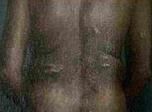
A patient of leprosy presents with lesions as shown. The likely diagnosis is:
Detailed Solution: Question 9

Observe the nearly symmetrical lesions associated with borderline leprosy (BL). Additionally, take note of the solitary annular, punched-out lesion located on the left side of the trunk. Such annular lesions may be present in both BB and BL.

  • The extensive number of lesions suggests a preference for BL over BB.

Test: Hansen’s Disease - 1 - Question 10

In leprosy neural involvement occurs what percentage of patients?

Detailed Solution: Question 10

While complete clinical nerve enlargement is not observed in every form of leprosy (for instance, indeterminate Hansen's displays normal nerve diameters), nerve involvement occurs subclinically in all individuals affected by leprosy.

Test: Hansen’s Disease - 1 - Question 11

A known case of lepromatous leprosy was initiated on treatment. She devel- oped painful erythematous papules with fever and lymphadenopathy. What is the likely reactional state?

Detailed Solution: Question 11

Leprosy patients may exhibit a type 2 lepra reaction following treatment.

  • Symptoms such as fever, painful papules or nodules, along with lymphadenopathy, all indicate the presence of erythema nodosum leprosum (ENL).

Test: Hansen’s Disease - 1 - Question 12

A 16-year-old student reports with multiple hypopigmented macules on trunk and limbs. All of the following tests are useful in making a diagnosis of leprosy except:

Detailed Solution: Question 12

Multiple hypopigmented lesions are indicative of borderline lepromatous (BL) leprosy. Sensory testing reveals hypoesthesia. Slit-skin smear (SSS) tests positive. Biopsy shows sparse tuberculoid granulomas with abundant foam cells. The lepromin test is used for prognosis, not diagnosis.

*Multiple options can be correct
Test: Hansen’s Disease - 1 - Question 13

Features of leprosy:

Detailed Solution: Question 13

In lepromatous leprosy (LL), nodules form, and saddle nose deformity often occurs due to nasal bridge collapse. Lagophthalmos results from facial nerve involvement, where the first ophthalmic division of the fifth cranial nerve causes corneal anesthesia, and the zygomatic branch of the seventh cranial nerve paralyzes the orbicularis oculi muscle, preventing proper eye closure. LL typically leads to ear lobe infiltration, resulting in large, pendulous "Buddha ears," not small lobes. Microstomia is unrelated to LL.

Test: Hansen’s Disease - 1 - Question 14

Type-1 lepra reaction is commonly seen in:

Detailed Solution: Question 14

Borderline lepromatous leprosy. Borderline leprosy (BT, BB, BL) is associated with lepra reaction. The most significant type is the type 1 lepra reaction.

Test: Hansen’s Disease - 1 - Question 15

Under leprosy eradication programme the management of single lesion is:

Detailed Solution: Question 15

The Indian programme has discontinued single-dose ROM (rifampicin, ofloxacin, minocycline) therapy.

Test: Hansen’s Disease - 1 - Question 16

In multibacillary leprosy the follow-up examination after adequate treatment should be done yearly for:

Detailed Solution: Question 16

As per the WHO, there is no need for any follow-up after MDT at this time.

Test: Hansen’s Disease - 1 - Question 17

Most common type of leprosy in India:

Test: Hansen’s Disease - 1 - Question 18

Virchow's cells are seen in: 

Test: Hansen’s Disease - 1 - Question 19

Lepra cell is a: 

Test: Hansen’s Disease - 1 - Question 20

Satellite lesions are seen in:

327 tests
Information about Test: Hansen’s Disease - 1 Page
In this test you can find the Exam questions for Test: Hansen’s Disease - 1 solved & explained in the simplest way possible. Besides giving Questions and answers for Test: Hansen’s Disease - 1, EduRev gives you an ample number of Online tests for practice
Download as PDF