NEET PG Exam  >  NEET PG Test  >  Topic Wise MCQs  >  Test: Hansen’s Disease - 2 - NEET PG MCQ

Hansen’s Disease - 2 - Free MCQ Practice Test with solutions, NEET PG


MCQ Practice Test & Solutions: Test: Hansen’s Disease - 2 (20 Questions)

You can prepare effectively for NEET PG Topic Wise MCQs for NEET PG with this dedicated MCQ Practice Test (available with solutions) on the important topic of "Test: Hansen’s Disease - 2". These 20 questions have been designed by the experts with the latest curriculum of NEET PG 2026, to help you master the concept.

Test Highlights:

  • - Format: Multiple Choice Questions (MCQ)
  • - Duration: 20 minutes
  • - Number of Questions: 20

Sign up on EduRev for free to attempt this test and track your preparation progress.

Test: Hansen’s Disease - 2 - Question 1

Treatment of severe ulnar neuritis in borderline tuberculoid leprosy is:

Detailed Solution: Question 1

MDT must be maintained throughout the reaction. Steroids are the drug of choice.

Test: Hansen’s Disease - 2 - Question 2

Best method of treatment of abscess in case of leprosy

Detailed Solution: Question 2

Incision and drainage are necessary procedures. In the case of a nerve abscess, the use of steroids alone may not be adequate.
Incision and drainage alleviate pressure on the nerve and help to restore its function.

Test: Hansen’s Disease - 2 - Question 3

The most effective drug against M. leprae is:

Detailed Solution: Question 3

Rifampicin is a strong bactericidal agent. Four days following a single dose of 600 mg, the bacilli in the patient are no longer alive.

Test: Hansen’s Disease - 2 - Question 4

The Ridley-Jopling classification for leprosy is based on which of the following parameter: 

Detailed Solution: Question 4

Clinical, bacteriological, immunological, and histological. This does not encompass pure neural types of Hansen's.

Test: Hansen’s Disease - 2 - Question 5

Commonest nerve involved in leprosy is: 

Detailed Solution: Question 5

Ulnar is the most frequently affected peripheral nerve in leprosy. Most references, as cited below, provide evidence supporting ulnar as the predominant nerve.

  • Harrison 19th edn (pages 1024, 1125)
  • Harrison 18th edn
  • The Classical Dharmendra Textbook of Leprosy Vol. 1 (pages 101, 209)
  • IAL Textbook, 2nd edn (page 252)
  • Yawalkar book (pages 30, 33, 88)

All of these sources affirm the ulnar nerve's prominence. However, two cohort studies conducted in 1999 and 2000 indicate that the posterior tibial nerve is the most commonly involved. Thus, consider the hierarchy as ulnar > posterior tibial.

Test: Hansen’s Disease - 2 - Question 6

Leprosy affects all organs except:

Detailed Solution: Question 6

The gastrointestinal tract, brain, lungs, heart, prostate, and female reproductive system are generally considered to be unaffected by leprosy; however, there have been case reports indicating involvement.

When choosing between the ovary and the uterus, the uterus is the preferred option for this question.

Test: Hansen’s Disease - 2 - Question 7

Ulceronecrotic lesion is seen in:

Detailed Solution: Question 7

Lucio leprosy is a non-nodular, smooth form of lepromatous leprosy (LL). In the Lucio phenomenon, patients develop ulcers and necrotic hemorrhagic infarcts with serrated margins.

Test: Hansen’s Disease - 2 - Question 8

Not true about lepromin test is: 

Detailed Solution: Question 8

Lepromin is utilised for prognosis rather than diagnosis, as it serves as a marker for immunity.

  • In early infancy, the immune system is underdeveloped, resulting in lepromin negativity.
  • The BCG vaccine can also lead to a positive conversion.

Test: Hansen’s Disease - 2 - Question 9

A 27-year-old patient was diagnosed to have borderline leprosy and started on multibacillary multidrug therapy. Six weeks later, he developed pain in the nerves and redness and swelling of the skin lesion. The management of his illness should include all of the following except:

Detailed Solution: Question 9

The patient is experiencing a type 1 lepra reaction accompanied by nerve inflammation. Treatment options include:

  • Steroids
  • Splinting of the limb
  • Analgesics

It is essential that anti-leprosy medications are not discontinued.

Test: Hansen’s Disease - 2 - Question 10

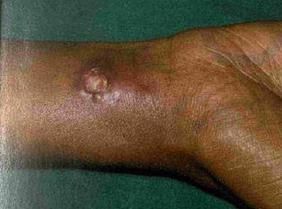
A patient of leprosy presents with painful ulcerated lesion on the wrist as shown. He has recently been started on MDT for leprosy. The DOC would.
Detailed Solution: Question 10

Steroids are the drug of choice for type 1 lepra reaction. The image depicts neuritis accompanied by ulceration. Dapsone should be maintained as part of the multidrug therapy (MDT) throughout the treatment for the reaction. Incision and drainage are performed for a nerve abscess resulting from severe neuritis.

*Multiple options can be correct
Test: Hansen’s Disease - 2 - Question 11

Manifestation of ENL includes all of the following except: 

Detailed Solution: Question 11

ENL leads to:

  • fever
  • red, tender skin nodules
  • hepatitis
  • arthralgia (not arthritis)

Test: Hansen’s Disease - 2 - Question 12

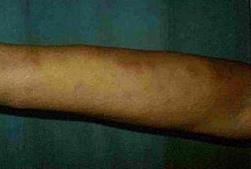
A patient of leprosy presents with painful lesions on arms as shown. He is also febrile. He is given a drug which increases the numbness of the hands and feet. The likely drug is:
Detailed Solution: Question 12

Thalidomide has the potential to induce peripheral neuropathy, which can result in numbness in the hands and feet. The image depicts ENLs on the arms.

Test: Hansen’s Disease - 2 - Question 13

Dose of dapsone in leprosy is:

Detailed Solution: Question 13

It is probable that the dark brown hyperpigmentation observed is a result of clofazimine administration. This hyperpigmentation is noticeable on the macrophages of certain patients, which adds to the overall pigmentation.

Test: Hansen’s Disease - 2 - Question 14

Thalidomide is not used in:

Detailed Solution: Question 14

Thalidomide neuropathy affects approximately 20% of individuals within a year.

Test: Hansen’s Disease - 2 - Question 15

All are true statement regarding leprosy except:

Detailed Solution: Question 15

Immunoprophylaxis plays no part in leprosy. The BCG and BCG combined with killed M. leprae vaccines demonstrate inconsistent effectiveness in preventing leprosy. Additionally, both Mycobacterium vaccae and the ICRC vaccine have been explored.

Test: Hansen’s Disease - 2 - Question 16

Which of the following is classical of borderline leprosy?

Detailed Solution: Question 16

An inverted saucer is characteristic of Bell's palsy. It is often accompanied by:

  • Extensive glove and stocking distribution
  • ENL (Erythema Nodosum Leprosum)
  • Facial lesions

These symptoms are indicative of infectious leprosy.

Test: Hansen’s Disease - 2 - Question 17

Nerve abscess is most seen in:

Test: Hansen’s Disease - 2 - Question 18

Earliest sensation to be lost in Hansen's disease is: 

Test: Hansen’s Disease - 2 - Question 19

Nerves are not thickened in:

Test: Hansen’s Disease - 2 - Question 20

A single hypopigmented anesthetic patch on forearm with satellite lesion Likely diagnosis is:

327 tests
Information about Test: Hansen’s Disease - 2 Page
In this test you can find the Exam questions for Test: Hansen’s Disease - 2 solved & explained in the simplest way possible. Besides giving Questions and answers for Test: Hansen’s Disease - 2, EduRev gives you an ample number of Online tests for practice
Download as PDF