NEET PG Exam  >  NEET PG Test  >  Medicine  >  Test: Headache & Neurocutaneous Disorders - NEET PG MCQ

Headache & Neurocutaneous Disorders - Free MCQ Practice Test with solutions,


MCQ Practice Test & Solutions: Test: Headache & Neurocutaneous Disorders (15 Questions)

You can prepare effectively for NEET PG Medicine with this dedicated MCQ Practice Test (available with solutions) on the important topic of "Test: Headache & Neurocutaneous Disorders". These 15 questions have been designed by the experts with the latest curriculum of NEET PG 2026, to help you master the concept.

Test Highlights:

  • - Format: Multiple Choice Questions (MCQ)
  • - Duration: 15 minutes
  • - Number of Questions: 15

Sign up on EduRev for free to attempt this test and track your preparation progress.

Test: Headache & Neurocutaneous Disorders - Question 1

True statement regarding migraine in pregnancy? (JIPMER May 2018)

Detailed Solution: Question 1
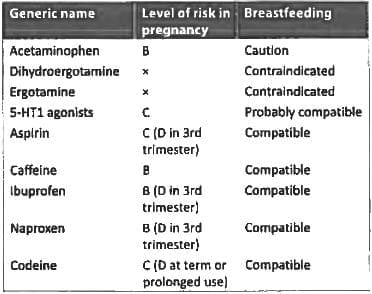
NSAIDs such as acetaminophen and ibuprofen may be utilised for migraines.

  • (Risk Category B)
  • 60-70% of individuals experiencing migraines improve naturally during pregnancy, typically around the third or fourth month.

Ergotamines are prohibited (risk category X), while triptans are not advised (risk category C; potential risk cannot be excluded). The status of medications currently used for migraines during pregnancy and breastfeeding includes

Test: Headache & Neurocutaneous Disorders - Question 2

Which of the following best describes a patient with classical migraine? (Recent Pattern Questions)

Detailed Solution: Question 2
  • Choice A provides an explanation of Giant cell arteritis.
  • Choice B outlines the characteristics of a Cluster headache.
  • Choice C describes the condition known as ophthalmoplegic migraine.

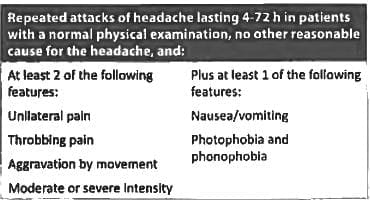
Simplified Diagnostic Criteria for Migraine

Test: Headache & Neurocutaneous Disorders - Question 3

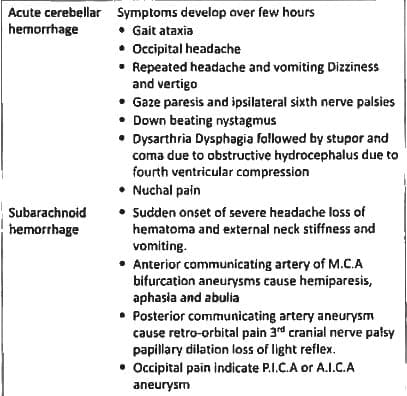
A patient presents with sudden onset occipital headache, ataxia,vomiting and drowsiness and down beating nystagmus.What is the diagnosis? (JIPMER Nov 2014)

Detailed Solution: Question 3

Test: Headache & Neurocutaneous Disorders - Question 4

A 22-yrs old man present with history of headache for 6 months which is mainly on frontal region occasionally associated with nausea He has been taking paracetamol 3g per day hydroxycodeine 50 mg 3 times a day and aspirin 300 mg 3 times a day for headache but only with temporary relief from symptoms no focal signs on neurological examinations he also has history of depression and is on treatment for 2 year with paroxetine now What is the diagnosis? (JIPMER Nov 2014)

Detailed Solution: Question 4

  • Analgesic abuse headache: Indicators for diagnosis include:
    • Presence of headaches that are resistant to analgesics and occur daily.
    • Headaches accompanied by asthenia, nausea, and other gastrointestinal issues, along with restlessness, anxiety, irritability, memory difficulties, and depression.
    • Evidence of tolerance to analgesics over time, requiring patients to use progressively larger doses for more than 15 days per month.
    • The slightest physical or mental exertion may trigger a headache, indicating a low threshold for head pain in these patients.
  • migraine: More prevalent in women, characterised by a pulsating, throbbing headache accompanied by photophobia and responds well to medication.
  • Depression-associated headache: This is a close contender; however, clinically, we should first eliminate the possibility of analgesic abuse headache by observing the patient's reaction to NSAID withdrawal.
  • Cluster headache: Characterised by retro-orbital pain, accompanied by epiphora and redness of the eye.

Test: Headache & Neurocutaneous Disorders - Question 5

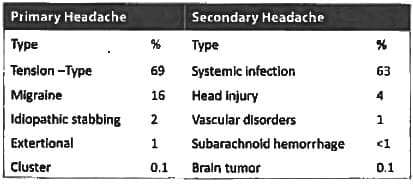
All of the following are causes of primary headache EXCEPT: (Recent Question 2015-16)

Detailed Solution: Question 5
Test: Headache & Neurocutaneous Disorders - Question 6

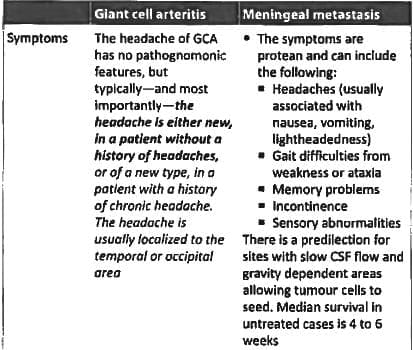
A 65 yr old lady underwent mastectomy. 6 months later she developed headache with pain at temple region with ESR = 55mm fall in 1 st hour. Diagnosis? (JIPMER 2014)

Detailed Solution: Question 6

Test: Headache & Neurocutaneous Disorders - Question 7

Sumatriptan is contraindicated in all except: (Recent Pattern 2014/15)

Detailed Solution: Question 7

Sumatriptan induces vasoconstriction in blood vessels, and this vasoconstriction of the basilar artery and its branches can exacerbate cranial nerve deficits observed in these patients, such as:

  • diplopia
  • vertigo
  • difficulties in swallowing

This vasoconstriction is the underlying cause of complications in patients with ischaemic heart disease (I.H.D). It is classified as a pregnancy category C drug.

Test: Headache & Neurocutaneous Disorders - Question 8

A 70 year old retired Military person with good previous medical record complains of bi-temporal headache which is decreased in lying down position. He states that he gets relief by giving pressure over bilateral temples. The patient also complains of loss of appetite with feeling feverish. The most probable diagnosis is: (AIIMS Nov 2012)

Detailed Solution: Question 8

Giant cell arteritis typically presents at the age of 72 and constitutes 15% of all instances of fever of unknown origin in individuals over 65 years old. The most frequent primary complaint is headache, occurring in over two-thirds of patients with temporal arteritis. This headache is usually new or differs in character from previous headaches, often appearing suddenly and localising to the temporal region. However, pain from temporal arteritis may also radiate diffusely through the occipital, frontal, or parietal areas. Thus, any new headache in patients over 50 years should raise the suspicion of temporal arteritis.

According to the 1990 American College of Rheumatology criteria for classifying temporal arteritis, at least three of the following five criteria must be met:

  • Age of onset older than 50 years
  • New-onset headache or localised head pain
  • Tenderness of the temporal artery to palpation or diminished pulsation
  • Erythrocyte sedimentation rate (ESR) greater than 50 mm/h
  • Abnormal arterial biopsy (necrotising vasculitis with granulomatous proliferation and infiltration)

Migraine is prevalent among young females, characterised by a pulsating headache accompanied by photophobia, phonophobia, nausea, and vomiting, and is typically ruled out. Fibromyalgia, presenting as musculoskeletal pain in women, is also excluded.

Regarding why the diagnosis is not chronic tension headache, it is critical for physicians treating elderly patients to avoid assuming that headache onset is due to benign causes, such as tension-type headaches, without investigating potential pathological origins. The onset of pain in tension-type headaches can sometimes be throbbing and is generally more gradual compared to migraines. In contrast to migraines, tension-type headaches are more variable in duration, more consistent in nature, and usually less severe.

The International Headache Society (IHS) diagnostic criteria for tension-type headaches specify that two of the following characteristics must be present:

  • Pressing or tightening (non-pulsatile quality)
  • Frontal-occipital location
  • Bilateral
  • Mild to moderate intensity
  • Not aggravated by physical activity

New headache onset in elderly patients should prompt consideration of causes other than tension headache.

Test: Headache & Neurocutaneous Disorders - Question 9

All are criteria for NF-1 except? (Recent Pattern 2018)

Detailed Solution: Question 9

Bilateral acoustic neuromas are the most characteristic aspect of NF-2. The most prevalent CNS tumour associated with NF-1 is optic glioma.
  • Six or more café-au-lait macules (C.A.L.M) greater than 5 mm in pre-pubertal individuals and exceeding 15 mm in post-pubertal individuals are hallmark traits of NF-1.
  • Cortical thinning of bones, with or without pseudoarthrosis, is observed in NF-1.
  • Scoliosis is the most frequent orthopaedic manifestation of NF-1, although it lacks specificity to serve as a diagnostic criterion.

Test: Headache & Neurocutaneous Disorders - Question 10

Schwannoma of spinal nerve roots is seen in? (Recent Question 2016-17)

Detailed Solution: Question 10

Schwannoma is a non-cancerous tumour that originates from the Schwann cells of cranial and spinal nerve roots. The most prevalent type of schwannoma is vestibular schwannoma, also known as acoustic neuroma, which develops from the vestibular segment of the eighth cranial nerve.

  • Individuals with neurofibromatosis type 2 have a significantly higher occurrence of vestibular schwannomas, which often present bilaterally.
  • Neurofibromatosis type 1 is linked to a greater frequency of schwannomas affecting the spinal nerve roots.

Test: Headache & Neurocutaneous Disorders - Question 11

Lisch nodules are seen in which of the following conditions? (UPSC 2015)

Detailed Solution: Question 11

Von Recklinghausen disease, also known as NF-1 or peripheral neurofibromatosis, is a condition linked to a deletion on chromosome 17. Diagnosis occurs when two or more of the following six criteria are met:

  • Cafe au lait spots
  • Two or more neurofibromas
  • Freckles in the axillary region
  • Optic glioma
  • More than two Lisch nodules or sphenoid bone dysplasia
  • A first-degree relative with NF1

Louis-Bar syndrome is another name for Ataxia telangiectasia. This condition arises from breaks on chromosome 11q, leading to a failure in DNA repair. It is inherited in an autosomal recessive manner and typically presents in children aged 2 to 7 years with:

  • Ataxia
  • Ocular apraxia accompanied by loss of proprioception
  • Conjunctival telangiectasia
  • Recurrent pulmonary infections (due to low IgA)

Tuberous sclerosis is characterised by a child exhibiting hypopigmented macules, adenoma sebaceum, and seizures.
Von Hippel-Lindau syndrome presents in children with:

  • Nystagmus and ataxia
  • Raised intracranial tension
  • Cerebellar and retinal hemangioblastomas
  • Angiomas of the spinal cord
  • Cystic tumours in the pancreas, kidneys, and epididymis

Test: Headache & Neurocutaneous Disorders - Question 12

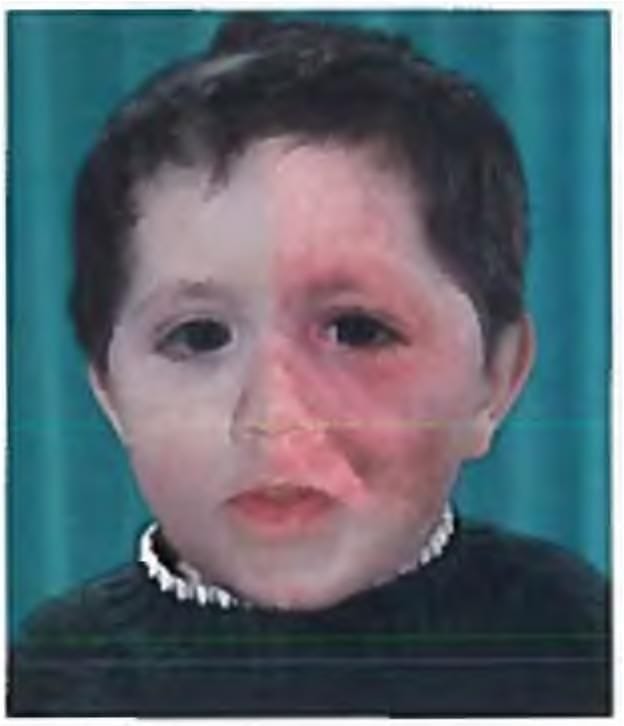
A 6-year old child with port wine stain, mental retardation and recurrent focal seizures. All are true about the condition except?
Detailed Solution: Question 12

The clinical diagnosis is Sturge-Weber syndrome.
  • Choice A is accurate as the presence of glaucoma can lead to cupping of the optic disc.
  • Choice B is correct because of the existence of intracranial calcification, which results in a tram-track appearance on an X-ray of the skull.
  • Choice C is valid since refractory focal seizures in the patient will necessitate vagal nerve stimulation to manage recurrent seizures.
Differential diagnosis of Sturge-Weber syndrome includes:
  • Klippel-Trenaunay-Weber syndrome, which is characterised by port-wine stains on the extremities and face, along with hemi-hypertrophy of both soft and bony tissues.
  • Beckwith-Wiedemann syndrome, which features a facial port-wine stain (PWS), macroglossia, omphalocele, and visceral hyperplasia.
Severe hypoglycaemia caused by pancreatic islet-cell hyperplasia can be life-threatening.

Test: Headache & Neurocutaneous Disorders - Question 13

Not seen in tuberous sclerosis (AIIMS Nov 14)

Detailed Solution: Question 13

Major characteristics of TSC encompass:

  • Facial angiofibromas or a forehead plaque
  • Non-traumatic ungual or periungual fibroma
  • Hypomelanotic macules (>3)
  • Shagreen patch
  • Multiple retinal nodular hamartomas
  • Cortical tuber
  • Subependymal nodule
  • Subependymal giant cell astrocytoma
  • Cardiac rhabdomyoma, either single or multiple
  • Lymphangioleiomyomatosis
  • Renal angiomyolipomas

Minor characteristics of TSC include:

  • Multiple randomly distributed pits in dental enamel
  • Hamartomatous rectal polyps
  • Bone cysts
  • Cerebral white matter radial migration lines
  • Gingival fibromas
  • Retinal achromic patch
  • 'Confetti' skin lesions
  • Multiple renal cysts

The diagnostic criteria for TSC are:

  • Definite TSC: Two major features or one major feature plus two or more minor features
  • Possible TSC: Either one major feature or two or more minor features

Test: Headache & Neurocutaneous Disorders - Question 14

All of the following are true about von Hippel Lindau syndrome except? (Recent Pattern 2014/15)

Detailed Solution: Question 14

VHL is marked by a tendency towards bilateral and multi-centric retinal angiomas, central nervous system (CNS) hemangioblastomas, renal cell carcinomas, pheochromocytomas, islet cell tumours of the pancreas, endolymphatic sac tumours, as well as renal, pancreatic, and epididymal cysts.

  • CNS hemangioblastoma is the most widely recognised feature of VHL, occurring in 40% of patients.

Option B: Hemangiopericytomas can be found in the craniospinal axis. Intracranial hemangiopericytomas are tumours of the pericytes that originate in the meninges. An association with von Hippel Lindau disease is observed in 10% of patients. The positioning of intracranial hemangiopericytomas is akin to that of meningiomas. Histologically, these tumours are highly cellular and vascular, consisting of angular pericytes surrounding often poorly defined capillaries in a branching arrangement (staghorn vascularity). Imaging of the craniospinal axis reveals these lesions in individuals with von Hippel Lindau disease.
Option C: Supratentorial lesions can also be observed. The majority of CNS tumours related to Von Hippel Lindau syndrome are cerebellar hemangioblastomas, primarily located infratentorially. Nonetheless, some supratentorial lesions may also be present in this condition.
Option D: Tumours of Schwann cells are prevalent. A schwannoma near the sciatic nerve was found in conjunction with von Hippel Lindau syndrome.

Test: Headache & Neurocutaneous Disorders - Question 15

Tuberculosis sclerosis is associated with all except: (APPG 2014)

Detailed Solution: Question 15

Skin manifestations of tuberous sclerosis include:

  • Over 90% of instances exhibit typical hypomelanotic macules, which resemble an ash leaf, located on the trunk and limbs.
  • Visualization of the hypomelanolic brainstem extends into the upper cervical canal through the foramen magnum.

This deformity obstructs the flow and absorption of cerebrospinal fluid (CSF), leading to hydrocephalus, which is present in more than 90% of infants with myelomeningocele.

56 docs|64 tests
Information about Test: Headache & Neurocutaneous Disorders Page
In this test you can find the Exam questions for Test: Headache & Neurocutaneous Disorders solved & explained in the simplest way possible. Besides giving Questions and answers for Test: Headache & Neurocutaneous Disorders, EduRev gives you an ample number of Online tests for practice
56 docs|64 tests
Download as PDF