NEET PG Exam  >  NEET PG Test  >  Medicine  >  Test: Disorders of WBC & Leukemias - NEET PG MCQ

Disorders of WBC & Leukemias - Free MCQ Practice Test with solutions, NEET


MCQ Practice Test & Solutions: Test: Disorders of WBC & Leukemias (39 Questions)

You can prepare effectively for NEET PG Medicine with this dedicated MCQ Practice Test (available with solutions) on the important topic of "Test: Disorders of WBC & Leukemias". These 39 questions have been designed by the experts with the latest curriculum of NEET PG 2026, to help you master the concept.

Test Highlights:

  • - Format: Multiple Choice Questions (MCQ)
  • - Duration: 20 minutes
  • - Number of Questions: 39

Sign up on EduRev for free to attempt this test and track your preparation progress.

Test: Disorders of WBC & Leukemias - Question 1

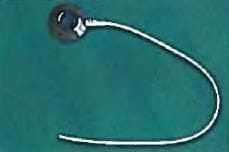
The following image shows (AIMS Nov 2018)

Detailed Solution: Question 1

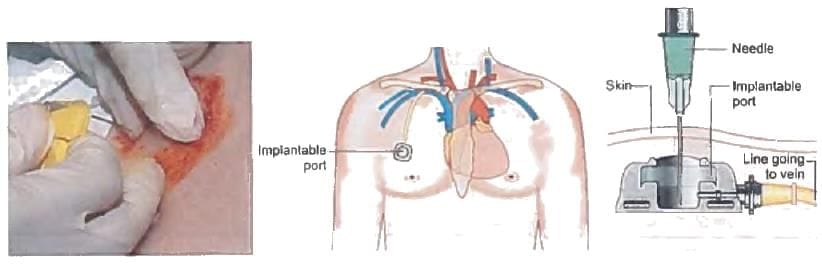
The image shows a chemoport which allows the patient to deliver drugs into a central line by himself/herself. It avoids the hassles and pain associated with repeated peripheral line insertion. The schematic diagram depicting the tip of the catheter in the Superior vena cava is shown below. The diagram on left shows insertion of a needle into the port by the patient himself.

Test: Disorders of WBC & Leukemias - Question 2

All of the following are associated with HHV8 except? (AIIMS May 2018)

Detailed Solution: Question 2

  • Adult T-ccll leukemia is caused by HTLV-1 whereas the remaining diseases are caused by HHV-8.
  • Diseases caused by HHV-8 infection include Kaposi sarcoma, multicentric Castleman disease (MCD), and primary effusion lymphoma (PEL), which occur primarily in patients with HIV infection.

Test: Disorders of WBC & Leukemias - Question 3

A young girl with APML on day 3 of treatment develops tachypnea, weight gain and fever. CXR shows bilateral pulmonary infiltrates. What is the best management for the patient? (AIIMS May 2017)

Detailed Solution: Question 3

  • The DOC for management of APML is ATRA (Al Trans Retinoic acid)
  • Use of tretinoin decreases the frequency of DIC but produces another complication known as APL differentiation syndrome.
  • On administration of tretinoin the immature cells will mature. However due to adhesion of these differentiated neoplastic cells to pulmonary vasculature endothelium, the microcirculation of lungs is affected. Hence the features of respiratory distress develop in the patient.
  • It occurs within 3 weeks of treatment and is characterised by fever, fluid retention, dyspnea, chest pain and pulmonary infiltrates.
  • The mortality rale for APL Differentiation syndrome can approach 10% due to development of severe hypoxia and pericardial/pleural effusions.
  • The best management for APL differentiation syndrome is administration of steroids.

Test: Disorders of WBC & Leukemias - Question 4

Which of the following has the least 5 year survival rate following allogenic bone marrow transplantation? (Recent Question 2016-17)

Detailed Solution: Question 4
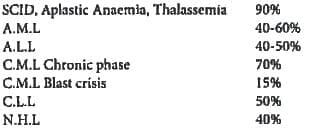
5 year Survival rate after bone marrow transplantation 

Test: Disorders of WBC & Leukemias - Question 5

Leukostasis is common with which of the following? (Recent Question 2016-17)

Detailed Solution: Question 5

Leukostasis is common with Acute Myeloid leukemia followed by ALL. It is rare in case of CLL or CML.

Test: Disorders of WBC & Leukemias - Question 6

Which organ is mainly affected in Leukostasis? (Recent Question 2016-17)

Detailed Solution: Question 6

  • WBC counts are in excess of > 100,000/cu.mm and leads to leukostatic plugging of the capillaries followed by endothelial damage to blood vessels.
  • The clinical presentation of leukostasis indicates neurologic and pulmonary pathology.
  • CNS leukostasis presents with stupor, headache and dizziness. Administration of 600 cGY of whole brain irradiation can protect against this complication along with anti-leukemic therapy
  • The presence of dysnea, tachypnea and respiratory distress indicates pulmonary leukostasis.
  • The mortality occurs due to respiratory failure, intracranial haemorrhage and coma.
  • The low PO2 is due to increased consumption of oxygen by leucocytes.
  • It is common with Acute leukemia subtypes like Acute promyelocytic leukemia, acute monocytic leukemia and T cell type of ALL

Test: Disorders of WBC & Leukemias - Question 7

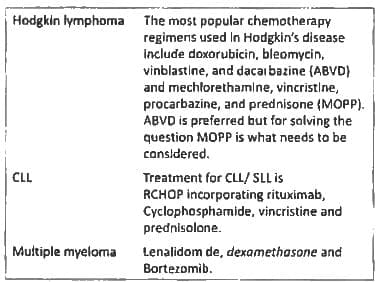
Steroids are not indicated in the treatment of? (AIIMS Nov 2015)

Detailed Solution: Question 7
Test: Disorders of WBC & Leukemias - Question 8

Most important best prognostic marker in ALL?  (AIIMS Nov 2015)

Detailed Solution: Question 8
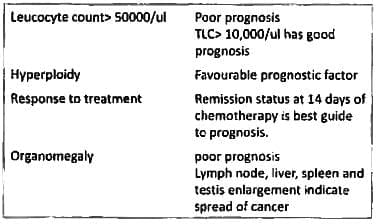

Unfavourable prognostic factors for ALL

  1. Extreme age group: <1 year or >10 years
  2. Black males
  3. TLC > 2 lac/cu.mm
  4. Organomegaly
  5. CNS Leukemia
  6. L2 ALL, pre B cell and mature B cell ALL
  7. Hypo-ploidy
  8. 1(9:22) and 1(4:11) 
  9. Remissions 14 days

Test: Disorders of WBC & Leukemias - Question 9

Which of the following statements is true regarding juvenile chronic myeloid leukemia? (UPSC 2015)

Detailed Solution: Question 9

  • In juvenile chronic myeloid leukemia or juvenile chronic myelomonocytic leukemia, Philadelphia chromosome is negative and monosomy 7 is seen in 30% cases.
  • Bone marrow aspirates show increased cellularity with predominance of granulocytic cells in all stages of maturation, megakaryocytes are normal to decreased. Hence low platelets are seen and need platelet transfusions.
  • The disease has a fulminant, rapidly progressive course. Even with transplant there is 50% event free survival at 3 years.
  • Management is supportive and needs packed RBC, platelet transfusions, infection management and allogenic stem cell transplantation.

Test: Disorders of WBC & Leukemias - Question 10

Treatment of choice in hairy cell leukemia is? (Bihar PG 2015)

Detailed Solution: Question 10

Cell leukemia is responsive to chemotherapy with interferon alpha, pentostatin, or cladribine, with the latter being the usually preferred treatment.
Cell leukemia presents predominantly in older males. Typical presentation involves pancytopenia, although occasional patients will have a leukemic presentation. Splenomegaly is usual.

  • The malignant cells appear to have “hairy" projections on light and electron microscopy and show a characteristic staining pattern with tartrate-resistant acid phosphatase.
  • Bone marrow is typically not able to be aspirated, and biopsy shows a pattern of fibrosis with diffuse infiltration by the malignant cells. Patients with this disorder are prone to unusual infections, including infection by Mycobacterium aviumintracellulare, and to vasculitic syndromes.

Test: Disorders of WBC & Leukemias - Question 11

2-year-old child with ALL, which of the following has the best prognosis? (Recent Question 2015-16)

Detailed Solution: Question 11
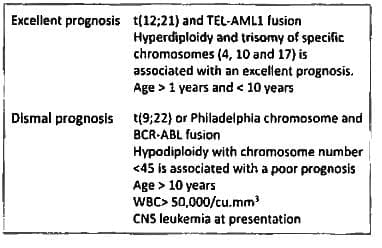
Prognostic factor in acute lymphoblastic leukemia

Test: Disorders of WBC & Leukemias - Question 12

Philadelphia chromosome refers: (Recent Question 2015-16)

Detailed Solution: Question 12

  • The exact chromosomal defect in Philadelphia chromosome is a translocation, in which parts of two chromosomes, 9 and 22, swap places. The result is that a fusion gene is created by juxta positioning the Abll gene on chromosome 9 (region q 34) to a part of the BCR (“breakpoint cluster region") gene on chrom osom e 22 (region q 11) . This is a reciprocal translocation, creating an elongated chromosome 9, and a truncated chromosome 22 (the Philadelphia chromosome).
  • The significance of knowing this information is that this chromosome defect causes activation of an enzyme by the name of tyrosine kinase which provides energy to the cancer cells to divide uncontrollably.

Test: Disorders of WBC & Leukemias - Question 13

Vitamin B, level in chronic myeloid leukemia is: (Recent Pattern 2014-15)

Detailed Solution: Question 13

In CML there will be rise in

  • B12 level
  • LDH level

And decreased levels of ALP.

Test: Disorders of WBC & Leukemias - Question 14

Agranulocytosis is defined as neutrophil count less than: (Recent Pattern 2014-15)

Detailed Solution: Question 14

The term agranulocytosis is used to communicate a more severe subset of neutropenia. Agranulocytosis refers to a virtual absence of neutrophils in peripheral blood. It is usually applied to cases in which the ANC is lower than 100/μL.

Test: Disorders of WBC & Leukemias - Question 15

What is the most effective treatment for chronic myeloid leukaemia? (Recent Pattern 2014-15)

Detailed Solution: Question 15

Allogeneic Stem Cell transplantation is currently the only curative therapy for CML and, when feasible, is the treatment of choice.

  • Interferons when allogeneic SCT is not feasible, IFN-a therapy used to be the treatment of choice before Imatinib Mesylate became available.
  • Only longer follow-up of patients treated with imatinib will prove whether IFN-a will still have a role in the treatment of CML. • Hydroxyurea, a ribonucleotide reductase inhibitor, induces rapid disease control.
  • Allogenic bone marrow transplantation is treatment of choice for patients of CML.

Test: Disorders of WBC & Leukemias - Question 16

What is the Neutrophil count for moderate neutropenia: (Recent Pattern 2014-15)

Test: Disorders of WBC & Leukemias - Question 17

Radiation exposure does not cause: (Recent Pattern 2014-15)

Test: Disorders of WBC & Leukemias - Question 18

Filgrastim is used for the treatment of: (Recent Pattern 2014-15)
Test: Disorders of WBC & Leukemias - Question 19

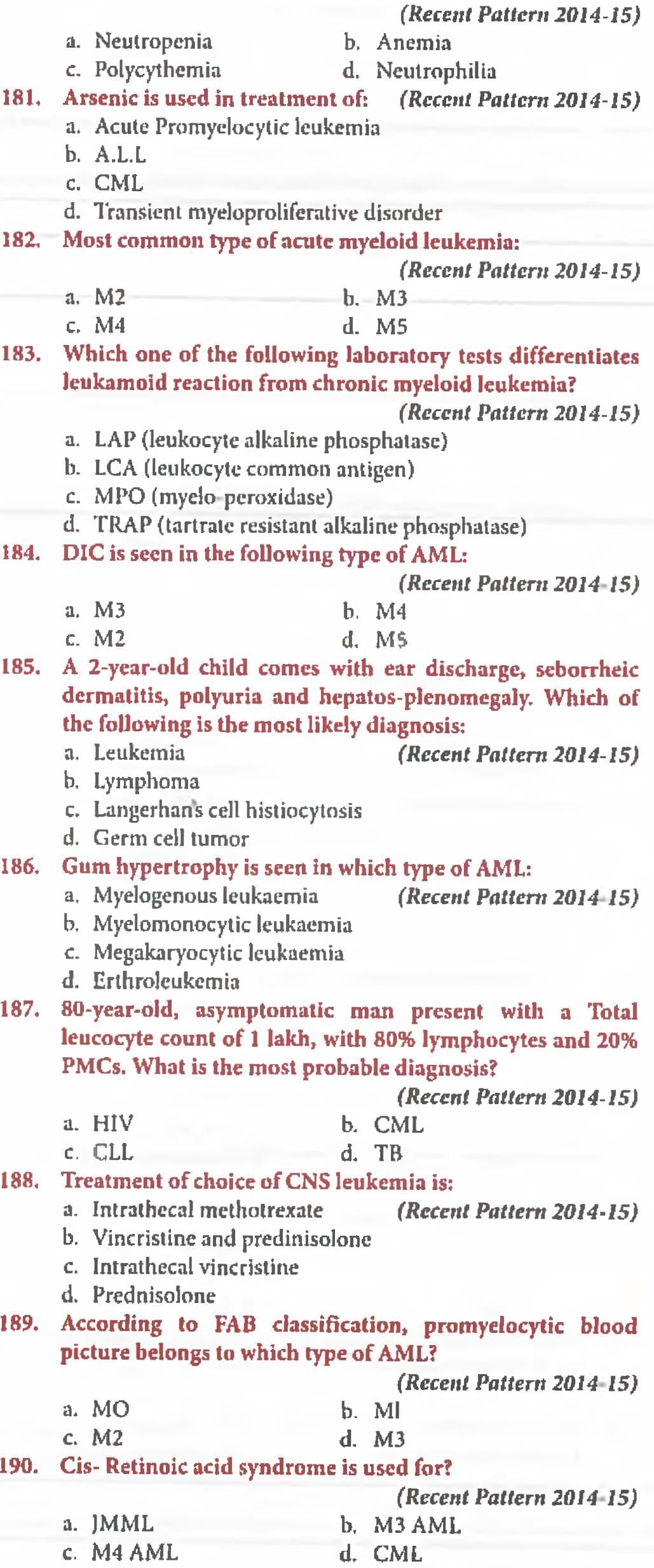
Arsenic is used in treatment of: (Recent Pattern 2014-I5)

Test: Disorders of WBC & Leukemias - Question 20

Most common type of acute myeloid leukemia: (Recent Pattern 2014-15)

Test: Disorders of WBC & Leukemias - Question 21

Which one of the following laboratory tests differentiates leukamoid reaction from chronic myeloid leukemia? (Recent Pattern 2014-15)

Test: Disorders of WBC & Leukemias - Question 22

DIC is seen in the following type of AML: (Recent Pattern 2014-15)

Test: Disorders of WBC & Leukemias - Question 23

A 2-year-old child comes with ear discharge, seborrheic dermatitis, polyuria and hepato-splenomegaly. Which of the following is the most likely diagnosis:

Test: Disorders of WBC & Leukemias - Question 24

Gum hypertrophy is seen in which type of AML:

Test: Disorders of WBC & Leukemias - Question 25

80-year-old, asymptomatic man present with a Total leucocyte count of 1 lakh, with 80% lymphocytes and 20% PMCs. What is the most probable diagnosis? (Recent Pattern 2014-15)

Test: Disorders of WBC & Leukemias - Question 26

Treatment of choice of CNS leukemia is:

Test: Disorders of WBC & Leukemias - Question 27

According to FAB classification, promyelocytic blood picture belongs to which type of AML? (Recent Pattern 2014 15)

Test: Disorders of WBC & Leukemias - Question 28

Cis-Retinoic acid syndrome is used for? (Recent Pattern 2014-15)

Test: Disorders of WBC & Leukemias - Question 29

All of the following are features of juvenile CML except: (Recent Pattern 2014-15)

Test: Disorders of WBC & Leukemias - Question 30

A peripheral smear with increased neutrophils, basophils, eosinophils, and platelets is highly suggestive of: (Recent Pattern 2014-15)

View more questions
52 docs|64 tests
Information about Test: Disorders of WBC & Leukemias Page
In this test you can find the Exam questions for Test: Disorders of WBC & Leukemias solved & explained in the simplest way possible. Besides giving Questions and answers for Test: Disorders of WBC & Leukemias, EduRev gives you an ample number of Online tests for practice
52 docs|64 tests
Download as PDF