
CAT Mini Mock Test - 4 Free Online Test 2026
Full Mock Test & Solutions: CAT Mini Mock Test - 4 (30 Questions)
You can boost your CAT 2026 exam preparation with this CAT Mini Mock Test - 4 (available with detailed solutions).. This mock test has been designed with the analysis of important topics, recent trends of the exam, and previous year questions of the last 3-years. All the questions have been designed to mirror the official pattern of CAT 2026 exam, helping you build speed, accuracy as per the actual exam.
Mock Test Highlights:
- - Format: Multiple Choice Questions (MCQ)
- - Duration: 60 minutes
- - Total Questions: 30
- - Analysis: Detailed Solutions & Performance Insights
- - Sections covered: Verbal and RC, DI and LR, Quantitative Aptitude
Sign up on EduRev for free and get access to these mock tests, get your All India Rank, and identify your weak areas to improve your marks & rank in the actual exam.

Directions: Read the following passage and answer the questions that follow:
Imagine a vast circular chamber, with walls covered in a towering painted map of planet Earth. Picture this hall ‘like a theater, except that the circles and galleries go right round through the space usually occupied by the stage’. Enormous rings of tiered seating circle its outer walls. Imagine that working in these seats are 64,000 ‘computers’ – humans doing calculations – each preparing a different weather forecast for their designated geography.
And in the middle of the hall, on a large pulpit at the top of a tall multistorey pillar, stands the ‘man in charge’, who coordinates the scattered weather calculations from his computers into a global forecast like a ‘conductor of an orchestra’. This ‘forecast factory’ was the dream of the 20th-century English mathematician and meteorologist Lewis Fry Richardson. Following hundreds of pages of equations, velocities and data in his prosaically titled book Weather Prediction by Numerical Process (1922), he asks the reader to indulge him: ‘After so much hard reasoning, may one play with a fantasy?’ For Richardson, one of the main limitations on weather forecasting was a lack of computational capacity. But through the fantasy he could ignore practical problems and bring an entire planet into focus.
His ‘factory’ saw once-scattered local observations merging into a coherent planetary system: calculable, predictable, overseen and singular. Richardson died in 1953, the year IBM released the first mass-produced electronic computer. Though his factory never materialized exactly as he imagined it, his dream of a calculable planet now seems prophetic. By the 1960s, numerical calculation of global weather conditions had become a standardized way of recording changes in the atmosphere. Clouds and numbers seemed to crowd the sky. Since the 1960s, the scope of what Richardson called weather prediction has expanded dramatically: climate models now stretch into the deep past and future, encompassing the entirety of the Earth system rather than just the atmosphere. What is startling about this is not that our technical abilities have exceeded Richardson’s wildest dreams but the unexpected repercussions of the modern ‘forecast factory’. The calculable, predictable, overseen and singular Earth has revealed not only aeons of global weather, but a new kind of planet – and, with it, a new mode of governance. The planet, I argue, has appeared as a new kind of political object. I’m not talking about the Sun-orbiting body of the Copernican revolution, or the body that the first astronauts looked back upon in the 1960s: Buckminster Fuller’s ‘Spaceship Earth’, or Carl Sagan’s ‘lonely speck’. Those are the planets of the past millennium. I’m talking about the ‘planet’ inside ‘planetary crisis’: a planet that emerges from the realization that anthropogenic impacts are not isolated to particular areas, but integrated parts of a complex web of intersecting processes that unfold over vastly disparate timescales and across different geographies. This is the planet of the Anthropocene, of our ‘planetary emergency’ as the UN secretary-general António Guterres called it in 2020. The so-called planetary turn marks a new way of thinking about our relationship to the environment. It also signals the emergence of a distinct governable object, which suggests that the prime political object of the 21st century is no longer the state, it’s the planet.
Q. In the context of the passage, all of the following statements are true EXCEPT:
Imagine a vast circular chamber, with walls covered in a towering painted map of planet Earth. Picture this hall ‘like a theater, except that the circles and galleries go right round through the space usually occupied by the stage’. Enormous rings of tiered seating circle its outer walls. Imagine that working in these seats are 64,000 ‘computers’ – humans doing calculations – each preparing a different weather forecast for their designated geography.
And in the middle of the hall, on a large pulpit at the top of a tall multistorey pillar, stands the ‘man in charge’, who coordinates the scattered weather calculations from his computers into a global forecast like a ‘conductor of an orchestra’. This ‘forecast factory’ was the dream of the 20th-century English mathematician and meteorologist Lewis Fry Richardson. Following hundreds of pages of equations, velocities and data in his prosaically titled book Weather Prediction by Numerical Process (1922), he asks the reader to indulge him: ‘After so much hard reasoning, may one play with a fantasy?’ For Richardson, one of the main limitations on weather forecasting was a lack of computational capacity. But through the fantasy he could ignore practical problems and bring an entire planet into focus.
His ‘factory’ saw once-scattered local observations merging into a coherent planetary system: calculable, predictable, overseen and singular. Richardson died in 1953, the year IBM released the first mass-produced electronic computer. Though his factory never materialized exactly as he imagined it, his dream of a calculable planet now seems prophetic. By the 1960s, numerical calculation of global weather conditions had become a standardized way of recording changes in the atmosphere. Clouds and numbers seemed to crowd the sky. Since the 1960s, the scope of what Richardson called weather prediction has expanded dramatically: climate models now stretch into the deep past and future, encompassing the entirety of the Earth system rather than just the atmosphere. What is startling about this is not that our technical abilities have exceeded Richardson’s wildest dreams but the unexpected repercussions of the modern ‘forecast factory’. The calculable, predictable, overseen and singular Earth has revealed not only aeons of global weather, but a new kind of planet – and, with it, a new mode of governance. The planet, I argue, has appeared as a new kind of political object. I’m not talking about the Sun-orbiting body of the Copernican revolution, or the body that the first astronauts looked back upon in the 1960s: Buckminster Fuller’s ‘Spaceship Earth’, or Carl Sagan’s ‘lonely speck’. Those are the planets of the past millennium. I’m talking about the ‘planet’ inside ‘planetary crisis’: a planet that emerges from the realization that anthropogenic impacts are not isolated to particular areas, but integrated parts of a complex web of intersecting processes that unfold over vastly disparate timescales and across different geographies. This is the planet of the Anthropocene, of our ‘planetary emergency’ as the UN secretary-general António Guterres called it in 2020. The so-called planetary turn marks a new way of thinking about our relationship to the environment. It also signals the emergence of a distinct governable object, which suggests that the prime political object of the 21st century is no longer the state, it’s the planet.
Detailed Solution: Question 1
Directions: Read the following passage and answer the questions that follow:
Imagine a vast circular chamber, with walls covered in a towering painted map of planet Earth. Picture this hall ‘like a theater, except that the circles and galleries go right round through the space usually occupied by the stage’. Enormous rings of tiered seating circle its outer walls. Imagine that working in these seats are 64,000 ‘computers’ – humans doing calculations – each preparing a different weather forecast for their designated geography.
And in the middle of the hall, on a large pulpit at the top of a tall multistorey pillar, stands the ‘man in charge’, who coordinates the scattered weather calculations from his computers into a global forecast like a ‘conductor of an orchestra’. This ‘forecast factory’ was the dream of the 20th-century English mathematician and meteorologist Lewis Fry Richardson. Following hundreds of pages of equations, velocities and data in his prosaically titled book Weather Prediction by Numerical Process (1922), he asks the reader to indulge him: ‘After so much hard reasoning, may one play with a fantasy?’ For Richardson, one of the main limitations on weather forecasting was a lack of computational capacity. But through the fantasy he could ignore practical problems and bring an entire planet into focus.
His ‘factory’ saw once-scattered local observations merging into a coherent planetary system: calculable, predictable, overseen and singular. Richardson died in 1953, the year IBM released the first mass-produced electronic computer. Though his factory never materialized exactly as he imagined it, his dream of a calculable planet now seems prophetic. By the 1960s, numerical calculation of global weather conditions had become a standardized way of recording changes in the atmosphere. Clouds and numbers seemed to crowd the sky. Since the 1960s, the scope of what Richardson called weather prediction has expanded dramatically: climate models now stretch into the deep past and future, encompassing the entirety of the Earth system rather than just the atmosphere. What is startling about this is not that our technical abilities have exceeded Richardson’s wildest dreams but the unexpected repercussions of the modern ‘forecast factory’. The calculable, predictable, overseen and singular Earth has revealed not only aeons of global weather, but a new kind of planet – and, with it, a new mode of governance. The planet, I argue, has appeared as a new kind of political object. I’m not talking about the Sun-orbiting body of the Copernican revolution, or the body that the first astronauts looked back upon in the 1960s: Buckminster Fuller’s ‘Spaceship Earth’, or Carl Sagan’s ‘lonely speck’. Those are the planets of the past millennium. I’m talking about the ‘planet’ inside ‘planetary crisis’: a planet that emerges from the realization that anthropogenic impacts are not isolated to particular areas, but integrated parts of a complex web of intersecting processes that unfold over vastly disparate timescales and across different geographies. This is the planet of the Anthropocene, of our ‘planetary emergency’ as the UN secretary-general António Guterres called it in 2020. The so-called planetary turn marks a new way of thinking about our relationship to the environment. It also signals the emergence of a distinct governable object, which suggests that the prime political object of the 21st century is no longer the state, it’s the planet.
Q. Which one of the following statements best reflects the main argument of the third paragraph of the passage?
Imagine a vast circular chamber, with walls covered in a towering painted map of planet Earth. Picture this hall ‘like a theater, except that the circles and galleries go right round through the space usually occupied by the stage’. Enormous rings of tiered seating circle its outer walls. Imagine that working in these seats are 64,000 ‘computers’ – humans doing calculations – each preparing a different weather forecast for their designated geography.
And in the middle of the hall, on a large pulpit at the top of a tall multistorey pillar, stands the ‘man in charge’, who coordinates the scattered weather calculations from his computers into a global forecast like a ‘conductor of an orchestra’. This ‘forecast factory’ was the dream of the 20th-century English mathematician and meteorologist Lewis Fry Richardson. Following hundreds of pages of equations, velocities and data in his prosaically titled book Weather Prediction by Numerical Process (1922), he asks the reader to indulge him: ‘After so much hard reasoning, may one play with a fantasy?’ For Richardson, one of the main limitations on weather forecasting was a lack of computational capacity. But through the fantasy he could ignore practical problems and bring an entire planet into focus.
His ‘factory’ saw once-scattered local observations merging into a coherent planetary system: calculable, predictable, overseen and singular. Richardson died in 1953, the year IBM released the first mass-produced electronic computer. Though his factory never materialized exactly as he imagined it, his dream of a calculable planet now seems prophetic. By the 1960s, numerical calculation of global weather conditions had become a standardized way of recording changes in the atmosphere. Clouds and numbers seemed to crowd the sky. Since the 1960s, the scope of what Richardson called weather prediction has expanded dramatically: climate models now stretch into the deep past and future, encompassing the entirety of the Earth system rather than just the atmosphere. What is startling about this is not that our technical abilities have exceeded Richardson’s wildest dreams but the unexpected repercussions of the modern ‘forecast factory’. The calculable, predictable, overseen and singular Earth has revealed not only aeons of global weather, but a new kind of planet – and, with it, a new mode of governance. The planet, I argue, has appeared as a new kind of political object. I’m not talking about the Sun-orbiting body of the Copernican revolution, or the body that the first astronauts looked back upon in the 1960s: Buckminster Fuller’s ‘Spaceship Earth’, or Carl Sagan’s ‘lonely speck’. Those are the planets of the past millennium. I’m talking about the ‘planet’ inside ‘planetary crisis’: a planet that emerges from the realization that anthropogenic impacts are not isolated to particular areas, but integrated parts of a complex web of intersecting processes that unfold over vastly disparate timescales and across different geographies. This is the planet of the Anthropocene, of our ‘planetary emergency’ as the UN secretary-general António Guterres called it in 2020. The so-called planetary turn marks a new way of thinking about our relationship to the environment. It also signals the emergence of a distinct governable object, which suggests that the prime political object of the 21st century is no longer the state, it’s the planet.
Detailed Solution: Question 2

Directions: Read the following passage and answer the questions that follow:
Imagine a vast circular chamber, with walls covered in a towering painted map of planet Earth. Picture this hall ‘like a theater, except that the circles and galleries go right round through the space usually occupied by the stage’. Enormous rings of tiered seating circle its outer walls. Imagine that working in these seats are 64,000 ‘computers’ – humans doing calculations – each preparing a different weather forecast for their designated geography.
And in the middle of the hall, on a large pulpit at the top of a tall multistorey pillar, stands the ‘man in charge’, who coordinates the scattered weather calculations from his computers into a global forecast like a ‘conductor of an orchestra’. This ‘forecast factory’ was the dream of the 20th-century English mathematician and meteorologist Lewis Fry Richardson. Following hundreds of pages of equations, velocities and data in his prosaically titled book Weather Prediction by Numerical Process (1922), he asks the reader to indulge him: ‘After so much hard reasoning, may one play with a fantasy?’ For Richardson, one of the main limitations on weather forecasting was a lack of computational capacity. But through the fantasy he could ignore practical problems and bring an entire planet into focus.
His ‘factory’ saw once-scattered local observations merging into a coherent planetary system: calculable, predictable, overseen and singular. Richardson died in 1953, the year IBM released the first mass-produced electronic computer. Though his factory never materialized exactly as he imagined it, his dream of a calculable planet now seems prophetic. By the 1960s, numerical calculation of global weather conditions had become a standardized way of recording changes in the atmosphere. Clouds and numbers seemed to crowd the sky. Since the 1960s, the scope of what Richardson called weather prediction has expanded dramatically: climate models now stretch into the deep past and future, encompassing the entirety of the Earth system rather than just the atmosphere. What is startling about this is not that our technical abilities have exceeded Richardson’s wildest dreams but the unexpected repercussions of the modern ‘forecast factory’. The calculable, predictable, overseen and singular Earth has revealed not only aeons of global weather, but a new kind of planet – and, with it, a new mode of governance. The planet, I argue, has appeared as a new kind of political object. I’m not talking about the Sun-orbiting body of the Copernican revolution, or the body that the first astronauts looked back upon in the 1960s: Buckminster Fuller’s ‘Spaceship Earth’, or Carl Sagan’s ‘lonely speck’. Those are the planets of the past millennium. I’m talking about the ‘planet’ inside ‘planetary crisis’: a planet that emerges from the realization that anthropogenic impacts are not isolated to particular areas, but integrated parts of a complex web of intersecting processes that unfold over vastly disparate timescales and across different geographies. This is the planet of the Anthropocene, of our ‘planetary emergency’ as the UN secretary-general António Guterres called it in 2020. The so-called planetary turn marks a new way of thinking about our relationship to the environment. It also signals the emergence of a distinct governable object, which suggests that the prime political object of the 21st century is no longer the state, it’s the planet.
Q. The author lists all of the following as reasons for the emergence of the new kind of planet EXCEPT:
Imagine a vast circular chamber, with walls covered in a towering painted map of planet Earth. Picture this hall ‘like a theater, except that the circles and galleries go right round through the space usually occupied by the stage’. Enormous rings of tiered seating circle its outer walls. Imagine that working in these seats are 64,000 ‘computers’ – humans doing calculations – each preparing a different weather forecast for their designated geography.
And in the middle of the hall, on a large pulpit at the top of a tall multistorey pillar, stands the ‘man in charge’, who coordinates the scattered weather calculations from his computers into a global forecast like a ‘conductor of an orchestra’. This ‘forecast factory’ was the dream of the 20th-century English mathematician and meteorologist Lewis Fry Richardson. Following hundreds of pages of equations, velocities and data in his prosaically titled book Weather Prediction by Numerical Process (1922), he asks the reader to indulge him: ‘After so much hard reasoning, may one play with a fantasy?’ For Richardson, one of the main limitations on weather forecasting was a lack of computational capacity. But through the fantasy he could ignore practical problems and bring an entire planet into focus.
His ‘factory’ saw once-scattered local observations merging into a coherent planetary system: calculable, predictable, overseen and singular. Richardson died in 1953, the year IBM released the first mass-produced electronic computer. Though his factory never materialized exactly as he imagined it, his dream of a calculable planet now seems prophetic. By the 1960s, numerical calculation of global weather conditions had become a standardized way of recording changes in the atmosphere. Clouds and numbers seemed to crowd the sky. Since the 1960s, the scope of what Richardson called weather prediction has expanded dramatically: climate models now stretch into the deep past and future, encompassing the entirety of the Earth system rather than just the atmosphere. What is startling about this is not that our technical abilities have exceeded Richardson’s wildest dreams but the unexpected repercussions of the modern ‘forecast factory’. The calculable, predictable, overseen and singular Earth has revealed not only aeons of global weather, but a new kind of planet – and, with it, a new mode of governance. The planet, I argue, has appeared as a new kind of political object. I’m not talking about the Sun-orbiting body of the Copernican revolution, or the body that the first astronauts looked back upon in the 1960s: Buckminster Fuller’s ‘Spaceship Earth’, or Carl Sagan’s ‘lonely speck’. Those are the planets of the past millennium. I’m talking about the ‘planet’ inside ‘planetary crisis’: a planet that emerges from the realization that anthropogenic impacts are not isolated to particular areas, but integrated parts of a complex web of intersecting processes that unfold over vastly disparate timescales and across different geographies. This is the planet of the Anthropocene, of our ‘planetary emergency’ as the UN secretary-general António Guterres called it in 2020. The so-called planetary turn marks a new way of thinking about our relationship to the environment. It also signals the emergence of a distinct governable object, which suggests that the prime political object of the 21st century is no longer the state, it’s the planet.
Detailed Solution: Question 3
Directions: Read the following passage and answer the questions that follow:
Imagine a vast circular chamber, with walls covered in a towering painted map of planet Earth. Picture this hall ‘like a theater, except that the circles and galleries go right round through the space usually occupied by the stage’. Enormous rings of tiered seating circle its outer walls. Imagine that working in these seats are 64,000 ‘computers’ – humans doing calculations – each preparing a different weather forecast for their designated geography.
And in the middle of the hall, on a large pulpit at the top of a tall multistorey pillar, stands the ‘man in charge’, who coordinates the scattered weather calculations from his computers into a global forecast like a ‘conductor of an orchestra’. This ‘forecast factory’ was the dream of the 20th-century English mathematician and meteorologist Lewis Fry Richardson. Following hundreds of pages of equations, velocities and data in his prosaically titled book Weather Prediction by Numerical Process (1922), he asks the reader to indulge him: ‘After so much hard reasoning, may one play with a fantasy?’ For Richardson, one of the main limitations on weather forecasting was a lack of computational capacity. But through the fantasy he could ignore practical problems and bring an entire planet into focus.
His ‘factory’ saw once-scattered local observations merging into a coherent planetary system: calculable, predictable, overseen and singular. Richardson died in 1953, the year IBM released the first mass-produced electronic computer. Though his factory never materialized exactly as he imagined it, his dream of a calculable planet now seems prophetic. By the 1960s, numerical calculation of global weather conditions had become a standardized way of recording changes in the atmosphere. Clouds and numbers seemed to crowd the sky. Since the 1960s, the scope of what Richardson called weather prediction has expanded dramatically: climate models now stretch into the deep past and future, encompassing the entirety of the Earth system rather than just the atmosphere. What is startling about this is not that our technical abilities have exceeded Richardson’s wildest dreams but the unexpected repercussions of the modern ‘forecast factory’. The calculable, predictable, overseen and singular Earth has revealed not only aeons of global weather, but a new kind of planet – and, with it, a new mode of governance. The planet, I argue, has appeared as a new kind of political object. I’m not talking about the Sun-orbiting body of the Copernican revolution, or the body that the first astronauts looked back upon in the 1960s: Buckminster Fuller’s ‘Spaceship Earth’, or Carl Sagan’s ‘lonely speck’. Those are the planets of the past millennium. I’m talking about the ‘planet’ inside ‘planetary crisis’: a planet that emerges from the realization that anthropogenic impacts are not isolated to particular areas, but integrated parts of a complex web of intersecting processes that unfold over vastly disparate timescales and across different geographies. This is the planet of the Anthropocene, of our ‘planetary emergency’ as the UN secretary-general António Guterres called it in 2020. The so-called planetary turn marks a new way of thinking about our relationship to the environment. It also signals the emergence of a distinct governable object, which suggests that the prime political object of the 21st century is no longer the state, it’s the planet.
Q. The central theme of the passage is about the choice between:
Imagine a vast circular chamber, with walls covered in a towering painted map of planet Earth. Picture this hall ‘like a theater, except that the circles and galleries go right round through the space usually occupied by the stage’. Enormous rings of tiered seating circle its outer walls. Imagine that working in these seats are 64,000 ‘computers’ – humans doing calculations – each preparing a different weather forecast for their designated geography.
And in the middle of the hall, on a large pulpit at the top of a tall multistorey pillar, stands the ‘man in charge’, who coordinates the scattered weather calculations from his computers into a global forecast like a ‘conductor of an orchestra’. This ‘forecast factory’ was the dream of the 20th-century English mathematician and meteorologist Lewis Fry Richardson. Following hundreds of pages of equations, velocities and data in his prosaically titled book Weather Prediction by Numerical Process (1922), he asks the reader to indulge him: ‘After so much hard reasoning, may one play with a fantasy?’ For Richardson, one of the main limitations on weather forecasting was a lack of computational capacity. But through the fantasy he could ignore practical problems and bring an entire planet into focus.
His ‘factory’ saw once-scattered local observations merging into a coherent planetary system: calculable, predictable, overseen and singular. Richardson died in 1953, the year IBM released the first mass-produced electronic computer. Though his factory never materialized exactly as he imagined it, his dream of a calculable planet now seems prophetic. By the 1960s, numerical calculation of global weather conditions had become a standardized way of recording changes in the atmosphere. Clouds and numbers seemed to crowd the sky. Since the 1960s, the scope of what Richardson called weather prediction has expanded dramatically: climate models now stretch into the deep past and future, encompassing the entirety of the Earth system rather than just the atmosphere. What is startling about this is not that our technical abilities have exceeded Richardson’s wildest dreams but the unexpected repercussions of the modern ‘forecast factory’. The calculable, predictable, overseen and singular Earth has revealed not only aeons of global weather, but a new kind of planet – and, with it, a new mode of governance. The planet, I argue, has appeared as a new kind of political object. I’m not talking about the Sun-orbiting body of the Copernican revolution, or the body that the first astronauts looked back upon in the 1960s: Buckminster Fuller’s ‘Spaceship Earth’, or Carl Sagan’s ‘lonely speck’. Those are the planets of the past millennium. I’m talking about the ‘planet’ inside ‘planetary crisis’: a planet that emerges from the realization that anthropogenic impacts are not isolated to particular areas, but integrated parts of a complex web of intersecting processes that unfold over vastly disparate timescales and across different geographies. This is the planet of the Anthropocene, of our ‘planetary emergency’ as the UN secretary-general António Guterres called it in 2020. The so-called planetary turn marks a new way of thinking about our relationship to the environment. It also signals the emergence of a distinct governable object, which suggests that the prime political object of the 21st century is no longer the state, it’s the planet.
Detailed Solution: Question 4
Directions: Read the following passage carefully and answer the given question.
The opposition between 'nature' and 'culture' is problematic for many reasons, but there's one that we rarely discuss. The 'nature vs culture' dualism leaves out an entire domain that properly belongs to neither: the world of waste. The mountains of waste that we produce every year or the new cosmos of micro-plastics expanding through our oceans – none of these have ever been entered into the ledger under 'culture'. Waste is precisely what dissolves the distinction between nature and culture. Nature and waste have fused at both planetary and microbiological scales. Similarly, waste is not merely a by-product of culture: it is culture. To focus our gaze on waste is not an act of morbid negativity; it is an act of cultural realism. If we look at the material ages of human history, from the Stone Age and the Bronze Age through to the Steam Age and the Information Age, we get the illusory sense that hard things are dematerialising. In fact, the opposite is true. The Steam Age launched a great explosion of material goods that has mushroomed exponentially ever since, while statistics about our current rates of waste numb the mind.
To say that we live in a Waste Age is to acknowledge both its geological and economic dimensions. It is to acknowledge that growth is entirely dependent on the relentless and ruthlessly efficient generation of waste. Is this an ungenerous and pessimistic take on human activity in the 21st century? On the contrary. Invoking the Waste Age offers the opportunity for a radical shift in late-capitalist civilisation. By recognising the scale of the crisis can we reorient society and the economy towards less polluting modes of producing, consuming and living.
The problem is that waste has always been a marginal issue, both literally and figuratively. It has been dumped in and on the peripheries, consigned to that mythical place called 'away'. It has always been an 'externality', an unavoidable byproduct of necessary industrialisation. But it is now an internality – internal to every ecosystem and every digestive system from marine microorganisms to humans. To invoke the Waste Age is to usher in the hope of a cleaner future.
Contrary to what we might assume, wastefulness is not a natural human instinct – we had to be taught how to do it. Consumers had to be persuaded that this magical new substance – plastic – was not too good to be thrown away. Some observers were quick to disapprove. Vance Packard's details at length the different forms of planned obsolescence, from products engineered to fail to those that are simply meant to be more desirable than last year's model. It is understood that such obsolescence is a necessary feature of a healthy economy – from politicians to cynical businessmen to consumers who think it is their patriotic duty to shop and support the economy. The very idea of the 'lifetime guarantee' conjured up the specter of unemployment and shuttered factories. You might think that I'm suggesting that recycling is the answer to this crisis. Recycling rates are pathetically inadequate, and in many countries the system is essentially broken. The notion of recycling works to justify the production of more virgin plastics and other materials, as if it's alright because they will be recycled.
Q. The author of this passage is LEAST likely to agree with which of the following:
Detailed Solution: Question 5
Directions: Read the following passage carefully and answer the given question.
The opposition between 'nature' and 'culture' is problematic for many reasons, but there's one that we rarely discuss. The 'nature vs culture' dualism leaves out an entire domain that properly belongs to neither: the world of waste. The mountains of waste that we produce every year or the new cosmos of micro-plastics expanding through our oceans – none of these have ever been entered into the ledger under 'culture'. Waste is precisely what dissolves the distinction between nature and culture. Nature and waste have fused at both planetary and microbiological scales. Similarly, waste is not merely a by-product of culture: it is culture. To focus our gaze on waste is not an act of morbid negativity; it is an act of cultural realism. If we look at the material ages of human history, from the Stone Age and the Bronze Age through to the Steam Age and the Information Age, we get the illusory sense that hard things are dematerialising. In fact, the opposite is true. The Steam Age launched a great explosion of material goods that has mushroomed exponentially ever since, while statistics about our current rates of waste numb the mind.
To say that we live in a Waste Age is to acknowledge both its geological and economic dimensions. It is to acknowledge that growth is entirely dependent on the relentless and ruthlessly efficient generation of waste. Is this an ungenerous and pessimistic take on human activity in the 21st century? On the contrary. Invoking the Waste Age offers the opportunity for a radical shift in late-capitalist civilisation. By recognising the scale of the crisis can we reorient society and the economy towards less polluting modes of producing, consuming and living.
The problem is that waste has always been a marginal issue, both literally and figuratively. It has been dumped in and on the peripheries, consigned to that mythical place called 'away'. It has always been an 'externality', an unavoidable byproduct of necessary industrialisation. But it is now an internality – internal to every ecosystem and every digestive system from marine microorganisms to humans. To invoke the Waste Age is to usher in the hope of a cleaner future.
Contrary to what we might assume, wastefulness is not a natural human instinct – we had to be taught how to do it. Consumers had to be persuaded that this magical new substance – plastic – was not too good to be thrown away. Some observers were quick to disapprove. Vance Packard's details at length the different forms of planned obsolescence, from products engineered to fail to those that are simply meant to be more desirable than last year's model. It is understood that such obsolescence is a necessary feature of a healthy economy – from politicians to cynical businessmen to consumers who think it is their patriotic duty to shop and support the economy. The very idea of the 'lifetime guarantee' conjured up the specter of unemployment and shuttered factories. You might think that I'm suggesting that recycling is the answer to this crisis. Recycling rates are pathetically inadequate, and in many countries the system is essentially broken. The notion of recycling works to justify the production of more virgin plastics and other materials, as if it's alright because they will be recycled.
Q. Which of the following can be best inferred about ''cultural realism'' as mentioned in the first paragraph of the passage?
Detailed Solution: Question 6
Directions: Read the following passage carefully and answer the given question.
The opposition between 'nature' and 'culture' is problematic for many reasons, but there's one that we rarely discuss. The 'nature vs culture' dualism leaves out an entire domain that properly belongs to neither: the world of waste. The mountains of waste that we produce every year or the new cosmos of micro-plastics expanding through our oceans – none of these have ever been entered into the ledger under 'culture'. Waste is precisely what dissolves the distinction between nature and culture. Nature and waste have fused at both planetary and microbiological scales. Similarly, waste is not merely a by-product of culture: it is culture. To focus our gaze on waste is not an act of morbid negativity; it is an act of cultural realism. If we look at the material ages of human history, from the Stone Age and the Bronze Age through to the Steam Age and the Information Age, we get the illusory sense that hard things are dematerialising. In fact, the opposite is true. The Steam Age launched a great explosion of material goods that has mushroomed exponentially ever since, while statistics about our current rates of waste numb the mind.
To say that we live in a Waste Age is to acknowledge both its geological and economic dimensions. It is to acknowledge that growth is entirely dependent on the relentless and ruthlessly efficient generation of waste. Is this an ungenerous and pessimistic take on human activity in the 21st century? On the contrary. Invoking the Waste Age offers the opportunity for a radical shift in late-capitalist civilisation. By recognising the scale of the crisis can we reorient society and the economy towards less polluting modes of producing, consuming and living.
The problem is that waste has always been a marginal issue, both literally and figuratively. It has been dumped in and on the peripheries, consigned to that mythical place called 'away'. It has always been an 'externality', an unavoidable byproduct of necessary industrialisation. But it is now an internality – internal to every ecosystem and every digestive system from marine microorganisms to humans. To invoke the Waste Age is to usher in the hope of a cleaner future.
Contrary to what we might assume, wastefulness is not a natural human instinct – we had to be taught how to do it. Consumers had to be persuaded that this magical new substance – plastic – was not too good to be thrown away. Some observers were quick to disapprove. Vance Packard's details at length the different forms of planned obsolescence, from products engineered to fail to those that are simply meant to be more desirable than last year's model. It is understood that such obsolescence is a necessary feature of a healthy economy – from politicians to cynical businessmen to consumers who think it is their patriotic duty to shop and support the economy. The very idea of the 'lifetime guarantee' conjured up the specter of unemployment and shuttered factories. You might think that I'm suggesting that recycling is the answer to this crisis. Recycling rates are pathetically inadequate, and in many countries the system is essentially broken. The notion of recycling works to justify the production of more virgin plastics and other materials, as if it's alright because they will be recycled.
Q. ''It has been dumped in and on the peripheries, consigned to that mythical place called 'away'.'' Which of the following can be inferred when the author states this in the passage?
Detailed Solution: Question 7
Directions: Read the following passage carefully and answer the given question.
The opposition between 'nature' and 'culture' is problematic for many reasons, but there's one that we rarely discuss. The 'nature vs culture' dualism leaves out an entire domain that properly belongs to neither: the world of waste. The mountains of waste that we produce every year or the new cosmos of micro-plastics expanding through our oceans – none of these have ever been entered into the ledger under 'culture'. Waste is precisely what dissolves the distinction between nature and culture. Nature and waste have fused at both planetary and microbiological scales. Similarly, waste is not merely a by-product of culture: it is culture. To focus our gaze on waste is not an act of morbid negativity; it is an act of cultural realism. If we look at the material ages of human history, from the Stone Age and the Bronze Age through to the Steam Age and the Information Age, we get the illusory sense that hard things are dematerialising. In fact, the opposite is true. The Steam Age launched a great explosion of material goods that has mushroomed exponentially ever since, while statistics about our current rates of waste numb the mind.
To say that we live in a Waste Age is to acknowledge both its geological and economic dimensions. It is to acknowledge that growth is entirely dependent on the relentless and ruthlessly efficient generation of waste. Is this an ungenerous and pessimistic take on human activity in the 21st century? On the contrary. Invoking the Waste Age offers the opportunity for a radical shift in late-capitalist civilisation. By recognising the scale of the crisis can we reorient society and the economy towards less polluting modes of producing, consuming and living.
The problem is that waste has always been a marginal issue, both literally and figuratively. It has been dumped in and on the peripheries, consigned to that mythical place called 'away'. It has always been an 'externality', an unavoidable byproduct of necessary industrialisation. But it is now an internality – internal to every ecosystem and every digestive system from marine microorganisms to humans. To invoke the Waste Age is to usher in the hope of a cleaner future.
Contrary to what we might assume, wastefulness is not a natural human instinct – we had to be taught how to do it. Consumers had to be persuaded that this magical new substance – plastic – was not too good to be thrown away. Some observers were quick to disapprove. Vance Packard's details at length the different forms of planned obsolescence, from products engineered to fail to those that are simply meant to be more desirable than last year's model. It is understood that such obsolescence is a necessary feature of a healthy economy – from politicians to cynical businessmen to consumers who think it is their patriotic duty to shop and support the economy. The very idea of the 'lifetime guarantee' conjured up the specter of unemployment and shuttered factories. You might think that I'm suggesting that recycling is the answer to this crisis. Recycling rates are pathetically inadequate, and in many countries the system is essentially broken. The notion of recycling works to justify the production of more virgin plastics and other materials, as if it's alright because they will be recycled.
Q. The author of the passage is LEAST likely to agree with which of the following statements?
Detailed Solution: Question 8
Directions: The passage given below is followed by four alternative summaries. Choose the option that best captures the essence of the passage.
Many addictions aim to increase arousal. This is the all-powerful feeling that might come from cocaine, amphetamines, the first few drinks of alcohol, shoplifting, video-games, or gambling. This omnipotent feeling, however, is eventually undermined when the addict realises that a dependency has been formed. A feeling of fear replaces the feeling of being all powerful - fear of losing the source of addiction and fear that others will find out how powerless the person actually is. Negative experiences always accompany the positive feelings the addict is seeking.
Detailed Solution: Question 9
Directions: The passage given below is followed by four alternative summaries. Choose the option that best captures the essence of the passage.
For each of the past three years, temperatures have hit peaks not seen since the birth of meteorology, and probably not for more than 110,000 years. The amount of carbon dioxide in the air is at its highest level in 4 million years. This does not cause storms like Harvey - there have always been storms and hurricanes along the Gulf of Mexico - but it makes them wetter and more powerful. As the seas warm, they evaporate more easily and provide energy to storm fronts. As the air above them warms, it holds more water vapour. For every half a degree Celsius in warming, there is about a 3% increase in atmospheric moisture content. Scientists call this the Clausius-Clapeyron equation. This means the skies fill more quickly and have more to dump. The storm surge was greater because sea levels have risen 20 cm as a result of more than 100 years of human-related global warming which has melted glaciers and thermally expanded the volume of sea water.
Detailed Solution: Question 10
Directions: There is a sentence that is missing in the paragraph below. Look at the paragraph and decide in which blank (option 1, 2, 3, or 4) the following sentence would best fit.
Sentence: There were no other options.
Paragraph: While traditional banks had been convenient one-stop shops for businesses and consumers, many didn't evolve their products in a way that matched the tech-driven pace of change in other industries. (1) ________. Products such as checking accounts, loans, and even corporate advisory seemed undifferentiated. (2) ________. And people increasingly felt frustrated by the financial fragmentation that banks had imposed on many consumer processes. For instance, buying a home once required navigating a confusing world of disconnected real-estate brokers, mortgage lenders, insurance companies, lawyers, renovation contractors, and so on. (3) ________. Our grandparents tolerated those frustrations, but they also used pay phones. (4) _______. Today, we are awash in new ways to reach and connect with consumers. Banks need to identify and engage these customers—as their newer competitors are doing.
Sentence: There were no other options.
Paragraph: While traditional banks had been convenient one-stop shops for businesses and consumers, many didn't evolve their products in a way that matched the tech-driven pace of change in other industries. (1) ________. Products such as checking accounts, loans, and even corporate advisory seemed undifferentiated. (2) ________. And people increasingly felt frustrated by the financial fragmentation that banks had imposed on many consumer processes. For instance, buying a home once required navigating a confusing world of disconnected real-estate brokers, mortgage lenders, insurance companies, lawyers, renovation contractors, and so on. (3) ________. Our grandparents tolerated those frustrations, but they also used pay phones. (4) _______. Today, we are awash in new ways to reach and connect with consumers. Banks need to identify and engage these customers—as their newer competitors are doing.
Detailed Solution: Question 11
Directions to Solve
Each of these questions are based on the information given below:
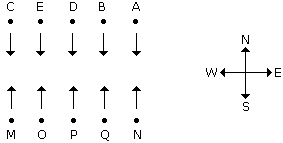
- A ,B, C, D and E are five men sitting in a line facing to south - while M, N, O, P and Q are five ladies sitting in a second line parallel to the first line and are facing to North.
- B who is just next to the left of D, is opposite to Q.
- C and N are diagonally opposite to each other.
- E is opposite to O who is just next right of M.
- P who is just to the left of Q, is opposite to D.
- M is at one end of the line.
Question - Who is sitting third to the right of O?
Detailed Solution: Question 12
Directions to Solve
Each of these questions are based on the information given below:
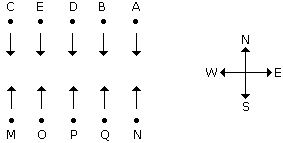
- A ,B, C, D and E are five men sitting in a line facing to south - while M, N, O, P and Q are five ladies sitting in a second line parallel to the first line and are facing to North.
- B who is just next to the left of D, is opposite to Q.
- C and N are diagonally opposite to each other.
- E is opposite to O who is just next right of M.
- P who is just to the left of Q, is opposite to D.
- M is at one end of the line.
Question - If B shifts to the place of E, E shifts to the place of Q, and Q shifts to the place of B, then who will be the second to the left of the person opposite to O?
Detailed Solution: Question 13
Directions to Solve
Each of these questions are based on the information given below:
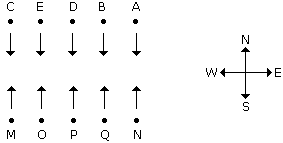
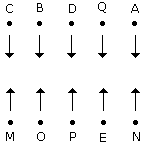
- A ,B, C, D and E are five men sitting in a line facing to south - while M, N, O, P and Q are five ladies sitting in a second line parallel to the first line and are facing to North.
- B who is just next to the left of D, is opposite to Q.
- C and N are diagonally opposite to each other.
- E is opposite to O who is just next right of M.
- P who is just to the left of Q, is opposite to D.
- M is at one end of the line.
Question - Which of the following pair is diagonally opposite to each other?
Detailed Solution: Question 14
Directions to Solve
Each of these questions are based on the information given below:
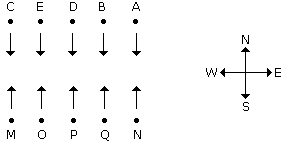
- A ,B, C, D and E are five men sitting in a line facing to south - while M, N, O, P and Q are five ladies sitting in a second line parallel to the first line and are facing to North.
- B who is just next to the left of D, is opposite to Q.
- C and N are diagonally opposite to each other.
- E is opposite to O who is just next right of M.
- P who is just to the left of Q, is opposite to D.
- M is at one end of the line.
Question - In the original arrangement who is sitting just opposite to N?
Detailed Solution: Question 15
Directions to Solve
Each of these questions are based on the information given below:
- A ,B, C, D and E are five men sitting in a line facing to south - while M, N, O, P and Q are five ladies sitting in a second line parallel to the first line and are facing to North.
- B who is just next to the left of D, is opposite to Q.
- C and N are diagonally opposite to each other.
- E is opposite to O who is just next right of M.
- P who is just to the left of Q, is opposite to D.
- M is at one end of the line.
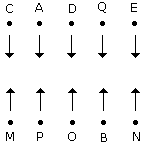
Question - If O and P, A and E and B and Q interchange their positions, then who will be the second person to the right of the person who is opposite to the person second of the right of P?
Detailed Solution: Question 16
If an Indian has invested Rs.93,000 in UK Stock Market in January 2019 then in which month his/her portfolio has declined by maximum percentage in rupee terms?
If an Indian has invested Rs. 100,000 in 1st January 2019 till 1st January 2020, then whichoption is best for her?
Detailed Solution: Question 18
If a person from USA Invest $1500 in Indian stock market in 1st February then, on which of thefollowing date investment reaches a maximum value in Dollar terms?
Detailed Solution: Question 19
If a person from India Invest Rs. 108,000 in US stock market in the month of January 2019 then, on which one of the following dates the investment reaches minimum value in rupee terms?
Detailed Solution: Question 20
(abc) is odd what would (a2 + b2 + c2) be, a, b and c are Integers.
Detailed Solution: Question 21
Let a, b, m and n be natural numbers such that a > 1 and b > 1. If ambn = 144145, then the largest possible value of n - m is
Detailed Solution: Question 22
A pipe can fill a tank in x hours and another can empty it in y hours. If the tank is 1 / 3rd full then the number of hours in which they will together fill it in is
Detailed Solution: Question 23
The monthly incomes of X and Y are in the ratio of 4:3 and their monthly expenses are in the ratio of 3:2. However, each saves Rs. 6,000 per month. What is their total monthly income?
Detailed Solution: Question 24
E sold at table to R at a profit of 25%.R sold the same table to S for Rs. 90 thereby making a profit of 20%. Find the price at which E bought the table from Z if it is known that Z gained 25% in the transaction.
Detailed Solution: Question 25
Walking 6/7th of his usual speed, a man is 12 minutes too late. What is the usual time taken by him to cover that distance?
Detailed Solution: Question 26
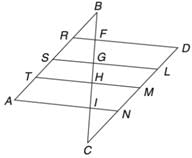
In the figure, AB is parallel to CD and RD || SL || TM || AN, and BR : RS : ST : TA = 3 : 5 : 2 : 7. If it is known that CN = 1.333 BR. Find the ratio of BF : FG : GH : HI : IC
Detailed Solution: Question 27
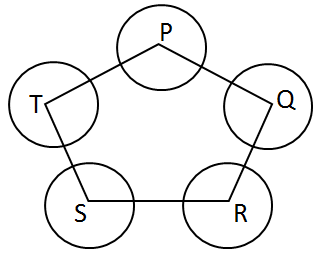
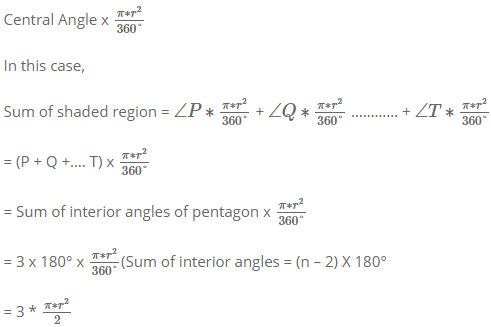
PQRST is a pentagon in which all the interior angles are unequal. A circle of radius ‘r’ is inscribed in each of the vertices. Find the area of portion of circles falling inside the pentagon.
Detailed Solution: Question 28
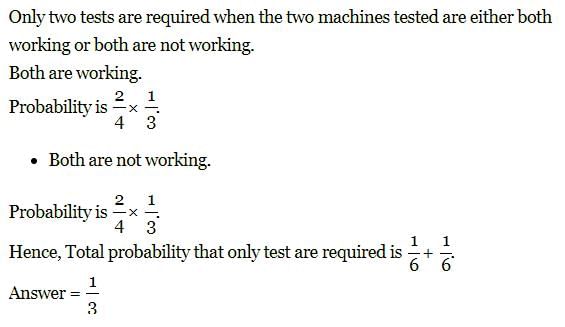
There are four machines and it is known that exactly two of them are faulty. They are tested one by one, in a random order till both the faulty machines are identified. Then the probability that only two tests are needed is
Detailed Solution: Question 29
If a lemon and apple together costs Rs. 12, a tomato and lemon cost Rs.4 and an apple cost of Rs.8 more than a tomato or a lemon, then which of the following can be the price of lemon?
Detailed Solution: Question 30
33 videos|20 docs|65 tests |
