
Epsilon Closures - Free MCQ Practice Test with solutions, GATE CSE (CSE)
MCQ Practice Test & Solutions: Test: Epsilon Closures (8 Questions)
You can prepare effectively for Computer Science Engineering (CSE) Theory of Computation with this dedicated MCQ Practice Test (available with solutions) on the important topic of "Test: Epsilon Closures". These 8 questions have been designed by the experts with the latest curriculum of Computer Science Engineering (CSE) 2026, to help you master the concept.
Test Highlights:
- - Format: Multiple Choice Questions (MCQ)
- - Duration: 10 minutes
- - Number of Questions: 8
Sign up on EduRev for free to attempt this test and track your preparation progress.

Which of the following does not belong to input alphabet if S={a, b}* for any language?
Detailed Solution: Question 1
The number of final states we need as per the given language?Language L: {an| n is even or divisible by 3}
Detailed Solution: Question 2
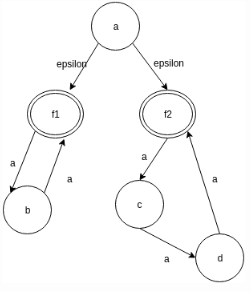

State true or false:Statement: Both NFA and e-NFA recognize exactly the same languages.
Detailed Solution: Question 3
Design a NFA for the language:
L: {an| n is even or divisible by 3}
Which of the following methods can be used to simulate the same.
L: {an| n is even or divisible by 3}
Which of the following methods can be used to simulate the same.
Detailed Solution: Question 4
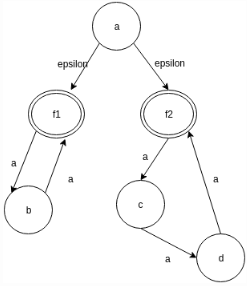
Which of the following belongs to the epsilon closure set of a?
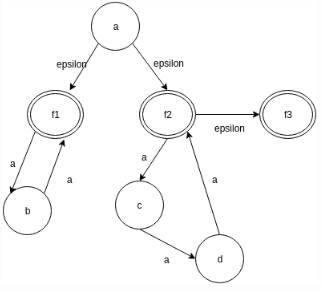
Detailed Solution: Question 5
The number of elements present in the e-closure(f2) in the given diagram:
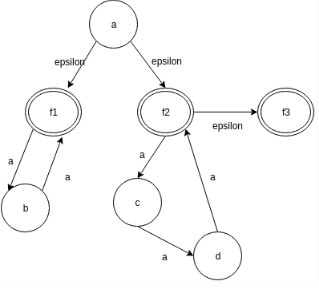
Detailed Solution: Question 6
Which of the steps are non useful while eliminating the e-transitions for the given diagram?
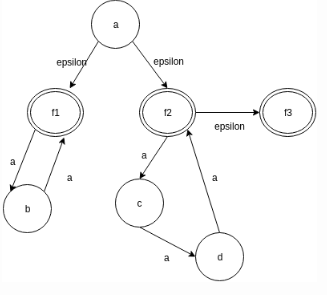
Detailed Solution: Question 7
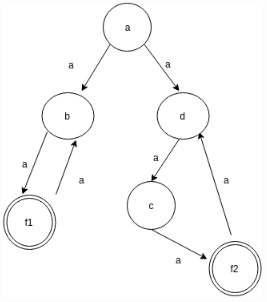
Remove all the epsilon transitions in the given diagram and compute the number of a-transitions in the result?
Detailed Solution: Question 8
18 videos|95 docs|44 tests |
