Computer Science Engineering (CSE) Exam  >  Computer Science Engineering (CSE) Test  >  Theory of Computation  >  Test: Turing Machine & Halting - Computer Science Engineering (CSE) MCQ

Turing Machine & Halting - Free MCQ Practice Test with solutions, GATE


MCQ Practice Test & Solutions: Test: Turing Machine & Halting (10 Questions)

You can prepare effectively for Computer Science Engineering (CSE) Theory of Computation with this dedicated MCQ Practice Test (available with solutions) on the important topic of "Test: Turing Machine & Halting". These 10 questions have been designed by the experts with the latest curriculum of Computer Science Engineering (CSE) 2026, to help you master the concept.

Test Highlights:

  • - Format: Multiple Choice Questions (MCQ)
  • - Duration: 10 minutes
  • - Number of Questions: 10

Sign up on EduRev for free to attempt this test and track your preparation progress.

Test: Turing Machine & Halting - Question 1

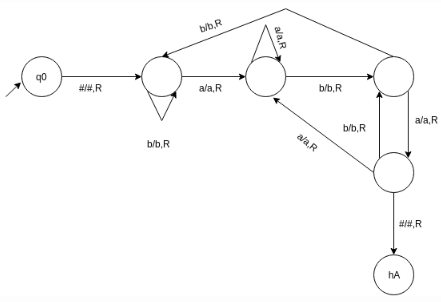
 Which of the following regular expression resembles the given diagram?
Detailed Solution: Question 1

The given diagram is a transition graph for a turing machine which accepts the language with the regular expression {a,b}*{aba}.

Test: Turing Machine & Halting - Question 2

 Construct a turing machine which accepts a string with ‘aba’ as its substring.
 

Detailed Solution: Question 2

The language consist of strings with a substring ‘aba’ as fixed at its end and the left part can be anything including epsilon. Thus the turing machine uses five states to express the language excluding the rejection halting state which if allowed can modify the graph as:

Test: Turing Machine & Halting - Question 3

 The number of states required to automate the last question i.e. {a,b}*{aba}{a,b}* using finite automata:

Detailed Solution: Question 3
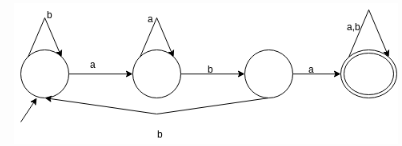
The finite automaton for the language {a,b}*{aba}{a,b}* can be constructed using the following steps:

  • Start with an initial state.
  • Recognise the sequence 'aba' by creating states for each letter.
  • Use a final state after recognising the sequence 'aba'.

The total number of states required is 4:

  • One initial state.
  • Three additional states for each letter in 'aba'.

The finite automata can be represented as:

Thus option a) is correct,

Test: Turing Machine & Halting - Question 4

The machine accept the string by entering into hA or it can:

Detailed Solution: Question 4
Three things can occur when a string is tested over a turing machine:
a) enter into accept halting state
b) enter into reject halting state
c) goes into loop forever

Test: Turing Machine & Halting - Question 5

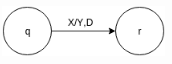
 d(q,X)=(r,Y,D) where D cannot be:

Detailed Solution: Question 5

D represents the direction in which automata moves forward as per the queue which surely cannot be a starting variable.

Test: Turing Machine & Halting - Question 6

 Which of the following can accept even palindrome over {a,b}

Detailed Solution: Question 6

A language generating strings which are palindrome is not regular, thus cannot b represented using a finite automaton.

Test: Turing Machine & Halting - Question 7

Which of the functions can a turing machine not perform?

Detailed Solution: Question 7

Different turing machines exist for operations like copying a string, deleting a symbol, inserting a symbol and accepting palindromes.

Test: Turing Machine & Halting - Question 8

If T1 and T2 are two turing machines. The composite can be represented using the expression:

Detailed Solution: Question 8

 If T1 and T2 are TMs, with disjoint sets of non halting states and transition function d1 and d2, respectively, we write T1T2 to denote this composite TM.

Test: Turing Machine & Halting - Question 9

 The following turing machine acts like:

Detailed Solution: Question 9

A turing machine does the deletion by changing the tape contents from yaz to yz, where y belongs to (S U {#})*.

Test: Turing Machine & Halting - Question 10

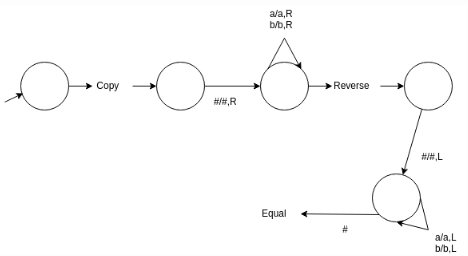
What does the following transition graph shows:

Detailed Solution: Question 10

The composite TM accepts the language of palindromes over {a, b} by comparing the input string to its reverse and accepting if and only if the two are equal.

18 videos|95 docs|44 tests
Information about Test: Turing Machine & Halting Page
In this test you can find the Exam questions for Test: Turing Machine & Halting solved & explained in the simplest way possible. Besides giving Questions and answers for Test: Turing Machine & Halting, EduRev gives you an ample number of Online tests for practice
18 videos|95 docs|44 tests
Download as PDF