
JEE Main Chemistry Test- 5 Free Online Test 2026
MCQ Practice Test & Solutions: JEE Main Chemistry Test- 5 (25 Questions)
You can prepare effectively for JEE Mock Tests for JEE Main and Advanced 2026 with this dedicated MCQ Practice Test (available with solutions) on the important topic of "JEE Main Chemistry Test- 5". These 25 questions have been designed by the experts with the latest curriculum of JEE 2026, to help you master the concept.
Test Highlights:
- - Format: Multiple Choice Questions (MCQ)
- - Duration: 60 minutes
- - Number of Questions: 25
Sign up on EduRev for free to attempt this test and track your preparation progress.

Crotonaldehyde (CH3CH = CHCHO) can be easily oxidised to crotonic acid (CH3CH = CHCOOH) using
Which of the following aldehydes forms a stable hydrate ?

When propyne is treated with aqueous H2SO4 in the presence of HgSO4 , the major product obtained is
The formation of cyanohdyrin from a ketone is an example of
An organic compound, C3H6O does not give a precipitate with 2, 4-dinitrophenylhydrazine reagent and does not react with metallic sodium. It could be
The end product ‘C’ in the following sequence of chemical reactions is 
 to
to  can be carried out with
Identify the compounds A and B in the following reaction sequence.

Detailed Solution: Question 12
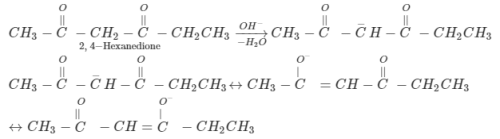
An organic compound ‘A’ has the molecular formula C3H6O It undergoes iodoform test. when saturated with HCl, it gives ‘B’of molecular formula C9H14O ‘A’ and ‘B’ respectively are
With which of the following reagents, carbonyl compound shows addition cum elimination reaction ?
Detailed Solution: Question 16
Self-condensation of ethyl acetate in presence of sodium ethoxide yields
The rate of a gaseous reaction is given by the expression k [A][B]. If the volume of the reaction vessel is suddenly reduced to 1/4th of the initial volume, the reaction rate relting to original rate will be
Detailed Solution: Question 19
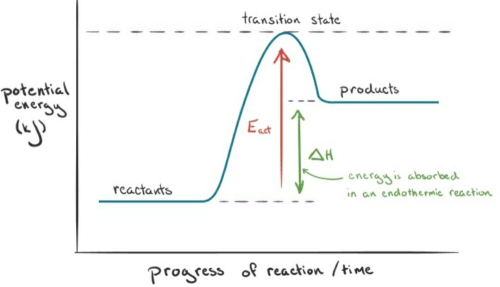
For an endothermic reaction, where  represents the enthalpy of the reaction in k.J./mol, the minimum value for the energy of activation will be
Detailed Solution: Question 20
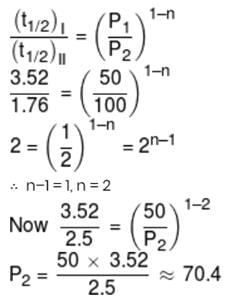
At a certain temperature, the half-life periods for the catalytic decomposition of NH3 were found to be as follows :-
Pressue (mm Hg) 50 100 200
Half-life period (hrs.) 3.52 1.76 0.88
What will be the pressure when the half-life period is 2.5 hours.
Pressue (mm Hg) 50 100 200
Half-life period (hrs.) 3.52 1.76 0.88
What will be the pressure when the half-life period is 2.5 hours.
Detailed Solution: Question 21
How many of the following elements form amphoteric oxides?
Si, P, N, B, Sn, Pb, O
Si, P, N, B, Sn, Pb, O
Detailed Solution: Question 22
One gm of activated carbon has surface area of 1000 m2. Considering complete coverage as well as mono molecular adsorption, how much ammonia at 1 atm and 273 K would be adsorbed on the surface of 44/7 g carbon if radius of ammonia molecule is 10–8 cm (NA = 6 × 10²³)
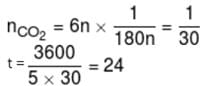
1gm of dry green algae absorbs 5 moles of CO2 per hour by photo synthesis. If fixed carbon atoms were all stored in the form of starch (C6H12O6)n after photo synthesis then calculate time required ( in sec.) to double the weight of algae.
Detailed Solution: Question 24
In the electronic configuration of Zn (Z = 30) find the total number of occupied orbitals which do not possess any nodal plane :-
360 docs|100 tests |
