Electrical Engineering (EE) Exam  >  Electrical Engineering (EE) Test  >  Electromagnetic Fields Theory (EMFT)  >  Test: Surface Integral - Electrical Engineering (EE) MCQ

Surface Integral - Free MCQ Practice Test with solutions, GATE EE Electromagnetic


MCQ Practice Test & Solutions: Test: Surface Integral (10 Questions)

You can prepare effectively for Electrical Engineering (EE) Electromagnetic Fields Theory (EMFT) with this dedicated MCQ Practice Test (available with solutions) on the important topic of "Test: Surface Integral". These 10 questions have been designed by the experts with the latest curriculum of Electrical Engineering (EE) 2026, to help you master the concept.

Test Highlights:

  • - Format: Multiple Choice Questions (MCQ)
  • - Duration: 10 minutes
  • - Number of Questions: 10

Sign up on EduRev for free to attempt this test and track your preparation progress.

Test: Surface Integral - Question 1

Gauss law for electric field uses surface integral. State True/False 

Detailed Solution: Question 1

Answer: a
Explanation: Gauss law states that the electric flux passing through any closed surface is equal to the total charge enclosed by the surface. Thus the charge is defined as a surface integral.

Test: Surface Integral - Question 2

Surface integral is used to compute

Detailed Solution: Question 2

Answer: b
Explanation: Surface integral is used to compute area, which is the product of two quantities length and breadth. Thus it is two dimensional integral.

Test: Surface Integral - Question 3

 Coulomb’s law can be derived from Gauss law. State True/ False 

Detailed Solution: Question 3

Answer: a
Explanation: Gauss law, Q = ∫∫D.ds
By considering area of a sphere, ds = r2sin θ dθ dφ.
On integrating, we get Q = 4πr2D and D = εE, where E = F/Q.
Thus, we get Coulomb’s law F = Q1 x Q2/4∏εR2.

Test: Surface Integral - Question 4

Compute the Gauss law for D= 10ρ3/4 i, in cylindrical coordinates with ρ= 4m, z=0 and z=5.

Detailed Solution: Question 4

Answer: d
Explanation: ∫∫ D.ds = ∫∫ (10ρ3/4).(ρ dφ dz), which is the integral to be evaluated. Put ρ = 4m, z = 0→5 and φ = 0→2π, the integral evaluates to 6400π.

Test: Surface Integral - Question 5

Find the value of divergence theorem for A = xy2 i + y3 j + y2z k for a cuboid given by 0<x<1, 0<y<1 and 0<z<1.

Detailed Solution: Question 5

Answer: c
Explanation: A cuboid has six faces. ∫∫A.ds = ∫∫Ax=0 dy dz + ∫∫Ax=1 dy dz + ∫∫Ay=0 dx dz + ∫∫Ay=1 dx dz + ∫∫Az=0 dy dx + ∫∫Az=1 dy dx. Substituting A and integrating we get (1/3) + 1 + (1/3) = 5/3.

Test: Surface Integral - Question 6

The ultimate result of the divergence theorem evaluates which one of the following?

Detailed Solution: Question 6

Answer: d
Explanation: Gauss law states that the electric flux passing through any closed surface is equal to the total charge enclosed by the surface. Thus, it is given by, ψ = ∫∫ D.ds= Q, where the divergence theorem computes the charge and flux, which are both the same.

Test: Surface Integral - Question 7

 If D = 2xy i + 3yz j + 4xz k, how much flux passes through x = 3 plane for which -1<y<2 and 0<z<4?

Detailed Solution: Question 7

Answer: c
Explanation: By Gauss law, ψ = ∫∫ D.ds, where ds = dydz i at the x-plane. Put x = 3 and integrate at -1<y<2 and 0<z<4, we get 12 X 3 = 36.

Test: Surface Integral - Question 8

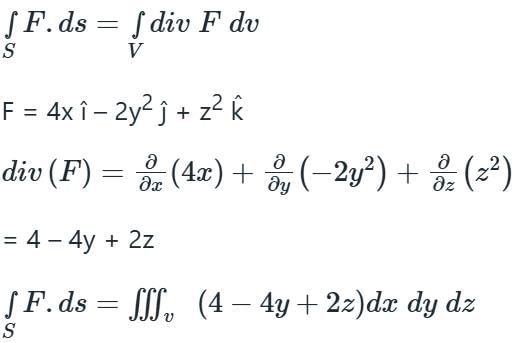
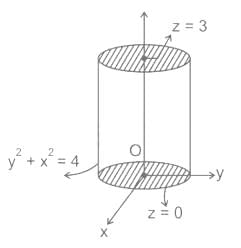
Evaluate where F = 4x î – 2yĵ + zk̂ and S is the surface bounding the region x2 + y2 = 4, z = 0 and z = 3.

Detailed Solution: Question 8

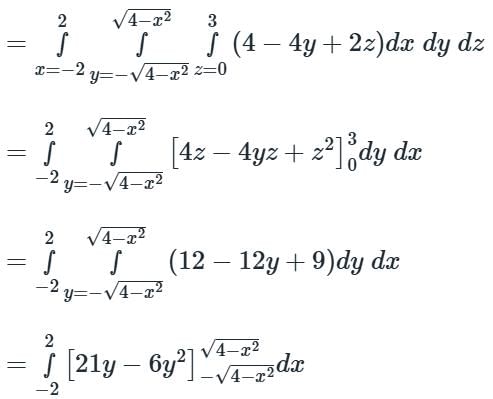
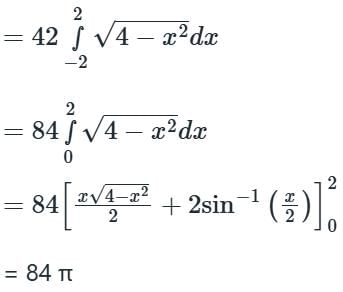
By Gauss divergence theorem,


Test: Surface Integral - Question 9

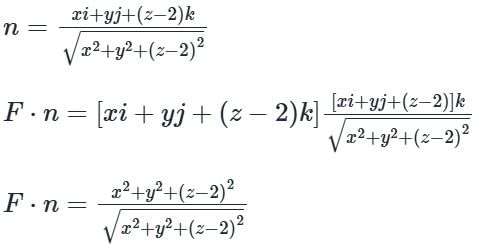
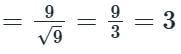
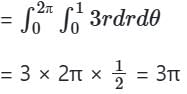
Consider the hemisphere x2 + y2 + (z - 2)2 = 9, 2 ≤ z ≤ 5 and the vector field F = xi + yj + (z - 2)k The surface integral ∬ (F ⋅ n) dS, evaluated over the hemisphere with n denoting the unit outward normal vector, is

Detailed Solution: Question 9
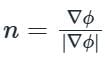
The unit vector normal to the surface will be given by:

ϕ = x2 + y2 + (z - 2)2 = 9
∇ϕ = 2xi + 2yj + 2(z - 2) k


Thus:

3 × Area = 3 × 2π(3)2   [∵ Surface area of Hemisphere = 2πr2]
= 54π  

Test: Surface Integral - Question 10

Let S be the portion of the plane z = 2x + 2y − 100 which lies inside the cylinder x2 + y2 = 1. If the surface area of S is απ, then the value of α is equal to ___________.

Detailed Solution: Question 10
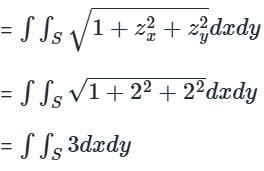
�� is the portion of the plane z = 2x + 2y − 100 which lies inside the cylinder x2 + y2 = 1.

zx = 2, zy = 2

then surface area of S

Now, the cylinder is x2 + y2 = 1

Let x = cosθ, y = sin θ

then surface area of S

Given area S = απ

Hnece α = 3

10 videos|55 docs|56 tests
Information about Test: Surface Integral Page
In this test you can find the Exam questions for Test: Surface Integral solved & explained in the simplest way possible. Besides giving Questions and answers for Test: Surface Integral, EduRev gives you an ample number of Online tests for practice
Download as PDF